 ZeroThreat Wins Bronze Stevie® Award in Tech Startup of the Year Read more

All Blogs
Securing CI/CD: Why API Discovery Fails and 60% of Endpoints Stay Hidden
Quick Overview: Most teams miss over 60% of their API endpoints because CI/CD pipelines only scan documented interfaces, leaving shadow APIs untested and risky. Continuous discovery and automated validation are essential to secure real-world attack surfaces. This blog explains why these gaps occur and how modern API security fixes them.
Modern applications teams have embraced CI/CD pipelines to ship faster, automate more, and reduce operational bottlenecks. But in the rush to accelerate releases, one critical area of security consistently falls through the cracks: API visibility.
Across enterprises, 40–60% of API endpoints remain undiscovered or untested, even in organizations with mature DevSecOps practices. These “shadow APIs” or “zombie APIs” become high-probability breach points, contributing to the steady rise of API-driven attacks reported in OWASP API Security Top 10 and multiple industry threat reports.
APIs now power over 83% of all web traffic, and Gartner predicts that API attacks will remain the top attack vector for applications in the coming years. Yet even with this risk, most engineering teams unknowingly miss their API endpoints during security testing, especially inside automated CI/CD pipelines meant to safeguard the software delivery lifecycle.
As per the report, in 2025, attacks on API hosts were 72% higher than those on traditional websites, while the exploitation of API vulnerabilities grew 13×, compared to just 27% growth in web vulnerability exploitation.
When vulnerabilities are discovered after the app is live, everything becomes more challenging. And that’s the reason API security testing can’t wait until the end. It has to be part of the CI/CD pipeline itself. By automating security checks inside development, every release gets validated, every update is reviewed, and issues are caught long before they ever reach production.
This blog explains why CI/CD pipelines fail to catch the full API attack surface, what’s structurally broken in traditional API security testing, and how modern approaches can eliminate blind spots while enabling speed.
Don’t let hidden APIs expose you. Secure your attack surface now. Sign Up Free
On This Page
- API Security Risks: Why CI/CD Pipelines Lose Visibility
- Business Impact of Missing API Endpoints
- Why Traditional API Security in CI/CD Fails
- How to Integrate API Security Into CI/CD
- How ZeroThreat Solves the API Blind Spot
- Conclusion
API Security Risks: Why CI/CD Pipelines Lose Visibility Into Critical API Endpoints
CI/CD security for SaaS teams is a very crucial factor. Modern CI/CD environments move faster than traditional security tools can keep up with. As teams push rapid releases, automate tests, and break systems into hundreds of microservices, the pipeline loses visibility into what APIs actually exist. This creates increased API blind spots, shadow endpoints, and hidden attack surfaces that security teams never see or test.
1) CI/CD Prioritizes Functional Delivery, Not Security Coverage
Most CI/CD workflows revolve around:
- Building artifacts
- Running unit/integration tests
- Deploying
- Validating functionality
Most organizations consider security scanning an optional step. Because of this:
- API discovery is not continuous
- Only “known” or documented APIs get tested
- Test suites depend on what developers think exists, not what actually runs
This creates the first major blind spot: unregistered or undocumented APIs never enter the pipeline.
2) Microservices Multiply API Endpoints Faster Than Security Can Track
Microservices architecture accelerates development, but it also multiplies API endpoints at a pace that security teams cannot manually track.
A microservices architecture introduces:
- Dynamic routing
- Auto-generated endpoints
- Internal service APIs
- Versioned endpoints across multiple clusters
- Transitive API usage (APIs calling other APIs)
In practice:
- Developers only track the endpoints they own
- API gateways only track north-south traffic
- CI/CD tests only cover what’s in OpenAPI specs
As a result, it leads to large clusters of internal, legacy, or deprecated endpoints that are never scanned.
3) OpenAPI Files Are Rarely Complete or Updated
Most teams rely on OpenAPI/Swagger definitions for API security tests.
The problem:
- Specs often lag weeks behind code
- Engineers forget to update them during refactors
- Multiple teams maintain their own versions
- Internal APIs rarely have complete specs
CI/CD pipelines built on incomplete specifications can never achieve full coverage. If the spec is incorrect, the security test is incorrect.
4) Runtime Behavior Differs From What CI/CD Thinks Exists
Since CI/CD runs in predictable, controlled environments, it completely misses these runtime-only endpoints. That gap creates a dangerous mismatch between what the pipeline validates and what the application actually exposes.
Many endpoints are created dynamically at runtime due to:
- Feature flags
- Deployment versions
- A/B testing
- Conditional logic
- Tenant-based configurations
Static analysis or spec-based coverage cannot catch these dynamic endpoints. Hence, CI/CD tests a theoretical version of your API, not the real one.
5) Traditional SAST/DAST Tools Cannot Discover APIs Automatically
Security scanning tools or other top pentesting tools weren’t built for modern API ecosystems. They rely on manual input, predefined routes, and static patterns. None of which reflects today’s dynamic, multi-step, tokenized API flows.
Since these traditional pentesting tools cannot automatically discover or map APIs across microservices, they generate shallow coverage, partial mapping, and inaccurate results, leaving vast portions of the attack surface unchecked.
Legacy scanning tools focus on:
- Known URLs
- Hardcoded routes
- Static signatures
They struggle with:
- JSON/REST/GraphQL multi-step flows
- Stateful authentication
- API chaining
- Token-based authorization
- Internal microservice APIs
- Async or event-driven APIs
Which leads to incomplete mapping and low-accuracy scanning.
Your APIs are changing daily—your tests should too. Catch what others miss. Test My APIs
Business Impact of Missing API Endpoints
Shadow APIs are a material business risk. If they fail to detect, it directly affects your organization’s financial exposure and regulatory posture.
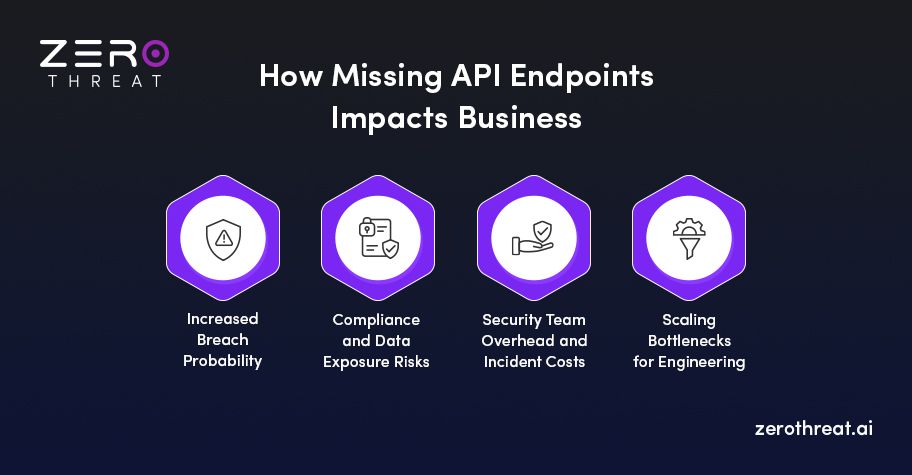
Increased Breach Probability
Unmonitored APIs frequently lack:
- Authentication
- Authorization enforcement
- Input validation
- Rate limiting
- Logging/monitoring
Attackers can easily exploit these “low-visibility endpoints” because no one is watching. If we look at the data, 83% of API breaches in 2024 involved unknown or unprotected endpoints.
Compliance and Data Exposure Risks
Shadow APIs often process:
- PII
- Payment data
- Tokens
- Customer metadata
- Internal operational payloads
Undiscovered APIs commonly violate:
Security Team Overhead and Incident Costs
When breaches occur due to unknown endpoints:
- Incident responders lack observability
- Log trails are incomplete
- Root cause analysis slows down
- Containment becomes more complex
Response costs 3x to 5x when the compromised interface was unknown.
Scaling Bottlenecks for Engineering
Without accurate API inventories, engineering leadership struggles with:
- Resource planning
- Prioritizing refactors
- Managing deprecations
- Eliminating legacy endpoints
- Standardizing authentication methods
Missing API visibility directly affects agility and long-term maintainability.
Why Traditional API Security in CI/CD Fails
As mentioned earlier, traditional API security testing tools were never designed for today’s fast, distributed, and authentication-heavy environments. As CI/CD pipelines grow more complex, these tools lose visibility, miss dynamic endpoints, and fail to keep up with changes happening across microservices and runtime environments.
They Don’t Perform Continuous Discovery
Most API security tools only understand what developers manually document, leaving them blind to real runtime behavior. Without continuous discovery across every environment, teams unknowingly ship shadow APIs, outdated endpoints, and unmonitored functions into production.
API security testing tools rely on developer-provided specs. They do not dynamically analyze traffic or automatically enumerate endpoints across:
- Staging
- Pre-production
- Production
- Ephemeral environments
- Canary deployments
- Containers
They Break in Modern Authentication Flows
As authentication grows more complex, legacy vulnerability scanners quickly fall behind. They fail to maintain sessions, handle token exchanges, or follow multi-step login flows. This makes it impossible to test entire sections of APIs protected by modern security and access-control mechanisms.
Most enterprises use:
- OAuth 2.0
- OAuth2 + PKCE
- JWT
- mTLS
- Session tokens
- API gateways with adaptive policies
Legacy vulnerability scanners cannot reliably authenticate multi-step flows, resulting in large blind spots.
They Can’t Handle Stateful or Multi-Step API Logic
Real applications depend on workflows that evolve with context. And this is something that traditional vulnerability scanners cannot replicate. When tools can’t follow chained requests or track object IDs, they miss critical business logic vulnerabilities that only emerge during real user journeys.
Real-world APIs require:
- Chained requests
- Dynamic object IDs
- Context-aware workflows
- Business logic testing
Static tools cannot simulate or discover these flows automatically.
Know your risk before attackers do. Pricing that scales with your security. View PlansView Plans
How to Integrate API Security Into CI/CD
Implementing API security in CI/CD means treating APIs as dynamic, constantly evolving assets rather than static components. With automated API discovery, specification updates, testing, and post-deployment validation, teams can maintain full visibility and reduce vulnerabilities across every release cycle.
Continuous API Discovery
CI/CD pipelines need an always-on view of the API landscape, not just a snapshot. Continuous discovery ensures every environment, including short-lived ones, feeds real runtime data into the pipeline so nothing is missed, hidden, or forgotten during rapid development cycles.
A modern solution continuously discovers APIs using:
- Runtime traffic analysis
- Passive discovery
- Active scanning
- Behavioral analysis
- Gateway logs
- Infrastructure-based extraction
This ensures CI/CD always scans the complete, real API surface.
Auto-Generate and Auto-Update API Specifications
Automating spec generation keeps documentation aligned with reality. It eliminates drift and missing endpoints. Moreover, this enables teams to maintain accurate OpenAPI definitions without manual effort and ensures that every test reflects the true API footprint across environments.
Instead of relying on developer-maintained OpenAPI specs, modern pipelines:
- Automatically generate OpenAPI documentation
- Compare runtime vs. declared endpoints
- Flag drift
- Map authentication and parameters automatically
This turns a historically manual process into an intelligent feedback loop.
Integrate API Security Checks as Code
Embedding security testing into the development workflow ensures vulnerabilities are caught early and consistently. By treating API security rules like code, teams can make scanning part of every commit, build, and deployment without slowing engineering velocity.
Shift security left by integrating API security into:
- Pull requests
- Build pipelines
- Automated test harnesses
- Container images
- API gateway policies
Dynamic and Stateful API Testing
It’s essential to follow the best API security practices to reflect real attacker behavior, not simple static checks. Dynamic engines that handle stateful flows provide deeper coverage of authentication, authorization, and business logic, ensuring vulnerabilities are discovered before they reach production.
Replace static scanning with engines that can:
- Enumerate endpoint parameters
- Replay flows
- Test for broken authentication
- Identify IDOR
- Validate access control
- Detect business logic flaws
Enforce Continuous Post-Deployment Validation
Even with strong pre-deployment checks, you can enhance the production phase. Continuous runtime validation ensures that misconfigurations, new features, or updated services don’t quietly introduce new vulnerabilities, keeping the deployed environment secure and monitored at all times.
Most vulnerabilities appear after deployment due to:
- Drift
- Feature flag changes
- Misconfigurations
- New service versions
Need coverage for complex API environments? Talk to our security team. Talk to Us
How ZeroThreat Solves the “60% API Blind Spot”
ZeroThreat eliminates the API visibility gaps that traditional CI/CD tools and vulnerability scanners consistently miss. Instead of relying on incomplete specs, developer assumptions, or static analysis, ZeroThreat continuously discovers every API, including shadow, internal, dynamic, and runtime-generated endpoints.
By mapping the actual API surface, ZeroThreat ensures teams see 100% of their attack surface, not just the documented 40%.
ZeroThreat combines API discovery, intelligent specification generation, and deep stateful testing to expose vulnerabilities that never enter the CI/CD pipeline with legacy tools.
As a result, it lets engineering and security teams confidently ship faster, fix sooner, and verify continuously, finally closing the industry’s largest API blind spot.
Sign up for free to secure API blind spots now.
Conclusion: You Can’t Secure What You Can’t See
Missing 60% of API endpoints is not a failure of people, but it’s a failure of traditional tooling and outdated CI/CD assumptions. As APIs grow more dynamic, distributed, and interconnected, the only feasible solution is continuous API discovery paired with automated security testing across every environment.
Organizations that adopt modern API security models dramatically reduce risk, improve compliance posture, and accelerate engineering velocity, all while eliminating the silent threat of shadow APIs.


Explore ZeroThreat
Automate security testing, save time, and avoid the pitfalls of manual work with ZeroThreat.