 ZeroThreat Wins Bronze Stevie® Award in Tech Startup of the Year Read more

All Blogs
API Pentesting Methodology for Enterprise-Scale Applications
Quick Overview: A structured API pentesting methodology is critical for securing enterprise-scale applications. This guide covers key testing phases, including API asset discovery, vulnerability analysis, authentication validation, business logic testing, reporting, and retesting. It also explains testing frequency, best practices, and how enterprises can scale API security efficiently using ZeroThreat’s automated pentesting tool.
In the next 60 seconds, an enterprise somewhere in the world will face an API-based attack. This isn't just a prediction; it's the new reality of a digital economy that runs on over 26 billion API attacks globally every month.
The numbers are a wake-up call for any security leader. Recent data shows that API-related security issues now affect 99% of organizations, with the average cost of a data breach involving these endpoints reaching $4.44 million globally.
Perhaps most concerning is that 43% of newly discovered vulnerabilities are now tied directly to APIs, yet only 21% of organizations report having a high level of confidence in their ability to detect these threats before they escalate.
For large-scale enterprises, traditional "check-the-box" scanning is no longer enough. A robust API penetration testing methodology is the only way to validate the actual security posture of your web application.
By pairing AI-powered API pentesting with periodic manual testing, enterprises can detect and fix vulnerabilities before attackers exploit them. With that said, let’s get started by understanding the reason behind using a structured approach for large-scale pentesting.
Get high-signal API security insights with Zero-Setup required. Create Account
On This Page
- Why Applications Require a Structured API Pentesting Methodology?
- API Penetration Testing Methodology for Enterprise Applications
- How Often Enterprises Should Conduct API Penetration Testing?
- Best Practices for API Penetration Testing at Scale
- Why Choose ZeroThreat for Enterprise-Scale API Pentesting?
- Final Thoughts
Why Applications Require a Structured API Pentesting Methodology?
Enterprise applications are the engines of modern business, handling thousands of service calls every second across complex, multi-cloud environments. Because APIs now represent the primary entry point for over 85% of web application attacks, a structured methodology is no longer optional. It provides a clear roadmap to secure your data in an environment where speed often outpaces security visibility.
Mitigating Massive Data Exposure
API breaches are devastating, often leaking ten times more data than typical security incidents. Global API-related breaches are estimated to cost businesses up to $87 billion annually. A disciplined testing approach ensures sensitive PII, financial records, and other sensitive data are not exposed.
Uncovering Complex Business Logic Flaws
Automated tools often fail to interpret the unique business logic of a custom application. Flaws like Broken Object Level Authorization (BOLA) allow attackers to manipulate IDs to access unauthorized data. Structured pentesting uses a hybrid approach (automated pentesting + manual expertise) to probe these workflows, catching vulnerabilities that standard scanners consistently miss.
Managing Shadow and Zombie APIs
Most large organizations cannot accurately count every API running in production. Developers frequently push code, creating undocumented shadow APIs or leaving zombie versions active after they are deprecated. A structured methodology provides the visibility required to find and secure these hidden risks.
Meeting Regulatory and Compliance Standards
Large enterprises must satisfy rigorous standards like PCI DSS, GDPR, and HIPAA. A structured methodology ensures your testing includes the audit-ready evidence and detailed reporting required for security compliance. It moves security from a manual "best effort" to a documented, repeatable governance process.
Aligning with Rapid Development Cycles
Modern teams push code multiple times per day, which can quickly make manual inventories obsolete. A structured API penetration testing methodology allows security to shift-left by integrating automated scans directly into CI/CD pipelines. This ensures that new vulnerabilities are identified during the build process rather than after they reach production.
API Penetration Testing Methodology for Enterprise Applications
Enterprise-scale APIs require a rigorous testing process to handle the massive volume of data they process every second. Here is a structured methodology that ensures every hidden endpoint is identified, and every business logic flaw is uncovered before an attacker can exploit them.
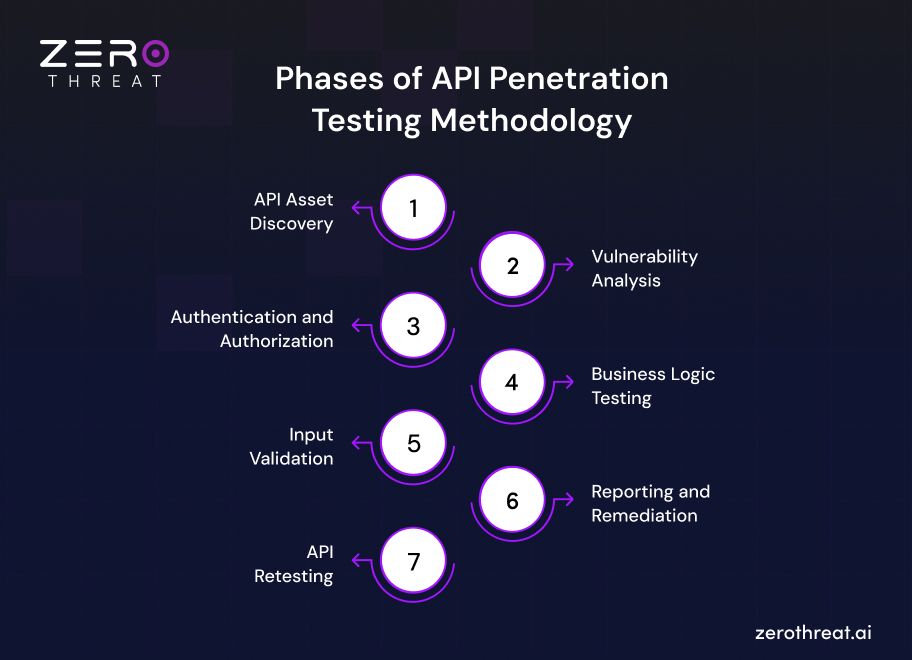
Phase 1: API Asset Discovery
The first step in any enterprise-grade test is identifying the full extent of the attack surface. In large organizations, the biggest risks often hide in undocumented "Shadow APIs" or legacy "Zombie APIs" that are no longer maintained but still active.
- Host and Endpoint Mapping: Using automated tools and traffic analysis to find all publicly and internally accessible API hosts.
- Documentation Audit: Comparing discovered endpoints against Swagger/OpenAPI files to identify gaps in documentation.
- Subdomain Enumeration: Checking for staging, dev, or UAT environments that might lead to sensitive data exposure or weaker security configurations.
By the end of this phase, you should have a complete inventory of every endpoint, version, and data type handled by the application. This ensures that no hidden gateway is left undiscovered, turning "unknown unknowns" into a manageable list of targets.
Phase 2: Vulnerability Analysis
Once the assets are mapped, testers must analyze each endpoint to find potential security gaps. This phase is about identifying technical weaknesses in the API's configuration. It sets the stage for active exploitation by creating a targeted list of unconfirmed vulnerabilities.
- Security Header Review: Checking for missing or weak headers like CORS, CSP, and HSTS that could lead to data leakage or injection.
- Information Leakage: Analyzing error messages and stack traces that might reveal internal server details or database structures.
- Service Versioning: Identifying the underlying frameworks and libraries to check for known CVEs (Common Vulnerabilities and Exposures).
Automated tools are used here to quickly identify standard security misconfigurations and known bugs. However, the tester must interpret these results to understand the true risk to the environment.
Phase 3: Authentication and Authorization
Authorization failures are the root cause of a large percentage of high-profile API breaches. The goal of this phase is to ensure the API correctly identifies who a user is (Authentication) and strictly limits what they are allowed to do (Authorization).
- BOLA (Broken Object Level Authorization): Attempting to access or modify resources belonging to other users by manipulating IDs in the request.
- Token Security: Testing JWTs for weak signatures, lack of expiration, or the ability to perform "algorithm switching" attacks.
- Privilege Escalation: Checking if a standard user can call administrative functions (BFLA) or access high-level data properties through mass assignment.
In an enterprise context, these tests are performed using multiple accounts with different roles. The result is a clear picture of whether the API’s "gates" actually hold up when a user tries to act outside their assigned permissions.
Phase 4: Business Logic Testing
Business logic testing focuses on how the API behaves in real workflows. Because these flaws are unique to every application, they are nearly impossible for traditional automated scanners to detect on their own. These issues appear when attackers manipulate sequences, roles, or transaction flows.
- Workflow Bypass: Testing if a user can skip essential steps in a sequence, such as accessing a "success" page before completing a payment.
- Parameter Manipulation: Checking if changing values like "price" or "quantity" in a hidden field allows for unauthorized discounts.
- Timing Attacks: Auditing if the API leaks information based on how long it takes to process specific requests, often used to guess valid usernames.
By simulating real-world user journeys, pentesters uncover logic gaps that could lead to massive data exfiltration or financial loss. This phase requires human intuition to understand the context of the business and how its workflows might be exploited.
Phase 5: Input Validation
API endpoints that accept user data are primary targets for injection attacks if the input isn't strictly sanitized. Since APIs often return raw data to the client, a single unvalidated field can become a gateway to the entire backend database or system command shell.
- Injection Testing: Attempting to perform SQL injection, NoSQL, or command-level scripts into API parameters to gain unauthorized access.
- Mass Assignment: Testing if a user can update restricted fields (like is_admin: true) by including them in a standard profile update request.
- Schema Validation: Ensuring the API strictly enforces its OpenAPI or Swagger definitions to reject unexpected or malformed payloads.
Solid input validation ensures that the API acts as a secure filter. By rigorously fuzzing every input field, we verify that the application remains stable and secure even when bombarded with malicious data.
Phase 6: Reporting and Remediation
The goal of a pentest is to improve security, so the results must be communicated in a way that developers can act on immediately. A high-quality report does more than just list bugs; it provides a prioritized roadmap for fixing the most critical issues first. This phase transforms technical findings into clear, business-focused documentation for the engineering and security teams.
- Exploit Validation: Providing clear evidence—such as screenshots or curl commands—that proves a vulnerability is real and not a false positive.
- Risk Prioritization: Scoring vulnerabilities using CVSS or custom enterprise metrics to help teams focus on the most critical fixes first.
- Remediation Guidance: Offering specific code-level advice or configuration changes to help developers fix the root cause of the issue.
A high-quality remediation report acts as a bridge between the security team and the engineering department. It serves as evidence of the current security state, which is often required for compliance with standards like PCI DSS or HIPAA.
Phase 7: API Retesting
In an enterprise environment, a vulnerability isn't truly "closed" until it has been verified. Retesting is the final quality gate that ensures the original issue is gone and that the developer's fix hasn't accidentally introduced a new security gap.
- Regression Testing: Running the original exploit again to confirm the specific vulnerability has been neutralized.
- Side-Effect Analysis: Checking related endpoints to ensure the code change didn't break other security controls or business functions.
- Automated Verification: Updating the continuous monitoring suite to ensure that same vulnerability doesn't reappear in future builds.
Retesting provides the "closed-loop" validation that enterprise leaders need for compliance and peace of mind. It ensures that the time and effort spent on remediation actually resulted in a measurably stronger security posture.
Scale your security methodology with ZeroThreat’s API pentesting tool. Test Your APIs
How Often Enterprises Should Conduct API Penetration Testing?
Enterprises should conduct API penetration testing at least every six months to protect sensitive customer records and organizational security. Regulatory standards like PCI DSS also mandate a full pentest at least annually or whenever a significant change occurs in the application’s infrastructure.
Because modern development cycles move quickly, periodic testing alone can leave long gaps where new vulnerabilities exist unnoticed. To maintain a truly resilient posture, follow these frequency guidelines:
- Bi-Annually: Perform a comprehensive manual pentest every six months.
- Post-Update: Conduct targeted tests immediately after infrastructure upgrades or new feature releases.
- Continuous Testing: Integrate automated security scans into your CI/CD pipeline to evaluate every code before it goes live.
Best Practices for API Penetration Testing at Scale
Securing APIs at scale requires a combination of intelligent automated tools and expert manual testing. Here are some of the practices that can help you perform pentesting APIs at scale:
- Automate Discovery Continuously: Manual tracking cannot keep pace with rapid development. Use automated discovery tools to find undocumented shadow and zombie APIs across your entire infrastructure.
- Follow Established Security Frameworks: Use standards like the OWASP API Top 10 and rank findings using CVSS. This provides a clear, prioritized roadmap for remediation teams.
- Use Agentic AI for Logic Testing: Leverage modern tools that use agentic AI to simulate human-like attack patterns. This allows you to test complex business logic and multi-step workflows at a scale manual testing can't match.
- Shift-Left into the CI/CD Pipeline: Integrate security checks directly into your development workflow. Catching vulnerabilities like BOLA or broken auth early in the SDLC is far more cost-effective than fixing them in production.
- Test Every User Role: Provide testers with credentials for every defined role. This ensures a low-privileged user cannot escalate permissions or access another customer's private data.
- Validate with Rigorous Retesting: Never assume a patch worked. Always re-evaluate remediated endpoints to confirm the fix is effective and didn't introduce new security vulnerabilities.
Why Choose ZeroThreat for Enterprise-Scale API Pentesting?
Enterprise APIs move much faster than traditional security teams can track manually. To keep your data safe, you need a solution that can simulate attacker-like behavior at the speed of your deployment cycle. ZeroThreat bridges this gap by providing AI-powered automated pentesting that identifies vulnerabilities without the typical manual overhead.
ZeroThreat enables API penetration testing at scale by:
- Automating API attack simulation across large API inventories without missing hidden endpoints
- Detecting business logic vulnerabilities that traditional scanners fail to identify
- Supporting end-to-end coverage for modern enterprise architectures, including REST, GraphQL, gRPC, and SOAP
- Validating authentication and authorization controls across roles, tokens, and object-level access
- Running production-safe security testing without disrupting live applications
- Integrating into CI/CD pipelines to support continuous API security validation
- Providing remediation steps and client-ready reports for developers and security teams
What makes ZeroThreat different is its AI-driven reasoning capability. It intelligently explores complex application behavior, adapts attack paths in real time, and proves exploitability. This allows enterprises to uncover deep, logic-driven vulnerabilities before they become incidents.
Modernize your enterprise security posture with ZeroThreat experts Contact Us
Final Thoughts
Enterprise APIs operate at scale, handle sensitive data, and support critical business workflows. That is why a structured API pentesting methodology is essential. From asset discovery to authentication testing and business logic validation, every phase reduces real risk and improves resilience.
Consistent testing helps enterprises detect vulnerabilities early, validate access controls, strengthen input handling, and meet compliance expectations. Regular retesting ensures fixes work properly. When done correctly, API penetration testing becomes a security strategy, not just a yearly audit requirement.
For organizations managing complex API ecosystems, automation adds real value. ZeroThreat enables enterprise-scale API pentesting through AI-driven attack simulation and continuous testing. If you are looking for a tool that can support testing at scale, try ZeroThreat today!
Frequently Asked Questions
Why is enterprise API penetration testing important?
Enterprise API penetration testing is important because APIs expose sensitive data, business workflows, and authentication systems at scale. A single authorization flaw can impact thousands of users. Structured testing helps identify exploitable weaknesses before attackers abuse them, reducing the risk of breach and compliance exposure.
How should enterprises structure an API pentesting methodology for large-scale applications?
How can enterprises integrate API pentesting into CI/CD pipelines?
What business risks does weak API security create for large organizations?
Why is scalability critical in an enterprise API pentesting methodology?


Explore ZeroThreat
Automate security testing, save time, and avoid the pitfalls of manual work with ZeroThreat.