 ZeroThreat Wins Top InfoSec Innovators 2026 Award for Penetration Testing Read more


All Blogs
Continuous Security Testing Across CI/CD Pipelines: Benefits, Tools, and Best Practices
Quick Overview: Modern software delivery demands real-time protection that keeps pace with rapid code deployments. This guide explains how continuous security testing strengthens modern CI/CD pipelines without slowing software delivery. It covers how continuous security testing works, its business benefits, common implementation challenges, essential testing tools, best practices, and how integrated security validation helps organizations protect applications and APIs while maintaining fast, secure, and reliable releases.
Software releases are faster than ever. Unfortunately, attackers are moving just as quickly. Every code commit, dependency update, and deployment can introduce new security risks if they are not continuously validated.
According to reports by IBM, 70% of the 604 organizations studied reported that breaches caused significant operational disruption. These numbers highlight why proactive security validation has become a business priority, not just a technical one.
That is why security can no longer be treated as a final checkpoint.
Continuous AI pentesting brings security directly into the CI/CD pipeline, allowing teams to identify exploitable vulnerabilities, validate fixes, and prevent security drift before changes reach production. Instead of slowing releases, it helps development and security teams build confidence into every deployment.
This guide explains how continuous security testing works across CI/CD pipelines, the business benefits it delivers, the tools that support it, and the best practices that help organizations secure applications and APIs without sacrificing development speed.
Your next deployment could ship a vulnerability. Validate it before it reaches production. Sign Up Now!
On This Page
- What is Continuous Security Testing in CI/CD Pipelines?
- Why Continuous Security Testing Matters in DevOps
- How Continuous Security Testing Works Throughout the CI/CD Pipeline
- Key Types of Continuous Security Testing for Applications
- Business Benefits of Continuous Testing in CI/CD Pipelines
- Common Challenges of Continuous Security Testing in CI/CD
- Tools for Continuous Testing in CI/CD Pipelines
- Best Practices for Continuous Testing in CI/CD Pipelines
- How ZeroThreat Simplifies Integrated Continuous Security Validation in CI/CD
- Wrapping Up
What is Continuous Security Testing in CI/CD Pipelines?
Continuous Security Testing (CST) in CI/CD pipelines is the practice of embedding automated security validation or AI pentesting into every stage of software development and deployment. Instead of treating security as a final checkpoint, it becomes an ongoing process that evaluates code, dependencies, APIs, and application behavior with every commit, build, and release.
A mature CI/CD continuous security testing strategy combines multiple security controls, including static analysis, dynamic application security testing, software composition analysis, API security testing, and secrets detection. Running these checks continuously helps teams identify vulnerabilities early, prevent security drift in CI/CD pipelines, and reduce the cost and effort of remediation.
The goal is not only to find vulnerabilities but to validate that every deployment meets security requirements before reaching production. By integrating continuous security testing into pipeline workflows, organizations can accelerate release cycles, strengthen application resilience, and deliver secure software without disrupting developer productivity or slowing continuous delivery.
Why Continuous Security Testing Matters in DevOps
Continuous security testing enables DevOps teams to build, test, and release software at high speed without compromising security. By embedding automated security validation or AI penetration testing into CI/CD pipelines, organizations can identify risks earlier, reduce remediation costs, and deliver secure applications with greater confidence.
- Detect vulnerabilities early in development: Continuous security testing scans code, dependencies, APIs, and configurations as changes are introduced. Early detection reduces remediation effort and prevents security issues from progressing through the software delivery pipeline.
- Prevent security drift across CI/CD pipelines: Automated AI penetration testing continuously verifies that builds, configurations, and deployment environments remain aligned with security policies. This helps prevent new risks from emerging as applications evolve over time.
- Support faster and more secure software releases: Integrating security testing into pipeline workflows allows development teams to identify and address vulnerabilities without delaying deployments. Security becomes a continuous process instead of a last-minute approval stage.
- Strengthen application and API security: Modern applications depend heavily on APIs and third-party components. Continuous security testing validates these assets throughout the development lifecycle, helping teams reduce exploitable attack paths before production deployment.
- Maintain compliance and audit readiness: Continuous security testing creates a consistent record of security checks across builds and deployments. This simplifies compliance reporting and demonstrates that security controls are continuously enforced throughout the software delivery lifecycle.
How Continuous Security Testing Works Throughout the CI/CD Pipeline
Continuous security testing embeds AI attack simulation straight into your software pipeline. This process triggers smart vulnerability validation at every major stage of the deployment lifecycle.
Note: There are various types of continuous security testing. We are going to understand how continuous security testing works when an AI pentesting tool is integrated.
1. Code Commit Triggers the Pipeline
A developer commits code to the shared repository, automatically triggering the CI/CD pipeline. Standard build, unit, and integration tests run first to verify application stability before continuous AI penetration testing begins.
2. Deploy to a Testable Environment
After the build succeeds, the application is deployed to a staging environment that mirrors production. This provides a realistic environment where AI penetration testing can safely evaluate runtime behavior and application security.
3. Launches AI Penetration Testing
The CI/CD pipeline automatically triggers the penetration testing engine. The platform crawls the application, maps the attack surface, identifies endpoints, and simulates real-world attack techniques to uncover exploitable vulnerabilities across applications and APIs.
4. Validate and Prioritize Security Findings
Instead of reporting every potential issue, the testing engine validates exploitability and prioritizes findings based on severity and business impact. This reduces false positives and helps developers focus on vulnerabilities that present genuine security risks.
5. Return Results to Developers
Security findings are automatically published to pipeline logs, dashboards, pull requests, or issue tracking systems. Developers receive clear remediation guidance while the code changes are still fresh, enabling faster vulnerability resolution.
6. Apply Security Gates Before Deployment
Organizations can configure security policies that automatically fail builds when critical or high severity vulnerabilities are validated. This prevents insecure releases from progressing further through the CI/CD pipeline while allowing low risk findings to be addressed later.
7. Revalidate After Every Code Change
Once vulnerabilities are remediated, the pipeline automatically reruns continuous automated AI penetration testing to confirm that fixes are effective and no new security issues have been introduced. This continuous validation helps prevent security drift and strengthens every software release.
Use ZeroThreat’s AI pentesting with your existing CI/CD workflow and automate security validation effortlessly. Run AI Pentesting
Key Types of Continuous Security Testing for Applications
Continuous security testing relies on multiple testing methods because no single approach can identify every security risk. Combining code analysis, runtime validation, and exploit simulation gives development teams broader visibility into vulnerabilities throughout the CI/CD pipeline and strengthens application security across the software development lifecycle.
Runtime Application Self-Protection (RASP)
RASP operates inside the running application, detecting and blocking attacks in real time. It monitors application behavior during execution, identifying threats like injection attacks or unauthorized access as they happen, without relying solely on perimeter defenses.
Continuous Automated AI Penetration Testing
AI penetration testing simulates real attacker behavior against applications and APIs without manual intervention. It runs continuously within the pipeline, identifying exploitable vulnerabilities like broken authentication or business logic flaws before attackers find them first.
Static Application Security Testing (SAST)
SAST analyzes source code without executing it, catching vulnerabilities early in development. It scans for issues like SQL injection or insecure coding patterns directly in the codebase, giving developers immediate feedback before code moves forward.
Dynamic Application Security Testing (DAST)
DAST tests running applications from the outside, simulating how an attacker would interact with a live system. It identifies runtime vulnerabilities like misconfigurations or authentication flaws that static analysis alone cannot detect.
Interactive Application Security Testing (IAST)
IAST combines elements of SAST and DAST, analyzing applications from within during runtime. It tracks data flow and code execution simultaneously, offering accurate, context aware vulnerability detection with fewer false positives than standalone methods.
Business Benefits of Continuous Testing in CI/CD Pipelines
Continuous testing in CI/CD pipelines delivers measurable business value beyond security. It reduces costs, accelerates releases, and protects revenue by preventing vulnerabilities from reaching production.
- Faster time to market: Automated, continuous AI validation removes manual testing bottlenecks, letting teams release features and updates without delaying launches for security reviews.
- Lower remediation costs: Catching vulnerabilities early in the pipeline costs significantly less than fixing them after deployment or during a security incident.
- Reduced business risk: Continuous testing limits exposure to breaches, data loss, and downtime, protecting both revenue and customer trust over time.
- Better resource allocation: Automation frees security and engineering teams from repetitive manual checks, letting them focus on higher value strategic work.
- Stronger customer confidence: Consistently secure releases build trust with customers and partners, especially in regulated industries handling sensitive data.
- Improved audit and compliance outcomes: Continuous testing creates documented, ongoing evidence of security diligence, simplifying audits and regulatory reporting requirements.
Common Challenges of Continuous Security Testing in CI/CD
Continuous security testing strengthens software delivery, but implementing it effectively requires more than adding security tools to a CI/CD pipeline. Organizations must balance security coverage, developer productivity, and release speed while ensuring security validation remains accurate, scalable, and actionable.
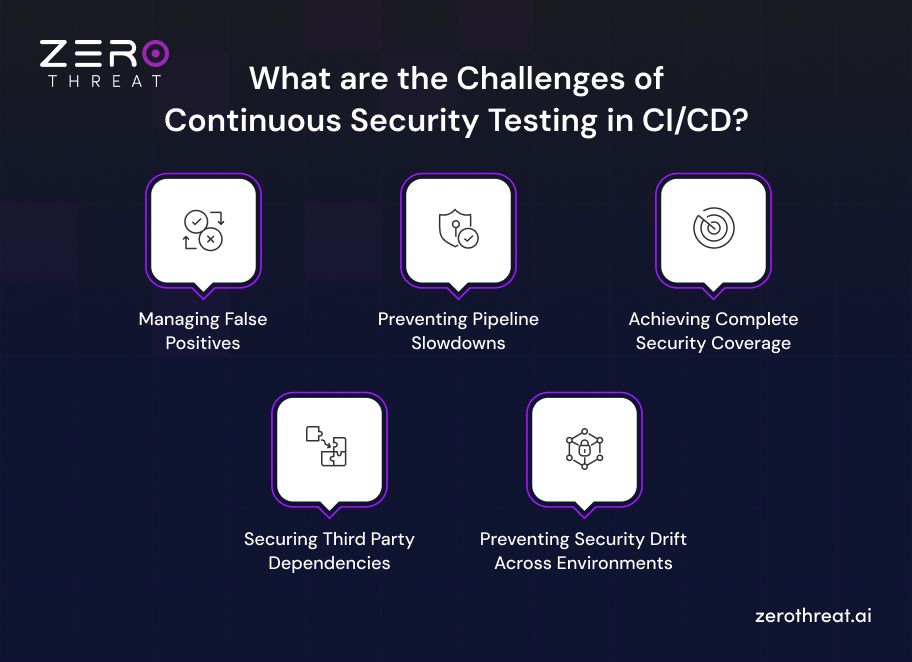
Managing False Positives
Security scanners can generate alerts that are not exploitable in the application's real-world context. Excessive false positives create alert fatigue, reduce developer confidence, and delay remediation efforts. Effective risk prioritization and exploit validation help security teams focus on vulnerabilities that require immediate attention.
Preventing Pipeline Slowdowns
Running multiple security scans during every build can increase CI/CD execution time and impact developer productivity. Organizations must optimize their continuous testing pipeline by scheduling appropriate security checks at different stages while maintaining fast and reliable feedback for developers.
Achieving Complete Security Coverage
Modern applications consist of source code, APIs, open-source libraries, containers, infrastructure as code, and cloud services. Testing only one layer leaves security gaps. Continuous security testing should provide integrated security testing for applications and APIs across the entire software delivery lifecycle.
Securing Third Party Dependencies
Open source packages and external dependencies are essential to modern development, but they also introduce software supply chain risks. Without continuous dependency scanning and integrity verification, vulnerable or malicious components can move through the CI/CD pipeline into production environments.
Preventing Security Drift Across Environments
An application that passes security checks during development can become vulnerable as dependencies, infrastructure, or cloud configurations change over time. Continuous security validation helps detect security drift across development, staging, and production, ensuring security policies remain consistently enforced throughout the CI/CD pipeline.
Continuous security testing shouldn't break your budget. Compare plans built for every team size. See Pricing
Tools for Continuous Testing in CI/CD Pipelines
Selecting the right security testing tools is essential to achieving full visibility across your automated pipeline workflows. The right DevSecOps toolset bridges the gap between development speed and continuous security validation.
ZeroThreat
ZeroThreat is an AI penetration testing platform built for continuous security testing in CI/CD pipelines. It combines API security testing, business logic testing, exploit validation, and production-safe scanning to identify real attack paths instead of theoretical risks. The platform integrates with popular CI/CD tools (GitHub Actions, Azure Pipelines, AWS CI/CD, etc.) and continuously revalidates applications after every code change.
OWASP ZAP
OWASP ZAP is an open-source dynamic application security testing (DAST) tool widely used for identifying runtime vulnerabilities in web applications and APIs. It supports automated scans, authenticated testing, REST APIs, Docker, and CI/CD integrations, making it a popular choice for DevSecOps teams implementing continuous security testing.
Burp Suite
Burp Suite is a comprehensive web application security testing platform that combines automated vulnerability scanning with advanced manual penetration testing capabilities. Its Enterprise Edition supports continuous security testing by integrating automated DAST into CI/CD pipelines, enabling teams to identify and validate application security issues before deployment.
Checkmarx
Checkmarx provides an application security platform that includes Static Application Security Testing (SAST), Software Composition Analysis (SCA), API security, and infrastructure security. It integrates directly with developer workflows and CI/CD pipelines, allowing organizations to identify vulnerabilities early and enforce secure coding practices throughout continuous integration.
Veracode
Veracode offers a cloud-based application risk management platform with SAST, DAST, Software Composition Analysis, API security testing, and container scanning. Its extensive CI/CD integrations enable development teams to automate security validation, prioritize exploitable risks, and maintain secure software releases throughout the development lifecycle.
Best Practices for Continuous Testing in CI/CD Pipelines
Continuous testing is most effective when it follows a structured strategy instead of relying on isolated automation. Applying proven CI/CD testing practices helps teams improve software quality, strengthen security, and deliver reliable releases without slowing development.
- Automate testing at every pipeline stage: Run unit, integration, regression, API, and security tests automatically after every code commit to detect issues early and maintain consistent software quality.
- Adopt a shift-left testing approach: Integrate functional and continuous security testing early in development so vulnerabilities and defects are identified before they become expensive production issues.
- Use risk-based security validation: Prioritize exploitable vulnerabilities based on business impact, runtime context, and threat intelligence instead of treating every finding with equal urgency.
- Keep feedback fast and actionable: Deliver clear test results directly within developer workflows so teams can remediate defects and security issues before the next build progresses.
- Monitor dependencies and software supply chain risks: Continuously scan third-party libraries, container images, and build artifacts to prevent vulnerable components from entering production environments.
- Continuously refine your testing strategy: Review pipeline performance, reduce false positives, eliminate flaky tests, and optimize automation to improve release velocity without sacrificing application security or reliability.
How ZeroThreat Simplifies Integrated Continuous Security Validation in CI/CD
ZeroThreat simplifies integrated continuous security testing in CI/CD by automating attacker style testing across every build, mapping findings directly to compliance standards.
- Native CI/CD integration: ZeroThreat connects directly with platforms like GitHub Actions, GitLab CI/CD, Azure Pipelines, CircleCI, and AWS CI/CD, running security testing on every push automatically.
- Continuous testing and revalidation: ZeroThreat continuously rescans every commit, auto verifies fixes, and revalidates the entire attack surface, keeping security current instead of stagnant.
- Compliance mapped to every scan: ZeroThreat maps scan findings to compliance controls across OWASP, PCI DSS, HIPAA, GDPR, and ISO 27001, showing pass, fail, or not applicable status for each requirement.
- Business logic aware testing: ZeroThreat tests authenticated workflows and business logic, not just known vulnerability patterns, catching flaws that generic scanners miss in pipeline runs.
- Proof based findings reduce noise: Every vulnerability includes reproducible exploit proof with request and response evidence, helping developers act on real issues instead of chasing false positives.
- Blocks risky releases automatically: ZeroThreat blocks releases when critical findings appear, preventing vulnerable code from advancing through the pipeline.
- Remediation guidance built into reports: Each compliance result includes mapped vulnerabilities and tailored remediation steps with code examples, speeding up fixes for development teams.
Every pipeline is different. Validate security in your CI/CD from day-0 with ZeroThreat's AI pentesting. Get Started Now!
To Wrap Up
Continuous security testing transforms security from a release checkpoint into an ongoing process that keeps pace with modern software delivery. By embedding automated security validation into CI/CD pipelines, organizations can detect vulnerabilities early, reduce security drift, and release applications with greater confidence.
A successful strategy combines continuous testing, risk-based prioritization, AI penetration testing, and developer-friendly workflows. This approach improves collaboration between development, security, and operations teams while maintaining both release velocity and a strong security posture.
As applications evolve with every deployment, security validation must evolve alongside them. Organizations that are using an AI penetration testing tool throughout the software development lifecycle are better positioned to reduce operational risk, strengthen compliance, and deliver resilient applications without slowing innovation.
If you are looking to streamline security in your web application or APIs (or both), get started with ZeroThreat for free. It integrates with most CI/CD pipelines and cuts 90% of manual testing efforts with its AI pentesting capabilities.
Frequently Asked Questions
Why does security drift occur in CI/CD pipelines without continuous security testing?
Security drift occurs when frequent code changes, dependency updates, infrastructure modifications, or configuration changes introduce new vulnerabilities that are never revalidated. Without continuous security testing, these risks accumulate across builds and deployments, leaving the application's security posture outdated.
How does continuous security testing protect applications and APIs across builds and deployments?
At what stage of CI/CD pipelines should continuous security testing be introduced?
How does ZeroThreat enable continuous security testing without complex configuration or security expertise?
How does continuous security testing reduce alert fatigue in DevSecOps teams?
Explore ZeroThreat
Automate security testing, save time, and avoid the pitfalls of manual work with ZeroThreat.