 ZeroThreat Wins Bronze Stevie® Award in Tech Startup of the Year Read more

All Blogs
ZeroThreat: Turning Security Scanning into Seamless CI/CD Automation
Quick Overview: This blog explains how ZeroThreat seamlessly embeds automated security scans into CI/CD pipelines, helping teams deliver apps faster and more safely. It highlights the benefits for both developers and business leaders, showing how built-in security strengthens velocity, reduces risk, and supports long-term product resilience.
Every day, thousands of organizations release and deliver new software updates, features, and patches to customers. Sometimes, it often happens multiple times per day. At the same time, cyber threats are growing in scale and sophistication, and the cost of failure keeps rising.
According to the report, the average cost of a data breach (global) was $4.88 million in the previous year, which increased by 10%.
For businesses delivering SaaS applications, this presents a significant risk: every release could introduce vulnerabilities, and every flaw could lead to costly disruptions, regulatory fines, reputation loss, or customer churn.
At the same time, the way software is designed and developed has evolved. This adoption of Continuous Integration/Continuous Delivery (CI/CD) pipelines, with automation, frequent builds, and rapid deployment, has transformed how teams ship software.
According to 2024 Continuous Delivery Foundation (CDF) “State of CI/CD Report”, 83% of developers now report being involved in DevOps-related activities.
Meanwhile, adoption of security-first DevOps (often called DevSecOps) is steadily growing. As per the record, around 61% of DevOps teams have adopted DevSecOps.
Still, we will find a gap. Many organizations still consider security a separate phase or an afterthought in the development process. This increases the chance that vulnerabilities escape into production, and cost far more to remediate later than if they’d been identified early.
That’s where a modern platform, ZeroThreat, changes the game by turning security scans into first-class CI/CD steps. ZeroThreat’s automated pentesting embeds security deeply into development workflows, which delivers speed and safety.
In this article, we are going to explore how ZeroThreat bridges the gap between security, development, and business risk. We will also talk about why it matters, how it works, and what value it delivers to both business owners and developers.
Secure your pipeline before the next release window closes. Sign Up Now
On This Page
- Why Continuous Security Testing Inside CI/CD Pipelines is Essential
- How ZeroThreat Embeds Security Scans into CI/CD Pipelines
- How ZeroThreat Addresses Challenges
- How to Integrate ZeroThreat’s Pentesting into CI/CD
- Why ZeroThreat is Different
- Final Thoughts
Why Continuous Security Testing Inside CI/CD Pipelines is Essential
CI/CD security testing is essential as software changes faster than traditional checks can handle. Automating these scans ensures issues surface early, not after release.
Let’s go through why this approach has become the new baseline for security testing among developers.
Cost of Late Discovery
Traditional security practices, such as manual code reviews, end-of-cycle audits, or external penetration testing, are often delayed. By the time we find vulnerabilities, the software might already be in production, exposing customers to risk or compliance failures. As a result, it increases both the cost and complexity of remediation.
On the other hand, embedding security scans into CI/CD will help you find threats early in the environment, before deployment. This shift-left testing in cybersecurity enables fixes when code context is fresh; developers still remember their changes, and rollback or patching is simpler, faster, and cheaper.
Fast Development, Strong Security Posture
Modern businesses look for faster speed. Release cycles that once occurred in months now happen in weeks, daily, or even multiple times per day. Disjointed security checks slow down this development release.
Therefore, with ZeroThreat’s CI/CD-integrated scans, security becomes part of the workflow, not a separate task. This enables organizations to continue rapid delivery without compromising security.
Reducing Risk and Maintaining Trust
CI/CD pipelines and their respective infrastructure represent an attack surface. If you don’t properly secure them, they can be exploited to inject malicious code or misconfigurations.
Integrating security scans into CI/CD ensures that every code change, every dependency update, and every build gets automatically evaluated for vulnerabilities. Organizations can enforce security compliance policies, making sure no component slips into production.
This not only reduces the risk of data breaches, supply-chain attacks, and compliance failures but also helps preserve brand reputation, customer confidence, and regulatory compliance.
How ZeroThreat Embeds Security Scans into CI/CD Pipelines
ZeroThreat is built on Zero Trust architecture, which focuses on security scans and integrates into the CI/CD pipeline. This shifts security left, closer to development, earlier in the lifecycle, before code reaches production.
Following is a breakdown of how ZeroThreat integrates security into CI/CD.
1) End-to-End Integration
- Automated Scans: Instead of requiring manual security reviews or individual “security sprints,” ZeroThreat integrates directly into your CI/CD pipelines. Every commit, merge, or build can trigger static analysis, dependency-vulnerability scanning, API and configuration audits, or other relevant tests.
- Fail-Fast Without Disrupting Flow: If a scan detects a critical vulnerability or policy violation, ZeroThreat can automatically fail the build, preventing insecure code from advancing to staging or production. This allows developers to receive rapid feedback, enabling them to fix issues before they become costly.
- Actionable Results: Instead of bulk logs or hard-to-understand outputs, ZeroThreat delivers AI-powered remediation. These results are tied to specific lines of code, dependencies, configuration settings, or container layers, helping developers quickly understand and remediate.
For developers, this turns security from a slow, manual gate at the end into an integral, transparent part of their existing workflow.
2) Alignment with Business Goals
For business leaders and executives, ZeroThreat’s CI/CD integration offers several strategic advantages:
- Reduced Risk: By identifying vulnerabilities early, ZeroThreat lowers the probability of security incidents that lead to costly breaches or downtime.
- Faster Time to Market: Since security is embedded into the pipeline, teams don’t have to pause long manual security audits or “security-only” sprints. This maintains a high release velocity.
- Operational Efficiency: By automating security, ZeroThreat reduces reliance on manual code reviews, separate security teams, and error-prone ad-hoc checks.
- Audit and Compliance Readiness: ZeroThreat supports regulatory or industry requirements. It can maintain audit trails, generate reports on security posture, and maintain compliance evidence automatically, supporting regulatory or industry requirements.
Don’t wait—see which plan fits your team before prices change. See Pricing
How ZeroThreat Addresses Challenges
Of course, when you integrate security into CI/CD, you may encounter several challenges. Let’s understand how ZeroThreat addresses those challenges.
1) Tooling Sprawl and Complexity
Many organizations already utilize various SAST tools, dependency checkers, container scanners, manual audits, and configuration checkers. This leads to duplication, inefficiency, and confusion.
How ZeroThreat helps: ZeroThreat simulates over 130K real-world attacks to detect, triage, and remediate vulnerabilities from web apps and APIs. You get a unified interface, consistent reporting, and streamlined workflows.
2) Developer Friction and Noise
Many top vulnerability scanners produce too many false positive results. This results in slow builds or causes frustration. Moreover, many organizations don’t consider security a priority task, especially when it interferes with speed.
How ZeroThreat helps: With configurable policies and issue prioritization, ZeroThreat delivers threats based on priority. Developers get clear, actionable outputs focused on critical issues. This preserves speed and reduces noise.
3) Legacy Apps and Existing Technical Debt
Large or legacy applications often have accumulated dependencies, outdated libraries, and misconfigurations. This simply blocks all existing issues, which may be infeasible when first integrating security.
How ZeroThreat helps: ZeroThreat can record existing issues without immediately blocking builds. This allows for gradual adoption without disrupting existing workflows.
4) Organizational Resistance and Culture Change
Bringing security into CI/CD isn’t about implementing a tool. In fact, developers, security teams, product owners, and managers all need to be on board. And that’s where friction appears. That’s why organizations are worried about slowing down. Studies show that technical complexity, resource constraints, and cultural resistance remain major barriers to DevSecOps adoption, especially for SMEs.
How ZeroThreat helps: By integrating transparently, reducing developer friction, and simplifying the security workflow, ZeroThreat lowers the barrier. For executives and higher management, the combination of reduced risk, cost savings, and compliance readiness presents a compelling business case.
How to Integrate ZeroThreat’s Pentesting into CI/CD
ZeroThreat’s CI/CD integration allows you to do automated security testing directly into your development pipeline. By integrating with platforms like GitHub Actions, GitLab, Jenkins, and others, ZeroThreat enables teams to continuously monitor their applications for vulnerabilities without manual intervention.
Now, let’s understand how to integrate ZeroThreat into your CI/CD pipeline using GitHub Actions to automate security scans.
Step 1: Setup GitHub Actions Workflow
- Open your target's GitHub repository.
- Navigate to the Actions tab.
- Click "New Workflow" and select "Simple Workflow" as your starting template.
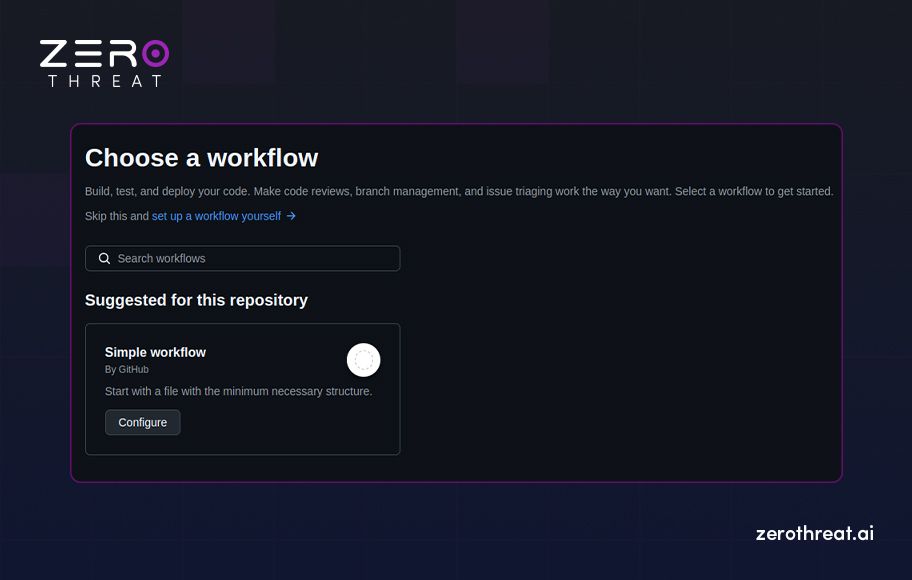
- Name your workflow file (e.g., .github/workflows/scan.yml).
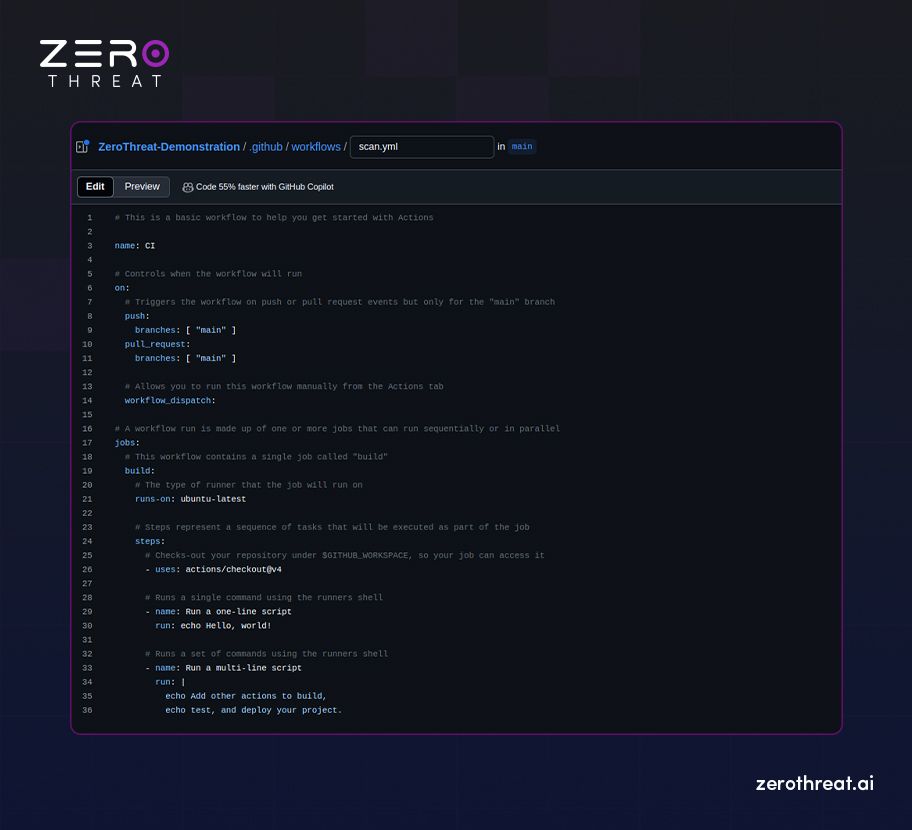
Step 2: Configure the Workflow File
We are using workflow_dispatch trigger to manually initiate the workflow from GitHub interface.
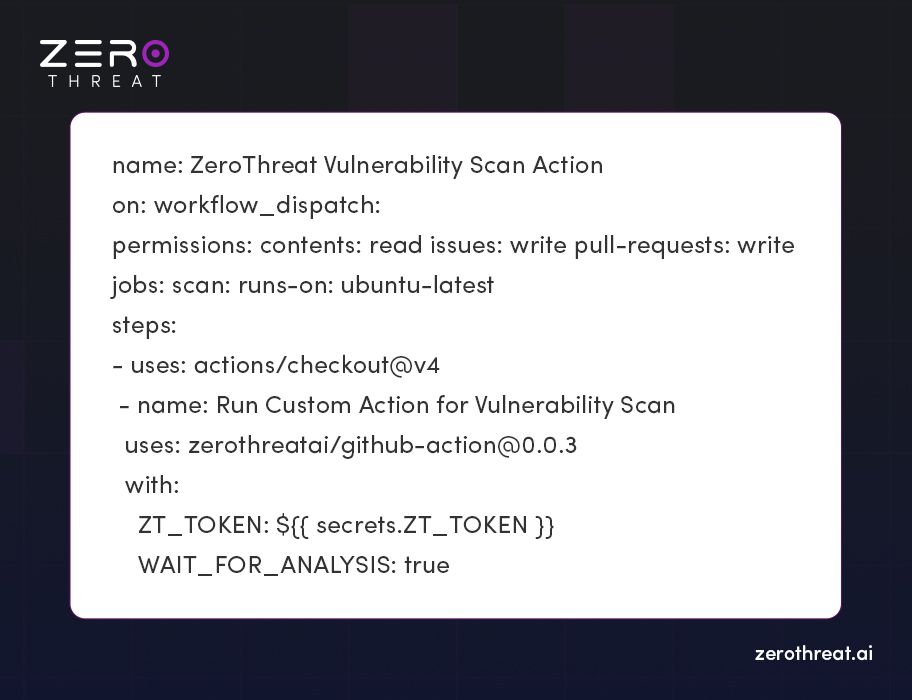
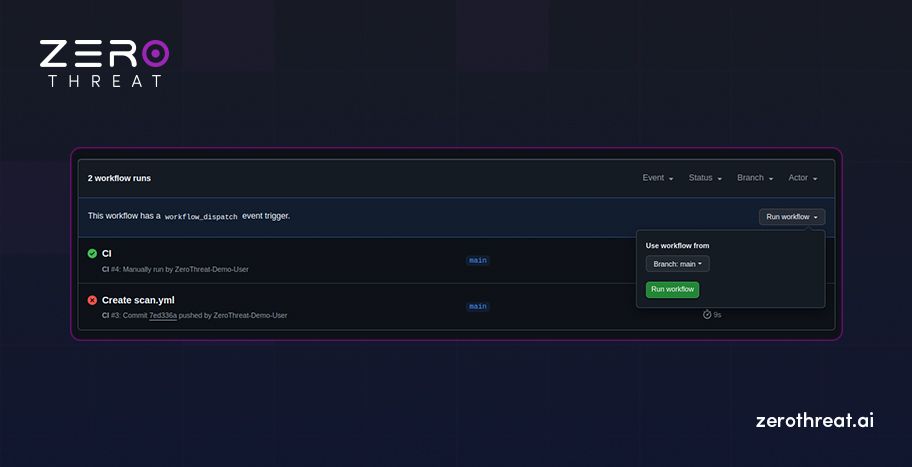
Step 3: Run the workflow
Since this example uses workflow_dispatch, you can manually start a scan:
- Go to the Actions tab in your GitHub repository.
- Select your new workflow.
- Click "Run Workflow".
Automating with Push or Pull Requests
To automate scans on every code change, you can replace the on: block in the workflow with:
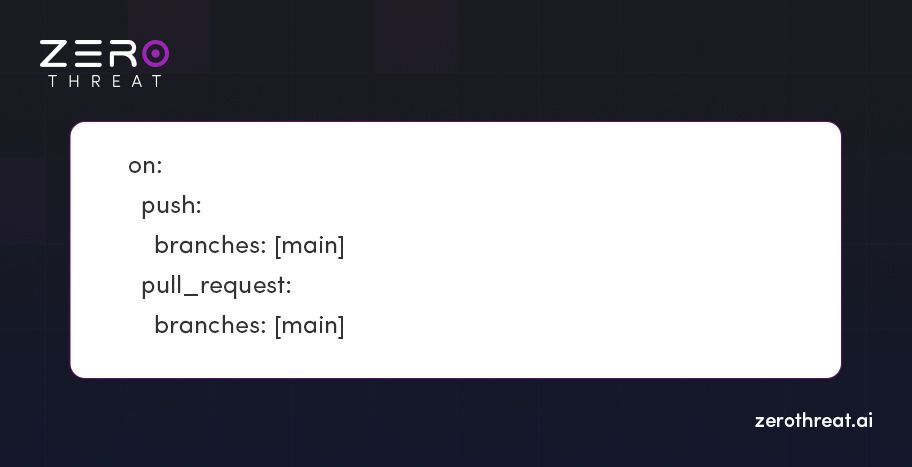
This will trigger ZeroThreat scans automatically for pushes or pull requests to the main branch.
Top DevOps teams already automated their security. Join them. ZeroThreat for DevOps
Why ZeroThreat is Different: The Edge Over Traditional Security Approaches
While many organizations attempt to bolt on security via occasional pentests, ZeroThreat embeds security as a first-class part of the software delivery process. The difference may seem subtle, but the impact is significant.
Automation Over Manual: Eliminates dependency on manual reviews or audit cycles that come too late or irregularly.
Integration Over Isolation: Rather than security being an add-on, it becomes part of build, test, and deployment. Security gates, policy enforcement, and auditing are all part of the pipeline.
Continuous Over Periodic: Traditional pentests or audits occur quarterly or annually, often missing newly introduced vulnerabilities. ZeroThreat enables continuous, consistent scanning across the SDLC, early and automated.
Shift-Left Over Shift-Right: Instead of waiting until code is complete or deployed, security is considered from the earliest phases.
Collaboration Over Silo: Encourages DevSecOps culture (developers, DevOps, security, ops), sharing responsibility, visibility, and metrics.
Final Thoughts: ZeroThreat in Building Security-First CI/CD Pipelines
Organizations face pressure to deliver software quickly while maintaining security. Traditional vulnerability scanners can no longer keep pace with the demands of frequent delivery, agile workflows, and rapidly evolving threat landscapes.
By integrating security scans as first-class citizens into CI/CD pipelines, ZeroThreat enables organizations to deliver with confidence. It means fewer manual audits, faster feedback, and security baked into everyday workflows.
In a nutshell, ZeroThreat helps organizations adopt secure-by-default, automated, scalable development workflows.
For any business serious about app delivery, embedding security into CI/CD isn’t just an option. It’s fast becoming a strategic imperative. So, sign up for free now and experience ZeroThreat in your development cycle.


Explore ZeroThreat
Automate security testing, save time, and avoid the pitfalls of manual work with ZeroThreat.