 ZeroThreat Wins Bronze Stevie® Award in Tech Startup of the Year Read more


All Blogs
Continuous DAST in CI/CD Pipelines: Automating Exploit Validation Before Production Deployment
Quick Overview: Modern apps move quickly through CI/CD pipelines, making continuous security testing essential. Traditional scans performed late in the development cycle can leave exploitable vulnerabilities unnoticed until release. This blog explains how Continuous DAST integrates security testing into CI/CD, validates real exploitability, and uses verified findings as security gates before production. It also covers authenticated apps, APIs, and SPAs.
Attackers do not read your source code. They probe the running application, and every release changes what they can reach. A parameter added on Tuesday becomes an injection point on Wednesday, and a new admin route ships with an authorization gap nobody reviewed. If your security testing runs on a monthly schedule, the version it tested is already gone by the time the report lands.
This is the gap continuous DAST is meant to close: dynamic testing that fires on pipeline events instead of a calendar, so each build is tested as it moves toward production. The problem is that detection-only scanning inside a pipeline generates too much noise to trust. A reflected string, a version banner, or a stack trace can all look like vulnerabilities, and a gate built on unverified findings gets overridden until it stops blocking anything. Teams quiet the gate, and the pipeline ships anyway.
Identifying a vulnerability is not the same as proving it is exploitable. That distinction is the whole argument of this article. When automated security testing in your CI/CD pipeline confirms exploitability with evidence before it fails to build, blocking becomes a decision you can defend. The OWASP DevSecOps guideline for DAST provides additional context on integrating DAST into the development pipeline. The sections below cover how continuous DAST fits a pipeline, how coverage reaches authenticated and API surfaces, how exploit validation actually works per vulnerability class, and how to turn validated findings into a gate policy.
Don’t let the next build hide an exploitable flaw. Validate vulnerabilities before they reach production. Start Validating
On This Page
- What is Continuous DAST in CI/CD?
- How Does Continuous DAST Work in a CI/CD Pipeline?
- Extending DAST Coverage to Authenticated Web Apps, APIs, and SPAs
- How DAST Exploit Validation Works
- Using Exploit Validation as a CI/CD Security Gate
- Continuous DAST vs Traditional DAST
- Conclusion
What is Continuous DAST in CI/CD?
It is dynamic security testing that is triggered automatically by pipeline events, such as pull requests, merges, and release candidates, against a deployed, production-like build, with results feeding directly into the deployment decision. It replaces the calendar with the pipeline as the thing that decides when a scan runs.
The difference from traditional periodic DAST is not the scanner, but it is the trigger and the consequence. A periodic scan runs a weekly or monthly cadence against whatever happens to be deployed, and its report goes to a queue. Continuous DAST security testing runs on the exact build that a commit produced, scoped to what changed, and its result can pass or fail that build. Because it is event-driven, the version tested is the version being promoted, which removes the drift between "what we scanned" and "what we shipped."
This event-scoping is also what makes speed matter. A scan tied to a pull request has minutes, not days, to return a verdict, so continuous DAST leans on incremental scoping and parallelism rather than exhaustive full crawls on every trigger. For a fuller grounding in how dynamic testing evaluates a running app, see the DAST fundamentals guide; here we assume that base and focus on the pipeline.
How Does Continuous DAST Work in a CI/CD Pipeline?
Continuous DAST works by deploying each build to a disposable, production-like environment, running a scan scoped to the pipeline trigger, validating the findings, and returning a pass or fail verdict to a security gate before the build is allowed to promote. The scanner is one stage in a sequence, not a separate tool to run out of band.
The canonical flow places DAST after the build is deployable but before it reaches production:
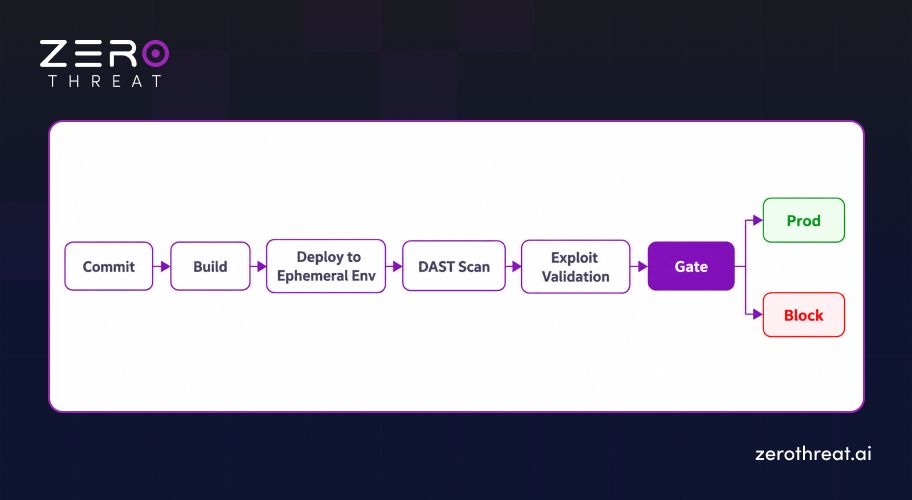
Positioning matters more than it looks. DAST needs a deployed, reachable target, so it runs after the build produces a deployable artifact and after that artifact lands in an environment, not against a static package. Several conditions make the difference between a scan that reflects production and one that wastes pipeline minutes:
- Environment Parity: The scanned environment should mirror production configuration, feature flags, and backend integrations. A build tested against a stripped-down config hides the routes and workflows that actually ship.
- WAF Allowlisting: Allowlist the scanner past any web application firewall in front of the environment. Otherwise, you are testing the WAF's blocking behavior, not the application, and real flaws stay hidden behind a 403.
- Deterministic Seed Data: Seed the environment with known, disposable data, so tests are repeatable, and validation has predictable objects to act on.
Scan depth should scale with the trigger, because a pull request cannot absorb a full crawl on every push. Tiering the scan by pipeline event keeps fast feedback fast while reserving deep coverage for the moments that warrant it:
| Pipeline Trigger | Scan Scope | Duration Budget | Gate Behavior |
|---|---|---|---|
| Pull request | Changed routes, endpoints, and their dependencies | Minutes | Warn |
| Merge to main | Affected modules plus authenticated surface | Tens of minutes | Block |
| Release candidate | Full application and API surface | Longer, off critical path | Block |
API scope should come from the build, not from a stale list maintained by hand. When the same build emits an OpenAPI or GraphQL schema, importing that schema as the scan scope guarantees the tested contract matches the deployed one, so newly added endpoints are covered at the moment they exist. This is one of the most reliable ways to keep DAST automation in CI/CD from silently missing new attack surfaces.
Finally, the pipeline needs to know when the scan is done and what it is found. A blocking poll holds the stage open until the scan finishes, which suits release-candidate gates; an asynchronous trigger with a webhook callback suits fast PR feedback where you do not want to hold a runner idle. Either way, results should return in a machine-consumable format, SARIF for native code-host annotations or JSON for custom logic, so the verdict drives an exit code rather than a human reading a dashboard. Teams standing this up alongside broader pipeline controls can see how the pieces fit in this CI/CD security testing walkthrough..
Stop gating builds on guesswork. Let AI-powered DAST validate what’s actually exploitable. Explore AI-Powered DAST
Extending DAST Coverage to Authenticated Web Apps, APIs, and SPAs
DAST coverage for web applications in CI/CD depends on reaching the parts of the app that only exist after logging in, since most high-impact vulnerabilities live behind authentication rather than on public pages. An unauthenticated scan of a modern application tests the marketing surface and misses the product.
Getting a headless pipeline authenticated takes more than a stored password. The scanner needs credentials injected from the pipeline's secrets store rather than committed anywhere, and it needs to complete a real login sequence and hold the resulting session.
For token-based apps, that means handling JWT expiry with refresh or running an OAuth client-credentials flow for service-to-service APIs, so the session does not die mid-scan. Because interactive multi-factor prompts cannot be answered by an automated job, teams typically provision MFA-exempt test accounts scoped to the staging environment, never production identities.
Authorization testing needs more than one identity. To detect broken access control, the scanner has to hold at least two authenticated roles at once, for example a standard user and an admin, so it can attempt one role's actions with another role's session. That multi-role capability is a prerequisite for the IDOR and access-control validation covered in the next section. This is also where continuous web application pentesting separates from surface scanning: it exercises the post-login attack surface the way a real user, and a real attacker, would.
Single-page applications add a rendering problem. Routes and inputs in a React or Vue app do not exist in the initial HTML; they appear after client-side JavaScript executes. A scanner that only parses static responses sees an almost empty page, so SPA coverage requires a headless browser that runs the client-side logic, follows asynchronous routes, and discovers the API calls the frontend makes. Those discovered calls feed directly into API security testing, and maintaining session state across that whole traversal is what keeps a deep authenticated scan from silently logging itself out.
How DAST Exploit Validation Works
DAST exploit validation is the process of confirming a suspected vulnerability by safely executing proof of exploitability and capturing evidence, before the finding is reported or used to fail a build. It is the step that turns a heuristic signal into a fact.
The key challenge is that raw DAST findings can be noisy. A scanner may flag a reflected parameter, database error, or outdated component without proving that the condition is actually exploitable. If unverified findings are used directly as CI/CD gates, false positives can block legitimate builds and lead teams to weaken or bypass the security gate. and lead teams to weaken or bypass the security gate.
Exploit validation addresses this gap by verifying whether a detected vulnerability can actually be exploited. This turns DAST from vulnerability detection into automated security validation that can support reliable CI/CD deployment decisions.
Validation takes a suspected vulnerability, safely tests it with a targeted attack, and analyzes the result to determine whether it is actually exploitable. The exact approach varies by vulnerability type, making real-world examples more useful than a generic validation process.
Example: Validating SQL Injection
A suspected injection point is confirmed by differential behavior, not by an error message. The validator sends a pair of requests whose only difference is a boolean condition, for example one payload that resolves true and one that resolves false, and compares the responses. A consistent, logic-driven difference confirms the input reaches the query. For blind variants that return no visible difference, the validator uses a time-based probe (a conditional delay) or an out-of-band (OAST) technique: it injects a payload that makes the database resolve an attacker-controlled hostname, then watches a controlled listener for the callback. A received callback is unambiguous proof the input executed, with no reliance on scraping error text. This maps to CWE-89.
Example: Validating XSS
Reflection is not execution. Confirming cross-site scripting means proving the injected script actually runs in a browser context, so the validator loads the affected page in a headless browser and checks whether the payload executed, for instance by observing that an injected callback fired in the DOM. This distinguishes a genuinely exploitable finding from a value that is reflected but safely encoded, and it extends to DOM-based XSS, where the sink is in client-side JavaScript and never appears in the server response at all. This maps to CWE-79.
Example: Validating IDOR and Broken Access Control
Access-control flaws are confirmed by cross-role replay, which is why the multi-role sessions from the previous section are a prerequisite. The validator takes a request that legitimately belongs to one identity, for example user A retrieving their own record, then replays it using user B's session, or as an unauthenticated request. If B receives A's data, the authorization check is missing, and the finding is confirmed with concrete evidence rather than inference. Broken object-level authorization (BOLA) on APIs is validated in the same way. This maps to CWE-284 and CWE-639.CWE-284 and CWE-639.
Evidence Returned to the Pipeline
A validated finding is only useful if the pipeline and the developer can act on it, so each confirmation carries a structured evidence package: the request and response pair that proved exploitability, a reproducible command to replay it, the exact endpoint and parameter affected, and a severity rationale tied to the confirmed impact. That package is what lets a developer fix the issue without re-triaging it, and what lets the gate make a defensible decision. ZeroThreat's engine attaches this proof to every confirmed finding, which is the basis for its near-zero false positive rate.
Safety Boundaries for Automated Exploitation
Automated exploitation has to be safe to run on every build, which means hard boundaries. Validation uses non-destructive payloads and canary values, confines itself to read-only proof wherever possible, and never runs state-mutating exploits against shared data. Scope is restricted to the target environment, and request rates are controlled, so the scan does not act as a denial-of-service against staging, and every validation action is logged for auditability. These constraints are what make it responsible to point exploit validation at a pipeline environment continuously rather than once a quarter under supervision.
Your next release shouldn’t be a security gamble. See what continuous DAST costs. View Pricing
Using Exploit Validation as a CI/CD Security Gate
A CI/CD security gate uses exploit validation to block a deployment when a confirmed, exploitable vulnerability crosses a defined severity threshold, letting proven risk stop a release while unverified noise does not. Once a finding arrives already confirmed with evidence, the gate logic becomes simple and defensible.
The core policy choice is severity-based versus exploitability-aware gating:
| Gate Model | Blocks On | Failure Mode |
|---|---|---|
| Severity-based | Any finding at or above a CVSS cutoff, validated or not | False positives block clean builds; teams add overrides until the gate is ignored |
| Exploitability-aware | Findings confirmed exploitable at or above a severity cutoff | Blocks map to real risk, so the gate stays trusted and enforced |
In practice, a workable policy blocks validated Critical and High findings, warns on validated Medium, and reports everything unvalidated without failing the build. The scanner returns a non-zero exit code on a block condition, and the pipeline stops there. A minimal policy-as-code expression of that rule:
security-gate.ymlgate:block_if:validated:trueseverity:[critical, high]warn_if:validated: trueseverity:[medium]baseline:.zt-baseline.json # accepted findings,don't re-failon_block:exit_code: 1
A good security gate should be strict without becoming a bottleneck. Baselines prevent reviewed findings from failing every build, while explicit risk acceptance with an owner and expiry date keeps exceptions accountable. A break-glass override can handle emergency releases, but every override should be logged.
The process then becomes a simple loop: block → fix → retest → confirm. If the vulnerability is no longer exploitable, the build passes; if it still is, the gate blocks it again.
Continuous DAST vs Traditional DAST: The Difference Exploit Validation Makes
The value of continuous DAST is not just that it runs more often. It is that validation makes automated gating viable at all. The comparison below isolates where each model lands, including the middle case of continuous scanning without validation, which many teams reach first and then abandon because of noise.
| Dimension | Traditional DAST | Detection-only CI DAST | Continuous DAST with Exploit Validation |
|---|---|---|---|
| Testing frequency | Periodic (weekly/monthly) | On pipeline events | On pipeline events |
| Feedback timing | Late in the SDLC | Per build | Per build |
| Noise level | High, triaged manually | High, floods CI logs | Low, only confirmed findings |
| Exploit validation | Manual and separate | None | Automated, inline |
| Deployment gating | Not viable | Advisory only in practice | Enforceable |
| Evidence with findings | Added by hand later | Rarely | Attached at confirmation |
Catch exploitable flaws before release and strengthen your CI/CD security gates with automated pentesting.Test Before Release
Conclusion
Continuous DAST brings dynamic testing into the delivery workflow, but frequency alone does not make a deployment gate you can trust. The deciding factor is whether findings arrive proven. Automated exploit validation supplies that proof, so only vulnerabilities confirmed exploitable, with evidence attached, stop a release, and everything else stays out of the way of shipping.
This is where ZeroThreat’s DAST fits in. It continuously tests web apps and APIs, validates findings against attack patterns, and provides reproducible evidence for reliable CI/CD security gates. With coverage across authenticated flows, SPAs, and APIs, DevOps teams can catch exploitable vulnerabilities without slowing down releases.
Frequently Asked Questions
What is pre-production application security testing, and which tests should run before deployment?
Pre-production application security testing validates a build in a production-like environment before it is promoted live. A layered pipeline typically runs SAST and SCA on the code and dependencies early, then DAST with exploit validation against the deployed build to confirm runtime, exploitable risk. DAST is the last line before deployment because it tests the running application the way an attacker would reach it.
What is automated penetration testing in CI/CD, and how does it differ from continuous DAST?
Does automated DAST replace manual penetration testing?
Which vulnerabilities are hard to validate automatically?
How do you run continuous DAST for microservices that deploy independently?



Explore ZeroThreat
Automate security testing, save time, and avoid the pitfalls of manual work with ZeroThreat.