 ZeroThreat Wins Bronze Stevie® Award in Tech Startup of the Year Read more

All Blogs
Security Compliance Reporting Explained: Types, Frameworks, Challenges, and Best Tools
Quick Overview: Compliance reporting is essential for proving security, maintaining audit readiness, and meeting regulatory requirements. This guide explains what compliance reporting is, the different types of compliance reports, their benefits, industries that require them, major frameworks such as GDPR, HIPAA, ISO 27001, PCI DSS, and SOC 2, common reporting challenges, and the best tools organizations can use to streamline compliance reporting and simplify audits.
Compliance reporting should make audits easier. For many organizations, it does the opposite.
Security teams today must prove compliance across multiple frameworks while managing growing volumes of evidence, controls, vulnerabilities, and audit requirements. In fact, nearly 43% of organizations manage four or more compliance frameworks, and 55.6% report that increasing complexity is one of their biggest concerns regarding compliance frameworks
The challenge is not just staying compliant. It is proving compliance.
According to recent audit and compliance research, 91% of organizations have to resubmit audit evidence, while 53% struggle to collect evidence across multiple tools and systems. These inefficiencies turn compliance reporting into a time-consuming process instead of a strategic advantage.
That is why security compliance has become a critical part of modern cybersecurity programs. It helps organizations generate audit-ready compliance reports, maintain continuous visibility into security controls, and align security testing with regulatory requirements such as GDPR, HIPAA, PCI DSS, and ISO 27001.
This guide explains the different types of compliance reports, their benefits, the industries that rely on them, key regulatory frameworks, common reporting challenges, and the tools that help security teams stay audit-ready year-round.
Ditch preparing for compliance reports manually. Use ZeroThreat to stay audit-ready effortlessly. Automate Compliance Reporting
On This Page
- What is Compliance Reporting in Cybersecurity?
- Types of Compliance Reports Organizations Need for Audits
- Benefits of Effective Compliance Reporting
- Industries and Types of Organizations that Require Compliance Reporting
- Key Regulatory Compliance Reporting Frameworks You Need to Track
- Top 5 Compliance Reporting Tools
- Common Compliance Reporting Challenges Security Teams Face
- Wrapping Up
What is Compliance Reporting in Cybersecurity?
Compliance reporting is the process of documenting an organization's security controls, vulnerabilities, and remediation efforts to prove adherence to regulatory standards like GDPR, HIPAA, or PCI DSS. It turns technical security work into structured evidence that auditors, regulators, and stakeholders can review and verify.
In practice, this means capturing scan results, risk assessments, and audit trails in a format that maps directly to specific compliance requirements. A report that simply lists vulnerabilities isn't enough. It needs to show controls in place, gaps identified, and corrective action taken.
This is what separates compliance reporting from routine security reporting. General reports inform internal teams. Compliance reports must satisfy external auditors, hold up under legal scrutiny, and demonstrate continuous compliance, not just a one-time snapshot of security posture.
Types of Compliance Reports Organizations Need for Audits
Organizations rely on different types of compliance reports to demonstrate adherence to regulations, validate security controls, support governance efforts, and prepare for audits. Each report serves a specific purpose and helps provide evidence that policies, processes, and controls are operating as intended.
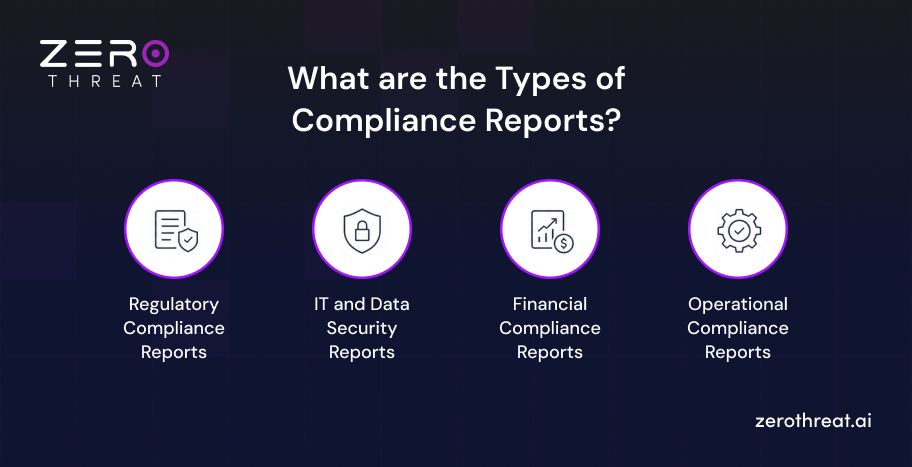
Regulatory Compliance Reports
Regulatory compliance reports demonstrate adherence to specific legal frameworks like GDPR, HIPAA, or PCI DSS. They map controls directly to regulatory clauses, track data handling practices, and record consent or breach notification processes. Auditors use them to confirm an organization meets the exact obligations its industry or region requires.
IT and Data Security Reports
IT and data security reports cover technical controls such as encryption, access management, vulnerability scans, and incident response logs. They show how data is protected across systems and networks. Security teams rely on them to prove that infrastructure meets baseline standards like ISO 27001 or internal security policies before an audit even begins.
Financial Compliance Reports
Financial compliance reports document internal controls over financial data, transaction integrity, and fraud prevention measures. They're central to frameworks like SOX and PCI DSS, where payment data security intersects with financial accountability. Auditors review these to confirm that financial systems and reporting processes carry no material weaknesses or unresolved discrepancies.
Operational Compliance Reports
Operational compliance reports evaluate adherence to internal policies, employee training records, vendor risk management, and business continuity planning. They show whether day-to-day operations align with stated governance standards. Without them, organizations struggle to demonstrate that compliance isn't just a policy on paper but an active part of daily operations.
Benefits of Effective Compliance Reporting
Effective compliance reporting reduces financial exposure, builds trust, and gives security teams a clear, defensible record of how risk is managed across the organization.
Improves Audit Readiness
Well-structured compliance reports provide auditors with clear evidence of control implementation, security testing activities, remediation efforts, and policy enforcement. This reduces last-minute preparation and makes audits more efficient and predictable.
Strengthens Regulatory Compliance
Compliance reporting helps organizations track adherence to frameworks such as GDPR, HIPAA, PCI DSS, and ISO 27001. It creates a documented record of compliance activities and simplifies regulatory reviews.
Provides Better Risk Visibility
Regular reporting highlights compliance gaps, control weaknesses, and unresolved security risks. This allows security and compliance teams to prioritize remediation efforts before issues become audit findings or regulatory violations.
Supports Faster Decision-Making
Accurate compliance data gives leadership teams visibility into risk exposure, control effectiveness, and compliance status. This helps organizations make informed decisions about security investments, governance strategies, and remediation priorities.
Increases Operational Efficiency
Standardized reporting processes reduce manual effort, improve accountability, and streamline evidence management. Teams spend less time gathering documentation and more time addressing security and compliance priorities.
Builds Trust with Customers and Stakeholders
Consistent compliance reporting demonstrates transparency and a strong commitment to security governance. This helps strengthen trust with customers, partners, auditors, regulators, and investors who expect proof of ongoing compliance.
Simplify GDPR, HIPAA, PCI DSS, and ISO 27001 reporting with a click, within minutes. Get Compliance-Ready Reports
Industries and Types of Organizations that Require Compliance Reporting
| Industry | Types of Organizations | Compliance Reports They May Require |
|---|---|---|
| Cybersecurity | MSSPs, security consultancies, IT service providers | ISO 27001 reports, SOC 2 reports, OWASP-aligned reports |
| Finance | Banks, credit unions, payment processors, fintech firms | PCI DSS reports, SOX reports, AML reports |
| Healthcare | Hospitals, clinics, health insurers, telehealth providers | HIPAA reports, HITRUST reports |
| Technology and SaaS | Software vendors, cloud providers, SaaS platforms | SOC 2 reports, ISO 27001 reports, GDPR reports |
| E-commerce and Retail | Online retailers, marketplaces, subscription services | PCI DSS reports, GDPR reports, CCPA reports |
| Government and Public Sector | Federal agencies, defense contractors, public utilities | FedRAMP reports, NIST reports, CMMC reports |
| Education | Schools, universities, ed-tech platforms | FERPA reports, GDPR reports (for EU student data) |
| Telecommunications | ISPs, telecom carriers, communication platforms | GDPR reports, ISO 27001 reports, data privacy reports |
Key Regulatory Compliance Reporting Frameworks You Need to Track
Organizations must align their compliance reporting efforts with the regulatory and industry frameworks that apply to their business. These frameworks define security, privacy, risk management, and audit requirements while providing the evidence auditors and regulators expect to review.
GDPR
The General Data Protection Regulation (GDPR) governs how organizations collect, process, store, and protect personal data of individuals within the European Union. Compliance reporting typically includes data protection assessments, consent management records, breach notifications, access control reviews, and evidence demonstrating adherence to privacy and data governance requirements.
HIPAA
The Health Insurance Portability and Accountability Act (HIPAA) establishes requirements for protecting electronic protected health information (ePHI). Compliance reports often document security risk assessments, access management controls, audit logs, encryption measures, incident response activities, and safeguards designed to ensure healthcare data confidentiality and integrity.
ISO 27001
ISO 27001 is an internationally recognized information security standard that requires organizations to establish and maintain an Information Security Management System (ISMS). Compliance reporting focuses on risk assessments, control effectiveness, security policies, internal audits, corrective actions, and continuous improvement activities that support information security governance.
PCI DSS
The Payment Card Industry Data Security Standard (PCI DSS) applies to organizations that process, store, or transmit payment card information. Compliance reports typically include vulnerability assessment results, access control reviews, network security controls, security testing evidence, and documentation demonstrating protection of cardholder data environments.
SOC 2
SOC 2 evaluates whether an organization's security controls effectively protect customer data based on the Trust Services Criteria, including security, availability, confidentiality, processing integrity, and privacy. Reporting generally includes control testing results, security monitoring activities, vulnerability management practices, incident response procedures, and audit evidence supporting operational effectiveness.
Top 5 Compliance Reporting Tools
The right compliance reporting tool reduce manual effort while improving visibility into compliance status and security posture. Here are five platforms worth evaluating, each suited to different compliance and reporting needs.
Vanta
Vanta automates compliance across frameworks like SOC 2, ISO 27001, HIPAA, GDPR, and PCI by continuously collecting evidence from connected systems. Its trust center and audit automation features help organizations move from manual spreadsheets to always-current, audit-ready compliance documentation.
Hyperproof
Hyperproof excels at centralizing compliance operations by linking your internal control health directly to active risk registers. The platform automates recurring evidence collection through deep integrations, allowing teams to scale common control sets across multiple frameworks without duplicating manual workflows.
Drata
Drata combines compliance automation with continuous control monitoring and AI-driven evidence collection across frameworks including HIPAA, ISO 27001, GDPR, and PCI DSS. It cross-maps controls between frameworks, helping security teams cut audit preparation time significantly.
Centraleyes
Centraleyes offers an AI-powered GRC platform supporting over 180 frameworks, including CMMC, PCI DSS, SOC 2, and HIPAA. It automates data collection through smart questionnaires and generates real-time dashboards, helping compliance teams visualize risk and reporting status quickly.
Optro
Optro, formerly AuditBoard, is an enterprise GRC platform built for audit, risk, and compliance management at scale. It supports risk-based audits and connected compliance reporting across large organizations, rather than functioning as a narrow point solution for a single framework.
Common Compliance Reporting Challenges Security Teams Face
Compliance reporting is essential for audit readiness, but many organizations struggle with fragmented data, manual processes, and evolving regulatory requirements. These challenges can slow reporting cycles, increase audit risk, and make it difficult to maintain continuous compliance visibility.
- Changing Regulatory Requirements: Regulatory frameworks continue to evolve, requiring organizations to update controls, reporting processes, and compliance documentation on an ongoing basis to remain compliant.
- Maintaining Audit-Ready Documentation: Many organizations struggle to keep evidence current throughout the year. As a result, audit preparation often becomes a last-minute effort that consumes valuable security and compliance resources.
- Limited Real-Time Compliance Visibility: Without centralized reporting and continuous monitoring, teams struggle to understand current compliance status, control effectiveness, and emerging risks across the environment.
Facing a complex enterprise audit deadline? A quick conversation can save weeks of audit prep. Connect With Us
Wrapping Up
Compliance reporting is important for demonstrating adherence to regulatory and industry standards in a measurable way while also being a critical part of maintaining visibility into security controls and managing risk.
Organizations that establish structured, evidence-driven reporting processes are better positioned to handle audits, address compliance gaps, and respond to evolving regulatory requirements. Effective reporting also helps security and compliance teams make informed decisions based on accurate and current data.
As compliance frameworks continue to expand, automation and continuous security validation are becoming essential for maintaining audit readiness. A proactive approach to compliance reporting strengthens security posture, improves operational efficiency, and builds greater trust with customers, partners, and regulators.
Frequently Asked Questions
How do audit-ready security reports differ from standard security reports?
Audit-ready security reports are designed to provide structured compliance evidence, control validation results, remediation records, and traceable documentation for auditors. On the other hand, standard security reports primarily focus on vulnerabilities, risks, and technical findings without the compliance context needed for regulatory assessments.
How does automated compliance reporting improve audit readiness?
How often should compliance-ready reports be generated?
Can compliance-ready security reporting reduce regulatory penalties?
Explore ZeroThreat
Automate security testing, save time, and avoid the pitfalls of manual work with ZeroThreat.