 ZeroThreat Wins Bronze Stevie® Award in Tech Startup of the Year Read more

All Blogs
Zero Trust Statistics 2026: What Every Security Leader Needs to Know

Quick Overview: Explore the latest Zero Trust Statistics for 2026 in this comprehensive blog. From adoption trends and market growth to implementation challenges and security outcomes, we break down key data points shaping enterprise security strategies. Discover why Zero Trust is no longer optional, but essential.
The term “Zero Trust” is not just a concept, but a paradigm shift in the modern cybersecurity strategy. It has become a backbone while implementing a new approach in organizations. In fact, many organizations are embracing Zero Trust Architecture (ZTA), a security model built on the principle of “Never Trust, Always Verify.”
But how deeply is this concept understood? And more importantly, put into practice across different industries? From government mandates to enterprise adoption, the shift toward Zero Trust is accelerating at an unprecedented pace.
This comprehensive blog – Zero Trust statistics for 2026- has a collection of some shocking data, including adoption rates, investment trends, regional insights, threat landscape impacts, and future projections.
From how well it's understood in regions like the U.S. and the UK to the financial impact of adopting this security model, we break down the key statistics that matter.
Test your application before attackers exploit vulnerabilities in production. Start Testing Now
On This Page
- TL;DR: Table
- Zero Trust Security Market Overview
- Adoption Rates and Implementation
- Zero Trust Market Size and Investment Trends
- Zero Trust Architecture Components – Penetration & Effectiveness
- Regional Zero Trust Adoption & Regulatory Landscape
- Zero Trust and the Threat Landscape in 2026
- Impact and ROI Metrics of Zero Trust Statistics
- Challenges and Barriers to Zero Trust Adoption
- Conclusion
TL;DR: Zero Trust Statistics Table
| Metric | Value |
|---|---|
| Organizations with Zero Trust adoption (or in-progress) | 81% |
| Organizations with full deployment | 52% |
| Insider threat reduction with Zero Trust | 68% |
| Faster incident response | 50% |
| Breach prevention potential | 78% |
| Market size in 2026 | $49.43 billion |
| Projected market by 2030 | $88 billion |
| Potential cost savings from incident prevention | Up to $465 billion globally |
Zero Trust Security Market Overview
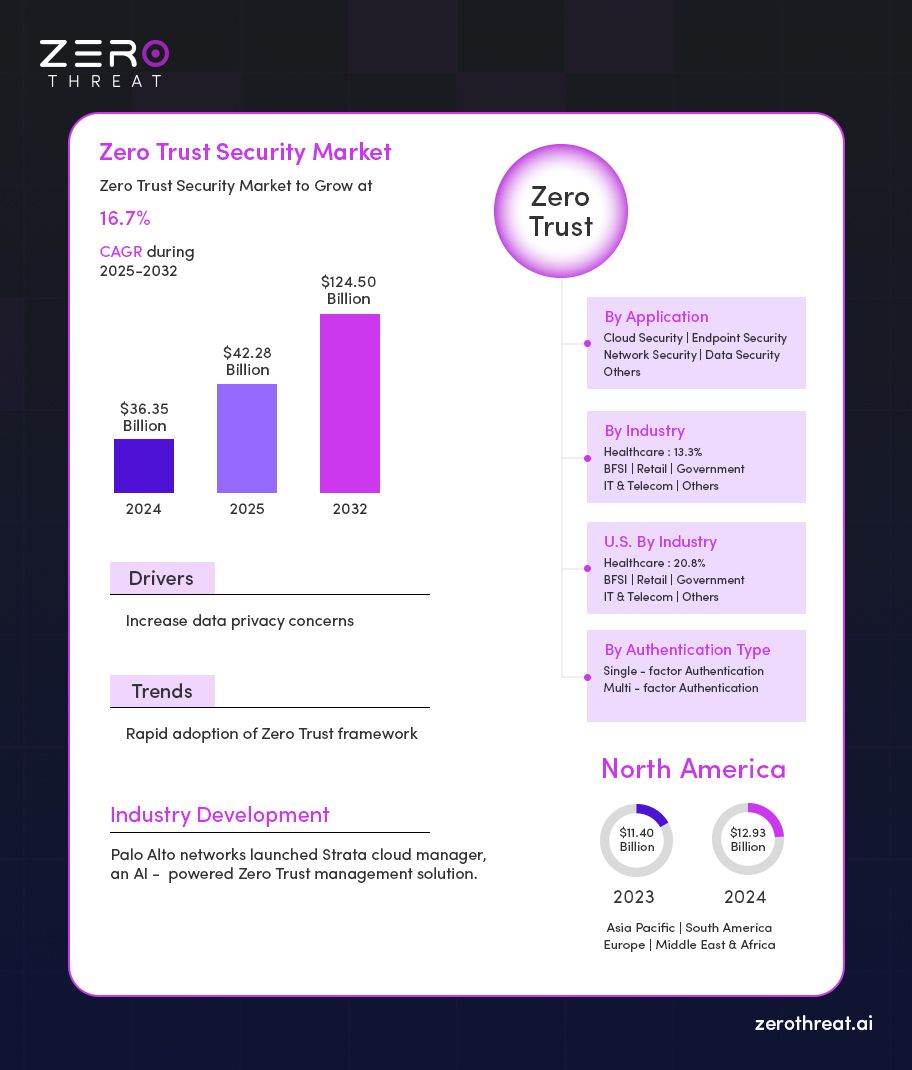
The global Zero Trust security market was valued at USD 42.28 billion in 2025 and is expected to grow to USD 124.50 billion by 2032, reflecting a robust CAGR of 16.7% over the forecast period. In 2025, North America led the market, accounting for 34.48% of the global share.
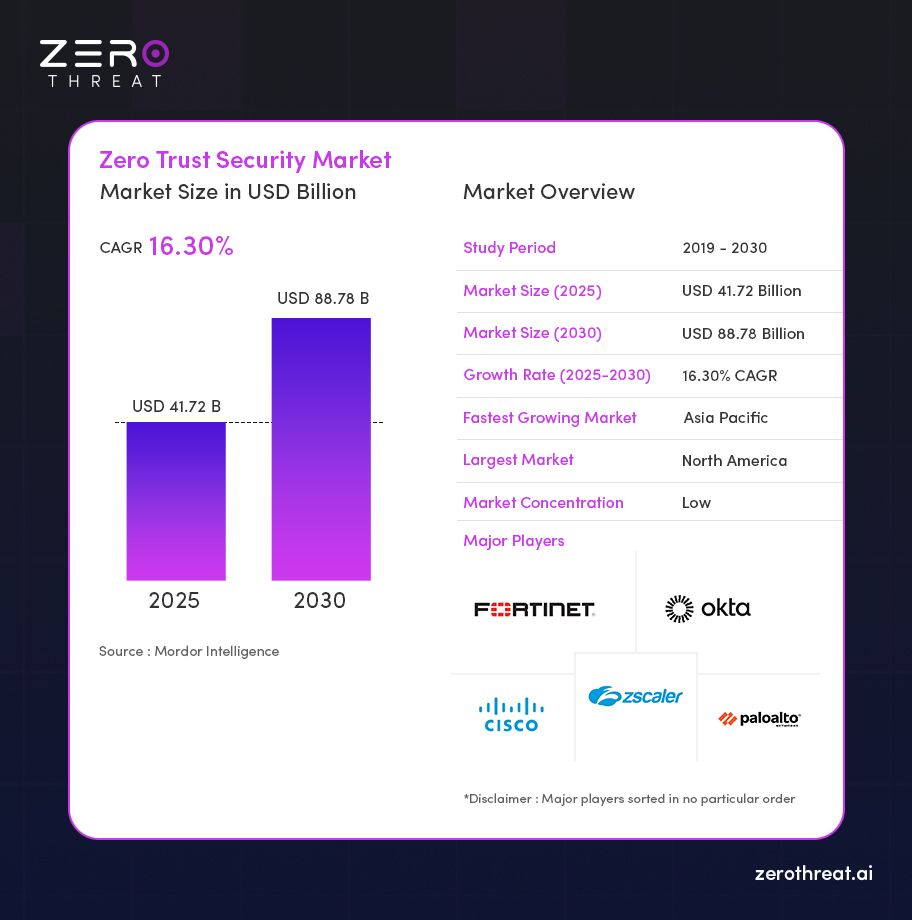
The Zero Trust Security market is projected to grow from USD 41.72 billion in 2025 to USD 88.78 billion by 2030, registering a CAGR of 16.3% during the forecast period.
The global zero trust security market size was valued at USD 42.28 billion in 2025 and is projected to grow from USD 49.43 billion in 2026 to USD 148.68 billion by 2034, exhibiting a CAGR of 14.76% during the forecast period.
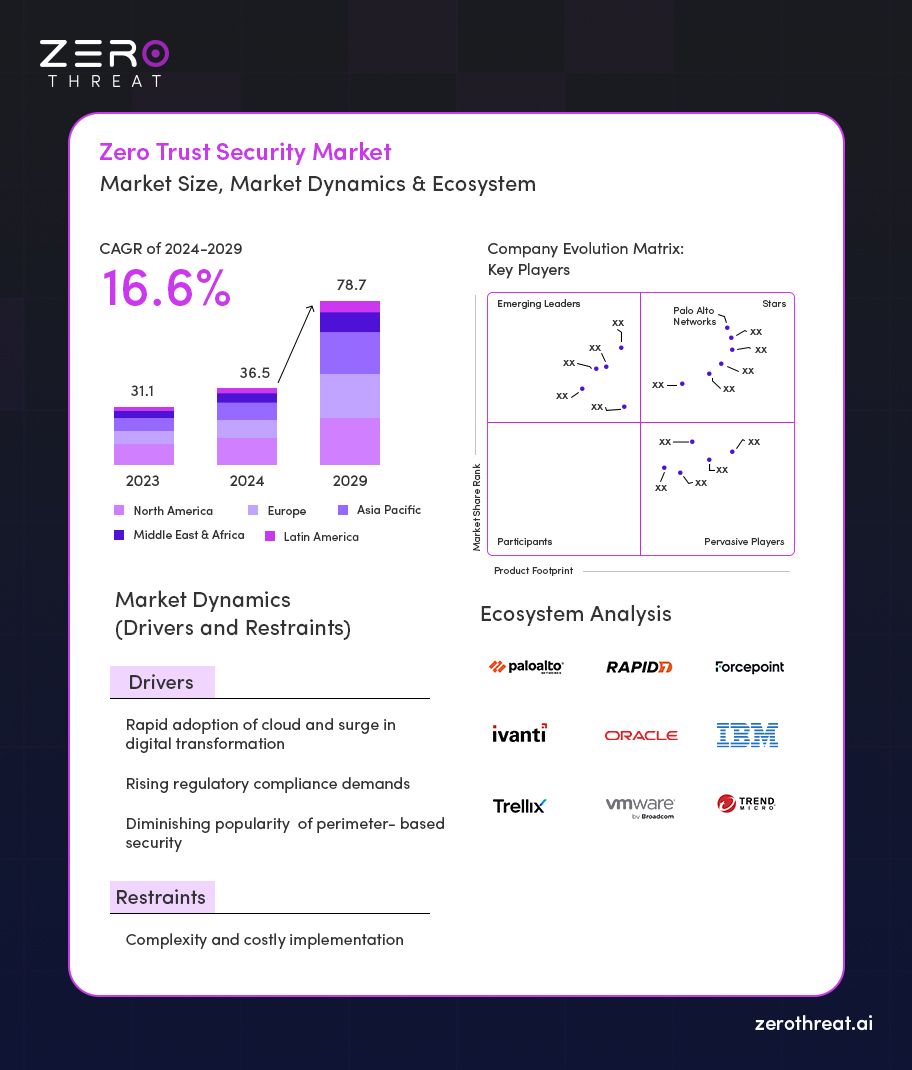
The global Zero Trust Security market is projected to grow from $36–38 billion in 2024 to approximately $85–95 billion by 2029, at a CAGR of 16–18%.
Large enterprises accounted for the majority of revenue in the Zero Trust Security market, holding a dominant 76% share. However, small and medium-sized enterprises (SMEs) are expected to experience the fastest growth by 2030.
The IT and telecommunications sectors led the market in 2022, contributing 45% of the total revenue—driven by the critical need for secure system access inherent to these industries.
- Looking ahead, the healthcare sector is poised to register the highest growth rate. This surge is fueled by two key factors: healthcare organizations are frequent targets of cyberattacks, and the adoption of telehealth services has accelerated since the COVID-19 pandemic, increasing the demand for secure digital infrastructure.
- Another forecast estimates the market will reach USD 41.72 billion in 2025 and expand to USD 88.78 billion by 2030, indicating a CAGR of approximately 16.3%.
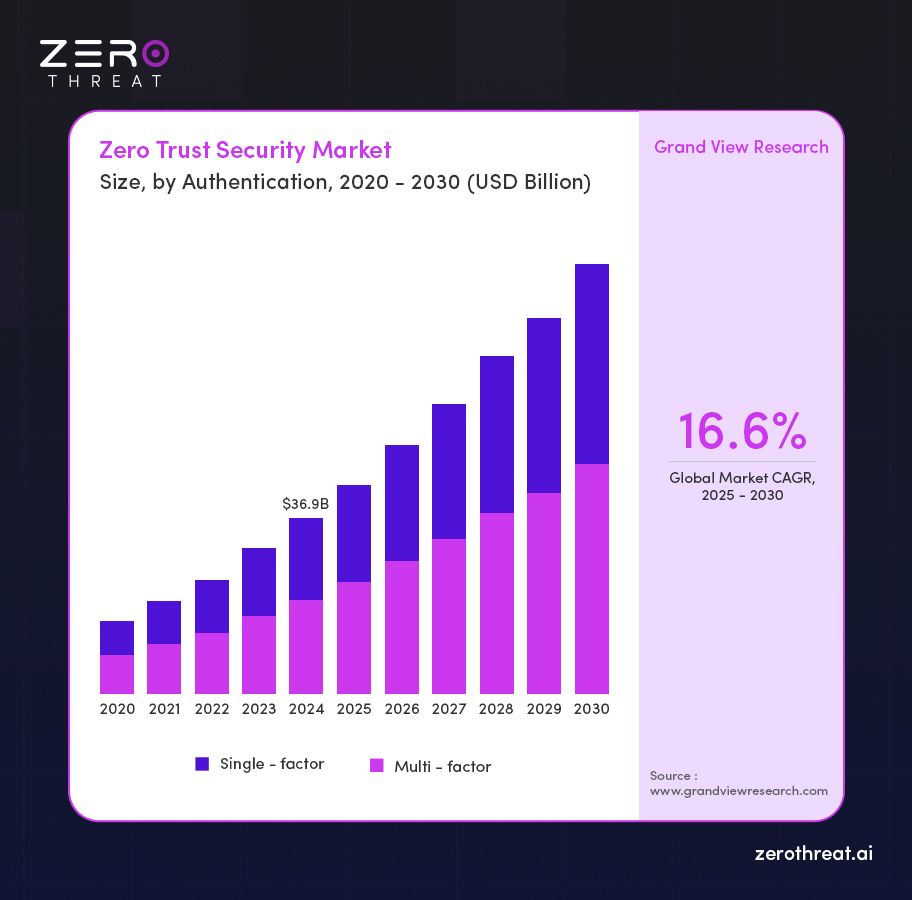
- A separate source places the market size at USD 36.96 billion in 2024, with a projected CAGR of 16.6% through 2030.
- By 2026, approximately 65–70% of organizations are expected to adopt Zero Trust as a core cybersecurity strategy, up from 60% in 2025.
- 81% of organizations have either implemented a Zero Trust security model or are actively working toward adopting one.
- 70% of cybersecurity professionals consider Zero Trust a critical component of their organization’s security strategy.
- Only 25% of organizations believe their existing security architecture fully aligns with Zero Trust principles.
- 60% of enterprises intend to adopt Zero Trust security architectures within the next 12 to 18 months.
- The global Zero Trust Security market was valued at USD 22.19 billion in 2022 and is projected to grow at a CAGR of 17.1% from 2023 to 2030.
- 65% of organizations reported experiencing a cybersecurity breach due to inadequate access controls—a key challenge addressed by Zero Trust.
- 78% of cybersecurity leaders identify Zero Trust as a top strategic priority.
- 35% of organizations cite complex legacy infrastructure as a major barrier to implementing Zero Trust.
- 87% of organizations that have adopted Zero Trust report a significant decrease in security incidents.
- Businesses implementing Zero Trust experience up to 50% faster threat detection and response.
- 49% of all breaches involve identity-related threats—risks that Zero Trust frameworks are specifically designed to mitigate.
- With the average cost of a data breach reaching USD 4.45 million in 2023, Zero Trust strategies can reduce breach-related costs by as much as 30%.
- 72% of organizations state that adopting a Zero Trust architecture has strengthened their overall security posture.
Simulate real attacks continuously, detect vulnerabilities before hackers exploit them. Run Automated Pentest
Global Zero Trust Adoption Rates and Implementation
- By 2026, approximately 65–70% of organizations globally have adopted Zero Trust as a foundational element of their security strategy.
- According to a recent Gartner survey, 63% of organizations have either partially or fully implemented a Zero Trust framework.
- In one global poll:
- 46% of organizations are actively transitioning to Zero Trust.
- 43% have already embedded core Zero Trust principles.
- Only 11% have yet to begin implementation.
- 81% of organizations have either implemented a Zero Trust security model or are in the process of adopting one.
- 60% of enterprises plan to implement Zero Trust security architectures within the next 12 to 18 months.
- Organizations that adopt Zero Trust report an average of 50% faster threat detection and response times.
- 44% of organizations have seen their security incidents drop by more than 90% after adopting Zero Trust.
- 63% of organizations are adopting Zero Trust primarily to enhance security in cloud environments.
- 38% of organizations have partially implemented Zero Trust and plan to complete full deployment within the next two years.
- 78% of security breaches could be avoided with full adoption of a Zero Trust framework.
- 65% of all security incidents involved compromised identities—an area Zero Trust is designed to protect.
- 40% of small and medium-sized businesses intend to implement Zero Trust within the next year, reflecting growing adoption among smaller enterprises.
- Organizations with Zero Trust architectures report, on average, 42% fewer security incidents compared to those without.
- Zero Trust adoption in the healthcare sector rose by 50% between 2021 and 2023.
- 65% of organizations using Zero Trust report reduced incident response times.
- The use of multi-factor authentication (MFA), a key element of Zero Trust, has risen by 70% among organizations over the past two years.
- 45% of organizations have integrated Zero Trust into their existing security frameworks and plan to expand its implementation further.
- 78% of companies report increased user trust following the adoption of Zero Trust policies.
- 52% of organizations report fully deploying a Zero Trust architecture, while 38% are in the process of partial implementation.
- 60% of enterprises plan to adopt Zero Trust within the next 12 to 18 months, and 70% aim to do so within the next 12 months.
- 72% of organizations are planning to implement micro-segmentation; 74% have adopted multi-factor authentication (MFA); 71% utilize identity and access management (IAM) tools; and 58% are prioritizing endpoint security.
According to the 2026 Cybersecurity Adoption Index by Gartner:
- 72% of global enterprises have adopted or are actively implementing Zero Trust frameworks.
- This represents a 28% increase from 2022 (44%) and a 12% jump from 2024 (60%).
Breakdown by Organization Size:
- Large Enterprises (1,000+ employees): 86% adoption
- Mid-Sized Companies (250–999 employees): 68% adoption
- SMBs (1–249 employees): 41% adoption
Industry-Specific Adoption
Zero Trust adoption rates across industries vary and are influenced by data sensitivity, compliance requirements, and attack surface.
| Industry | Adoption Rate | Key Pointers |
|---|---|---|
| Financial Services | 91% | PCI-DSS, SOX, fraud prevention |
| Healthcare | 85% | HIPAA, patient data protection |
| Government | 83% | CISA mandates, EO 14028 |
| Technology & SaaS | 80% | Cloud-native infrastructure, IP protection |
| Manufacturing | 62% | OT/ICS security, supply chain risks |
| Retail & E-commerce | 58% | Payment security, customer PII |
| Education | 48% | Budget constraints, decentralized systems |
Zero Trust Market Size and Investment Trends
The global Zero Trust market is experiencing explosive growth. According to Statista 2025 Market Report:
- Market Size in 2026: $49.43 billion
- CAGR (2026–2036): 14.76%
- Projected Market Size by 2027: $78.1 billion
This growth is fueled by rising cyber threats, cloud migration, remote work, and government mandates.
- According to SkyQuest, the market is predicted to rise from USD 41.85 billion in 2024 to USD 143.96 billion by 2032, with a 16.7% CAGR.
- Precedence Research anticipates growth from USD 34.26 billion in 2024 to USD 161.60 billion by 2034, at a strong 16.78% CAGR.
- Roots Analysis projects yet another trajectory: from USD 35.24 billion in 2024 to USD 190.27 billion by 2035, with a 16.57% CAGR.
Enterprise Spending on Zero Trust Components
Organizations are investing across multiple Zero Trust pillars. The 2025 Ponemon Institute Zero Trust Investment Study reveals average annual spending per enterprise:
| Zero Trust Component | Avg Annual Spend (Per Organization) | % of Total Security Budget |
|---|---|---|
| Identity & Access Management (IAM) | $1.8M | 28% |
| Endpoint Security | $1.5M | 23% |
| Network Security & Micro-segmentation | $1.2M | 19% |
| Cloud Security Posture Management (CSPM) | $980K | 15% |
| Security Analytics & SIEM | $750K | 12% |
| Zero Trust Network Access (ZTNA) | $620K | 10% |
| Others (encryption, logging, etc.) | $400K | 6% |
Investment Trends & Drivers
- Zero Trust deployments increased by 55% over the past two years, with 86% of cybersecurity budgets expected to rise significantly—55% of organizations plan to boost their Zero Trust spending by more than 20% within the next year.
- Gartner reports that 60% of companies will treat Zero Trust as a primary security model by the end of 2025.
- MRFR forecasts the global Zero Trust Security market to reach USD 67.9 billion by 2035 from USD 25.71 billion in 2024, with a CAGR of 8.43% between 2025 and 2035.
U.S. & Regional Outlook
- The U.S. market generated revenue of USD 10.77 billion in 2024, and is expected to reach USD 24.07 billion by 2030, growing at a 14.4% CAGR from 2025 through 2030.
- North America emerged as a dominant region: accounting for roughly 29% of global Zero Trust security revenue in 2024, and expected to lead global growth through 2030.
- Other regions like Asia-Pacific are projected to grow fastest thanks to rapid digital transformation and cloud adoption, whereas Europe benefits from strong regulatory drivers such as GDPR.
Zero Trust Architecture Components – Penetration & Effectiveness
Zero Trust is not a single element but a set of integrated methodologies. Let’s analyze the adoption and efficacy of each component.
Zero Trust Network Access (ZTNA)
- Adoption Rate: 68% of enterprises use ZTNA as a replacement or supplement to traditional VPNs.
- Top Providers: Zscaler (32% market share), Palo Alto Prisma Access (24%), Cisco SecureX (18%).
- Effectiveness: Organizations using ZTNA report 58% fewer successful phishing attacks and 45% reduction in lateral movement during breaches.
Identity and Access Management (IAM)
- Multi-Factor Authentication (MFA) Adoption: 89% of enterprises enforce MFA for all users.
- Passwordless Authentication: 41% of organizations have adopted biometrics, FIDO2, or mobile push.
- Privileged Access Management (PAM): 76% of enterprises use PAM tools to secure admin accounts.
Impact: According to Microsoft’s 2025 Digital Defense Report, 99.9% of account compromises could be prevented with MFA.
Endpoint Security & Device Trust
- EDR/XDR Adoption: 82% of enterprises use Endpoint Detection and Response (EDR) or Extended Detection and Response (XDR) platforms.
- Device Posture Assessment: 65% of organizations check device health before granting access.
- Automated Remediation: 54% of EDR tools now include automated threat response.
Micro-segmentation
- Adoption Rate: 58% of enterprises have implemented micro-segmentation in data centers or cloud environments.
- Primary Use Cases: Isolating critical workloads (72%), containing ransomware (68%), compliance (55%).
- Effectiveness: Reduces lateral movement by up to 80% during attacks.
Continuous Monitoring & Analytics
- SIEM + SOAR Integration: 74% of enterprises use Security Information and Event Management (SIEM) with automated response (SOAR).
- User and Entity Behavior Analytics (UEBA): 52% adoption rate.
- Mean Time to Detect (MTTD): Organizations with continuous analytics reduce MTTD from 207 days (global avg.) to 48 days.
Secure APIs with ZeroThreat’s API pentesting tool, built on Zero Trust principles for total visibility. Scan My APIs
Regional Zero Trust Adoption & Regulatory Landscape
As per the Frost & Sullivan Regional Cybersecurity Index report, North America leads due to aggressive government policies and mature cybersecurity ecosystems. Europe follows closely, driven by GDPR enforcement and the NIS2 Directive.
| Region | Adoption Rates | Key Pointers |
|---|---|---|
| North America | 78% | CISA mandates, NIST guidelines, high cyber maturity |
| Europe | 69% | GDPR, NIS2 Directive, ENISA recommendations |
| Asia-Pacific | 64% | Rapid digitalization, APAC Cybersecurity Strategy |
| Latin America | 51% | Growing cloud adoption, increasing cybercrime |
| Middle East & Africa | 47% | Smart city initiatives, government digitization |
- The U.S. zero trust architecture market represented 80% of global revenue in 2024 and is projected to exceed $23.7 billion by 2034; major vendors include Cisco, Palo Alto, Microsoft, Zscaler, Okta, IBM, VMware.
- The Asia Pacific region is the fastest-growing geographic market, driven by manufacturing, SME digitalization, and government-led cybersecurity initiatives.
- Leading vendors like Microsoft have been named leaders in Zero Trust Platforms (Forrester Wave, Q3 2025), particularly for strategy, while Zscaler reports strong AI-enabled growth with massive transaction volumes and retention rates exceeding 95%
Regulatory Influence on Zero Trust
Governments are mandating Zero Trust as a baseline for national security:
- United States: Executive Order 14028 (2021) requires federal agencies to adopt Zero Trust. By 2025, 95% of federal agencies are compliant.
- European Union: NIS2 Directive (2023) mandates Zero Trust principles for critical infrastructure operators.
- UK: NCSC’s “Secure Cloud Guidance” promotes ZTNA and identity-centric security.
- Australia: ASD’s Essential Eight now includes Zero Trust-aligned controls.
Zero Trust and the Threat Landscape in 2026
Reduction in Breach Incidents
Organizations with mature Zero Trust implementations report significant improvements in security posture:
- 47% reduction in successful phishing attacks
- 62% fewer ransomware incidents
- 55% decrease in insider threat incidents
- 71% lower likelihood of data exfiltration
Ransomware and Zero Trust
Ransomware remains the top threat in 2026. However:
- Organizations with Zero Trust frameworks are 3.2x less likely to pay a ransom.
- Average ransom demand: $3.2M (up from $1.1M in 2022), but Zero Trust adopters pay 41% less on average.
- Dwell time for ransomware: Reduced from 18 days to 6.2 days in Zero Trust environments.
Cloud Breaches and Zero Trust
With 94% of enterprises using multi-cloud environments, cloud misconfigurations are a leading cause of breaches.
- Zero Trust adopters experience 68% fewer cloud misconfiguration incidents.
- 72% of cloud breaches occur in organizations without ZTNA or CSPM tools.
- Top cloud vulnerabilities mitigated by Zero Trust:
- Exposed storage buckets (reduced by 75%)
- Overprivileged identities (reduced by 63%)
- Unauthorized API access (reduced by 59%)
Impact and ROI Metrics of Zero Trust Statistics
Implementing a Zero Trust security model is not just about ticking compliance checkboxes; it’s about measurable, high-impact results that directly affect your operational resilience and cyber maturity. Here’s how organizations are seeing real returns on their Zero Trust investments.
- According to a Forrester Total Economic Impact study, organizations that implemented Zero Trust architecture achieved an average 246% return on investment over three years — with payback in under six months.
- Companies with mature Zero Trust implementations report up to 50% lower likelihood of data breaches. By verifying every user, device, and session before granting access, Zero Trust significantly reduces attack surfaces and lateral movement.
- Identity and access management automation — a cornerstone of Zero Trust — results in up to 75% reduction in manual provisioning time, freeing up IT and security teams to focus on strategic initiatives rather than routine user requests.
- Multi-Factor Authentication (MFA) is now an important pillar of Zero Trust. Recent studies show that 70% of enterprises have adopted MFA organization-wide, drastically lowering the success rate of phishing and credential theft attacks.
- Post-pandemic, organizations with Zero Trust frameworks report 83% improved visibility and control over remote users, cloud apps, and BYOD devices — without compromising user experience.
- Gartner reports that 90% of cybersecurity leaders agree that adopting a Zero Trust strategy has strengthened their organization’s ability to withstand modern cyberattacks and recover from incidents with less disruption.
Challenges and Barriers to Zero Trust Adoption
- According to IDG, 67% of enterprises say their legacy environments lack the flexibility needed for Zero Trust implementation. Many of these systems were never designed with identity-based access, making enforcement across hybrid networks a technical nightmare.
- 54% of IT leaders cite budget constraints as a primary barrier to implementation. From upgrading identity solutions to deploying micro-segmentation, the upfront costs often delay full-scale rollouts, especially in mid-sized enterprises.
- 47% of organizations report resistance from internal stakeholders, especially regarding stricter access controls and perceived “productivity slowdowns.”
- 42% of security teams admit to lacking complete visibility into users, devices, and workloads across their environment — especially in hybrid and multi-cloud setups.
- From firewalls to IAM tools, 39% of organizations face integration challenges when trying to retrofit Zero Trust into their current stack.
- Zero Trust is not plug-and-play. 35% of organizations report a lack of in-house skills to design, implement, and maintain a Zero Trust architecture.
- Despite the hype, 30% of IT decision-makers still admit to unclear understanding of what Zero Trust really entails. The term is often confused with VPN alternatives or access control only, when it’s actually a comprehensive framework covering users, devices, networks, workloads, and data.
Ready to take the next step toward Zero Trust security? Get in Touch
Conclusion: The State of Zero Trust in 2026
Zero Trust has emerged as a fundamental and necessary strategic change in the way organizations approach cybersecurity. While adoption surges (over 80%), full deployment is still limited (52%), and only a tiny fraction (1%) of organizations feel their access infrastructure is optimized. This leads to fostering more awareness and building robust security culture.
Therefore, it is important to implement a Zero Trust approach, ranging from MFA and micro-segmentation, to integrating emerging technologies and managing user experience. Yet the challenges of legacy systems, human behavior, siloed architectures, and organizational culture remain.
Organizations that proactively adopt the Zero Trust model will be better equipped to protect their sensitive data, build customer trust, maintain the brand value, and secure their future in a dynamic cybersecurity landscape.
Frequently Asked Questions
How many organizations plan Zero Trust adoption by 2026?
As of the latest 2025 research, over 70% of organizations plan to adopt a Zero Trust architecture by 2026. This surge is driven by the need for stronger identity-based security, increasing cloud usage, and rising threats across hybrid work environments.
What is the Zero Trust security market size forecast in 2026 and beyond?
What is the adoption percentage by industry (e.g. finance, software, healthcare)?
What operational challenges do organizations face implementing Zero Trust?
How does Zero Trust improve incident detection and reduce breaches?



Explore ZeroThreat
Automate security testing, save time, and avoid the pitfalls of manual work with ZeroThreat.