 ZeroThreat Wins Bronze Stevie® Award in Tech Startup of the Year Read more

All Blogs
Attack Surface Coverage vs Vulnerability Coverage: What's the Difference?
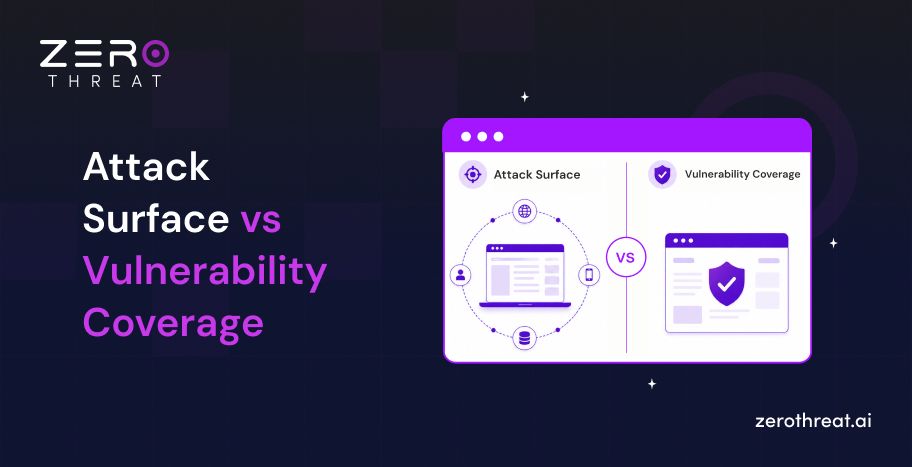
Quick Overview: This blog explains the fundamental difference between attack surface coverage and vulnerability coverage, why both are essential for effective application security, and how relying on only one creates security blind spots. It also explores how modern security platforms like ZeroThreat combine continuous asset discovery with deep vulnerability assessment to provide comprehensive, real-world risk coverage across web applications and APIs.
Picture the attacker who breached your last competitor. They did not start with a vulnerability. They started with a list: every subdomain, forgotten staging server, exposed API, and login page that answered when they knocked. Only after mapping everything reachable did they test where each door was weak. Reach came first. Exploitation came second.
Most security programs invert that order. They test the applications they already know about, deeply and repeatedly, while the assets nobody documented sit untested at the edge. A vulnerability scanner can help identify weaknesses across known assets, but it cannot protect what the security team has not discovered. That gap has two names that get used interchangeably and should not be: attack surface coverage and vulnerability coverage.
One measures how much of your reachable footprint you actually see. The other measures how thoroughly you test the footprint you do see. A program can score high on one and dangerously low on the other, and the difference between them is where breaches live.
This article breaks down what each type of coverage means and why it matters, the blind spots created when you have one without the other, and the practices that close both at once, so you can answer the question that matters: are we testing everything an attacker can reach, and deeply enough to know what they can exploit?
Your security is only as complete as your coverage. Find what's missing for free. Get Started Free
On This Page
- What is Attack Surface Coverage?
- What is Vulnerability Coverage?
- Key Differences: A Side-By-Side Comparison
- Attack Surface Coverage Without Vulnerability Coverage
- Vulnerability Coverage Without Full Attack Surface Coverage
- How Modern AppSec Combines Both?
- How ZeroThreat Delivers Complete Coverage?
- The Bottom Line
What is Attack Surface Coverage?
Attack surface coverage is the measure of how much of your organization's reachable, internet-facing footprint you have discovered, mapped, and put under continuous monitoring. It answers a single question an attacker asks first: what can I even reach? The wider your coverage, the smaller the pool of assets that exist without your knowledge.
An attacker does not need your architecture diagram. They enumerate what responds from the outside, and every asset that answers is a candidate. Attack surface coverage is your attempt to build that same map before they do, and to keep it current as your footprint changes.
What it includes
A full external attack surface runs from the network layer all the way up to application behavior. Comprehensive coverage spans the whole funnel:
- Network and Perimeter: Open ports, exposed services, SSL and TLS configuration, DNS records, and mail infrastructure.
- Domains and Hosts: Subdomains, staging and development environments, forgotten hosts, and assets from acquisitions or spun-up cloud projects.
- Applications: Public-facing web apps, single-page applications, admin panels, and login portals.
- APIs: Documented endpoints plus shadow APIs, deprecated zombie endpoints, and undocumented internal services exposed by mistake.
- Authentication and Workflows: the reachable paths behind login, where the highest-value functionality usually lives.
Why it matters
You cannot secure what you cannot see. Unknown assets are not tested, not patched, and not monitored, which makes them the softest possible target. The scale of the problem is well documented: audits routinely find that roughly a third of an organization's API footprint is shadow or zombie endpoints, and only a small minority of teams are confident their inventory is complete. Every asset outside that inventory is exposure you are carrying without pricing in.
What is Vulnerability Coverage?
Vulnerability coverage is the measure of how thoroughly you test each known asset for exploitable weaknesses, across the range of vulnerability classes an attacker could use against it. Where attack surface coverage asks what you can reach, vulnerability coverage asks a deeper question about each reachable thing: where is it weak, and can that weakness actually be exploited?
This is the assessment layer. Discovery tells you that a login page exists. Vulnerability coverage tells you whether that login page is susceptible to credential stuffing, broken authentication, or an authorization flaw that lets one user reach another user's data.
What it includes
Strong vulnerability coverage spans the full spectrum of weakness types, not just the low-hanging fruit that generic scanners catch:
- Injection and Input Flaws: SQL injection (CWE-89), cross-site scripting (CWE-79), SSRF, XXE, and command injection.
- Access Control: Broken object level authorization (BOLA), broken function level authorization (BFLA), IDOR, and privilege escalation (CWE-284).
- Authentication and Session: Broken authentication, weak session handling, and token or credential weaknesses.
- Business Logic: Workflow abuse, price manipulation, and race conditions that never appear in a CVE database.
- Framework Alignment: mapping findings to OWASP Top 10, OWASP API Security Top 10, and the CWE and SANS Top 25 taxonomies.
Why it matters
Depth is where risk becomes real. A discovered asset with an unexploited weakness is a theoretical problem. A validated, exploitable path is an incident waiting to happen, and attackers are moving faster than ever to find them. Coverage that stops at detection, without confirming exploitability, leaves teams drowning in findings while the genuinely dangerous ones hide in the noise.
Modern attacks span assets, APIs, and workflows. See AI uncover what traditional scanners overlook. Discover AI Pentesting
Key Differences: Attack Surface Coverage Vs Vulnerability Coverage
The core difference between attack surface coverage and vulnerability coverage is that one measures breadth of discovery while the other measures depth of assessment. Attack surface coverage is horizontal, mapping everything reachable. Vulnerability coverage is vertical, drilling into how exploitable each reachable thing is.
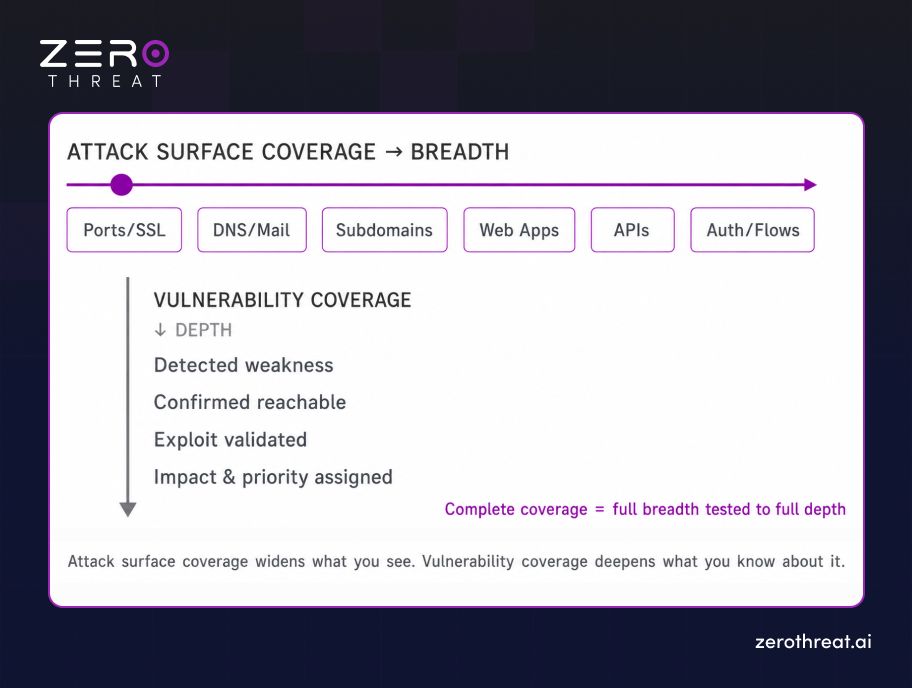
| Dimension | Attack Surface Coverage | Vulnerability Coverage |
|---|---|---|
| Purpose | Find everything an attacker can reach | Find how each reachable asset can be broken |
| Scope | Horizontal: the full external footprint | Vertical: weakness classes within each asset |
| Discovery vs assessment | Discovery. Maps what exists | Assessment. Tests what was found |
| Question answered | "What do we expose?" | "What is exploitable, and how badly?" |
| Typical tooling | EASM, asset discovery, subdomain and API enumeration | DAST, pentesting, exploit validation engines |
| Business outcome | No unknown assets carrying silent risk | Validated, prioritized risk you can act on |
| Common blind spot | Assets found but never tested | Deep testing of an incomplete asset list |
Attack Surface Coverage Without Vulnerability Coverage Leaves You Exposed
Attack surface coverage without vulnerability coverage means you have mapped your exposure but never confirmed which parts of it are exploitable, leaving discovered assets to sit at untested risk. A complete inventory feels like progress, but an inventory is not an assessment. Knowing an asset exists tells you nothing about whether an attacker can walk through it.
This is the trap of discovery-only programs. External attack surface management tools are excellent at enumeration, and they will hand you a long, accurate list of everything you expose. Then the list just sits there. The failure modes are consistent:
- Assets discovered but never assessed. A newly found subdomain gets added to a dashboard and never gets tested for the injection flaw or broken access control it actually carries.
- Unknown exploitable weaknesses. You know the endpoint is there. You do not know it exposes another customer's records through a BOLA flaw, because nothing probed it.
- No risk validation. Without exploit confirmation, every discovered asset looks equally benign, so nothing gets prioritized, and the genuinely dangerous exposure blends in.
Discovery answers "what do we have?" It never answers, "which of these will get us breached?" That second question is the whole point, and it requires depth that discovery alone cannot provide.
Vulnerability Coverage Without Full Attack Surface Coverage Creates Blind Spots
Vulnerability coverage without complete attack surface coverage means you are testing a fraction of your real footprint deeply while the assets you never discovered stay completely untested. The testing quality is high, but it is aimed at the wrong denominator. Perfect assessment of 60 percent of your footprint still leaves 40 percent as pure blind spot.
This is the more common and more dangerous imbalance, because it feels responsible. The team runs deep, authenticated scans on the known applications and the reports look thorough. Meanwhile the attacker is testing the assets that never made it onto the list:
What stays invisible
- Hidden APIs deployed without documentation or security review
- Shadow assets from acquisitions, contractors, or spun-up cloud projects
- Unmapped application routes that never surfaced in the crawl
- Forgotten environments like staging and dev servers left publicly reachable
Why it happens
- Scans are pointed at a manually maintained target list that drifts out of date
- New endpoints ship faster than inventory updates
- Discovery is a one-time project instead of a continuous feed
- APIs behind authentication are never enumerated in the first place
The uncomfortable truth is that the depth of your vulnerability coverage is capped by the breadth of your attack surface coverage. You can only assess what you have found, and if discovery is stale or incomplete, your best testing is running against yesterday's map.
Comprehensive coverage shouldn't be out of reach. Compare plans built for modern AppSec teams. Compare Plans
How Modern Application Security Combines Both for Complete Coverage?
Modern application security achieves complete coverage by wiring continuous asset discovery directly into continuous, exploit-validated testing, so every asset that appears is found and then assessed to depth automatically. The two coverage types of stops being separate projects owned by separate tools and become one continuous loop: discover, test, validate, prioritize, repeat.
The practices that make this work reinforce each other. Each one widens breadth or deepens assessment, and together they close the gap between what you expose and what you understand:
- Continuous Asset Discovery: Ongoing enumeration of the full external footprint, from ports, SSL, DNS, and mail up through apps, APIs, and authentication, so new and forgotten assets surface as they appear rather than at audit time.
- Deep Crawling: Thorough exploration of modern applications, including single-page apps and dynamic routes, so the map reflects real application structure instead of just the landing page.
- API Discovery: Active enumeration of documented, shadow, and zombie endpoints, including the ones that only exist behind authentication.
- Authenticated Testing: Testing the functionality behind login, where the highest-value logic and the highest-impact flaws usually live.
- Real-user Workflow Testing: Exercising complex multi-step journeys the way an actual user would, with no scripts required, to reach the business logic that simple scanners walk past.
- Attack Chain Analysis: Correlating individual findings into the multi-step paths an attacker would actually string together, so a low-severity issue plus a misconfiguration is seen as the critical chain it forms.
- Continuous Reassessment: Rescanning as the surface changes, because a footprint that shifts weekly cannot be secured by a quarterly test.
The shift is from two point-in-time snapshots to one living system. Discovery keeps the target list honest. Testing keeps the risk picture real. Reassessment keeps both current as the application changes underneath them.
How ZeroThreat Delivers Complete Security Coverage?
Instead of forcing teams to bolt a discovery tool onto a separate scanner and hope the two stay in sync, ZeroThreat runs discovery and assessment as one loop, the way an attacker approaches a target.
That combined approach shows up across the platform:
- Automated Asset Discovery: Full-funnel external attack surface coverage, from ports, SSL, DNS, and mail infrastructure through applications, APIs, authentication, and workflows, so the target list reflects your real footprint.
- Deep Application Coverage: Crawling of modern web applications and complex routes so testing reaches the real structure of the app, not just its public shell.
- Real-user Workflow Testing: Complex multi-step journeys exercised the way a genuine user would, with no scripts required, to reach the business logic that generic scanners miss.
- API Security Testing: Discovery and assessment of documented, shadow, and zombie APIs, including endpoints exposed only behind authentication.
- Exploit Validation: Proof-based findings that confirm real exploitability, driving toward zero false positives, so your team acts on risk that is actually real.
- Attack Chain Detection: Correlation of individual findings into the critical, multi-step paths an attacker would chain together, prioritized by business impact rather than raw severity.
Find out what your current security testing isn't seeing. We'll show you. Talk to an Expert
The Bottom Line
Attack surface coverage and vulnerability coverage are not competing priorities or interchangeable terms. They are two halves of the same defensive posture. One keeps your map of exposure honest. The other keeps your understanding of that exposure real. Score high on only one, and you have built a program that is confident about exactly the wrong things, with a gap in the shape of everything you never tested or never found.
Attackers exploit the seam between the two, and that seam is widening: exploitation is now the leading way breaches begin, attack surfaces change weekly, and AI is collapsing the time between an exposed weakness and a working exploit. Closing the gap manually across an attack surface that never stops changing is no longer realistic.
That is the problem ZeroThreat’s AI pentesting platform is built to solve. By running continuous asset discovery and application-aware, exploit-validated testing as one platform, it gives you full breadth and full depth without the seams where risk usually hides, with proof-based findings and business-aware prioritization your team can act on immediately. Sign up for ZeroThreat and see your complete attack surface, tested to depth, in one place.
Frequently Asked Questions
Is attack surface coverage the same as attack surface management?
Attack surface management (ASM) is the practice and tooling used to achieve attack surface coverage. Coverage is the outcome; the actual percentage of your footprint you discover and monitor. ASM is how you get there. Most ASM tools focus on discovery and stop short of deep vulnerability assessment.
Can you have good vulnerability coverage without full attack surface coverage?
Why do shadow APIs matter for coverage?
How does exploit validation improve vulnerability coverage?
What tools are used for each type of coverage?

Explore ZeroThreat
Automate security testing, save time, and avoid the pitfalls of manual work with ZeroThreat.