 ZeroThreat Wins Bronze Stevie® Award in Tech Startup of the Year Read more

All Blogs
AI Vulnerability Scanner vs Traditional Vulnerability Scanner: Which One Finds Exploitable Risk?
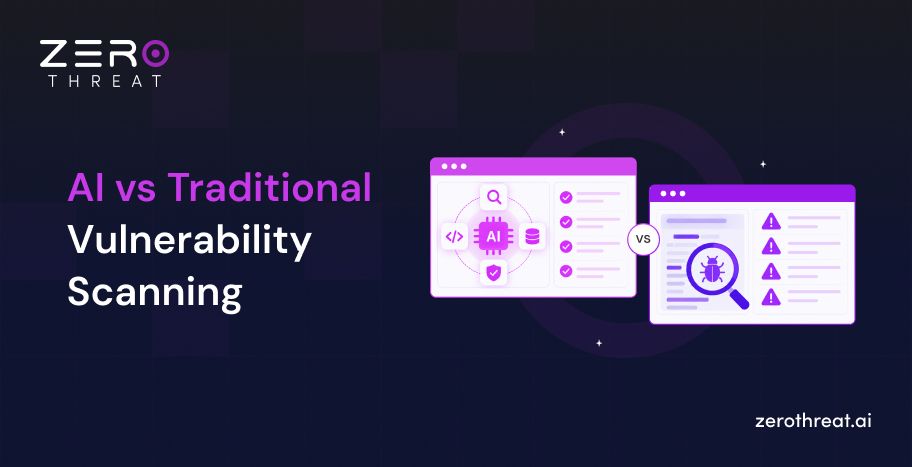
Quick Overview: Vulnerability scanning is evolving from simply finding weaknesses to identifying which vulnerabilities are actually exploitable and impactful. This blog compares AI and traditional vulnerability scanners, covering their detection methods, limitations, exploit validation, application behavior analysis, and multi-step attack paths to explain what actually finds exploitable risk.
Scan the same application with two scanners. One scanner returns with 340 findings. The other comes with 12. The second one is frequently more useful, and understanding why the difference is between managing a backlog and reducing risk.
Vulnerability scanning has always carried out a measurement problem. Vulnerability scanners report what they can observe, and what they can observe is the presence of a pattern: a version string, a response signature, a reflected parameter. Presence is not exploitability. A finding that cannot be reached, cannot be triggered without credentials nobody holds, or cannot produce impact once triggered still occupies the same row in a report as one that hands an attacker in your customer database.
That gap has consequences. Attackers are not working from finding counts. They are working from paths.
The two approaches resolve into two different loops:
- Traditional: Match → Flag → Report
- Agentic: Discover → Understand → Test → Validate → Chain → Prove
This comparison breaks down both, technically: how signature-based detection works in a legacy vulnerability scanner and what it structurally cannot see, how reasoning-driven engines traverse authenticated and stateful applications, what separates a detected vulnerability from a validated one, and where each approach is genuinely the right tool. The honest answer is not that one replaces the other.
Your scanner found vulnerabilities. Now find the exploitable ones it missed. Find What You Miss
On This Page
- Difference Between AI Vulnerability Scanner vs Traditional Vulnerability Scanner
- How Do Traditional Vulnerability Scanners Detect Vulnerabilities?
- Where Do Traditional Scanners Miss Exploitable Risk?
- How Do AI Vulnerability Scanners Analyze Application Behavior?
- Vulnerability Detection vs Exploitability Validation
- How AI Discovers Multi-Step Attack Paths?
- AI vs Traditional Vulnerability Scanners: Technical Comparison
- Where Each Approach is Actually Correct?
- What Actually Finds Exploitable Risk?
- See the Difference on Your Own Application
AI Vulnerability Scanner vs Traditional Vulnerability Scanner: What Is the Difference?
Traditional vulnerability scanners report a vulnerability when a known pattern matches, while AI vulnerability scanners report a vulnerability when the engine has reasoned about application context and confirmed the condition is actually exploitable.
A traditional vulnerability scanner is a deterministic detection system. It carries a corpus of signatures, version fingerprints, and fixed payloads, applies against reachable surface, and matches responses. Its output is a list of conditions that resemble known vulnerabilities.
An AI-powered vulnerability scanner is a reasoning and validation system. It builds a working model of the application's routes, roles, parameters, and state transitions, derives test cases from that model, attempts to trigger the condition safely, and reports only what it can demonstrate. Its output is a list of conditions it has confirmed.
Everything below follows from that single distinction: pattern presence versus proven behavior.
How Do Traditional Vulnerability Scanners Detect Vulnerabilities?
Traditional vulnerability scanners detect vulnerabilities by matching observed application responses against known signatures, version fingerprints, and fixed payload libraries, then assigning severity from a static scoring model rather than from confirmed impact.
CVE and CPE version matching
The scanner fingerprints a component, resolves it to a CPE identifier, and looks up associated CVEs. This is inference by inventory, and it is the layer that conventional vulnerability scanning rarely moves beyond. It never establishes that the vulnerable code path is reachable in your deployment, that the affected feature is enabled, or that a compensating control sits in front of it. A patched backport that leaves the version banner unchanged produces a false positive; a vulnerable component behind an unreachable route produces a true positive that carries no risk.
Signature and rule-based testing
Detection rules encode a request pattern and an expected response condition. Send a payload, look for a marker in the response body, a timing delta, an error string, or a status code change. This works well for classes where the signal is unambiguous: reflected XSS with a distinctive marker, error-based SQL injection, known misconfigurations.
Fixed payload libraries and response matching
Payloads come from a curated list. They are not derived from the application under test. A parameter that expects a base64-encoded JSON blob, a signed token, or a nested GraphQL variable will typically reject a generic payload before it ever reaches the vulnerable logic, and the scanner records a negative.
Configuration and exposure checks
TLS configuration, exposed ports, security headers, directory listing, default credentials, and known sensitive paths. These are genuinely valuable, deterministic, and repeatable. They are also the part of the surface that has the least to do with application-specific logic.
Why these methods produce potential rather than proven risk
Each method stops at the point of recognition. None of them carry the finding forward to ask whether the condition can actually be exercised by an attacker with realistic access, or what happens if it is. Severity is then assigned from a base score computed for the vulnerability class in the abstract, not for your instance of it. The result is a report that is accurate about what it saw and silent about what it means.
Go beyond CVEs and signatures with AI-powered analysis built around real application risk. Discover AI Scanning
Where Do Traditional Scanners Miss Exploitable Risk?
Traditional scanners miss exploitable risk wherever the vulnerability depends on application context rather than a detectable pattern, which covers broken object and function level authorization, business logic abuse, state dependent routes, and undocumented API surface.
Broken object and function level authorization
IDOR, BOLA, BFLA, and horizontal or vertical privilege escalation share one property: the request is syntactically valid and the response is a normal 200. There is no signature. GET /api/v2/invoices/8842 returns an invoice whether or not it belongs to you. Detecting the flaw requires holding at least two authenticated identities, knowing which objects legitimately belong to which, and comparing responses across that boundary. A single-session scanner has no way to form the comparison. OWASP ranks broken object level authorization first in the API Security Top 10, and it remains among the least reliably automated classes.
Business logic and workflow sequence abuse
Applying a single-use discount code repeatedly by racing concurrent requests. Skipping the payment step by advancing directly to the confirmation endpoint. Submitting a negative quantity that inverts a balance calculation. Each of these is a legal request sequence that produces an illegitimate outcome. There is nothing malformed to match against, and vulnerability exists only in the relationship between steps.
Crawler and state blind spots
Client-rendered routes that never appear in HTML source. Views that only exist after a specific state of transition, such as an order that must be created before it can be modified. Sessions that expire mid-scan and silently downgrade the remaining coverage to unauthenticated. Multi-factor and step-up authentication that halts the crawl entirely. Surface that is never reached is never tested, and most scan reports do not distinguish between tested-and-clean and never-reached.
API surface gaps
Scanners driven by an OpenAPI specification test what the specification declares. Real APIs accept undocumented parameters, expose deprecated versions that were never removed, and include mass-assignment surface where an extra field in a request body is silently bound to a privileged attribute. Testing role as an unexpected field in a profile update request is an application-specific hypothesis, not a library entry, and reaching it requires API security testing that discovers surface rather than trusting a declared inventory of it.
Risk-based prioritization vs CVSS-based prioritization
CVSS base scores describe a vulnerability class under assumed conditions. They do not describe reachability in your application. Two identical CVSS 9.8 findings can differ completely in real risk when one sits behind authentication that no external party holds, and the other is exposed at the edge. EPSS improves this materially by modeling exploitation probability in the wild, but it scores the vulnerability, not your instance of it. Neither model answers whether the path is reachable in your deployment.
How AI-powered Vulnerability Scanners Analyze Application Behavior?
AI-driven vulnerability scanners analyze application behavior by navigating the application as a user would, building a model of its routes, roles, parameters, and state transitions, then deriving test cases from that observed behavior instead of from a fixed payload list.
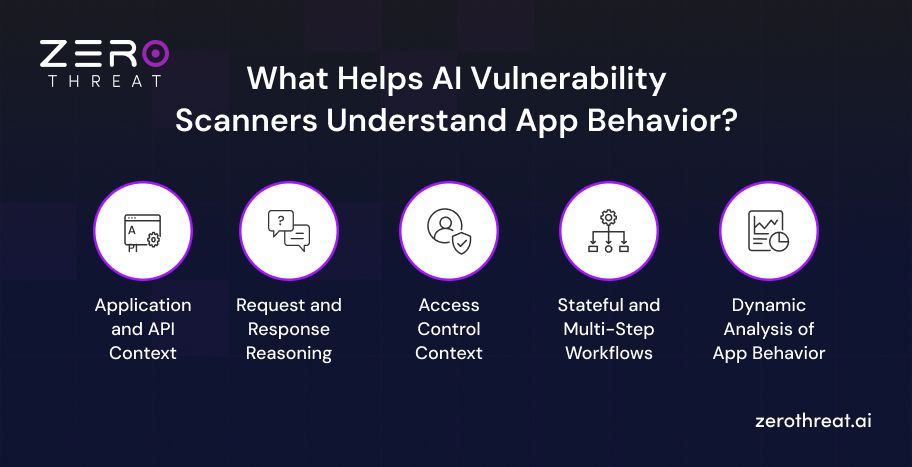
Application and API context
Before testing, the engine establishes what the application is. Which endpoints exist, which parameters they accept, what data types and formats they expect, which responses indicate success versus rejection, and how endpoints relate to one another. An endpoint that returns a list of identifiers and another that accepts one of those identifiers to form a relationship, and that relationship is testable.
Request and response reasoning
Payloads are constructed against the observed contract. If a parameter accepts a signed JWT, the engine reasons about claim manipulation rather than firing a SQL injection string at it. If a field accepts a nested object, it tests unexpected keys within that object. Response interpretation is equally contextual: distinguishing a generic error from a validation rejection from a partially successful operation that leaked state.
Access control context
The engine operates across multiple identities and role levels simultaneously and maintains a model of which resources belong to which principal. That model is what makes access control testing possible at all, because the flaw is defined by the boundary rather than by the request. Session validity is monitored and re-established rather than assumed, so coverage does not silently degrade.
Stateful and multi-step workflows
Reaching a vulnerable state often requires performing the preceding steps: register, verify, add an item, initiate checkout, then test the modification endpoint that only exists at that point. Agentic AI pentesting performs those sequences by traversing the interface by reasoning about the interface, without a pre-written script for each flow. This matters most in exactly the applications where traditional coverage is weakest.
Dynamic analysis of app behavior
Some conditions only appear under sequence or concurrency: a race window between validation and commit, a state machine that permits a backward transition, a rate limit applied per session rather than per account. These require varying the order and timing of otherwise ordinary requests, which is a behavioral experiment rather than a pattern match.
Vulnerability Detection vs Exploitability Validation
Vulnerability detection establishes that a weakness may exist, while exploitability validation establishes that the weakness can actually be reached and triggered under real conditions to produce a demonstrable effect.
Existence versus exploitable conditions
A vulnerable library is present. Is the vulnerable function called? Is the calling path reachable from an external entry point? Does reaching it require a role that no attacker can obtain? Detection answers the first question. Validation answers the rest, and the rest is where the risk lives. The same split separates API vulnerability scanning from API penetration testing: one enumerates conditions, the other proves what can be done with them.
Reachability and attack prerequisites
Every exploit has preconditions: a network position, a privilege level, a specific application state, a configuration flag. Validation makes those explicit. A finding that requires administrative access to exploit is a real finding with a very different priority than one exploitable by an unauthenticated visitor, and a scoring model applied without that context cannot separate them.
Safe exploit validation
Validation must confirm the impact without causing it. That means retrieving a single record rather than a table, demonstrating write capability against a benign attribute rather than a production value, confirming command execution through a non-destructive signal, and stopping at proof rather than continuing to consequence. Production safety is a design constraint on the validation step, not an afterthought.
Evidence and proof of impact
A validated finding carries the request sequence, the parameters involved, the response evidence, the identity and state under which it succeeded, and the concrete effect achieved. That artifact is what makes a finding actionable for a developer and defensible in an audit, and it is what turns a disagreement about severity into a reproducible test. It is also what allows remediation reporting to carry fixed guidance tied to a specific confirmed path rather than to a vulnerability class in general.
Why validation reduces false positives structurally
Most false positive reduction is threshold tuning: suppress low-confidence rules, accept the coverage loss, and hope the suppression was correct. Validation removes the problem at a different layer. If the condition cannot be triggered, it is not reported, so the false positive never enters the queue. This is why exploitability validation changes the shape of a report rather than just its length, and why 0 false positives is an architectural claim rather than a tuning result.
Don't spend more on findings that still leave your biggest attack paths undiscovered. Compare Plans
How AI Discovers Multi-Step Attack Paths?
AI vulnerability scanners discover multi step attack paths by treating validated findings as connected states rather than isolated entries, following attacker controlled data across privilege boundaries until a sequence reaches sensitive functionality or data.
A traditional report is a flat list. Each row is scored independently, and three low-severity rows get triaged as three low-severity items. Attackers do not read reports that way. They read them as a graph, looking for the sequence where each step supplies the precondition for the next.
Chain construction requires four things the flat model does not provide: a record of what each finding grants an attacker, a map of privilege boundaries, the ability to follow attacker-controlled data across requests, and a definition of what constitutes a sensitive destination.
Worked example: three low findings, one critical path
Consider a scan that produces the following individually unremarkable results.
[Low] Verbose Error Disclosure: A malformed request to /api/v2/reports/export returns a stack trace exposing an internal service path and the naming convention for report identifiers. Scored low on its own: information disclosure with no direct impact.
[Low] Predictable Resource Identifiers: Report identifiers follow a sequential pattern derived from the naming convention above. Scored low on its own: predictable identifiers are only a finding if something can be reached with them.
[Medium] Missing Object Level Authorization on a Secondary Endpoint: The primary export endpoint validates ownership correctly. A secondary status endpoint, /api/v2/reports/{id}/status, returns metadata including the report title and the requesting account identifier without an ownership check. Scored medium on its own: metadata exposure, no document contents.
[Critical] The Chain: The disclosure supplies the identifier format. The format makes enumeration cheap. The unprotected status endpoint confirms which identifiers are valid and which accounts they belong to, turning enumeration into a targeted map of every report in the tenant, including titles that themselves contain sensitive context. From there, the attacker enumerates the tenant's reporting surface as an unauthenticated party. No single finding is critical. The sequence is.
Nothing in this path requires a novel exploit technique. It requires only that the three findings be considered together, which is precisely what independent scoring prevents. This is also why finding counts are a poor proxy for coverage: a scanner that reported all three items and ranked them 34th, 51st, and 12th technically detected the entire chain and communicated none of it.
AI vs Traditional Vulnerability Scanners: Technical Comparison
AI and traditional vulnerability scanners diverge across eight technical dimensions, and the decisive ones are exploit validation, attack chain discovery, and evidence generation, because those determine whether a report describes potential risk or proven risk.
| Dimension | Traditional scanner | AI vulnerability scanner |
|---|---|---|
| Detection method | Signature, version fingerprint, and fixed payload matching | Context-derived test cases built from observed application behavior |
| Context awareness | None. Findings evaluated in isolation against a rule corpus | Models routes, roles, parameters, and state relationships before testing |
| Authenticated and stateful testing | Single session, degrades silently on expiry, limited multi-step reach | Multiple concurrent identities, session maintenance, sequence traversal |
| API testing | Bounded by the supplied specification | Tests undocumented parameters, deprecated versions, mass assignment surface |
| Business logic testing | Not addressable. No signature exists for a legal request sequence | Tests workflow order, state transitions, and concurrency conditions |
| Exploit validation and false positives | Reports on match. False positives managed by threshold tuning | Reports only on safe confirmation. Unconfirmed conditions never enter the queue |
| Attack chain discovery | Flat list, findings scored independently | Findings linked into reachable paths and scored by chain outcome |
| Evidence generated | Rule identifier, matched response, CVSS base score | Request sequence, identity and state, response evidence, demonstrated impact |
Where Each Approach is Actually Correct?
Traditional vulnerability assessment platforms are the correct tool for deterministic, inventory driven problems such as host and dependency CVE coverage, while reasoning driven engines are the correct tool for application specific, context dependent risk that has no signature.
Moving beyond CVE detection does not mean discarding it. Signature-based scanning is not a legacy technology waiting to be replaced. For known-CVE coverage across hosts, containers, and operating system packages, an inventory-and-lookup model is the right architecture, because the question genuinely is whether a known vulnerable version is present. The same holds for software composition analysis, and for the deterministic checks that make good regression baselines: TLS configuration, security headers, exposed services. Determinism is a feature there. The same input produces the same output every time, which is what you want when comparing build to build and when an auditor asks for a repeatable control.
Reasoning-driven engines carry a corresponding cost that deserves naming. Non-deterministic exploration can vary between runs, and a reasoning step can misinterpret application behavior or pursue an unproductive hypothesis. Two things constrain this in practice. Validation gating means a reasoning error produces a missed finding rather than a fabricated one, since nothing is reported without demonstration, and a false negative is a coverage problem rather than a trust problem. And validated findings are reproducible by construction, because the evidence artifact contains the exact sequence required to trigger the condition again.
The practical arrangement in most mature programs is both, scoped to what each is actually good at: deterministic scanning for inventory, configuration, and dependency breadth, and reasoning-driven testing for the application-specific logic where the real exploitable risk concentrates.
What Actually Finds Exploitable Risk?
Exploitable risk is found by combining deterministic detection of breadth with contextual reasoning and a validation step that gates reporting, because neither pattern matching nor reasoning alone can prove that a weakness is reachable and impactful.
The question in the title has a narrower answer than the debate usually allows. It is not the scanner that finds the most. It is the one that can demonstrate that what it found can be used.
That reframes what a vulnerability report should be, and it reframes what risk visibility means. A count of findings measures detection activity, not exposure. A severity distribution measures scoring policy, not reachability. The only measure that survives contact with an actual attacker is the set of paths that were proven traversable, ranked by what they reach. Real-world risk detection is a statement about paths, not about volume.
So, the standard worth holding a scanner to is not how many issues it surfaced or how few false positives it claims. It is whether each finding arrives with the sequence that triggered it, the conditions required to reach it, and the impact it produced. Anything short of that is a hypothesis, and hypotheses are not a security posture.
Don't assume your scanner has full coverage. See what deeper testing reveals. Book a Demo
See the Difference on Your Own Application
ZeroThreat tests web applications and APIs the way an attacker does: application-aware traversal of authenticated and multi-step workflows, exploit validation before anything is reported, attack chain discovery that links individually low-severity findings into proven critical paths, and business-impact prioritization. Security teams receive full attack path and impact. Application teams receive reproduction steps, endpoints, parameters, evidence, and remediation guidance. 99.9% detection accuracy, 130K+ attack patterns per scan, near 0 false positives.
Frequently Asked Questions
How do traditional vulnerability scanners detect vulnerabilities?
Traditional vulnerability scanners detect vulnerabilities by matching observed application responses against known signatures, version fingerprints, and fixed payload libraries, then assigning severity from a static scoring model rather than from confirmed impact.
Where do traditional scanners miss exploitable risk?
How do automated vulnerability scanners analyze application behavior?
How do AI-driven vulnerability scanners discover multi-step attack paths?


Explore ZeroThreat
Automate security testing, save time, and avoid the pitfalls of manual work with ZeroThreat.