 ZeroThreat Wins Bronze Stevie® Award in Tech Startup of the Year Read more

All Blogs
Why CVSS Scores Aren't Enough: Prioritizing Vulnerabilities by Business Impact
Quick Overview: CVSS measures severity, not risk, and that gap is where breaches happen. Only ~6% of the 48,000+ CVEs published in 2025 will ever be exploited, yet CVSS-only triage treats them all as urgent. This blog breaks down what CVSS actually measures, its six structural limitations, how it compares with EPSS, CISA KEV, and SSVC, and how to build a risk-based vulnerability management program with a prioritization matrix that ranks findings by validated exploitability and business impact.
Every security team knows the ritual. The scanner finishes, the dashboard lights up with a few thousand findings, and the queue gets sorted the same way it has been sorted for two decades: CVSS score, descending. Criticals first. Highs next. Everything else joins a vulnerability backlog that nobody honestly expects to clear.
The problem isn't the effort, it's the sorting key. The Common Vulnerability Scoring System was designed to characterize the technical properties of a vulnerability: how it can be reached, how complex it is to trigger, and what it could do to confidentiality, integrity, and availability in a worst-case scenario. It was never designed to answer the question security leaders actually need answered: "Which of these findings, in my environment, is most likely to cause a breach that hurts my business?"
The distance between those two questions is measurable. A record 48,185 CVEs were published in 2025, and NIST reports CVE submissions grew 263% between 2020 and 2025, so sharply that the NVD has stopped enriching most of them.
Meanwhile, only a single-digit percentage of those CVEs will ever be weaponized, and the ones that are often aren't the ones at the top of a severity-sorted queue. That mismatch is why CVSS limitations have moved from an academic debate to an operational crisis, and why risk-based vulnerability management (RBVM) has become the default recommendation from CISA, FIRST, and virtually every serious practitioner.
This article explains what a CVSS score actually measures, and what exploitation data reveals about severity-driven vulnerability triage. It also compares CVSS with EPSS, the CISA KEV catalog, and SSVC. Finally, you'll learn how to build a vulnerability prioritization framework based on exploitability and business impact, and how modern AI Pentesting helps security teams identify and prioritize exploitable risks beyond CVSS scores.
Don't let a severity score decide what gets fixed first. Start prioritizing vulnerabilities that actually threaten your business. Start Prioritizing Smarter
ON THIS PAGE
- What Does a CVSS Score Actually Measure?
- Does a High CVSS Score Mean High Risk?
- Six Structural CVSS Limitations That Break Prioritization
- CVSS vs EPSS vs CISA KEV vs SSVC: What Each Signal Actually Tells You
- What is Risk-Based Vulnerability Management?
- How Do You Calculate Business Impact for Vulnerability?
- Building a Vulnerability Prioritization Matrix
- From Scores to Attack Paths: Prioritizing the Way Attackers Operate
- How ZeroThreat Prioritizes Vulnerabilities by Business Impact
- Conclusion
What Does a CVSS Score Actually Measure?
CVSS, maintained by FIRST.org, produces a 0–10 score from a set of metric groups. In CVSS v3.1, the base score is built from eight metrics: Attack Vector, Attack Complexity, Privileges Required, User Interaction, Scope, and the impact triad of Confidentiality, Integrity, and Availability. CVSS v4.0 refines this model with a richer set of base metrics and supplemental attributes, but the core intent is unchanged: describe the intrinsic, context-free technical severity of a single flaw.
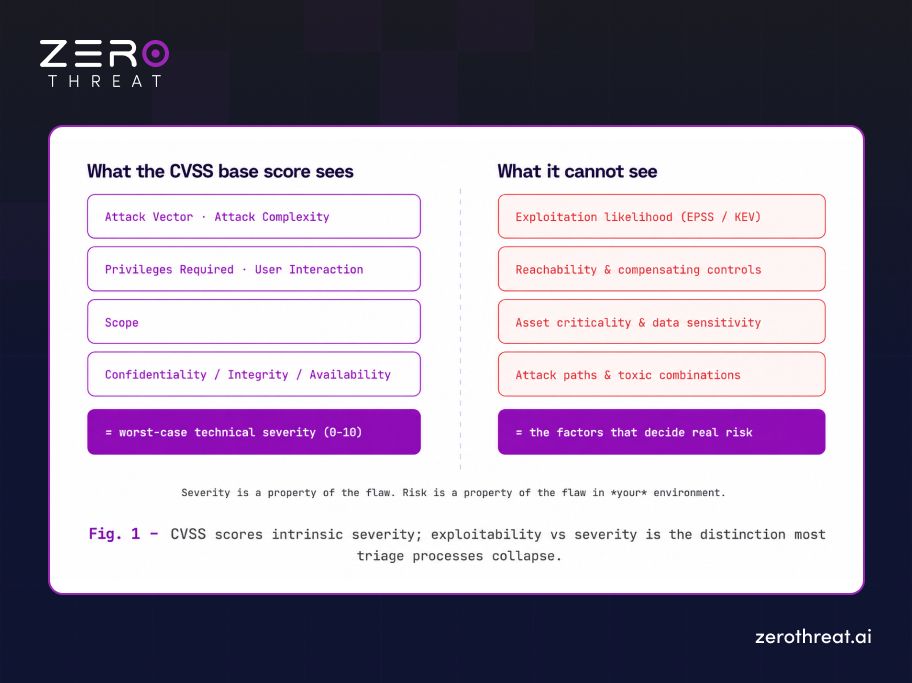
Read that carefully, because it defines the boundary of the tool. A base score tells you how bad a vulnerability could be for a hypothetical worst-positioned victim. It does not tell you:
- Whether anyone is exploiting it — or ever will. Exploitation likelihood lives outside the base score entirely.
- Whether it's reachable in your environment — a network-vector flaw behind three layers of segmentation, and a WAF is not the same exposure as one on your public login endpoint.
- What asset it sits on — the same CVE scores identically on a demo server and on the API that processes your payments.
- What an attacker gains next — CVSS scores flaw one at a time; attackers exploit them in sequences.
To be fair to the framework, FIRST has always acknowledged this. CVSS includes Temporal/Threat and Environmental metric groups precisely so consumers can adjust base scores with exploit maturity and asset context.
In practice, almost nobody does: the ecosystem like scanners, ticketing rules, compliance mandates, vulnerability remediation of SLA policies, consumes the raw base score, because it's the only value published at scale. So, the industry runs a number that its own maintainers describe as an input to prioritization, not a prioritization framework.
Does a High CVSS Score Mean High Risk?
If severity predicted risk, exploitation would cluster tightly around CVSS 9–10 and remediation-by-severity would work. The research says otherwise, from multiple independent directions.
- 6% of all published CVEs have ever been observed exploited in the wild. (FIRST / Cyentia EPSS research)
- 48,185 CVEs published in 2025, an all-time record. (CVE Explained Guide)
- 20% of breaches began with vulnerability exploitation, which is up 34% year over year. (Verizon 2025 DBIR)
- 45.4% of enterprise vulnerabilities remain unpatched 12 months after discovery. (Edgescan backlog analysis)
Exploitation is rare, and it doesn't track severity
The joint FIRST and Cyentia Institute research behind EPSS puts the base rate plainly: out of the entire published CVE corpus, only around 5–6% of vulnerabilities are ever exploited in the wild. Flip that number around and the CVSS-only strategy looks stark, which is roughly 94% of the findings a severity-sorted queue asks your team to treat urgently will never be used by an attacker. With finite engineering hours, every sprint spent patching a never-exploited CVSS 9.1 on an internal utility box is a sprint not spent on the flaw an attacker is actively probing.
Exploitation likelihood is instead driven by attacker economics: whether public exploit code exists, whether the target software is widely deployed and internet-facing, and whether exploitation is reliable. Cyentia's analysis found that a vulnerability's odds of in-the-wild exploitation jump from roughly 3.7% to 37.1% once a weaponized exploit is available, a tenfold swing that no base score captures, because base scores don't change when exploit code drops.
The scores themselves are noisier than they look
Even taken on their own terms, CVSS scores are less objective than dashboards imply. Analyses of dual-scored CVEs, where both a vendor CNA and NVD assigned a score, have documented divergence rates above 50% across the past decade, reaching 70% in 2023, with disagreements sometimes large enough to move a vulnerability across severity tiers.
When two expert bodies scoring the same flaw land in different severity bands, the majority of the time, a triage process that treats 7.0 as a hard SLA trigger and 6.9 as backlog is enforcing a precision the underlying data doesn't have.
And the supply of scores is shrinking. Facing a submission volume, it can no longer enrich, NIST announced in April 2026 that the NVD will now fully enrich only prioritized categories of CVEs, KEV-listed flaws, federal software, and critical software, after enriching a record 42,000 CVEs in 2025 and still falling behind. For the majority of new CVEs, the authoritative severity scores for many programs were built around simply won't arrive.
Meanwhile, attackers are getting faster
The Verizon Data Breach Investigations Report found exploitation of vulnerabilities was the initial access vector in 20% of breaches, a 34% year-over-year increase that puts it within two points of credential abuse, the long-time leader. The same report found organizations took a median of 32 days to patch targeted edge-device flaws, and fully remediated only about 54% of them within the year. Edgescan's 2026 dataset shows high and critical application/API vulnerabilities averaging 54.81 days to close, while newly disclosed flaws are weaponized within hours. Defenders sort by severity in weeks; attackers sort by opportunity in hours. That asymmetry, not any single flaw, is the risk.
Six Structural CVSS Limitations That Break Prioritization
None of the following are scoring bugs, but they're consequences of asking a severity metric to do a risk metric's job. Understanding them is what separates a vulnerability triage process that manages noise from one that manages risk.
No Exploitation Likelihood
The base score is identical for a flaw with a Metasploit module and a flaw with no public research. Since exploit availability shifts real-world exploitation odds by an order of magnitude, this is the single largest blind spot, the heart of the exploitability vs severity confusion.
No Asset Criticality
CVSS knows nothing about the asset behind the CVE. A CVSS 6.5 authorization flaw on the API that serves customer financial data is a business emergency; a CVSS 9.8 on a sandboxed internal tool may be a non-event. Without asset criticality scoring, both look like the wrong priority.
No Business Impact Model
Confidentiality/Integrity/Availability impact in CVSS is technical, not organizational. It cannot express "this endpoint exposes regulated PHI," "this workflow generates 60% of revenue," or "compromise here triggers PCI DSS breach-notification obligations." Prioritizing vulnerabilities by business impact requires data CVSS was never designed to carry.
Blind to Compensating Controls and Reachability
A WAF rule, network segmentation, mandatory MFA, or a feature flag can reduce a flaw's practical exploitability to near zero, and none of it changes the score. Teams that ignore compensating controls in vulnerability decisions over-patch what's already mitigated and under-invest where controls are absent.
Scores Flaws in Isolation, and Attackers Chain Them
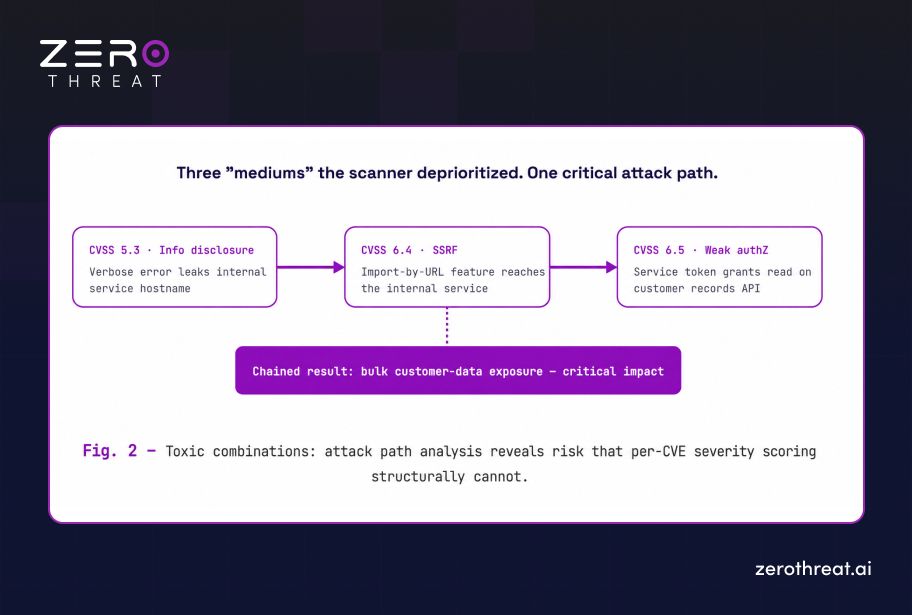
CVSS evaluates one CVE at a time. Real intrusions are built from attack path analysis in reverse: an information-disclosure "low" reveals an internal hostname, an SSRF "medium" reaches it, a misconfigured token "medium" escalates, three modest scores forming one critical breach. These toxic combinations are invisible to any per-finding severity model.
Static in a Dynamic Threat Landscape
A base score assigned at disclosure typically never changes, not when proof-of-concept code is published, not when a ransomware crew adopts the flaw, not when your architecture changes around it. Risk is a moving target; CVSS is a snapshot.
ZeroThreat POV
This chaining problem is why we built ZeroThreat's engine around attack paths rather than findings. When testing runs like an attacker, crawling authenticated workflows, probing each step, and carrying context forward, a low-severity information leak isn't a footnote; it's a potential first link. Our automated penetration testing engine correlates individually modest weaknesses into validated chains, so the finding that reaches customer data gets ranked by where the chain ends, not where the CVSS score of its first link begins.
CVSS measures severity. AI measures exploitability, application context, and business impact. See the difference. Explore AI Pentesting
CVSS vs EPSS vs CISA KEV vs SSVC: What Each Signal Actually Tells You
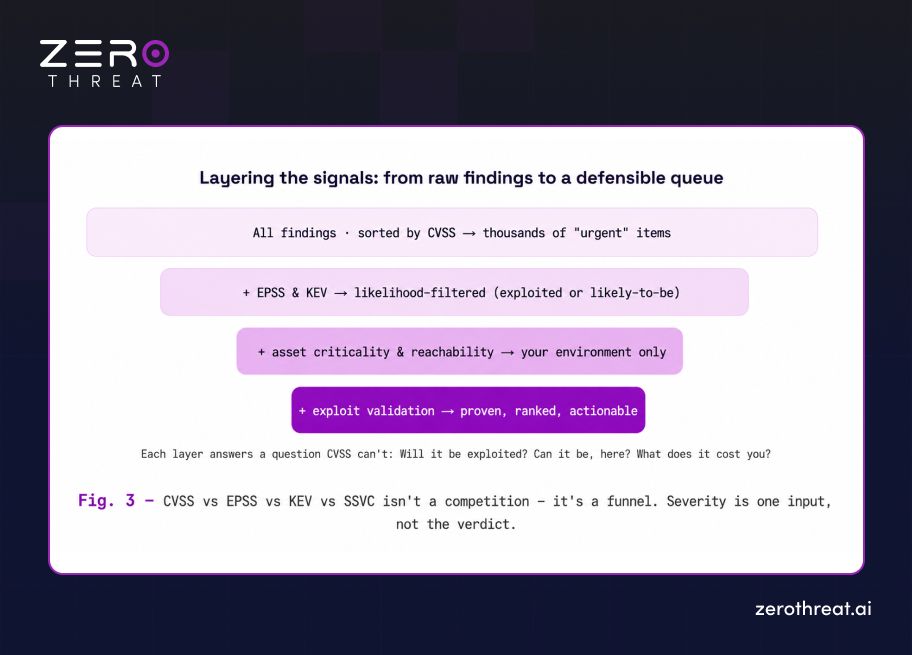
The industry's answer to CVSS limitations hasn't been a replacement, it's been a stack of complementary signals. The CVSS vs risk score debate is really a question of which signals you combine and in what order. Here's what each one measures, and where it breaks down on its own.
| Signal | What it measures | Output | Strength | Blind spot |
|---|---|---|---|---|
| CVSS | Intrinsic technical severity of a single flaw | 0–10 score + vector string | Universal, standardized, compliance-recognized | No likelihood, no context, static |
| EPSS | Probability of exploitation in the wild within 30 days | 0–100% probability, updated daily | Data-driven, dynamic, predictive | No asset context; global, not your environment; app-logic flaws without CVEs aren't scored |
| CISA KEV | Confirmed exploitation in the wild | Curated catalog (1,484 CVEs at end of 2025) | Highest-confidence "fix now" evidence; drives federal SLAs | Lagging and narrow, Cyentia found 94% of CVEs with exploitation signals aren't on the KEV |
| SSVC | Decision context: exploitation status, exposure, automatability, mission impact | Decision: Track / Track* / Attend / Act | Forces stakeholder-specific judgment; outputs an action, not a number | Requires accurate inputs about your own assets, garbage in, garbage out |
EPSS Score Meaning
The Exploit Prediction Scoring System is a machine-learning model maintained under FIRST that estimates, daily, the probability each CVE will be exploited in the next 30 days. Its calibration is unintuitive at first: because the base rate of exploitation is so low, an EPSS score of just 10% places a CVE around the 88th percentile of all scored vulnerabilities. Used with CVSS, likelihood × severity, EPSS collapses the "everything is critical" pile dramatically. Used instead of context, it inherits its own gap: EPSS predicts global exploitation activity, not whether the vulnerable asset in your stack is reachable or valuable.
CISA KEV Catalog: Evidence, Not Coverage
The CISA Known Exploited Vulnerabilities catalog is the cleanest "patch this first" signal available, every entry has confirmed in-the-wild exploitation, and U.S. federal agencies are bound to remediation deadlines for it. But it is deliberately conservative: 1,484 entries by the end of 2025 against a corpus of over a quarter-million CVEs. Treat the KEV as a mandatory floor for your vulnerability remediation of SLA, never as the ceiling of your exposure.
SSVC: From Scores to Decisions
SSVC, Stakeholder-Specific Vulnerability Categorization, developed by Carnegie Mellon's SEI and adopted by CISA, takes the opposite approach from scoring entirely. It walks a decision tree over questions like: Is this being exploited? Is exploitation automatable? What's the technical impact? What's the mission and well-being impact? The output isn't a number; it's a decision, Track, Track*, Attend, or Act. SSVC's key insight is the one CVSS-only programs miss: the same vulnerability legitimately deserves different responses from different organizations, because risk is stakeholder-specific by definition.
What is Risk-Based Vulnerability Management (RBVM)?
Risk-based vulnerability management is the discipline of ranking and remediating vulnerabilities by the actual risk they pose to your organization, a function of exploitation likelihood, reachability, asset criticality, and business impact, rather than by generic severity. Where a legacy program asks "how severe is this flaw?", an RBVM program asks "how likely is this flaw to be exploited here, and what would it cost us if it were?"
Structurally, a working RBVM program rests on five capabilities:
Continuous, Complete Discovery: You can't prioritize what you can't see. That means every web application, every API, including shadow and zombie endpoints, and every authenticated workflow, discovered continuously rather than annually. Continuous vulnerability scanning is the intake layer; point-in-time snapshots create point-in-time blind spots.
Validated Findings, Not Raw Alerts: Alert fatigue in vulnerability management is a prioritization killer: when a meaningful share of the queue is false positives, engineers rationally start ignoring the queue. Findings should be confirmed exploitable, or at minimum reachability-verified, before they consume triage time.
Threat-Informed Likelihood: EPSS scores, KEV membership, exploit-code availability, and observed attacker behavior feed the "will this be exploited?" dimension, updated continuously rather than frozen at disclosure.
Asset Criticality Scoring: Every asset gets a tier based on the data it handles, the workflows it powers, its exposure, and its compliance scope. A practical model uses 3–4 tiers, e.g., Tier 1: revenue/regulated data, Tier 2: customer-facing, Tier 3: internal, Tier 4: dev/test, and maps every finding to a tier automatically.
Risk-aligned SLAs and Vulnerability Backlog Management: Remediation SLAs keyed to risk (e.g., validated + Tier 1 = 48 hours; KEV-listed + exposed = 7 days) instead of raw severity, plus a deliberate policy for the long tail: accept, mitigate with compensating controls, or schedule, explicitly, with an owner, instead of letting 45% of findings silently age past a year.
How Do You Calculate Business Impact for Vulnerability?
Business impact is where most RBVM implementations get vague, so make it concrete. For each validated finding, score:
- Data Sensitivity: What data does the vulnerable function actually expose? PII, PHI, payment data, credentials, and secrets each carry regulatory and breach-cost weight. IBM's research puts the global average cost of a data breach at $4.44 million in 2025. and per-record costs scale with data class.
- Workflow Criticality: Does exploitation disrupt checkout, authentication, payouts, or another revenue-bearing or safety-bearing flow?
- Blast Radius: What does the attacker hold after exploitation? A foothold, a token, lateral reach, tenant-wide access?
- Compliance Exposure: Does the affected scope fall under PCI DSS, HIPAA, GDPR, or ISO 27001 obligations, with notification of duties and audit consequences?
- Recovery Cost: Incident response, downtime, customer remediation, and rebuild effort if this path is exercised.
Multiply that impact dimension by validated exploitability and you have a defensible answer to "how do you prioritize vulnerabilities with limited resources?". The two-axis model in the next section turns into a working matrix.
Every hour spent fixing low-priority vulnerabilities delays remediation of the ones that truly matter. Compare Plans
Building a Vulnerability Prioritization Matrix
A vulnerability prioritization matrix plots every finding on two axes, validated exploitability (is it proven or likely exploitable, here?) and business impact (what does successful exploitation cost?). It's simple enough to explain to a CFO and rigorous enough to run a remediation program on. The quadrants translate directly into action and SLA:
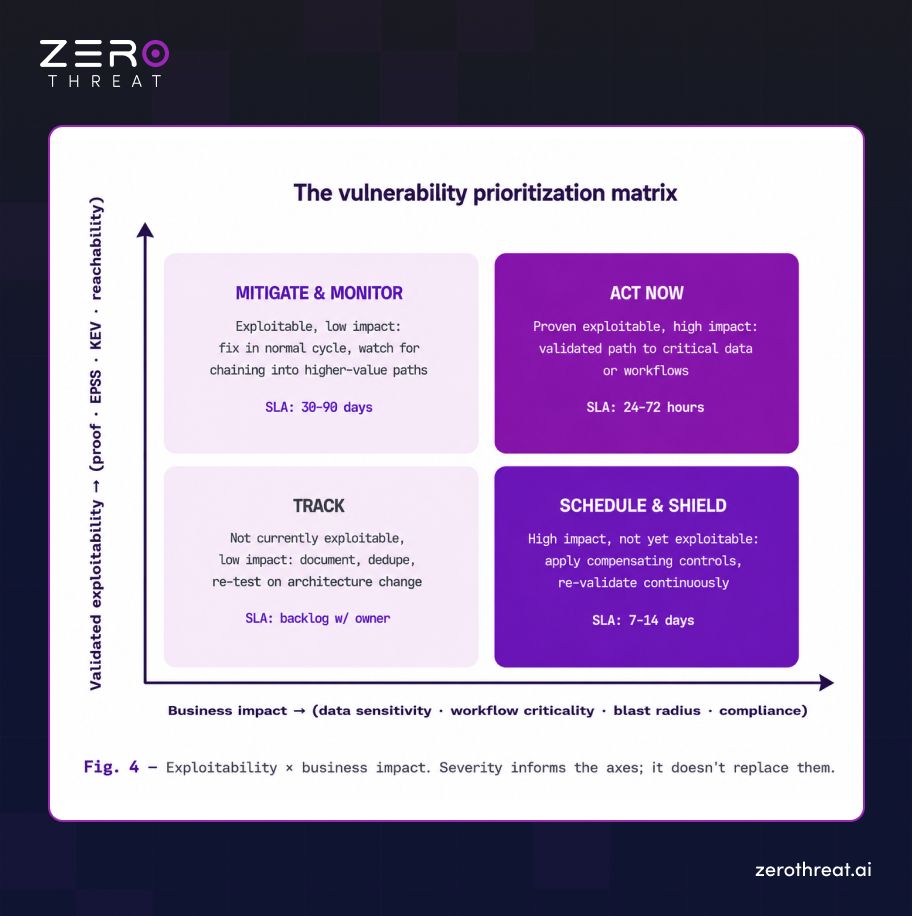
Three operating rules make the matrix work in practice:
- Validation Gates the Vertical Axis: "Exploitable" should mean demonstrated, or at least KEV/EPSS-supported and reachability-confirmed, not "the scanner pattern-matched a version banner." This is the difference between a prioritization framework and a better-organized pile of guesses.
- Compensating Controls Move Findings Down, Temporarily: A WAF rule or segmentation shifts a finding toward Schedule & Shield, but controls drift, so re-test them; a compensating control you haven't re-validated is a hope, not a mitigation.
- Chains Inherit the Quadrant of Their Endpoint: If three "Track" findings link into a path that reaches Tier 1 data, the chain is an Act Now item, and every link in it inherits that urgency.
From Scores to Attack Paths: Prioritizing the Way Attackers Operate
Everything to this point improves how you rank individual findings. The final maturity step abandons the finding as the unit of analysis altogether, because attackers never think in findings; they think of paths. Attack path analysis asks: from an external, unauthenticated starting point, what sequences of weaknesses, misconfigurations, and over-permissive trust relationships lead to something worth stealing or breaking? The dangerous items are toxic combinations, individually tolerable weaknesses that become intolerable together.
This is also where scoring frameworks run out of road entirely, for a structural reason: the flaws that anchor real application breaches often have no CVE at all. Business logic abuse, broken object-level authorization (BOLA), workflow manipulation, and privilege escalation through legitimate features are application-specific, no CVE, no CVSS score, no EPSS probability, no KEV entry. A prioritization program built purely on CVE-keyed signals is silent about the class of vulnerability that dominates web application security testing and API security testing findings in modern, custom-built software.
Discovering paths requires testing the way an attacker tests: authenticated, stateful, and sequential, executing multi-step workflows, carrying tokens and session context forward, and checking at each step what the accumulated position makes possible. That is a fundamentally different activity from matching version numbers against a CVE feed, and it's the capability gap that separates vulnerability listing from risk discovery.
ZeroThreat POV
We consider "prioritization" incomplete if it starts after detection. If the detection layer floods the queue with unvalidated pattern matches, the smartest scoring formula downstream is just triaging noise with better math. ZeroThreat's position: validation is the first act of prioritization. Every finding our engine reports is exploit-validated, zero false positives, which means the prioritization matrix operates on proof, and engineering trust in the queue stops eroding. That's the practical cure for alert fatigue in vulnerability management: not better dashboards over doubtful data, but a queue where every entry is real.
How ZeroThreat Prioritizes Vulnerabilities by Business Impact
ZeroThreat engine reaches that conclusion in four stages, each of which replaces an assumption a CVSS-only pipeline is forced to make.
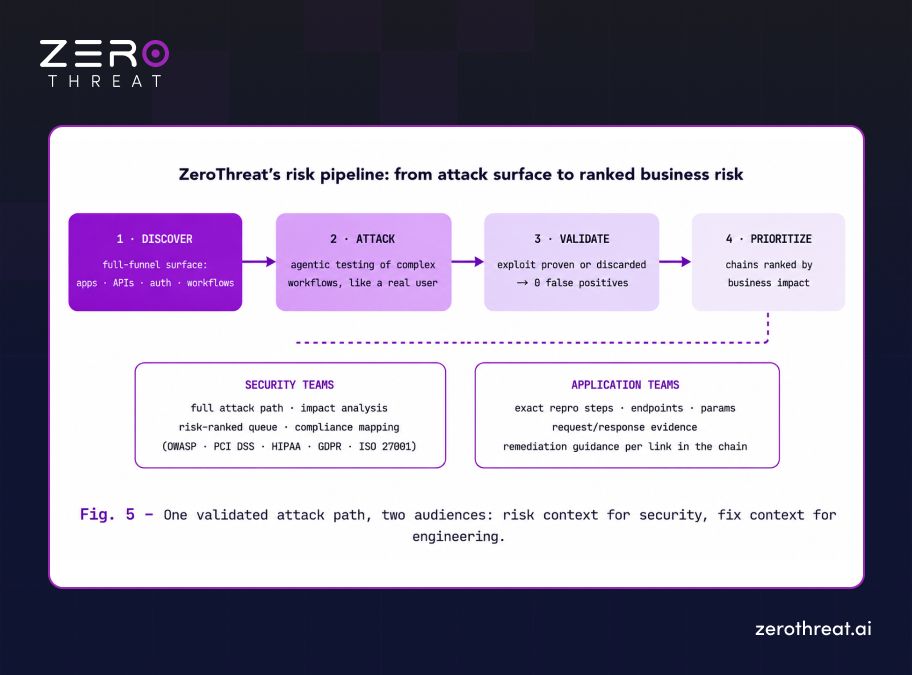
- It tests the application it actually finds, not a CVE list. The engine maps the external attack surface end to end and exercises real authenticated workflows the way a user (and an attacker) would, which is how it surfaces the logic-layer and authorization flaws that carry no CVSS score at all. Coverage spans 130K+ vulnerabilities across web apps and APIs with 99.9% detection accuracy.
- It validates before it reports. A finding enters the queue only when exploitation is demonstrated. Validation is a hard gate, not a confidence percentage, which is what makes the exploitability axis of the prioritization matrix trustworthy.
- It correlates findings into attack chains. Individually modest weaknesses are linked into end-to-end paths, and each chain is assessed by what it ultimately reaches, the customer-data API, the payment workflow, the admin plane, not by the severity of its entry point.
- It ranks by business impact and speaks to both audiences. Security teams get the attack path, impact, and priority with compliance mapping across OWASP, PCI DSS, HIPAA, GDPR, and ISO 27001; application teams get repro steps, endpoints, parameters, evidence, and remediation guidance. Same truth, zero translation loss, which is how findings actually exit the backlog.
The result is a queue that behaves the way this article says a vulnerability prioritization framework should: short, proven, ranked by consequence, and continuously re-tested as the application and the threat landscape move.
Curious what your current prioritization process is overlooking? Let's walk through it together. Request a Risk Review
Conclusion
CVSS isn't broken, but it's misused. As a standardized description of technical severity, it does exactly what it was designed to do; the failure happens when organizations promote that description into a decision, letting a context-free number set SLAs, allocate engineering sprints, and stand in for risk.
The evidence is now overwhelming that severity and risk diverge: exploitation is rare and concentrated, attackers weaponize opportunity rather than score, real breaches ride chained and often CVE-less weaknesses, and the databases that supply scores can no longer keep pace with disclosure volume.
Organizations that prioritize vulnerabilities effectively don't rely on CVSS alone. They combine technical severity with exploitability, asset criticality, and business context to identify the risks that matter most. Next-gen AI pentesting strengthens this approach by validating exploitability, uncovering attack paths, and helping security teams focus on vulnerabilities with the highest business impact.
That is the entire premise behind risk-based vulnerability management, and the entire premise behind ZeroThreat: find what attackers can actually do, prove it, chain it, and rank it by what it would cost you, so your team spends its finite hours fixing the handful of things that genuinely stand between your business and a breach.
Frequently Asked Questions
Why isn't CVSS enough for vulnerability prioritization?
Because CVSS measures technical severity in isolation, not exploitation likelihood, asset criticality, or business impact. With only ~6% of published CVEs ever exploited in the wild, a CVSS-only vulnerability triage process directs most remediation effort at flaws attackers never touches while exploitable, chainable weaknesses age in the backlog.
What does a CVSS score actually measure?
What is a vulnerability prioritization matrix?


Explore ZeroThreat
Automate security testing, save time, and avoid the pitfalls of manual work with ZeroThreat.