 ZeroThreat Wins Bronze Stevie® Award in Tech Startup of the Year Read more

All Blogs
Quick Overview: AI-powered DAST reasons about application state and business logic the way an attacker does, closing gaps legacy DAST tools never could: authenticated flows, single-page apps, and multi-step abuse. But not every change is real. This article - AI-powered DAST vs legacy DAST separates the genuine engineering shift from the marketing.
An attacker rarely starts with the vulnerability, that your scanner flagged. They start with the login you never tested, the API parameter that quietly returns another tenant's data, the checkout step that can be replayed for a free order. None of these looks like signatures. All of them are how real breaches begin.
That gap matters more than ever. Attackers are moving faster and reasoning deeper than the tools most teams point at their applications.
Legacy DAST was built for a simpler web: server-rendered pages, predictable forms, payloads matched against known patterns. Modern applications are single-page front ends, authenticated APIs, and multi-step workflows where the dangerous flaws live in logic, not syntax. AI-powered DAST claims to close that distance. Some of those claims are real engineering. Some of them are familiar crawlers wearing a new label.
This article breaks down the difference on technical grounds: how legacy DAST works and where it fails, what AI-powered DAST actually does differently, which changes are genuine and which are hype, and how ZeroThreat's AI-powered DAST turns the real shift into validated, prioritized findings.
Still trusting legacy DAST? See what modern security teams already know. Upgrade Your Testing
On This Page
- How Legacy DAST Works, And Where It Breaks Down
- What is AI-powered DAST?
- Ai-powered DAST vs Legacy DAST: What Has Actually Changed
- What Hasn't Changed: Separating Signal from Hype
- How ZeroThreat's AI-Powered DAST Delivers the Change That Matters
- Conclusions
How Legacy DAST Works, and Where It Breaks Down
Legacy DAST is a dynamic application security testing approach that crawls a running application, injects known attack payloads into the inputs it discovers, and flags responses matching predefined vulnerability signatures. It works from the outside in, with no knowledge of the application's code, state, or intent.
That model was a good fit for the web it was designed for. A crawler followed links in server-rendered HTML, built a map of pages and forms, and fired payloads for classes like SQL injection (CWE-89) and reflected XSS (CWE-79). If a response matched a known-bad pattern, it raised a finding. Fast, broad, and fully automated.
The problem is that modern applications no longer look like that web. The structural assumptions legacy DAST depends on break in predictable places:
- JavaScript-heavy Single-Page Apps: Crawlers that read static HTML cannot render client-side routes or discover states that only exist after user interaction, so large parts of the app are never reached.
- Authenticated and Multi-step Flows: Complex logins, MFA, and session handling defeat simple form-based auth, leaving the highest-value, post-login surface untested.
- APIs and Dynamic Parameters: Undocumented and dynamically generated endpoints never appear in a link-following crawl, so shadow APIs stay invisible.
- Business Logic Flaws: Per OWASP, these involve legitimate use of application functionality and cannot be scanned automatically. A signature scanner has nothing to match.
- False-Positive Noise: Signature matching without exploit validation produces long lists of unconfirmed findings that consume triage time and erode trust in the tool.
None of these are tuning problems. They are consequences of an architecture that inspects surface patterns instead of understanding the application. That is the baseline any honest comparison has to be measured against.
What is AI-Powered DAST?
AI-powered DAST is dynamic application security testing driven by an AI engine that interprets application state, navigates the app like a real user, and reasons about intent, instead of matching requests against a fixed library of signatures.
The shift is architectural, not cosmetic. Rather than crawling static links, the engine renders the application, understands the live DOM, and moves through it the way a person would: logging in, holding an authenticated session, and completing multi-step journeys. Coverage stops being limited to what a link-follower can see.
On top of that traversal sits reasoning. Agentic behavior means the engine takes multi-step autonomous actions toward a goal, not single-shot classification. It can recognize that an endpoint returns object references, try altering them, and check whether it just read another user's record. It treats the application as states and transitions to probe, which is exactly how business logic and access-control flaws surface.
The final difference is validation. Instead of reporting every signature match, a capable AI-powered DAST engine attempts to confirm exploitability before flagging a result, so what reaches the report is closer to proof than suspicion. That single change is what turns raw scanner output into findings a team can act on without re-verifying each one by hand.
AI-Powered DAST vs Legacy DAST: What Has Actually Changed
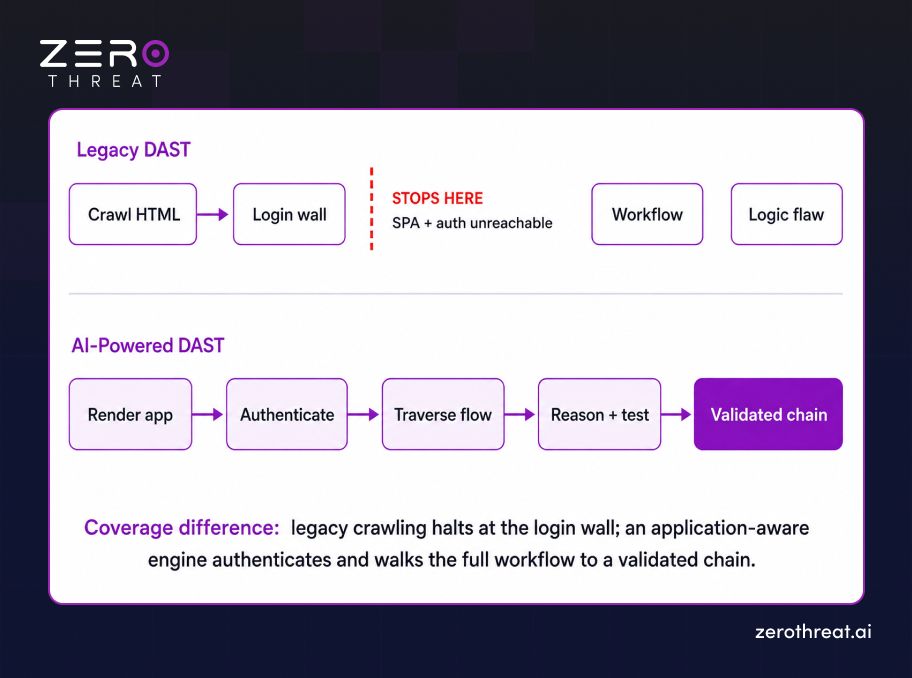
The core change from legacy DAST to AI-powered DAST is a move from pattern matching to reasoning: legacy scanners match requests against known signatures, while AI-powered DAST interprets application state and intent to find flaws that have no signature. The difference plays out across six technical dimensions.
1) Crawling and Attack Surface Coverage
Legacy crawlers map links in server-rendered HTML and stop where JavaScript begins. An application-aware engine renders the SPA, follows client-side routes, and discovers APIs behind the interface, so the tested surface reflects the real application rather than its static shell.
2) Authenticated and Multi-step Workflow Testing
Form-based auth breaks legacy scanners on anything beyond a basic login. AI-powered DAST maintains authenticated sessions through complex and multi-step logins, then tests the post-authentication surface where access-control and privilege issues actually live.
3) Business Logic Vulnerability Discovery
This is the sharpest divide. Legacy DAST is structurally blind to logic flaws because they use the application exactly as intended. As OWASP puts it, these vulnerabilities cannot be scanned automatically. A reasoning engine can attempt step-skipping, value manipulation, and IDOR-style object access, testing intent rather than syntax.
From static scanning to intelligent testing - see what AI changes. Discover AI-Powered DAST
4) Vulnerability Validation and False Positives
Legacy output is a list of signature matches, many unconfirmed, all needing manual triage. AI-powered DAST validates exploitability before reporting, replacing noise with proof-based findings and cutting the hours teams lose confirming what the scanner guessed.
5) Isolated Findings vs Attack-chain Discovery
A signature scanner reports each issue in isolation. A reasoning engine can link them: a leaked token here, a weak access check there, combined into the single exploitable path an attacker would actually walk. That chain is the finding that matters, and legacy tooling almost never produces it.
6) Remediation Output Quality
Legacy tools attach generic advice to each signature. An application-aware engine that validated the exploit can hand back the reproduction steps, the exact endpoint and parameter, and the evidence, so the fix is targeted instead of guessed.
| Dimension | Legacy DAST | AI-Powered DAST |
|---|---|---|
| Coverage model | Crawls links in server-rendered HTML | Renders SPAs, follows routes, discovers APIs |
| Authentication | Breaks on complex, multi-step login | Holds authenticated sessions, tests access control |
| Business logic | Blind by design (no signature to match) | Reasons about workflow intent and abuse |
| Findings | Unconfirmed signature matches | Validated, exploit-proven results |
| False positives | High noise, heavy manual triage | Near-zero, validated before reporting |
| Attack chains | Isolated single findings | Links steps into exploitable chains |
| Remediation | Generic advice per signature | Repro steps, endpoint, parameter, evidence |
The Constraints AI-Powered DAST Can't Engineer Away
What has not changed is that DAST is still bound by what it can reach, and that the "AI" label alone guarantees nothing. The genuine advances are real, but they sit next to marketing that outruns them.
Three things stay true. First, coverage is still finite: an engine can only test what it can reach and authenticate into, so scoping, credentials, and environment setup still decide how much gets covered.
Second, judgment still matters. The most novel, high-context logic flaws still benefit from a human tester, and any tool claiming to fully replace manual pentesting is overselling.
Third, and most important for buyers, some products labeled AI-powered DAST are the same signature crawler with a new badge. If it does not render the app, hold a session, or validate exploits, the label changed but the engine did not.
The honest test is behavioral, not linguistic. Ask whether the tool navigates authenticated workflows, whether it validates findings before reporting, and whether it produces attack chains instead of isolated matches. Those answers, not the word "AI," tell you what actually changed.
How ZeroThreat's AI-Driven DAST Delivers the Change That Matters
ZeroThreat is an AI-powered automated DAST tool that tests web apps and APIs the way an attacker would: navigating real user journeys, validating exploits before reporting them, and prioritizing every finding by business impact. It is built on the behavioral changes above, not the label. Three properties carry the difference.
Application-aware Attack Surface Coverage
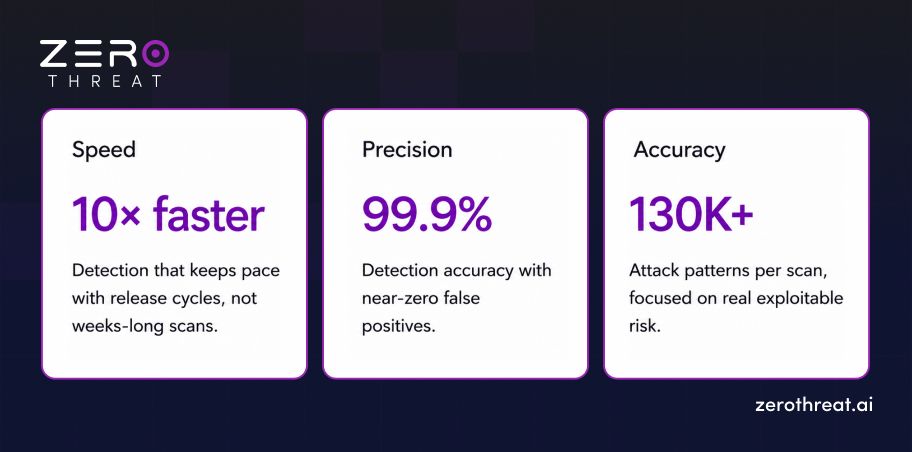
ZeroThreat’s AI-powered DAST scanner maps the full external surface, from ports, SSL, DNS, and mail through to apps, APIs, auth, and workflows, then tests it as one connected application. That breadth is what makes 10x faster detection meaningful: the engine scans thousands of URLs in minutes without leaving the SPA and API surface untested.
Testing Complex Workflows Like a Real User
The engine completes multi-step, authenticated journeys without requiring hand-written Playwright specs. It behaves like a user moving through checkout, onboarding, or role changes, so the post-login surface where logic and access-control flaws live is actually exercised, at scale.
Critical Attack Chain Discovery
Reasoning over 130K+ attack patterns per scan, ZeroThreat’s AI DAST platform links individual weaknesses into the attack chains an adversary would use. The output is the exploitable path, not a scattered list of matches, which is where accuracy translates into risk you can act on.
Zero False Positives with Validated Findings
Every reported issue is validated for exploitability before it reaches you. That is what precision means in practice: 99.9% detection accuracy with near-zero false positives, so triage time goes to fixing real problems rather than dismissing noise.
Business-aware Prioritization and Dual-audience Output
Findings are ranked by business impact, then delivered to two audiences. Security teams get full attack path, impact, and priority. Application teams get reproduction steps, endpoints, parameters, evidence, and remediation guidance, so nothing stalls in translation.
Compliance Mapping
Validated findings map cleanly to OWASP, PCI DSS, HIPAA, GDPR, and ISO 27001, turning a security scan into audit-ready evidence.
Before you renew your DAST tool, see what modern testing looks like. Schedule My Demo
The Change That Actually Matters
The honest answer to what has actually changed: the best AI-powered DAST stops testing URLs and starts testing applications. It authenticates, reasons about logic, validates what it finds, and reports what an attacker could actually do. The label is not the point. The engine behavior is.
ZeroThreat’s AI-powered DAST tool is built on that behavior. It navigates real user journeys, proves exploits before flagging them, and prioritizes every finding by business impact, so security teams get the attack path, and application teams get the fix. If legacy DAST has been handing your team a backlog of unvalidated noise, see what application-aware testing surfaces instead.
Frequently Asked Questions
Is AI-powered DAST better than traditional DAST?
AI-powered DAST is better than traditional DAST for modern applications, where coverage, business logic, and false positives are the real problems. Traditional DAST still works for simple server-rendered sites, but it cannot reason about authenticated, API-driven, or logic-level flaws.
Can legacy DAST detect business logic vulnerabilities?
Does AI-powered DAST reduce false positives?
Does AI-powered DAST replace manual penetration testing?
How does ZeroThreat's AI-powered DAST platform differ from legacy scanners?



Explore ZeroThreat
Automate security testing, save time, and avoid the pitfalls of manual work with ZeroThreat.