 ZeroThreat Wins Bronze Stevie® Award in Tech Startup of the Year Read more

All Blogs
Web Application Penetration Testing: From Types to Methods, Understanding the Fundamentals

Quick Summary: Web application penetration testing is a pragmatic approach to web app security audits. It offers a thorough security assessment to expose vulnerabilities that hackers can exploit to strengthen cybersecurity posture. Let’s learn more about it, its importance, types, and more in detail.
Web applications are quite common these days, and we use them for banking and shopping. These web apps process sensitive data like bank details, credit/debit card numbers, and PIIs, which make them a lucrative target for hackers.
Hence, organizations must take stern steps to protect these applications. A comprehensive vulnerability assessment of these applications is pivotal to identify weaknesses and fortify web apps. You can perform penetration testing to conduct this assessment.
Web app penetration testing helps evaluate web apps with a hacker-like attack technique. As a result, it offers in-depth security insights, providing details of vulnerabilities, how a hacker can breach security, and more.
Minimize Up to 90% of Manual Pentesting Efforts with ZeroThreat, Perform Fast and Precise Scanning Try It Now
On This Page
- An Overview of Web Application Pen Testing
- Importance of Web App Penetration Testing
- Types of Web Application Penetration Testing
- How Does Pentesting for Web Apps Work?
- Limitations of Web App Pentesting
- How ZeroThreat Supports Web App Penetration Testing
- To Wrap Up
What is Web Application Penetration Testing?
Penetration testing (pen testing) is a controlled security assessment used to identify and exploit vulnerabilities in a web application before attackers can. It simulates real-world attack techniques to evaluate how well an application prevents sensitive data exposure, authentication mechanisms, business logic, and user sessions. The goal is not just to find weaknesses, but to understand their real impact and prioritize fixes that reduce breach risk.
A structured web application penetration test typically focuses on:
- Authentication and authorization: Detecting weak login controls, privilege escalation, and broken access controls.
- Input validation: Identifying risks such as SQL injection, cross-site scripting (XSS), and command injection.
- Session management: Checking cookie security, session timeouts, and token handling.
- API and data exposure risks: Ensuring endpoints do not leak sensitive information.
- Business logic vulnerabilities: Uncovering flaws that allow misuse of application workflows.
Unlike automated scans alone, penetration testing adds human-driven analysis to validate exploitability. This helps security teams move beyond surface-level findings and focus on vulnerabilities that could actually lead to compromise, financial loss, or reputational damage.
Understanding the Importance of Web Application Pen Testing
Web applications are constant targets for cyberattacks because they store sensitive data and remain publicly accessible. Even a small security gap can lead to data breaches, financial loss, and reputational damage.
Pentesting web apps help organizations proactively evaluate their security by uncovering vulnerabilities before attackers do. Instead of reacting to incidents, businesses gain clear visibility into their security readiness and can take informed steps to reduce risk.
Key reasons why web application pen testing is important:
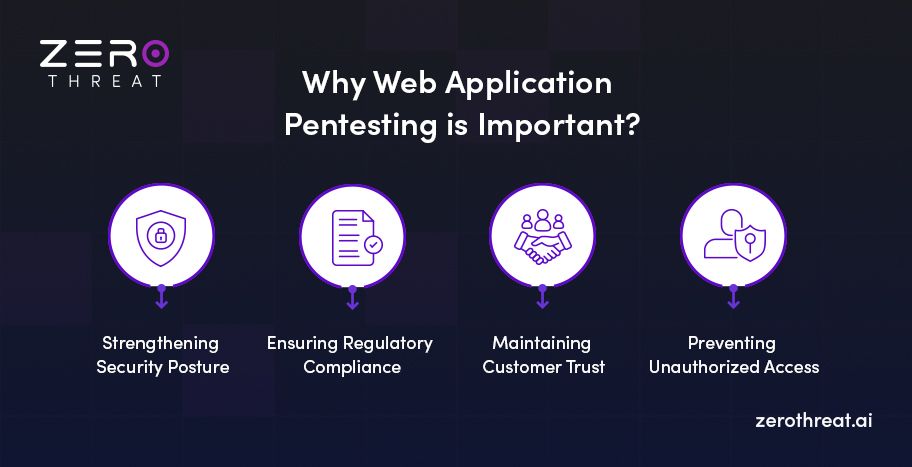
Strengthening Security Posture
A pen test enables you to thoroughly analyze your web application and associated security controls. A pen tester will design test cases by considering the potential risks and structure of the application to identify weaknesses like a real hacker will do.
As a result, it will provide precise insights into the security posture of your web app. The tests will check the resilience of the security posture and expose any weaknesses. You can work on those gaps and strengthen the security posture.
Ensuring Regulatory Compliance
There are necessary data security frameworks and standards that organizations must comply with, such as PCI DSS, HIPAA, GDPR, ISO27001, SOC2, and more. Web app pen testing checks your cybersecurity readiness and identifies gaps that could affect compliance and regulations. So, it helps you make your web app compliance-ready.
Maintaining Customer Trust
Web application pen testing is a proactive approach that helps you stay ahead of hackers. It enables you to assess your web application regularly and remediate weaknesses before a hacker can find and exploit them. Besides, this regular security exercise builds trust among customers because it shows your commitment to protecting their data.
Preventing Unauthorized Access
Unauthorized access occurs when someone without requisite permission accesses the data. Penetration testing helps evaluate the authorization and authentication controls to discover any weaknesses and fix them. This will prevent unauthorized people from accessing the data.
Types of Web App Pen Testing You Can Perform
There are different types of web app pentesting that offer diverse methods to evaluate web applications. The following are the two main types that it can be categorized in.
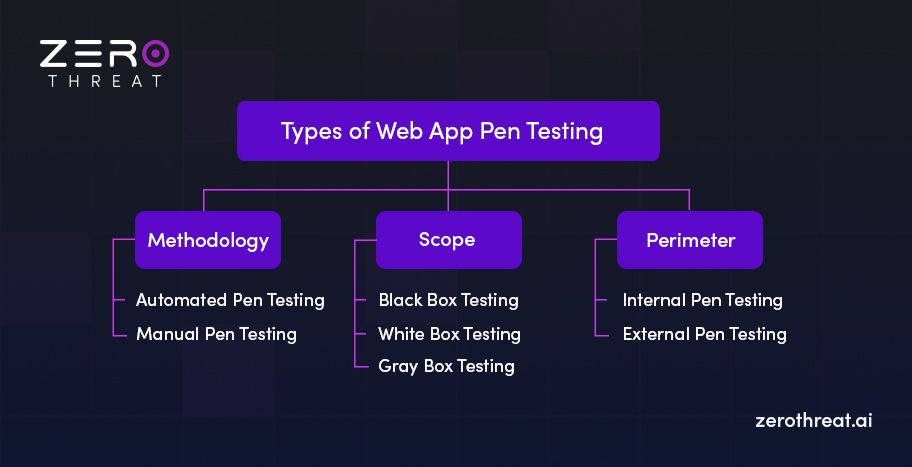
Methodology
A methodology defines how a pentest is performed. It means it refers to the method that you follow to pentest your web application. There are two methods to do this, as given below.
Automated Pen Testing
As you can clearly understand from the term itself, it refers to pen testing which is automated. In this method, you use automated pentesting tool to scan web apps for vulnerabilities. There are SAST, IAST, and DAST tools to perform automated tests.
Manual Pen Testing
It is a manual method in which web apps are evaluated by human pen testers. Usually, they are ethical hackers who offer their expertise to help organizations identify weaknesses in their web apps and strengthen security.
Scope
Web application penetration testing is also divided based on the scope of testing. For example, the tester might have partial or full knowledge of the target. The following are the types of web app pentesting based on the scope.
This is a kind of penetration test in which the tester doesn’t have prior knowledge of the target system. So, the tester assesses the web app without any knowledge of the source code, architecture, and internal workings. This test evaluates web apps from a real hacker’s perspective.
White Box Testing
Unlike black box testing, the tester has full knowledge about the target in this method. So, in white box testing, the tester knows the architecture and internal workings of the target web app. Besides, he has access to the source code. The advantage of this method is that the tester can pinpoint the vulnerabilities exactly.
Gray Box Testing
The gray box is a kind of pen testing method that combines the benefits of both the above methods. In this method, the tester has partial information about the target application. So, the tester has some prior external and internal knowledge about the web app. It helps testers focus on areas that are more likely to be affected by vulnerabilities.
Perimeter
Another basis for differentiating pen testing is the network perimeter. It means whether the tester executes the tests from an organization’s internal network or attacks remotely.
Internal Pen Testing
It involves pen testing web apps from an organization’s network periphery. This allows a tester to evaluate the security status of an application when it confronts an internal attack, also known as an insider attack, who has access to a system or application. The pen tester will perform a simulated attack using the internal network or intranet.
External Pen Testing
In this method, pen tests on web apps are performed from outside of an organization's network periphery. This means that the tester will assess a web application by planning attacks remotely. For example, the hacker may conduct the test from a van or a location that is quite distant from an organization’s premises to identify the possibility of an outsider attack. It helps assess all external threats to an organization.
Continuously Scan Web Apps to Prevent Evolving Cyber Threats and Maintain Customer Trust Check How It Works
How Does Web App Penetration Testing Work?
You have already understood that a web application pen test is a simulated attack performed by a human tester manually or automated with a tool. But how does the entire process work? Let’s see how this test is conducted step by step.
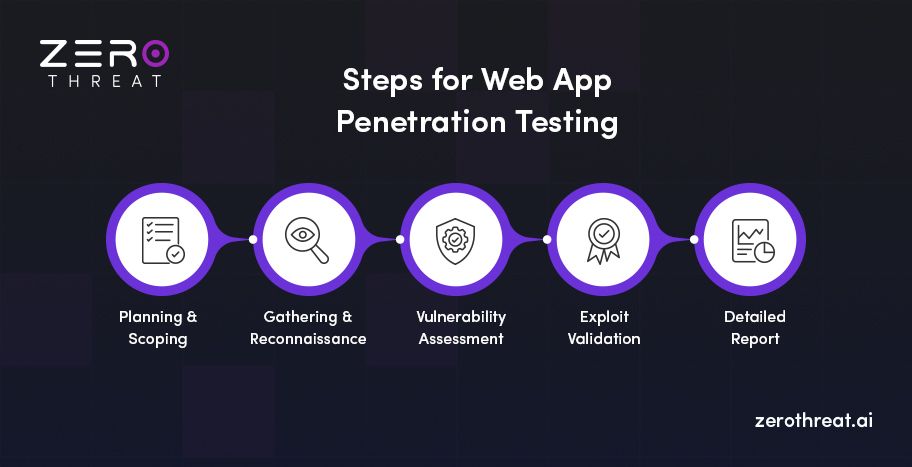
Step 1: Planning & Scoping
Defining the scope of the test is the first step in web app pentesting. The scope includes many decisions, such as what pages to be tested, which method to choose, whether to conduct an internal or external test, and more. Additionally, it also involves defining the timeline for the test.
Step 2: Gathering & Reconnaissance
The correct information is essential to test web apps. Reconnaissance is the step of web app pentesting when the tester gathers information about the target web app, its components, and its environment. This will help the pen tester plan tailored attacks to identify web application security risks more precisely.
Step 3: Vulnerability Assessment
Once the tester gains data, the next step is to perform vulnerability scanning with automated tools. It helps discover known vulnerabilities in web applications like misconfigurations, weak session management, outdated software, and more. It helps track the response of the web app to intrusion attempts and identify potential entry points.
Step 4: Exploit Validation
Vulnerability scanning is a quick process to uncover common vulnerabilities. However, you need in-depth analysis to discover more complex vulnerabilities and misconfigurations. So, manual exploitation is performed to identify vulnerabilities like business logic flaws that automated scans may fail to detect.
It is an essential step in web app pentesting in which the tester uses known attack vectors to try to exploit vulnerabilities with techniques like privilege escalation, intercepting traffic, stealing data, and more. This allows the tester to gain access to sensitive information and evaluate the damage a real hacker can do.
Apart from this, the tester will try to maintain access to identify the risk of advanced persistent threat (APT). This risk will enable a hacker to gain prolonged access to the web app.
Step 5: Detailed Report
All the findings of the test are compiled into a report with details about the vulnerabilities exploited, data compromised, the time for which the pen tester could attain access and more. The report contains all the essential information that security teams need to remediate vulnerabilities.
The security team will take the appropriate measures to mitigate the risks. These measures include configuring the WAF (Web Application Firewall), launching a patch, and implementing additional security layers to protect the web app.
Limitations of Web Application Penetration Testing
While web application pentesting is a solid method to identify and resolve vulnerabilities to strengthen web app security, it has its own limitations too. Undoubtedly, pen testing is crucial to performing web app security audits. However, knowing the limitations of this method, apart from the benefits, is also important to understand its effectiveness. It will also help you make the best use of this method while overcoming any challenges.
- Potential of Human Error: Since manual pen tests are performed by humans, there is always a possibility of human error. Despite the skills, a pen tester can make mistakes that could alter the results. Besides, results can be inconsistent due to the varied methodologies that different pen testers follow.
- Time and Budget Constraints: In today’s dynamic software landscape, changes are more frequent than some time ago. So, continuous security testing is necessary to frequently build and launch applications. However, pen testing is a lengthy process and requires a lot of time. Plus, it is resource intensive. Hence, it isn’t feasible for modern agile processes. It is also a costly process that poses budget-related challenges for small and medium-sized organizations.
- Limitation to Evolving Threats: Web application pentesting is a point-in-time assessment. So, it may fail to uncover evolving threats as cyber attackers are increasingly using sophisticated techniques.
- Risk of Overreliance: Relying solely on web app pen testing can be a delusion. Organizations could assume that their web apps are secure after a successful pen test. However, continuous testing is crucial to mitigate the risks.
- Ethical Constraints: Pen testers perform attacks in an ethical constraint, and they cannot perform actions that could result in violation of laws. As a result, this limits the breadth and depth of testing.
How ZeroThreat Supports Web App Penetration Testing
ZeroThreat is an AI-powered, automated penetration testing platform built specifically to secure modern web applications and APIs. Unlike traditional pentesting tools that require deep expertise and manual setup, ZeroThreat offers zero configuration and point-and-click simplicity. This simplicity allows security teams to start testing in minutes without hiring experts.
It performs continuous web application penetration testing by simulating over 130,000 real-world attack paths, including OWASP Top 10 vulnerabilities and logic-based flaws. Its AI-driven engine prioritizes findings based on exploitability and business impact.
Key ways ZeroThreat enhances web app pentesting:
- Automated Attack Simulation: Runs deep, real-attacker-style tests across pages, authenticated areas, and APIs.
- Authenticated Scans: Tests behind login and authorization boundaries to catch hidden vulnerabilities.
- CI/CD Integration: Integrates security into your CI/CD pipeline for continuous feedback and regression testing.
- Actionable Reporting: Delivers clear, AI-guided remediation steps with evidence to accelerate fixes and support compliance.
By combining automated penetration testing and developer-ready insights, ZeroThreat helps organizations strengthen their security posture and maintain security compliance with standards like PCI DSS, HIPAA, GDPR, ISO27001, and more.
Eliminate Cyber Risks with 99.9% Accuracy and Avoid Costly Data Breaches Perform a Pen Test
Top Wrap Up
Web application penetration testing is an important security exercise that helps you ensure vulnerability-free applications. However, you should also focus on the frequency of this test. How often should you pen test your web app? Since it is a costly and time-consuming method, you cannot perform it continuously. But you can conduct this test quarterly, half-yearly, or annually to regularly discover vulnerabilities and secure your web apps.
For continuous testing, you can opt for automated pentesting with ZeroThreat, which offers faster scanning speed and a pentester-like security assessment. It seamlessly integrates into your SDLC to evaluate web applications with advanced AI-powered features.
It is a powerful security testing tool that reduces your manual pen test efforts by 90%. It detects vulnerabilities with 99.9% accuracy and with zero false positives. You can give it a try to know how it works and the benefits it offers.
Frequently Asked Questions
What is the checklist for web app pentesting?
Web app pentesting checklist is a formal guide that security testers will review to evaluate web apps for vulnerabilities. There are different sections in this checklist that cover details on information gathering, security assessment, manual testing, and more.
How are web app pentesting and vulnerability scanning different?
How long does it take to perform a web app penetration test?


Explore ZeroThreat
Automate security testing, save time, and avoid the pitfalls of manual work with ZeroThreat.