 ZeroThreat Wins Bronze Stevie® Award in Tech Startup of the Year Read more

All Blogs

Quick Summary: Penetration testing is performed by ethical hackers to discover vulnerabilities. The tests are performed with permission by simulating cyberattacks. Keep reading for a complete understanding of penetration testing and its importance.
With the rising trend of cyberattacks in the last few years, cybersecurity has become the prime concern for every service organization. It has become a need of the hour for companies to identify threats and prevent vulnerabilities in their systems.
In fact, one successful cyberattack can cause many damages, in terms of losing sensitive data, customer information, and money, eventually destroying customer trust. Therefore, the most appropriate way to secure your organization and application is to focus on comprehensive security testing methods. An effective technique to identify and prevent vulnerabilities and cyberattacks on the system is penetration testing.
Penetration testing is a cost-effective method to reduce cyberattacks from hackers. Think of it as a practice round before the big game. Penetration testing helps your business stay one step ahead of the tricky hackers, ensuring your organization is safe.
Without it, it's like leaving the front door wide open, and who wants that?
In this digital world, your customers trust you to keep their data safe. Penetration testing is your trusty sidekick, making sure your business application can’t be breached. So, next time you hear about penetration testing, remember it’s not just a fancy term; it’s your cyber shield in the digital era.
In this article, we are going to talk about why penetration testing is important for your business and how often you should perform it. We’ll also explore how ZeroThreat’s AI-driven automated penetration testing tool can simplify your testing process with reduced effort and cost. But before that, let’s understand what penetration testing is.
Discover vulnerabilities accurately and reduce manual pentest efforts by 90%. Try It Now
Table of Contents
- Understanding Penetration Testing
- Seven Major Reasons Your Business Needs a Penetration Test
- How Often Should You Conduct a Penetration Test?
- ZeroThreat for Automated Penetration Testing
- Amplify Your Business Security with Penetration Testing
Understanding Penetration Testing: What is it?
Penetration testing is a simulated cyberattack on a system, application, or network to identify security vulnerabilities before real attackers can exploit them. It is often called ethical hacking because it mimics real-world attack techniques in a controlled and authorized way to evaluate how secure your systems actually are.
In practice, penetration testing validates the vulnerabilities by exploiting them. It can be either performed by a skilled tester or using an automated penetration testing tool.
With a pen test, you can find flaws in authentication, business logic, APIs, cloud configurations, and more. This testing approach gives a realistic view of how a breach could happen and what can be exploited by the attacker.
The outcome of a penetration test is clear insights into risk, impact, and how to fix them. It helps teams prioritize what matters most and strengthen their overall security posture before an actual incident occurs.
7 Major Reasons Your Business Needs a Penetration Test
Effective penetration testing is a strategic necessity for modern businesses. It identifies critical security gaps, validates your defenses against real-world exploits, and reduces the risk of costly breaches.
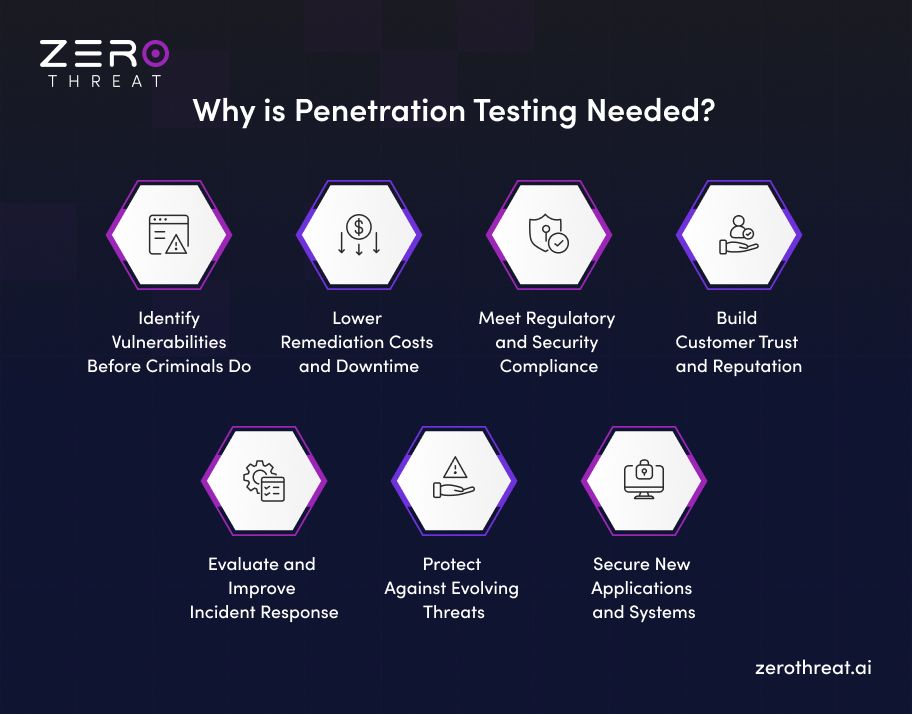
Identify Vulnerabilities Before Criminals Do
Penetration testing helps businesses uncover security vulnerabilities before attackers can exploit them. Real-world simulations expose weaknesses in web applications, APIs, and networks, reducing the risk of unauthorized access and data breaches across critical systems.
Modern breach data shows that vulnerability exploitation accounts for around 20% of initial attack vectors, making unpatched flaws a major entry point for attackers. Proactive vulnerability assessment helps close these gaps before they are exploited.
By identifying risks early, organizations strengthen their attack surface management and reduce exposure. This approach shifts security left, helping teams fix issues before they turn into costly security incidents or operational disruptions.
Lower Remediation Costs and Downtime
Penetration testing reduces the cost of fixing vulnerabilities by identifying them early in the development or production lifecycle. Fixing issues before exploitation avoids expensive incident response, system downtime, and business disruption.
The global average cost of a data breach is around $4.44, with costs increasing when detection is delayed. Early detection significantly lowers financial impact and operational damage.
Organizations that proactively test their systems can prioritize critical fixes and avoid emergency remediation. This improves business continuity, reduces downtime, and ensures systems remain available without the chaos of post-breach recovery efforts.
Meet Regulatory and Security Compliance
Penetration testing plays a key role in meeting regulatory and security compliance requirements such as GDPR, PCI-DSS, and HIPAA. Many frameworks require regular security testing to validate the effectiveness of security controls.
Regulatory penalties now contribute up to 8–12% of total breach costs, making compliance failures financially significant. Regular testing helps demonstrate due diligence and reduces the risk of non-compliance fines.
Beyond compliance checklists, penetration testing validates real-world security posture. It ensures that controls are not just implemented but effective, helping organizations align with industry standards and maintain a strong security and compliance program.
Build Customer Trust and Reputation
Penetration testing helps businesses protect customer data, which directly impacts trust and brand reputation. A single breach can damage credibility and lead to long-term customer loss and reduced market confidence.
Studies show that lost business accounts for up to 30–40% of total breach costs, often due to customer churn and reputational damage. This highlights how security failures directly affect revenue and brand perception.
By proactively securing applications and systems, businesses signal reliability and responsibility. Strong security practices, backed by regular testing, build customer confidence and position the organization as a trustworthy and security-first brand.
Evaluate and Improve Incident Response
Penetration testing helps organizations assess how effectively their incident response processes work under real-world attack conditions. It simulates security incidents, allowing teams to identify gaps in detection, response time, and coordination across security operations and infrastructure.
Recent data shows the average breach lifecycle is around 241 days, with 181 days just to detect an attack. This highlights how delayed detection increases risk and exposes weaknesses in incident response readiness.
By regularly testing response workflows, businesses can reduce mean time to remediate (MTTR). This strengthens security posture, improves threat visibility, and ensures faster containment when actual cyber incidents occur in production environments.
Protect Against Evolving Threats
Penetration testing helps businesses stay ahead of constantly evolving cyber threats by simulating modern attack techniques. It identifies how attackers exploit new vulnerabilities, misconfigurations, and emerging technologies such as APIs, cloud environments, and identity systems.
Cyber threats are becoming more aggressive, with ransomware present in 44% of breaches and vulnerability exploitation contributing to over 20% of initial attack vectors. Attackers are continuously adapting faster than traditional defenses.
Regular penetration testing ensures security controls evolve alongside threat landscapes. It enables organizations to proactively address new attack vectors, strengthen defense mechanisms, and reduce the likelihood of successful exploitation in rapidly changing digital environments.
Secure New Applications and Systems
Penetration testing ensures that new applications, APIs, and systems are secure before they go live. It validates security controls during development and deployment, reducing the risk of introducing exploitable vulnerabilities into production environments.
Studies show that 84% of penetration tests uncover at least one exploitable vulnerability, and 72% of organizations report preventing breaches through proactive testing. This highlights the importance of testing new systems before exposure.
By integrating penetration testing into development pipelines, businesses strengthen application security, reduce risk in DevSecOps workflows, and ensure that new releases meet security standards without exposing critical assets to real-world cyber threats.
Identify, exploit, and validate security risks with ZeroThreat’s penetration testing tool.
Pentest My App
How Often Should You Conduct a Penetration Test?
Penetration testing should be conducted regularly based on risk, system changes, and compliance needs, not as a one-time activity. Most standards recommend a baseline frequency, but modern environments often require more frequent and event-driven testing.
- Conduct at least one penetration test annually to meet baseline security and compliance requirements.
- Perform tests after major application updates, infrastructure changes, or new feature releases.
- Schedule biannual testing for growing businesses with evolving systems and expanding attack surfaces.
- Run quarterly tests for high-risk industries handling sensitive or financial data.
- Test immediately after a security incident to validate fixes and uncover additional vulnerabilities.
- Adopt continuous or on-demand testing for agile, cloud-native, or DevSecOps-driven environments.
Why Choose ZeroThreat for Automated Penetration Testing
ZeroThreat redefines application security by shifting the focus from endless vulnerability lists to validated exploit paths. It enables teams to secure web apps and APIs with speed and accuracy.
- Exploit Validation First: ZeroThreat prioritizes real risk by confirming exploitability, effectively eliminating false positives, and provides 99.9% accurate findings.
- Agentic AI Pentesting: Its autonomous agentic AI pentesting tool simulates multi-step attack paths, adapting to application behavior just like a human attacker would for deeper coverage.
- Production-Safe Execution: Conduct deep security testing in live environments without performance disruption, maintaining 100% uptime while proactively hunting for critical vulnerabilities and logic flaws.
- SPA Testing: It extends Playwright into automated security testing to navigate complex SPAs and API flows, discovering hidden endpoints and pentesting authorization boundaries that traditional tools miss.
- AI-Powered Remediation: Receive precise, code-level remediation guidance and HTTP proof for every finding, enabling your engineering team to close security gaps 10x faster.
- Compliance-Ready Documentation: Instantly generate audit-ready reports mapped to global standards like PCI DSS, GDPR, and HIPAA, providing documented evidence of your security posture.
Need help securing complex applications? Talk to security experts now! Contact Us
Amplify Your Business Security with Penetration Testing
Successful cybersecurity is increasingly essential for businesses and organizations. These days, it's normal for vendor security questionnaires to ask about penetration test results. If you want to ensure that your system is secure, you should expect to perform one.
Unlike other vulnerability assessments, a penetration test employs the same methodologies that an actual attacker may use to breach your defenses.
You can either perform the pentest manually or use ZeroThreat’s AI-driven automated pentesting tool for faster and more accurate findings. So, if you are serious about your organization's security, sign up for free with ZeroThreat and start pentesting your application now.
Frequently Asked Questions
Why is penetration testing important?
The following is the importance of penetration testing:
- It helps to identify and prioritize security risks.
- Security experts can manage vulnerabilities intelligently.
- It offers a proactive security approach.
- Used to identify strengths and weaknesses of your security posture.
- It helps to boost confidence in your security posture.
- Pen testing is also helpful to attain regulatory compliance.
Why do businesses need penetration testing?
Is penetration testing necessary?
What are the phases of penetration testing?


Explore ZeroThreat
Automate security testing, save time, and avoid the pitfalls of manual work with ZeroThreat.