 ZeroThreat Wins Bronze Stevie® Award in Tech Startup of the Year Read more

All Blogs
ZeroThreat: The First Platform to Apply Zero Trust to Offensive Security

Quick Overview: ZeroThreat is an automated pentesting platform designed for teams building Zero Trust applications. It continuously tests web applications and APIs from an attacker's perspective, validating that authentication, authorization, and access controls work as intended. In this blog, we'll explore why traditional pentesting struggles to keep pace with modern development, how ZeroThreat's continuous testing approach works, and how it helps security teams validate Zero Trust controls in production environments.
For more than two decades, penetration testing has been the industry’s trusted methodology for identifying security weaknesses. Yet the pace of modern development has dramatically changed the pace of traditional pentests.
Developers push code multiple times a day. Microservices are deployed independently. APIs evolve weekly. Access policies change with every sprint. Infrastructure updates, identity providers, and cloud configurations frequently drift out of alignment.
In this hyper-dynamic environment, an annual penetration test is no longer enough. The gaps between tests are no longer months, but they are thousands of deployments, millions of API calls, and countless identity integrations later.
To solve this gap, ZeroThreat introduces the first-ever Zero-Trust Automated Pentesting platform: a system engineered to continuously emulate real-world attacks, validate trust boundaries, and verify that security controls behave as expected in a Zero-Trust environment.
ZeroThreat combines autonomous threat modeling, dynamic vulnerability discovery, and authenticated attack execution under a strict “never trust, always verify” philosophy.
The result: a platform that delivers continuous, scalable, and highly repeatable offensive security aligned to modern Zero-Trust architectures.
Secure your apps before the next release exposes a critical flaw. Sign Up for FREE
On This Page
- Why Zero Trust Demands a New Generation of Pentesting
- What is ZeroThreat?
- How It Works: The Technical Architecture
- Capabilities of ZeroThreat
- Why ZeroThreat Stands Out
- Use Cases Across Security Teams
- The Future: Automated Pentesting as a Core Security Control
- Implement Zero Trust Architecture, Get ZeroThreat Now
Why Zero Trust Demands a New Generation of Pentesting
Zero Trust has become the de facto security framework for modern enterprises. However, many organizations implement Zero Trust as a static architecture rather than utilizing it with a continuously validated security posture.
Traditional pentesting falls short for below mentioned fundamental reasons:
1) Periodic Testing Leaves Blind Spots
New vulnerabilities and misconfigurations appear daily. Point-in-time tests cannot keep up with dynamic infrastructure.
2) Assume-Trust Internal Testing is Outdated
The implicit internal trust is often a starting point of the traditional pentests. Zero Trust environments must have adversary simulations that authenticate identity, authorization, enforce MFA, and policy in each step.
3) Limited Coverage Across Cloud, APIs, Microservices, and SaaS
Attack surfaces have expanded across supply chains and distributed architectures, but pentesting methodologies have not evolved at the same pace.
4) Manual Processes Do Not Scale
Human pentesters are invaluable. However, they cannot continuously test thousands of endpoints or revalidate every code deployment.
What is ZeroThreat?
ZeroThreat is an autonomous pentesting platform that continuously simulates advanced attackers, evaluates trust boundaries, and validates policy enforcement across web applications, APIs, identity systems, and CI/CD pipelines.
Core Testing Philosophy
ZeroThreat operates on the same principles that define Zero Trust security:
- Never Trust User Roles: Continuously validate that authentication and authorization controls prevent privilege escalation. Test whether lower-privileged users can access resources they shouldn't.
- Never Trust Endpoints: Test every API endpoint and application route to verify access controls are correctly enforced, not just assumed to be configured properly.
- Never Trust Configuration: Validate that security controls remain effective as configurations change, dependencies update, and new features ship.
- Continuously Verify: Retest automatically whenever your application changes, ensuring security doesn't degrade between manual assessments.
How It Works: The Technical Architecture
ZeroThreat is built upon five tightly integrated engines that work in concert to perform zero-trust-aware automated pentests:
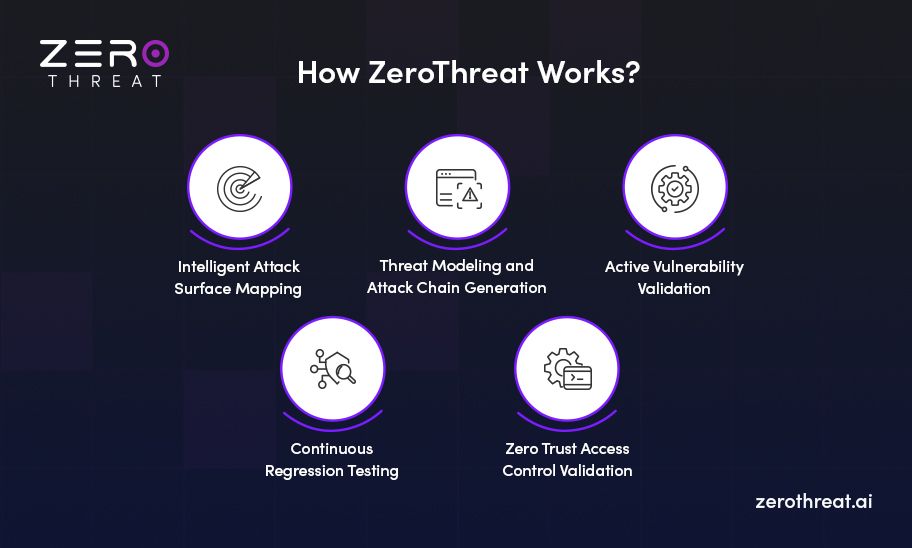
1) Intelligent Attack Surface Mapping
ZeroThreat begins by comprehensively mapping your application's external attack surface:
- API Discovery: Automatically identifies REST and GraphQL endpoints, extracts schemas from OpenAPI specifications, and maps API functionality
- Authentication Flow Analysis: Discovers login mechanisms, SSO integrations, OAuth flows, and token-based authentication patterns
- Technology Detection: Identifies JavaScript frameworks, server-side technologies, and outdated packages that may contain known vulnerabilities
- SSL/TLS Analysis: Validates certificate configurations, protocol versions, and encryption strength
This creates a living map of your application's external attack surface that updates as your application evolves.
2) Threat Modeling and Attack Chain Generation
Using knowledge of common attack patterns from MITRE ATT&CK, CVE databases, and OWASP guidelines, ZeroThreat models potential attack paths:
- Authentication bypass scenarios
- API abuse patterns
- Input validation weaknesses
- Session handling vulnerabilities
Each potential attack path is prioritized based on severity and potential impact to help teams focus on the most critical risks first.
3) Active Vulnerability Validation
ZeroThreat goes beyond traditional vulnerability scanners and dynamic application security testing (DAST). It actively validates whether discovered issues are genuinely vulnerable:
- Tests authentication and authorization bypasses with proof-of-concept requests
- Validates injection vulnerabilities (SQL injection, XSS, command injection) with safe, non-destructive test payloads
- Confirms access control issues by demonstrating unauthorized access paths
- Verifies cryptographic weaknesses and insecure configurations
- Tests for business logic flaws and IDOR vulnerabilities
All testing is designed to provide evidence of vulnerabilities while avoiding service disruption and careful payload selection.
4) Continuous Regression Testing
ZeroThreat performs CI/CD pipeline integrations to automatically retest your application:
- Triggers scans on deployment to catch security regressions before they reach production
- Retests previously discovered vulnerabilities to confirm they remain fixed
- New attack vectors introduced by code changes or dependency updates are tested
- Tracks security posture over time to measure improvement
This transforms security testing from a periodic checkpoint into a continuous feedback loop.
5) Zero Trust Access Control Validation
The platform specifically tests the access control mechanisms that underpin Zero Trust architectures:
- Authentication Testing: Validates password policies, MFA enforcement, session management, and credential handling
- Authorization Testing: Confirms role-based access controls (RBAC) correctly enforce least privilege
- API Security: Tests that API endpoints validate permissions on every request, not just at the application perimeter
- Token Security: Validates JWT implementations, OAuth flows, and session token handling for weaknesses
ZeroThreat acts as a persistent red team, continuously probing whether your Zero Trust controls work as intended. This ensures that “Zero Trust on paper” becomes “Zero Trust in practice.”
Discover vulnerabilities your current tools are missing before attackers do. See It in Action
Capabilities of ZeroThreat
1) Comprehensive Web Application and API Testing
ZeroThreat provides thorough coverage of modern application architectures:
- Web Application Security: Tests server-side rendered and client-side applications for OWASP Top 10 vulnerabilities
- API Security: Validates REST and GraphQL APIs against common attack patterns
- Authentication Security: Tests SSO integrations, OAuth implementations, and custom authentication mechanisms
- JavaScript Security: Identifies vulnerabilities in client-side code and outdated JavaScript packages
- Infrastructure Security: Validates SSL/TLS configurations and mail server security
2) Contextual Vulnerability Analysis
ZeroThreat analyzes vulnerabilities within the context of your application architecture:
- Identifies logical access control flaws that signature-based scanners miss
- Detects authentication and authorization bypasses specific to your implementation
- Uncovers business logic vulnerabilities unique to your application workflows
- Highlights identity-related attack vectors like OAuth misconfiguration and SAML weaknesses
3) Technology and Dependency Analysis
The platform monitors your application's technology stack for security risks:
- Detects outdated server-side frameworks and libraries with known vulnerabilities
- Identifies JavaScript packages with security issues
- Flags weak cryptographic implementations and deprecated protocols
- Monitors SSL/TLS certificate validity and configuration
4) Actionable, Evidence-Based Findings
Every vulnerability report includes:
- Finding Reproduction details
- HTTP request/response evidence demonstrating the vulnerability
- CVSS scoring and impact assessment
- Detailed remediation guidance with code examples
- CWE and CVE References
- Common Consequences of the vulnerability
- Discovered History across past scans
This ensures development teams receive clear, actionable information they can immediately use to fix issues.
Why ZeroThreat Stands Out
Real Attack Simulation
Most top pentesting tools only flag potential vulnerabilities. ZeroThreat goes further by safely simulating real attacker behavior to confirm what’s actually exploitable. This means fewer false positives and clearer insight into real risk.
Zero Trust Validation
ZeroThreat doesn’t just look for code flaws. It tests identity and access to ensure your Zero Trust controls (least privilege, segmentation, and MFA) are enforced correctly at every step.
Continuous Testing Integration
Your application changes constantly. ZeroThreat integrates with your CI/CD pipeline and issue tracking systems to automatically retest applications whenever code ships. Issues are caught early in the development cycle, not months later during annual pentests.
Developer-Friendly Reporting
Every finding includes clear remediation guidance that developers can immediately act on. Integration with issue tracking tools (Jira, GitHub Issues) means vulnerabilities flow directly into existing workflows. Security teams spend less time translating findings and more time improving security posture.
Clear, Actionable Fixes
Every finding includes proof, impact analysis, and step-by-step remediation guidance. Teams know exactly what the issue is, why it matters, and how to fix it quickly with AI-driven remediation reports.
Use Cases of ZeroThreat Across Security Teams
From engineers to CISOs, ZeroThreat empowers every security team with actionable insights, automated testing, and confidence that Zero Trust controls work as intended.
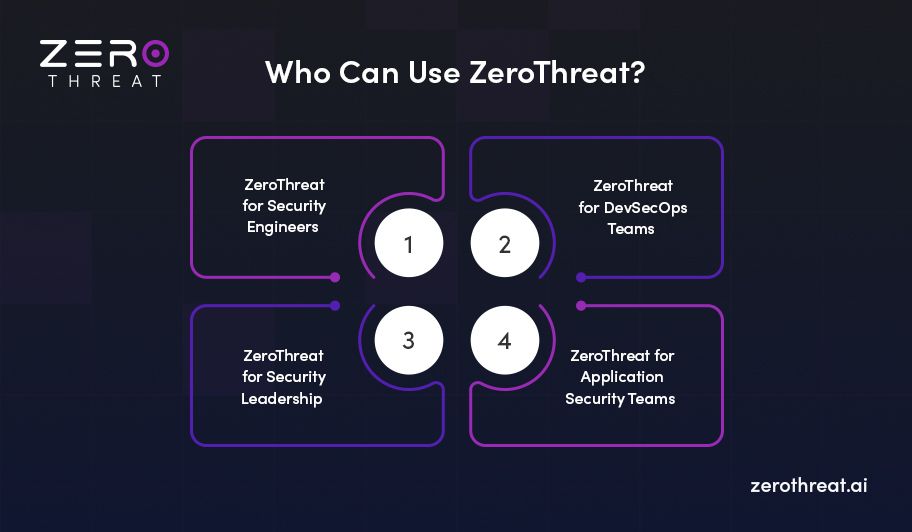
ZeroThreat for Security Engineers
Security engineers use ZeroThreat to maintain visibility into application security as code changes daily:
- Continuous Control Validation: Verify that authentication and authorization mechanisms function correctly under adversarial conditions
- Policy Debugging: Identify exactly which access control rule allows unintended access
- Attack Surface Monitoring: Track how the external attack surface evolves as new features ship
ZeroThreat for DevSecOps Teams
DevSecOps teams integrate ZeroThreat into CI/CD pipelines to shift security testing left:
- Pre-Production Gates: Peek into deployments that introduce critical vulnerabilities or security regressions
- Automated Regression Testing: Ensure fixed vulnerabilities don't reappear in future releases
- Noise Reduction: Focus on verified vulnerabilities rather than theoretical findings
ZeroThreat for Security Leadership
CISOs and security leaders use ZeroThreat to measure and communicate security posture:
- Continuous Visibility: Maintain real-time understanding of application security risks
- Metrics and Trends: Track vulnerability remediation velocity and mean time to fix
- Compliance Support: Demonstrate ongoing security validation for HIPAA, ISO 27001A, GDPR and PCIDSS
- Pentest Augmentation: Reduce reliance on annual pentests by maintaining continuous validation between manual assessments
ZeroThreat for Application Security Teams
AppSec teams use ZeroThreat to scale security expertise across multiple applications:
- Dependency Monitoring: Track outdated JavaScript packages and server-side libraries with known vulnerabilities
- Configuration Validation: Ensure SSL/TLS and authentication configurations meet security standards
- API Security: Validate that API access controls prevent unauthorized data access
The Future: Automated Pentesting as a Core Security Control
Since cyber threats are evolving at a faster pace than manual assessment systems can keep up with, organizations are shifting from reactive security to active, proactive validation. Pentesting is increasingly becoming a necessity that is automated to not only identify vulnerabilities but also to verify whether Zero Trust controls actually perform as intended under actual attack environments.
ZeroThreat is at the forefront of this change through the provision of:
- Continuous Attack Simulation: Testing runs automatically in the background, adapting as your application changes without manual intervention.
- Real validation – Confirms what’s actually exploitable, giving teams evidence-backed insights instead of speculative scanner alerts.
- Real Zero Trust policy assurance – Continuously tests authentication, authorization, and least-privilege enforcement to verify Zero Trust in practice.
- Continuous, scalable, automated security – Runs in the background, re-testing as your environment changes and adapting to new services, configurations, and risks.
With ZeroThreat, organizations gain a living, always-on offensive security capability. As a result, it ensures they don’t just adopt Zero Trust once, but maintain and enforce it every day.
See pricing now—before security gaps become more expensive to fix later. View Pricing
Implement Zero Trust Architecture, Get ZeroThreat Now
ZeroTrust architectures require constant verification. Traditional pentesting, whch is designed for static infrastructures, cannot keep up with modern environments that change daily.
ZeroThreat closes this gap by delivering the world’s first Zero-Trust Automated Pentesting platform: a system built to continuously challenge, validate, and improve your trust boundaries using safe, intelligent, autonomous adversary simulation.
It is not a scanner.
It is not a point-in-time test.
It is the future of continuous security validation.
When you’re ready to validate Zero Trust with real offensive intelligence—ZeroThreat is ready.
So, sign up for FREE and experience Zero Trust architecture for web apps and APIs.

Explore ZeroThreat
Automate security testing, save time, and avoid the pitfalls of manual work with ZeroThreat.