 ZeroThreat Wins Bronze Stevie® Award in Tech Startup of the Year Read more


All Blogs
Buffer Overflow Vulnerabilities: Understanding Memory Corruption and Exploitability
Quick Overview: Buffer overflow vulnerabilities turn ordinary memory-safety errors into full application compromise. This guide traces the path from an unchecked write through memory corruption, exploitation primitives, and control-flow hijacking, then covers mitigations, detection methods, and how exploit validation separates real risk from theoretical findings.
Three things get collapsed into one word in most vulnerability reports, and the distinction between them decides how a security team should spend its week.
A coding error is a missing bounds check. The flaw can sit quietly in the source code without causing problems on every request. It becomes memory corruption when that flaw is triggered, and the program writes beyond the memory it was supposed to use, overwriting data that the application still needs.
An exploitable vulnerability is the narrower case where an attacker controls enough of that write, and the corrupted bytes matter enough, that the program can be steered into doing something it was never designed to do.
Every buffer overflow is the first. Most reach the second under the right input. Only a subset reaches the third, and that subset is what actually threatens production. This gap is why a vulnerability scanner reporting a memory-safety defect and an attacker holding a working exploit are describing very different situations with the same CWE identifier.
Buffer overflow vulnerabilities have not aged out of relevance, because the code they live in has not gone anywhere. TLS terminators, image and video decoders, compression libraries, protocol parsers, database drivers, and language runtimes are still written in C and C++, and modern managed applications call into all of them. The attack surface moved up the stack. The memory-unsafe code underneath did not.
This article follows the full path: what an overflow is, how it corrupts memory, how corruption becomes code execution, what mitigations actually change, how testing finds these bugs, and how exploit validation determines which findings are real security risk.
Buffer overflows don't always crash an app. Find the vulnerabilities hiding behind the inputs you trust. Find My Hidden Risks
On This Page
- What is a Buffer Overflow?
- How Buffer Overflows Corrupt Memory
- From Memory Corruption to Code Execution
- How Modern Mitigations Affect Exploitability
- How Security Testing Detects Buffer Overflows
- How Exploit Validation Determines Real Security Risk
- Root Causes and How to Prevent Buffer Overflow Vulnerabilities
- Key Takeaways
What is a Buffer Overflow?
A buffer overflow vulnerability is a memory-safety error in which a program writes more data into a fixed-size memory region than that region was allocated to hold, so the excess bytes spill into adjacent memory and overwrite whatever was already there.
A buffer is a contiguous block of memory reserved for a known quantity of data: a 64-byte character array, a 4 KB packet scratch space, a heap allocation sized to a parsed header field. In C and C++ that boundary exists only in the arithmetic the developer wrote. Nothing in the instruction stream stops a write at byte 65 of a 64-byte array; the processor stores the value at the computed address and continues.
An out-of-bounds write occurs whenever the index or length used in a memory operation exceeds the allocated size. It happens when a length is taken from input rather than measured, when size arithmetic wraps, when a terminator is assumed to exist, or when a loop condition uses the wrong comparison.
void handle\_record(const char \input){char buf\[64\];strcpy(buf, input);/* no length check: writes until NUL */}
void handle\_packet(const uint8\_t\*pkt, uint16\_t declared\_len){uint8\_t body\[256\];memcpy(body, pkt + 4, declared\_len); /* trusts an attacker-supplied length */}
Both are recorded under CWE-120 (classic buffer copy without size checking) and the broader CWE-787 (out-of-bounds write), which has held a position at or near the top of the CWE Top 25 for years. CWE-787 is the more useful label in practice because it describes the security-relevant event, the write landing outside its region, rather than the specific API that caused it.
What converts this from a robustness bug into a security vulnerability is attacker control. If the oversized data comes from a configuration file written by an administrator, the worst outcome is usually a crash. If it arrives in an HTTP header, an uploaded image, a TLS extension, or an API request body, then the attacker chooses the length, the content, and the timing. Those three degrees of control are what later become the exploitation primitive.
This is also why memory-safety errors remain relevant to teams running web application security testing against managed-language applications. Requests reach native code constantly through image and document processors, compression and cryptography libraries, XML and protocol parsers, database drivers, reverse proxies, and any component reached through a foreign function interface. The request boundary is managed. The parser underneath frequently is not.
How Buffer Overflows Corrupt Memory
A buffer overflow causes memory corruption by writing past the end of an allocated region into memory the program is still using, replacing valid data, pointers, or allocator bookkeeping with attacker-supplied bytes that the program will later read and act on as if they were legitimate.
Corruption on its own is not the danger. The danger is what sits next to the buffer, because that determines whether the overwritten bytes are inert or load-bearing.
Stack-based Buffer Overflow
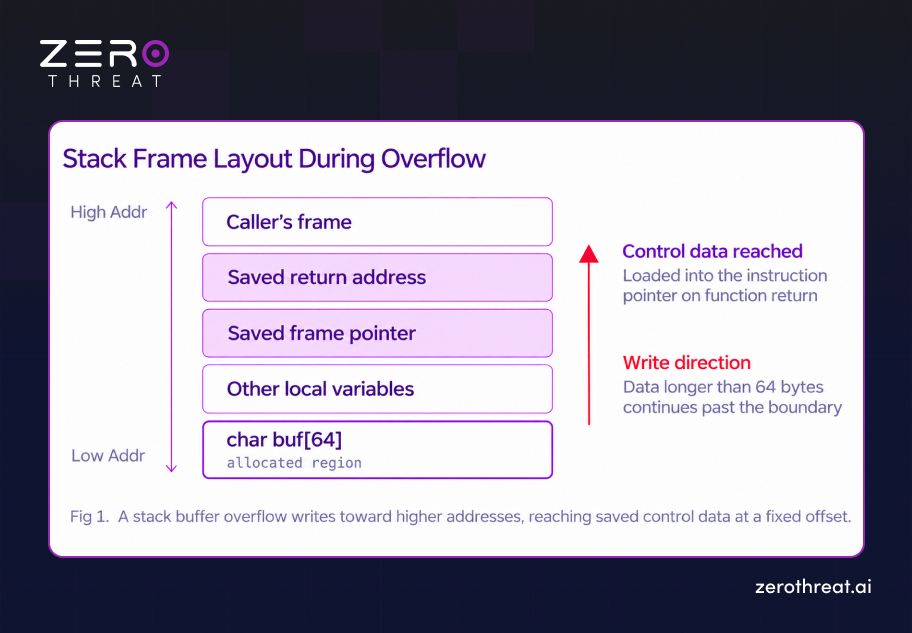
A stack-based buffer overflow is an overflow of a buffer allocated in a function's stack frame, where the overflowing data runs toward higher addresses and can overwrite local variables, the saved frame pointer, and the saved return address stored above the buffer.
Stack frame layout is what makes this class historically severe. A function's return address sits at a fixed, predictable offset from its local buffers, so a stack buffer overflow attack that writes far enough reaches that saved return address directly, and the corrupted value is loaded into the instruction pointer when the function returns. No further indirection is required. The overflow and the control-flow transfer are separated only by the epilogue of a single function.
Heap-based Buffer Overflow
Heap allocations carry no saved return address, so heap corruption takes an indirect route. Adjacent to a heap buffer sits either another allocation or the allocator's own metadata: chunk size fields, free-list pointers, arena bookkeeping. Overwriting an adjacent object can corrupt a C++ object's vtable pointer or a callback function pointer stored in a struct. Overwriting allocator metadata can turn a later free() or malloc() into an attacker-directed write.
The practical difference from the stack case is reliability rather than severity. Stack frame layout is deterministic. Heap layout depends on allocation of order, sizes, and timing, so exploitation typically requires grooming the heap into a predictable arrangement first. That raises effort and lowers reliability, but heap overflows routinely produce more powerful primitives once the layout is under control.
Adjacent Variables, Objects, and Control Data
Not all corruption reaches control data on the first write. An overflow may land on a neighboring integer that holds a length, a boolean that gates an authorization check, a file descriptor, or an index used in a later operation. These produce logic-level compromise without any control-flow hijack, and they are frequently the steppingstone that makes a second, more precise write possible.
Corrupted pointers are the most valuable target. A data pointer that the program later writes through converts an overflow with a fixed destination into an overflow with an attacker-chosen destination. A function pointer, C++ vtable pointer, or stored callback converts corruption directly into control-flow influence at the next indirect call.
Why Memory Layout Determines What Corruption is Worth
Memory layout determines what corruption is worth because the value of an out-of-bounds write depends entirely on what happens to sit at the overwritten address in that specific build. The same overflow, byte for byte, can be a stability bug in one build and a critical memory corruption vulnerability in another. Compiler version, optimization level, struct padding, variable reordering, allocator implementation, and platform ABI all change what sits adjacent to the buffer. This is precisely why exploitability cannot be inferred from source alone, and why the same CVE can carry different real-world severity across two deployments of the same software.
Let AI-powered pentesting investigate real attack paths and uncover security issues that deserve your attention. Validate My Findings
From Memory Corruption to Code Execution
A buffer overflow becomes exploitable when the corruption yields a usable primitive, meaning the attacker gains reliable control over a value the program later trusts, such as a return address, an indirect call target, or an allocator field consumed by a subsequent operation.
The word to hold onto is primitive. Buffer overflow exploitation is not a single leap from bad input to shell. It is the construction of capabilities, where each one is built from the last.
Building an Exploitation Primitive
The weakest useful primitive is a fixed-offset overwrite: the attacker controls the content of the write but not where it lands. A write-what-where primitive gives control of both destination and value, and is usually assembled by first corrupting a pointer, then triggering the code path that dereferences it. An arbitrary read primitive, often obtained by corrupting a length field or a pointer used in an output operation, is equally important because it is the standard method for defeating address randomization.
Control-flow Hijacking
Once a primitive exists, the target is any value the processor will load into the instruction pointer. Saved return addresses are reached by stack overflows. Function pointers and vtable pointers are reached by heap and object corruption. Exception handler records, GOT entries in partially protected binaries, and stored callbacks are all viable depending on platform and build configuration.
Executing Attacker Logic
Historically, buffer overflow code injection meant writing machine code into the buffer itself and redirecting execution to it. Non-executable memory protections ended that as a default technique on modern platforms. The replacement is code reuse. Return-oriented programming chains together short instruction sequences that already exist in the binary and its libraries, each ending in a return, using a corrupted stack as the chain's control structure. Jump-oriented programming does the same with indirect jumps where return instructions are constrained. Neither injects a single byte of new code, which is exactly why non-executable memory does not stop them.
Why Not Every Buffer Overflow Leads to Code Execution
Not every buffer overflow leads to code execution, because execution requires an unbroken chain of conditions, and most overflows break at least one of them. An overflow reaches remote code execution only if every link holds: the vulnerable path must be reachable from an attacker-controlled interface, the write must extend far enough to reach something load-bearing, the corrupted value must survive to the moment it is used, the attacker must control enough of the written content to place a meaningful value, and the deployed mitigations must be defeatable with the primitives available.
Break any link and the outcome degrades. An overflow that only reaches padding may remain a latent defect, because it can corrupt unused memory without immediately affecting the program’s behavior. One that trips a canary produces a controlled abort, which is denial of service and nothing more. One that corrupts a length field but never a pointer may enable disclosure without execution. Exploiting buffer overflow vulnerabilities is the work of establishing that every link holds, which is why static severity ratings so often disagree with operational reality.
| Where the Chain Stops | Resulting Outcome | Practical Severity |
|---|---|---|
| Write reaches unused padding | No observable effect | Latent defect |
| Canary or guard page detects the write | Controlled process abort | Denial of service |
| Non-control data corrupted | Logic bypass, data disclosure | Variable, often high |
| Pointer corrupted, layout unknown | Unreliable crash or partial control | Conditional |
| Full control-flow hijack achieved | Code execution in process context | Critical |
How Modern Mitigations Affect Exploitability
Modern mitigations raise the cost and reduce the reliability of buffer overflow exploitation, but they do not remove the underlying memory-safety error, and each one has a known bypass class that becomes available when the attacker holds the right primitive.
The distinction that matters operationally is between a mitigation that makes exploitation harder and one that makes the vulnerability absent. Every entry below is the former.
| Mitigation | What It Blocks | Known Bypass Class | Residual Risk |
|---|---|---|---|
| Stack canaries | Naive linear overwrite of the saved return address | Canary disclosure via read primitive; targeted writes that skip the canary; overflows into pointers below it | Non-control data and heap paths remain fully open |
| DEP / NX | Executing injected shellcode from writable memory | Return-oriented and jump-oriented programming using existing code | Removes injection only, not control-flow hijack |
| ASLR | Hardcoded addresses in an exploit payload | Information leak revealing a base address; partial overwrite of low bytes; low entropy on 32-bit targets | One read primitive collapses the protection |
| PIE | Fixed executable base, enabling reliable gadget selection | Same leak requirement as ASLR; unrandomized non-PIE dependencies in the process | Only as strong as the least randomized module |
| RELRO | GOT overwrite as a control-flow target | Alternative targets such as vtables, callbacks, and hooks; partial RELRO leaves the GOT writable | Closes one target among many |
| Control-Flow Integrity | Indirect transfers to addresses outside the valid target set | Gadgets within the permitted set; coarse-grained policies; data-only attacks that never violate CFI | Strong against hijack, blind to data corruption |
| Compiler hardening | A subset of unsafe call patterns at build time | Dynamic lengths that defeat static size inference; unhardened third-party binaries | Coverage depends on build flags across all dependencies |
Two consequences follow. First, mitigations shift the exploitation target rather than eliminating it, which is why data-only attacks and heap metadata corruption have grown in relative importance as control-flow defenses have hardened. Second, the mitigation posture of a specific deployment is part of the vulnerability's real severity. The same overflow in a fully hardened build with CFI and in a legacy binary compiled without PIE are not the same finding, even though they share a CVE.
How Security Testing Detects Buffer Overflows
Security testing detects buffer overflows through a combination of static source analysis, coverage-guided fuzzing, runtime memory instrumentation such as AddressSanitizer, dependency analysis against known CVEs, and dynamic testing against the exposed interfaces of a running application.
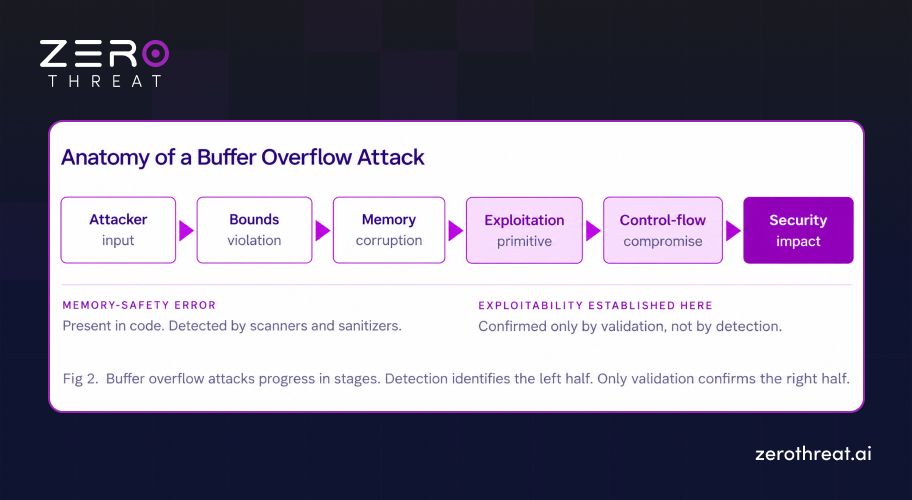
No single method is sufficient, because each one observes a different part of the chain in Fig 2. To find buffer overflow vulnerabilities reliably, teams need coverage across the source, the running process, and the attack surface.
| Method | What It Catches | What It Misses |
|---|---|---|
| SAST and source analysis | Unsafe API usage, missing bounds checks, obvious length arithmetic errors | Reachability from real input; produces high false positive volume on dynamic lengths |
| Coverage-guided fuzzing | Real triggering inputs on reachable paths, including cases no reviewer anticipated | Deep state behind authentication, protocol handshakes, or checksums without a harness |
| AddressSanitizer and MSan | Out-of-bounds reads and writes at the exact instruction, with allocation context | Requires instrumented builds and an input that reaches the code; unsuitable for production |
| Dependency and SCA analysis | Known vulnerable versions of native libraries, mapped to published CVE records | Whether the vulnerable function is reachable or the affected code path is compiled in |
| DAST and dynamic testing | Anomalous responses, timeouts, and crashes reachable from live HTTP and API interfaces | Internal memory state; a crash is visible, its cause is not |
| Crash triage | Fault classification, faulting instruction, register state at the point of failure | Whether an attacker can steer the fault into a controlled write |
The limitation shared by all six deserves to state plainly: a crash is evidence of a memory-safety error, not evidence of exploitability. A sanitizer report tells you a write went out of bounds. It does not tell you whether an attacker can choose where that write lands, whether the corrupted structure carries any security weight, or whether the deployed mitigations already reduce the outcome to an abort. That distinction is also what separates scanning from testing in general, a difference explored further in vulnerability scanning vs penetration testing.
Use AI pentesting to discover attack paths and vulnerabilities that can slip through traditional security testing. Start AI Pentesting
How Exploit Validation Determines Real Security Risk
Exploit validation determines real security risk by reproducing the vulnerable execution path, confirming attacker control over the input, observing the resulting memory corruption, identifying the primitive it produces, and testing whether that primitive can be driven to a security-relevant outcome in the deployed configuration.
Validation is the step that converts the left half of Fig 2 into the right half. It answers a question detection structurally cannot: does this defect matter here?
- Reproduce the vulnerable execution path. Establish a deterministic input that reaches the faulting operation, with the same build, flags, and dependency versions as the deployed artifact.
- Establish attacker control over the input. Confirm the length and content reaching the vulnerable operation are attacker-chosen rather than derived from trusted internal state.
- Confirm memory corruption occurs. Observe the write landing outside its allocation, with the faulting address and offset recorded rather than inferred.
- Determine the affected memory or control-flow structure. Identify what actually sits at the overwritten address: padding, a length field, a pointer, allocator metadata, or saved control data.
- Assess whether exploitation is achievable. Test whether the corruption yields a usable primitive against the mitigations actually enabled in that build, rather than against a theoretical unhardened target.
- Separate exploitable findings from theoretical ones. Classify the outcome against the chain-stop table above, so remediation effort follows demonstrated impact rather than a generic severity score.
- Produce evidence for remediation and verification. Capture the triggering input, the reachable path, the faulting operation, the corrupted structure, and the observed outcome, so engineering can fix it, and testing can confirm the fix.
That final artifact is what changes team behavior. A developer handed a CWE-787 alert has to reconstruct the entire chain before they can judge it. A developer handed out reproducible input, faulting instruction, and a demonstrated impact has a bounded task. The same evidence enables verification, since regression testing requires a concrete trigger to replay.
This is the same reasoning that applies to any vulnerability class where presence and exploitability diverge. Automated penetration testing that validates findings before reporting them, rather than listing every anomaly, is what makes prioritization tractable at production scale.
ZeroThreat applies this model through AI pentesting that executes controlled attack workflows and confirms real-world impact, extending to chained vulnerabilities where individually minor weaknesses combine into a genuine compromise path.
Root Causes and How to Prevent Buffer Overflow Vulnerabilities
Buffer overflow vulnerabilities are caused by missing or incorrect bounds enforcement, most often through unsafe copy operations, faulty length arithmetic, integer overflow producing an undersized allocation, off-by-one errors, and trusting attacker-supplied length fields.
| Root Cause | Corresponding Fix |
|---|---|
| Missing bounds check before a write | Validate the destination capacity at the write site, not at an earlier caller that may be bypassed |
| Unsafe copy and string operations | Use bounded APIs with explicit destination sizes and check their return values for truncation |
| Incorrect length calculation | Compute length against the destination capacity rather than the source size, and account for terminators |
| Integer overflow before allocation | Perform size arithmetic in checked form, with a width that cannot wrap for the input range accepted |
| Off-by-one and boundary errors | Verify loop and index boundary conditions explicitly, and cover boundary values in unit tests |
| Trusting attacker-supplied length fields | Treat every declared length as untrusted input and validate it against the actual available data |
| Unsafe native and FFI interfaces | Validate at the boundary crossing and keep unsafe regions minimal, isolated, and separately reviewed |
| Unhardened build configuration | Enable hardening flags, fortified library variants, and CFI where the toolchain supports them |
Two causes deserve more than a table row. Integer overflow before allocation is dangerous because the bug and the crash occur in different places. A multiplication of an element count by an element size wraps, the allocator receives a small value and succeeds, and the subsequent copy overflows a buffer that appeared correctly sized. Code review of the copy operation finds nothing wrong, because the copy is consistent with the size it was given. The defect lives in the arithmetic upstream.
Native and FFI boundaries matter because they are where memory safety is silently surrendered. A memory-safe language guarantees nothing about a C library it calls through a binding, and unsafe blocks reintroduce exactly the properties the language otherwise removes. Migrating to a memory-safe language shrinks the unsafe surface substantially, which is real value, but the remaining surface concentrates precisely where validation is weakest.
Prevention closes with verification. Fuzzing and sanitizers belong in continuous integration rather than in periodic audits, and every remediated overflow should leave behind its triggering input as a permanent regression test. A memory-safety fix that is not replayed against the original trigger is an assumption, not a confirmation.
See ZeroThreat in action and learn how AI-powered pentesting turns security testing into validated findings. See It in Action
Conclusion: Finding Memory-Safety Bugs Before They Become Exploits
Buffer overflows are the clearest example of a defect that crosses engineering concern to security compromise partway along a chain. The crossing point is not the missing bounds check and not the crash. It is the moment corrupted memory becomes a primitive the attacker can aim for.
That is why exploitability, rather than presence, is the right unit of prioritization for memory corruption vulnerabilities. A backlog sorted by CWE severity treats a latent defect in an unreachable code path and a validated control-flow hijack in an internet-facing parser as comparable work. They are not. Teams that sort by demonstrated impact fix the second one first, and the difference of compounds across every release.
The practical defense is layered: secure development that removes the defect class at the source, continuous automated testing that finds what review misses, and exploit validation that establishes which findings carry real risk. ZeroThreat’s AI pentesting is built on that last principle, executing controlled attack workflows against web applications and APIs and confirming exploitability with reproducible evidence before a finding ever reaches a developer. Sign up for a free trial and see which of your findings are actually exploitable.
Frequently Asked Questions
What is the difference between a buffer overflow and a stack overflow?
A buffer overflow is a memory-safety error where data is written past the end of an allocated buffer, while a stack overflow is exhaustion of the entire stack region, usually caused by unbounded recursion or an oversized stack allocation. The names are often confused because a stack-based buffer overflow contains both words, but the two are different conditions. A stack overflow typically triggers a guard page fault and terminates the process, and is generally an availability issue rather than an exploitable memory corruption vulnerability.
How do use-after-free and double-free bugs differ from buffer overflows?
Do memory-safe languages eliminate buffer overflow vulnerabilities?
How should security teams prioritize exploitable memory corruption findings?



Explore ZeroThreat
Automate security testing, save time, and avoid the pitfalls of manual work with ZeroThreat.