 ZeroThreat Wins Bronze Stevie® Award in Tech Startup of the Year Read more

All Blogs
Quick Overview: Attackers chain low-risk vulnerabilities by using each weak finding as a stepping stone to the next, turning a set of "minor" issues into a single high-impact attack path. This guide breaks down the anatomy of an attack chain, walks through real low-to-high exploit paths, and shows how to detect chains before they reach production.
A verbose error message is not a breach. It is a whisper. It tells the attacker about the internal user ID format, the framework version, maybe the shape of a token. On its own, the vulnerability scanner grades informational and moves on. The attacker does not. That whisper becomes the first move in a sequence that ends in someone else's account, someone else's cloud credentials, someone else's data.
This is the gap between how defenders score risk and how attackers use it. Severity ratings measure vulnerability in isolation. Attackers measure reachability: what does this finding let me do next, and what does that unlock after it. A single low-risk issue rated 3.1 on CVSS is a rounding error. Three of them, arranged in the right order, are an account takeover.
The threat data has caught up to this reality. Exploitation is where breaches start, and exploitation is rarely one clean hit.
The sections below define what vulnerability chaining is, explain why "low-risk" labels mislead, dissect the anatomy of a chain, walk through three real low-to-high attack paths with endpoints and parameters, and show how ZeroThreat’s AI pentesting discovers and breaks these chains before an attacker links them together.
Before you ignore another low-risk alert, see what it can become. Check My Exposure
On This Page
- What is Vulnerability Chaining?
- Why "Low-risk" Severity Labels Mislead?
- The Anatomy of An Attack Chain
- Examples: Real Low-to-High Attack Chains
- How Zerothreat Identifies and Breaks Attack Chains?
- Conclusion
What is Vulnerability Chaining?
Vulnerability chaining is the technique of combining two or more individually low-impact security weaknesses into a single, high-impact attack path, where the output of exploiting one flaw becomes the precondition for exploiting the next.
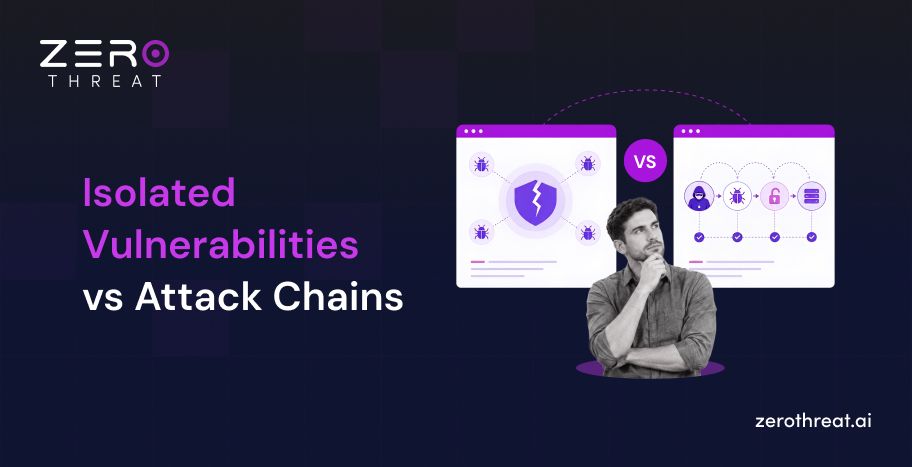
A standalone finding answers one question: is this thing broken. A chain answers a different one: what can a broken thing here reach over there. The severity score of any single link tells you almost nothing about the severity of the sequence, because the sequence creates capabilities that no individual flaw possesses.
Consider the difference in framing. A scanner reports an information disclosure issue, an access control gap, and a weak token generator as three separate rows in a report, each with its own severity. An attacker reads the same three rows as one instruction set: disclosure tells me the target identifier, the access control gap lets me reach that identifier's data, and the weak token lets me act as them. The findings did not change. The composition was done.
This is why chaining is the default operating mode of real intrusions and the blind spot of tools built to grade findings one at a time.
Why "Low-risk" Severity Labels Mislead?
"Low-risk" severity labels mislead because scoring systems like CVSS rate each vulnerability in isolation, with no model of reachability, chaining, or business context, so a finding that is trivial alone can be the decisive link in a critical attack path.
CVSS was designed to describe the intrinsic properties of a single vulnerability: how it is accessed, how complex it is to exploit, and what it impacts. Those are useful properties. They are also incomplete, because the standard explicitly scores the flaw in a vacuum. It has no field for "and once I have this, the next thing becomes trivial." Chaining lives entirely in that missing field.
The result is a severity math that does not add up the way defenders assume. Three findings scored 3.5, 4.0, and 3.1 look like a low-priority cleanup backlog. Arranged as a chain, their combined effect is a full account takeover, which any team would score critical if it were a single finding. The scores did not lie about each part. They simply have no way to describe the whole thing.
Attackers exploit exactly this accounting error. They do not sort out a findings list by severity and start at the top. They map which findings connect, and they prioritize the cheapest path to the highest-value asset, regardless of how each individual step was rated. A well-defended target with zero critical and a long tail of "accepted" lows is, from the attacker's seat, a target with a long tail of building blocks.
Isolated severity is not wrong. It is just answering a question that attackers stopped asking a long time ago.
The Anatomy of An Attack Chain
An attack chain is a staged sequence in which the attacker moves from reconnaissance to an initial foothold, then pivots and escalates context, and finally converts that access into business impact, with each stage enabled by a weakness that would be low-risk on its own.
Chains vary in length and content, but the structure is consistent. Understanding the stages is what lets you spot where a "minor" finding is actually load-bearing.
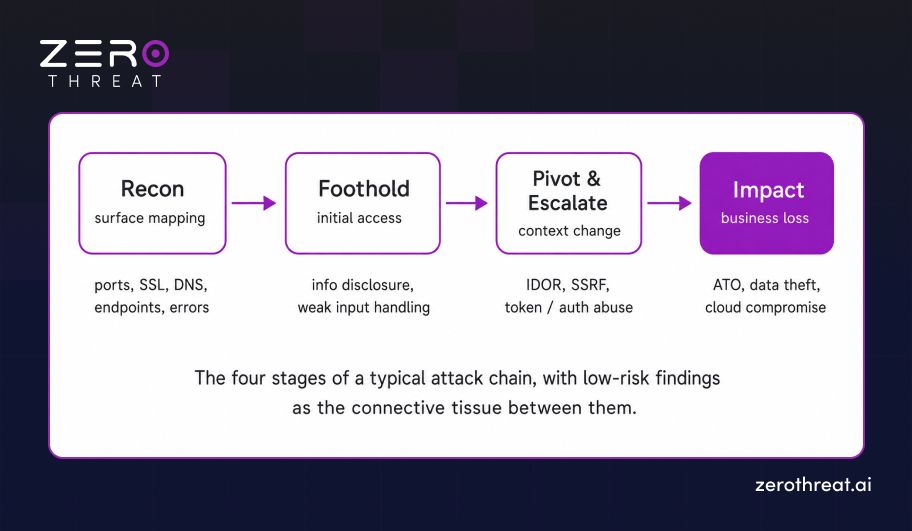
Stage 1: Reconnaissance and Surface Mapping
The attacker enumerates the external attack surface, from ports, SSL configuration, and DNS through to application endpoints, parameters, and error behavior. The goal is not a single flaw yet. It is inventory. Verbose errors, exposed headers, and predictable naming conventions all feed the map.
Stage 2: Initial Foothold
The attacker uses a low-friction weakness to gain first, limited capability. This is often an information disclosure, a permissive input handler, or an unauthenticated endpoint that leaks into structure. It rarely grants access to its own. It grants the next precondition.
Stage 3: Pivot and Privilege or Context Escalation
This is where isolated findings become dangerous. An access control gap like IDOR (CWE-639) turns a known identifier into someone else's data. An SSRF (CWE-918) turns a fetch feature into a request from inside the network. A weak token turns a leaked seed into a valid session. Each pivot expands what the attacker can reach.
Stage 4: Business Impact
The chain terminates at something that matters to the business: account takeover, sensitive data exfiltration, financial fraud through a broken workflow, or cloud account compromise. This is the only stage a severity score would have called critical, and it is the stage that isolated scoring never predicts.
Common Chain Ingredients
- Verbose errors and stack traces
- Information disclosure endpoints
- IDOR / broken object-level auth
- Open redirects
- Missing rate limiting
- Weak or predictable tokens
- Permissive CORS
- OAuth / redirect_uri misconfig
Every low-risk finding deserves a second look. Let AI decide why. Let AI Analyze
Real Examples: Low-to-High Attack Chains
The stages above are abstract until you see them assembled. Below are three chains built entirely from findings that most scanners grade low or informational. Each ends somewhere a business would call an incident.
Attack Chain 01 - Info disclosure + IDOR + predictable token → account takeover
Info disclosure → IDOR → Weak token → Full ATO
- A profile endpoint GET /api/v2/profile returns more than it should, including an internal userId and the account email. Rated informational.
- A settings endpoint GET /api/v2/account/{userId}/settings has no object-level ownership check (CWE-639). Supplying another user's userId returns their security metadata. Rated medium at most.
- The password reset token is derived predictably (CWE-330) from userId and a coarse timestamp. With both known, the attacker forges a valid token and submits POST /auth/reset. Rated low in isolation.
- Result: the attacker resets any user's password and takes over the account. Three low-to-medium findings compose into a critical.
Attack Chain 02 - Open redirect + loose redirect_uri → OAuth token theft
Open redirect → redirect_uri flaw → Missing state → Token exfil
- The login flow reflects an unvalidated returnUrl parameter (CWE-601), a classic open redirect that scanners flag low.
- The OAuth server validates redirect_uri with a prefix or substring match instead of an exact allowlist, so an attacker-controlled subdomain or path is accepted.
- The state parameter is not enforced, removing the last guardrail against a crafted authorization request.
- Chained, the attacker routes the authorization code or access token to a host they control and gains access to the victim's account. No single step was rated high.
Attack Chain 03 - Convenience fetch feature + no egress guard → SSRF to cloud credentials
URL fetch feature → No SSRF filter → Metadata endpoint → Cloud takeover
- A "helpful" feature lets users import from a URL, for example POST /api/import with a sourceUrl field, or an avatar-from-URL uploader. Treated as a product feature, not a finding.
- The server fetches the supplied URL with no egress filtering or allowlist, which is a server-side request forgery primitive (CWE-918).
- The attacker points sourceUrl at the cloud link-local metadata endpoint 169.254.169.254. On an instance still allowing IMDSv1, this returns temporary IAM credentials.
- With those credentials, the attacker acts against the cloud account directly. A convenience feature plus a missing filter becomes full cloud compromise.
None of these chains required a zero-day or a single high-severity vulnerability. Each required only that the individual weaknesses existed, were reachable, and were never evaluated together.
How Zerothreat Identifies and Breaks Attack Chains?
ZeroThreat’s AI-powered pentesting tool identifies attack chains by testing the application the way a real attacker does, discovering the pivots between findings, correlating individually low-risk weaknesses into a single validated attack path, and ranking that path by the business asset it actually reaches.
Traditional pentesting tools or vulnerability scanners cannot chain because they were never built to reason across findings. They emit rows. Discovering that row three is the token that unlocks row one requires understanding the application's behavior, state, and workflows, not just its response signatures. That understanding is where AI penetration testing operates.
- Application-aware Attack Path Discovery: ZeroThreat exercises real user workflows, including authenticated and multi-step flows, so it finds the pivots between findings rather than treating each endpoint in isolation. This is what surfaces the IDOR-into-token step that a signature scan walks straight past.
- Cross-finding Correlation into a Single Chain: Individually low-risk weaknesses are composed into the actual path an attacker would take, so three "lows" are reported as the one critical they add up to, not three rows to defer.
- Business-aware Prioritization: The chain is ranked by the asset it reaches, not by the CVSS of its weakest link, which answers the "high-impact" half of the problem directly and tells teams what to fix first.
- Proof-based Findings with Zero False Positives: Each chain is validated by exploiting it safely, so the load-bearing links are not buried under noise and every reported path is real.
- Output Tuned to Two Audiences: Security teams receive the full attack path, impact, and priority. Application teams receive reproduction steps, endpoints, parameters, evidence, and remediation guidance for each link, so the chain gets broken at the cheapest point.
Breaking a chain does not require fixing every node. It requires removing one load-bearing link, and knowing which link that is. That is precisely what path-level discovery gives you that a findings list cannot deliver.
| Dimension | Isolated Finding View | Attack Chain View |
|---|---|---|
| Dimension | Isolated Finding View | Attack Chain View |
| Unit of analysis | Single vulnerability | End-to-end attack path |
| Severity basis | CVSS of each flaw | Business impact of the reached asset |
| Cross-finding logic | None; rows are independent | Correlated; output of one feeds the next |
| Low-risk findings | Deferred or accepted | Evaluated as potential links |
| Validation | Signature or heuristic match | Safe exploitation, proof-based |
| Remediation guidance | Fix each row | Break the load-bearing link |
ZeroThreat’s penetration testing covers this across web applications and APIs, including the business logic and authenticated flows where the most valuable pivots hide.
One live demo. One attack chain. A completely different view of your security. Show Me Live
Closing The Gap Between Findings and Paths
The uncomfortable truth in most vulnerability backlogs is that the criticals are not the whole story. The story is in the lows that connect. A clean scorecard with a long tail of accepted low-risk findings is not a secure application. It is an unmapped attack surface waiting for someone to draw the edges between the nodes.
Closing that gap means testing the way attackers operate: discovering the pivots, correlating the weak links, validating the full path, and prioritizing by what the chain actually reaches. That is what ZeroThreat's attack chain discovery is built to do, so the chain is broken in your pipeline instead of demonstrated in your incident report. Start with ZeroThreat’s AI pentesting and see the paths, not just the list.
Frequently Asked Questions
Why do traditional scanners miss attack chains?
Traditional scanners miss attack chains because they grade findings one at a time and have no model of reachability, state, or workflows. Discovering that one finding unlocks another requires reasoning across the application's behavior, not matching response signatures row by row.
How is an attack chain different from a single exploit?
How do you defend against chained vulnerabilities?
How does ZeroThreat detect attack chains that scanners cannot?
Explore ZeroThreat
Automate security testing, save time, and avoid the pitfalls of manual work with ZeroThreat.