 ZeroThreat Wins Bronze Stevie® Award in Tech Startup of the Year Read more

All Blogs
Insecure Deserialization: How to Detect and Validate Exploitable Web Application Risks
Quick Overview: Insecure deserialization can allow attackers to manipulate serialized data and trigger unintended application behavior, including remote code execution. This guide explains how these attacks work across Java, PHP, Python, and .NET, why they are difficult to validate, and how security testing can confirm whether a finding is actually exploitable. It also covers remediation and how ZeroThreat helps validate deserialization risks.
Serialization exists so objects can move: into a cookie, across an API boundary, onto a message queue, into a cache. The problem is what happens on the way back. When an application deserializes data, it didn’t create or fully trust, attackers may be able to influence the objects the application creates. This can happen before the application has a chance to properly validate or inspect that data.
This is why insecure deserialization has outlived a decade of remediation guidance. It is not an input validation bug that a filter can catch at the edge. The dangerous work happens inside the deserializer itself, in callbacks that fire automatically during object reconstruction. By the time your validation code runs, the payload has already been executed.
That mechanic creates a specific problem for security teams: a deserialization sink is not a deserialization vulnerability. Scanners and code search will surface every readObject() and unserialize() call in a codebase, and most of them are harmless. Some are catastrophic. Nothing in the pattern itself tells you which is which.
This article works through the mechanics of insecure deserialization exploitation, then the five gates that a web app pentesting tool for automated security testing has to clear to turn a suspected sink into a proven, prioritized finding: sink reachability, entry point and integrity, gadget-chain availability, controlled trigger confirmation, and impact.
Find out whether your serialized entry points are actually exploitable, with proof rather than a pattern match. Start Testing for FREE
On This Page
- What is Insecure Deserialization?
- How Insecure Deserialization Becomes Exploitable?
- Insecure Deserialization by Runtime: Java, PHP, Python, and .NET
- Why is Insecure Deserialization Difficult to Validate?
- How Security Testing Validates Exploitable Deserialization Risk?
- What a Validated Deserialization Finding Should Change?
- Validating Deserialization Risk with ZeroThreat
- Conclusion
What is Insecure Deserialization?
Insecure deserialization is a vulnerability class in which an application reconstructs objects from untrusted serialized data, allowing an attacker to influence the objects that get built and the code that runs during reconstruction. It is catalogued as CWE-502, Deserialization of Untrusted Data.
Serialization converts an in-memory object into a portable byte stream. Deserialization reverses it. Web applications lean on this constantly: session state in cookies, view state in hidden form fields, cached objects in Redis, job payloads on a queue, and object graphs passed between microservices.
The distinction that matters are between parsing and reconstructing. Parsing untrusted JSON into a dictionary is a data operation, and the worst case is malformed data. Deserializing untrusted input with a native deserializer is a code operation: the runtime instantiates arbitrary classes and invokes their lifecycle methods as part of the process. Attacker-controlled input determines which vulnerability classes can be tested and how the application responds to the attack.
OWASP folded this risk into A08:2021, Software and Data Integrity Failures. Readers looking for the older standalone category will find it as A8:2017. The renaming reflects the root cause well: the failure is trusting the integrity of data that was never protected in the first place. For a broader look at how this risk fits into web application security, check out our guide to web application security testing.
How Insecure Deserialization Becomes Exploitable?
Insecure deserialization becomes exploitable when attacker-controlled input reaches a native deserializer that automatically invokes callback methods on the reconstructed objects, and the runtime has classes available that can be chained into a useful sequence of operations.
The sequence has four moving parts, and all four have to line up.
Attacker-controlled Input: The serialized blob has to be something the attacker can modify and resubmit. If the value is signed, encrypted, or generated entirely server-side and never round-tripped through the client, the chain stops here.
Object and Property Manipulation: Serialized formats encode both type information and field values. An attacker who can edit the blob can change a field, swap a class for a different one, or nest objects the application never intended to build. This is object injection, and in loosely typed runtimes it also enables type confusion, where a supplied object of the wrong type passes a check that assumed a different one.
Magic Methods and Dangerous Callbacks: This is the pivot. Deserializers invoke code during reconstruction. PHP calls __wakeup() and later __destruct(). Python's pickle honors reduce, which exists precisely to tell the unpickler what callable to invoke. Java runs a class's private readObject(). None of this wait for the application to approve the object.
Gadget Chains: A deserialization payload is not shellcode. It is a graph of legitimate objects, drawn from classes already present in the application's dependencies, arranged so that their callbacks pass control from one to the next until something dangerous executes. The final link is often a reflective method invocation or a template evaluation. Chains assembled this way are called gadget chains, or POP chains in the PHP world.
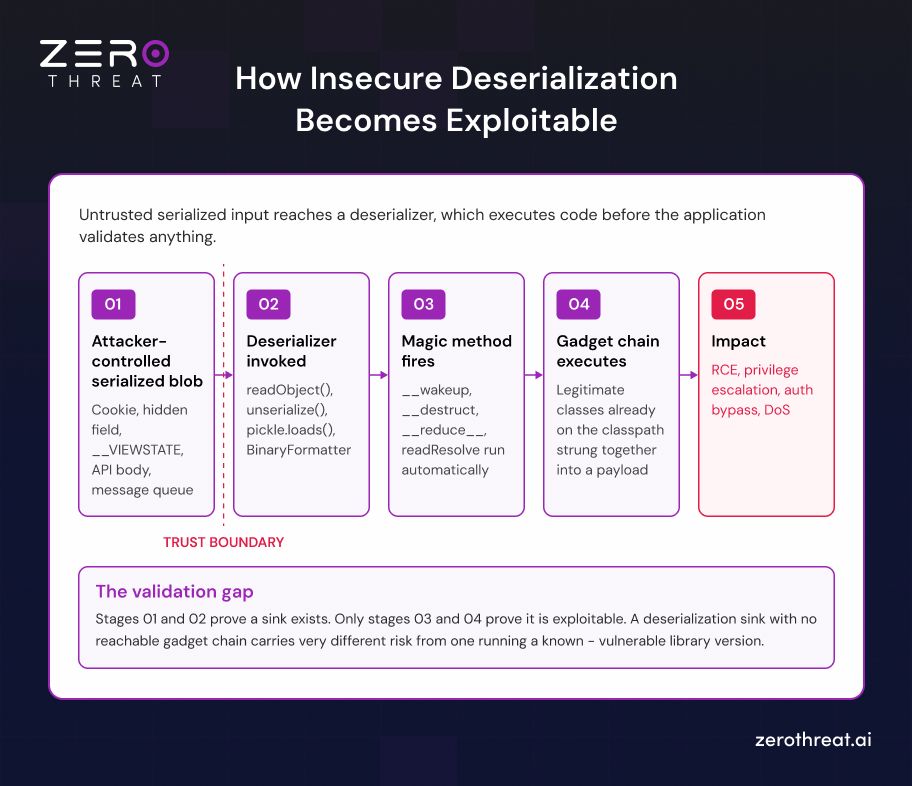
Remote code execution is the outcome that gets attention, but it is not the only one. Manipulating a deserialized session or identity object can produce authentication bypass or privilege escalation without executing a single command. Object graphs designed to expand during reconstruction cause denial of service. Gadget chains ending in a file read or an outbound request leak sensitive data or reach internal services. The impact depends on which chain is available, not on the sink.
What if that “low-confidence” finding leads to RCE? Let AI-powered pentesting investigate the attack path. Trace with Automated Pentesting
Insecure Deserialization by Runtime: Java, PHP, Python, and .NET
Insecure deserialization appears in every major web runtime, but the deserializer, the callbacks it invokes, and the recognizable format of the serialized blob differ enough that testing has to be runtime specific.
| Runtime | Deserializer | Attacker-reachable callbacks | Blob fingerprint |
|---|---|---|---|
| Java | ObjectInputStream.readObject() | readObject, readResolve, finalize | Hex AC ED 00 05, Base64 rO0 |
| PHP | unserialize() | __wakeup, __destruct, __toString | Starts O: or a: |
| Python | pickle.loads(), yaml.load() | reduce,setstate | Pickle opcodes, YAML !!python/ tags |
| .NET | BinaryFormatter, LosFormatter | OnDeserialized, type converters | Base64 AAEAAAD |
| Ruby | Marshal.load | marshal_load, method_missing | Starts \x04\x08 |
Java is the classic case. Gadget research against libraries such as Apache Commons Collections produced reusable chains that work against any application with a vulnerable version on the classpath, which is why Java deserialization bugs in enterprise middleware have been so consistently severe.
PHP object injection is often reachable through session handling and cookie values, where a serialized object round-trips through the client. The chain typically terminates in __destruct(), which fires even when the deserialization itself appears to fail.
Python pickle deserves the bluntest treatment: pickle.loads() on untrusted data is equivalent to executing that data. There is no safe configuration.
.NET exposes this most commonly through __VIEWSTATE when message authentication is disabled or the machine key has leaked, and through JSON libraries configured with permissive polymorphic type handling.
Entry points follow the same shape across all of them. Cookies and session objects, hidden form fields and view state, serialized parameters in API request bodies, message queue payloads, cache entries, file uploads, and internal object protocols. Anywhere a byte stream crosses a boundary and comes back, the fingerprints above are worth checking against.
Why is Insecure Deserialization Difficult to Validate?
Insecure deserialization is difficult to validate because exploitation is usually blind, the payload depends on runtime conditions a tester cannot see from outside, and a successful attack often produces a response identical to a failed one.
Several factors compound:
- Encoded and Obfuscated Data: Serialized blobs arrive at Base64-encoded, compressed, or encrypted, so the entry point is not obvious from traffic inspection alone.
- Application-specific Object Structures: A valid payload has to match the shape the application expects well enough to reach the deserializer at all.
- Sink Identification: The parameter an attacker controls and the code that deserializes it may sit several layers apart, in a framework or a library rather than application code.
- Runtime and Dependency Conditions: Exploitability depends on which classes are loaded at which versions, which is invisible from the outside and changes between deployments.
- No Observable Feedback: There is rarely reflected output or an error delta to confirm execution.
This is where pattern-matching tools reach their limit. Static analysis is good at enumerating sinks and poor at proving that untrusted input reaches them, which is why application security testing tools that rely on code patterns alone produces long lists of deserialization findings with no way to rank them. A codebase with forty unserialize() calls and one exploitable path looks, on a report, much like a codebase with forty harmless ones.
How Security Testing Validates Exploitable Deserialization Risk?
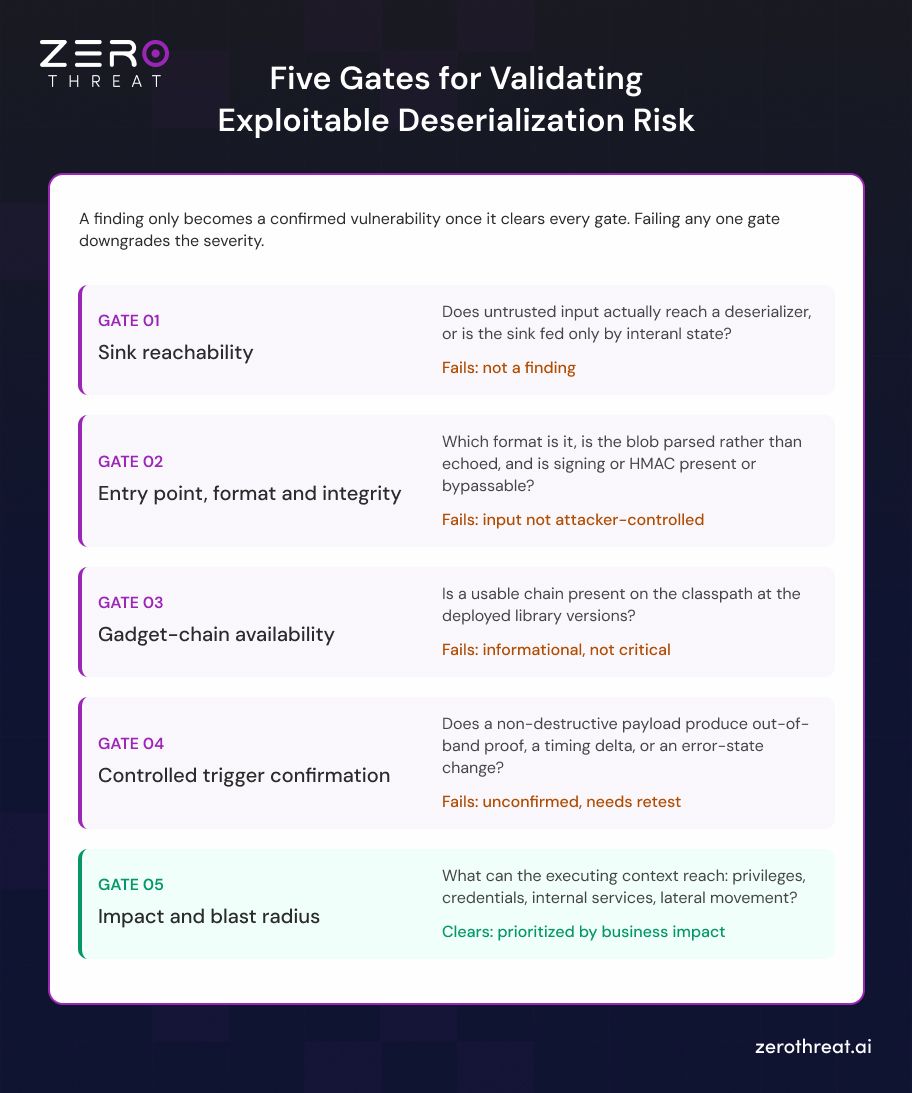
Security testing validates exploitable deserialization risk by working through five gates in sequence. A finding that clears all five is a confirmed vulnerability. A finding that fails any one of them is something less and should be reported as such.
Gate 1: Sink Reachability
Establish that untrusted input actually reaches a deserializer. This means mapping the application and API attack surface, identifying which parameters carry serialized data, and tracing whether the deserializing code path is fed by that input or only by internal state. A sink that never sees external data is not a finding. This gate is where web application security testing coverage matters most, because an unmapped endpoint is an untested one.
Gate 2: Entry Point, Format, and Integrity
Fingerprint the format using the markers in the table above, then confirm the blob is being parsed rather than echoed or stored. The integrity question follows: is the value signed, HMAC-protected, or encrypted? If it is, can that protection be bypassed through a weak or leaked key, a null-signature acceptance path, or an algorithm confusion trick? A signed blob with a verifiable signature and a secret key is not attacker-controlled, and the finding stops here.
Gate 3: Gadget-chain Availability
This is the decisive gate and the one most testing skip. An unsafe sink with no usable chain on the classpath carries a very different risk from the same sink in an application running a library version with a public chain against it. Validation here means fingerprinting the loaded libraries and their versions, then determining whether any known chain is reachable in that specific configuration. Version detection matters more than sink detection, because the sink rarely changes, and the dependency graph changes every release.
Gate 4: Controlled Trigger Confirmation
Prove execution without damaging anything. Since deserialization exploitation is usually blind, confirmation comes from out-of-band signals: a DNS lookup or HTTP callback to a controlled listener, a measurable timing differential from an induced delay, or a distinctive error-state change. This is deliberately not destructive proof. Writing files or spawning processes on a live system to demonstrate a bug creates a real incident, and a callback proves the same thing. Safe execution boundaries are what makes this testing viable against production.
Gate 5: Impact and Blast Radius
Determine what the executing context can actually reach. Process privileges, credentials available in memory or environment, network position, and reachable internal services all shape severity. Two confirmed deserialization bugs, one in a sandboxed worker with no network egress and one in an application server holding database credentials, are not the same risk. This gate converts a technical finding into a prioritized business decision, and it is the part most vulnerability reports omit entirely. Our overview of security testing for web applications covers how this validation step fits the wider testing process.
Stop collecting vulnerabilities. Start finding the ones attackers can use. Run an AI Pentest
What a Validated Deserialization Finding Should Change?
A validated deserialization finding should trigger a durable architectural fix rather than a filter, because blocklists of dangerous classes are consistently bypassed by new gadget research while the underlying sink remains.
Ordered by durability rather than by ease:
Remove native deserialization of untrusted data. Replace object serialization with a data-only format and an explicit schema. This eliminates the vulnerability class rather than constraining it.
Enforce strict class allowlisting where removal is not viable. Java offers ObjectInputFilter under JEP 290, PHP accepts an allowed_classes argument to unserialize(), and .NET JSON libraries should have permissive type-name handling disabled. Allowlist what is permitted; never blocklist what is known to be dangerous.
Verify integrity before parsing. If serialized data needs to travel through the client and back to the server, sign or encrypt it and verify its authenticity before deserializing it. Keep dependencies patched, since gadget availability tracks library versions directly.
Contain the blast radius. Least-privilege execution, network egress restriction, and runtime monitoring for anomalous deserialization behavior reduce what a successful exploit reaches. These are containment controls, not fixes. They belong alongside the durable measures covered in our web app security best practices guide.
Validating Deserialization Risk with ZeroThreat
ZeroThreat validates deserialization risk by testing applications at runtime rather than matching code patterns, generating serialization-aware payloads against discovered entry points and confirming exploitability through controlled, non-destructive execution.
The engine maps the full application and API attack surface first, including authenticated flows and complex user journeys, so serialized parameters in cookies, view state, and request bodies are discovered rather than assumed. It then mutates those inputs in a format-aware way, using out-of-band confirmation to establish whether a payload actually executed.
Findings that cannot be confirmed are not reported as critical, which is how automated penetration testing reaches 99.9% detection accuracy with near-zero false positives across 130K+ attack patterns per scan.
Agentic AI pentesting extends this to multi-step attack chains, reasoning about how a confirmed deserialization foothold connects to credentials, internal services, and lateral movement, which is the Gate 5 question. Output is split by audience: security teams receive the attack path, impact, and business-aware priority, while application teams receive the endpoint, parameter, reproduction steps, evidence, and remediation guidance needed to fix it.
Want to see whether your “secure” application can actually withstand an attack? Get a Free Demo
Conclusion
Finding a deserialization mechanism is the first step, not the finding. The distance between a sink that matches a pattern and a vulnerability that an attacker can actually use is measured in reachability, gadget availability, confirmed execution, and blast radius. Every one of those is a runtime property, and none of them can be read from source code.
Security programs that treat detection as the deliverable end up with backlogs ranked by severity labels that nobody validated. Programs that treat exploitability as the deliverable fix fewer things, faster, and fix the right ones. Insecure deserialization is a particularly unforgiving test of which kind you are running, because the gap between the two is so wide.
ZeroThreat is built for that gap. It discovers the entry points, tests them the way an attacker would, and reports only what it can prove, with the evidence attached. Sign up for free and validate what is actually exploitable in your applications and APIs.
Frequently Asked Questions
What is the difference between insecure deserialization and secure deserialization?
Secure deserialization restricts which types can be reconstructed and verifies data integrity before parsing begins, using explicit allowlists, schema validation, and signature checks. Insecure deserialization accepts arbitrary types from untrusted input and invokes their callbacks automatically. The difference is not the act of deserializing but whether the set of constructible types is bounded in advance.
How is a deserialization vulnerability different from an injection vulnerability?
Is insecure deserialization the same as remote code execution?
Can insecure deserialization be used to reach internal systems the way SSRF can?
Does static analysis or dynamic testing find deserialization vulnerabilities more reliably?


Explore ZeroThreat
Automate security testing, save time, and avoid the pitfalls of manual work with ZeroThreat.