 ZeroThreat Wins Bronze Stevie® Award in Tech Startup of the Year Read more

All Blogs
How to Detect SQL Injection Vulnerability: Step-by-Step Guide
Quick Summary: SQL injections are dangerous, and your data is at stake if you are hit with such an attack. Discover and eliminate hidden SQL injection vulnerabilities in your web app before an attacker finds and exploits them. This blog provides methods to detect SQL injection vulnerability along with a list of top tools to detect it.
Scared of a potential SQL injection attack on your web app? Your fear isn’t wrong! SQL injection is among the most common and dangerous vulnerabilities, affecting more than 23% of web applications and websites.
Being the third most critical web app security risk in the OWASP top 10, identifying and addressing SQL injection vulnerability is the priority of every AppSec team.
The risk of SQL injection arises due to the use of raw SQL queries, or the frameworks used to build applications may have inherent injection vulnerabilities.
From manipulation of databases and deletion of records to execution of unauthorized commands, SQL injection vulnerability poses several risks for applications.
Nevertheless, detecting SQL injection can be tricky, and you need the right tool to test your web app for this vulnerability.
Test Web Apps with ZeroThreat’s Next-Gen Capabilities to Uncover Hard-to-Detect Vulnerabilities Check the Pricing
On This Page
- An Overview of SQL Injection Vulnerability
- Types of SQL Injection
- Test for SQLi with Automated Tools
- Techniques to Detect SQLi Manually
- Top SQL Injection Vulnerability Scanner
- Final Thought
What is SQL Injection Vulnerability in Reality?
SQL injection (SQLi) vulnerability is a kind of security weakness in your web application that allows an attacker to inject malicious SQL statements or commands to hack your database. The attacker can insert SQL statements, typically in input fields or URL parameters in your web app, that it inadvertently executes, resulting in data manipulation.
The attacker usually manipulates forms or query parameters to trick an application into executing SQL commands. After successful SQL injection, an attacker can retrieve, manipulate, or delete data stored in a database.
The attack works as the following:
- Malicious Input: Web apps take inputs such as login credentials or search queries that are then used to build SQL queries to retrieve or manipulate data. The attacker enters specially crafted data with partial or full SQL statements in the input.
- Improper Validation: Vulnerable web applications lack robust input validation, sanitization, and character escape to validate every input before it goes to the core logic. Consequently, the application accidentally executes unintended SQL commands that risk its integrity and security.
- Data Exposure: An attacker can steal data or damage your database after an SQL injection attack is successful.
Types of SQL Injection
Attackers can use SQLi in a range of ways to cause serious damage to your database and reputation. The following are the different types of SQL injection.
Classic SQLi or In-band SQLi
In-band is the simplest and most common type of SQL injection attack in which an attacker uses the same channel to launch an attack and gather its results. There are two subtypes of classic SQLi:
- Error-based SQLi: This type of attack depends on the error messages generated by the database. These messages provide vital information about the structure and design of the database to the attacker that he can use to plan exploitation.
- Union-based SQLi: In this technique, an attacker uses the UNION operator of SQL that is used to combine two queries. With Union-based SQLi, the attacker tries to combine a malicious SQL statement with normal statements.
Blind SQLi or Inferential SQLi
In this technique of SQL injection, an attacker doesn’t directly get a response from the database after injecting malicious statements. Instead of this method, the attacker tries to infer information by observing application behavior, for example, changes in PHP status code, delay in response, and changes in page content. The following are the subtypes of blind SQLi.
- Time-based Blind SQLi: In this technique, the attacker uses a malicious SQL statement and observes the response time of the database. The attacker can infer that a longer delay indicates the condition is true. For example, ' OR IF(1=1, SLEEP(5), 0) -- will check for the delay.
- Boolean-based Blind SQLi: This is a kind of SQLi in which an attacker inserts conditional statements to trick an application into executing malicious commands. For example, a statement like ‘ AND 1=1 -- will always be true, and the web app will load a page.
Out-of-Band SQLi
In the out-of-band SQL injection, the attacker doesn’t use the same channel to launch the attack and gather information. The out-of-band technique is used to detect blind SQL injection vulnerabilities because there is no direct response from the web application.
How to Test Web Apps for SQL Injection with Automated Tools?
Testing a web application for SQL injection involves trying to feed malicious SQL data and see how it behaves. You can do this by inserting SQL code in URL parameters, input fields, and any other data source to check if the application behaves unexpectedly.
It can be done manually or using an automated security testing tool. Let’s see the automated method in action to detect SQL injection vulnerability.
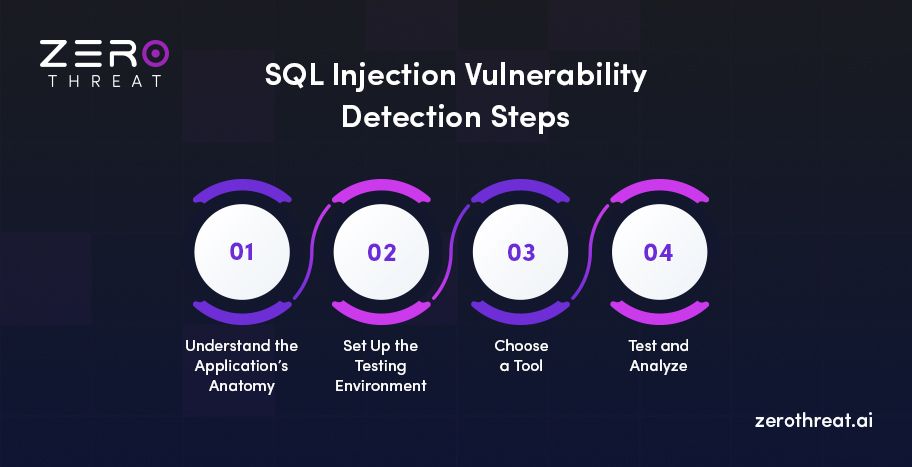
Step 1: Understand the application’s anatomy
First, understand your web application’s structure and components. Identify the app’s components that interact with the database like:
- Query parameters in URLs
- Search boxes
- Login forms
- Dropdowns, sorting options, and filters
Step 2: Set up the testing environment
Create a controlled test environment to test your web application. This should be a secure environment, often separate from a live environment, to avoid disruptions.
Step 3: Choose a tool
Choose a vulnerability detection or DAST tool to perform automated scans and identify critical vulnerabilities. There are free tools like ZeroThreat, OpenVAS, ZAP, Burp Suite Community Edition, and SQLMap. You can use these tools to test web applications for SQL injection and many other vulnerabilities.
These tools will automate hacker-like attacks on your application by sending payloads to identify the SQL injection vulnerability. The tools will report the vulnerability with suggestions for remediation. This will allow DevSecOps teams to take prompt action to fix the issue and secure the application.
Step 4: Test and Analyze
Configure the tool and run automated vulnerability scanning. After the test, the tool will generate a report. This report will offer essential insights into the vulnerabilities detected, their severity level, business impact, and more. Analyze the report carefully to identify the critical risks and take prompt action to remediate them.
Secure Your Apps Flawlessly – No Tech Expertise Needed, No Set Up Needed! Get Instant Access
5 Techniques to Detect SQL Injection Vulnerability Manually
Apart from automated scanning, you can also test web apps manually for SQL injection vulnerability. While an automated SQL injection scanner requires near-zero human involvement to test web apps and identify SQLi, manual testing requires technical skills and prior experience. Therefore, ethical hackers often perform these types of tests. Let’s check out the manual process to test web apps for SQL injection.
1. Basic Statements
Start by testing your web application with basic SQL statements that include characters like:
- '
- ;
- --
- "
After this observe the application’s response to see any error message like “SQL syntax error” or changes in the application’s output. Such behavior may indicate susceptibility to attacks.
2. Conditional Statements
Now try to inject Boolean statements (those with output – true or false). Insert Boolean statements like ‘ OR 1=1-- into the input field to see the response. The application is likely vulnerable to SQL injection if all results are shown in the response.
3. Time Delay Method
Use an SQL injection payload that can cause a delay in response when a condition is true. For example, you can use a payload like ‘ OR IF(1=1, SLEEP(5), 0)-- that pauses the execution for 5 sec when the condition is true. The application is likely vulnerable if the response takes longer.
4. Union-based Queries
UNION is an SQL operator that combines data from two or more SELECT statements. Unintended union-based queries can be inserted into legitimate queries to produce unexpected results or application behavior. However, for this attack technique to work successfully, you must identify the number of columns returned by the original query.
For example, a specifically crafted statement like ‘ UNION SELECT NULL, NULL— can be used where NULL can be incremented gradually to match the number of columns in the table. After successful matching, you can switch NULL with data like “username” and “password” to try to access data.
5. Error Messages
Another technique to test SQL injection is inspecting error messages. Test the application by sending more complex payloads that can cause an error. Analyze error messages generated by the database to understand the structure and design to exploit it.
Top 5 SQL Injection Vulnerability Scanners
The following is the list of the top 5 SQL injection scanner tools.
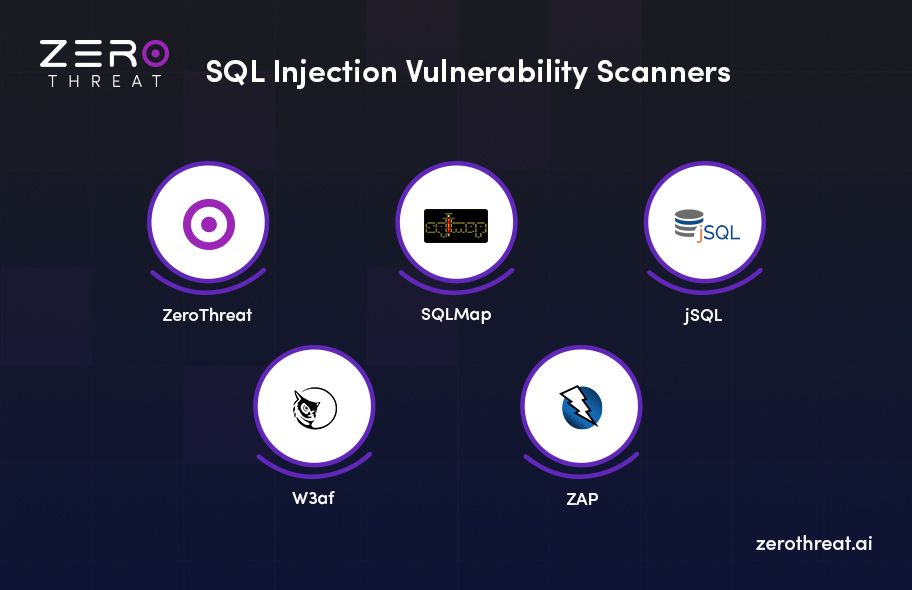
1. ZeroThreat
ZeroThreat combines next-gen DAST capabilities with automated pentest to uncover critical security vulnerabilities. It allows you to detect SQL injection vulnerabilities precisely by evaluating your web app for blind SQLi, in-band, error-based, and other SQL injection flaws.
2. SQLMap
SQLMap is an open-source SQL vulnerability scanner that performs simulated attacks on the target web apps to identify and exploit vulnerabilities. With automated pen testing, it thoroughly evaluates your application for six SQL injection techniques – UNION query-based, time-based blind, boolean-based blind, error-based, and out-of-band SQL injection.
3. jSQL
JSQL is also an open-source SQL injection vulnerability scanner with excellent features to detect vulnerabilities. As a Java-based cross-platform tool, jSQL is available for Windows, Linux, and macOS systems. It is also preinstalled on popular pentest OSes like Parrot and Kali Linux. It provides various attack payloads to detect SQL injection vulnerability.
4. W3af
W3af is a feature-rich web application security scanner that discovers a wide range of vulnerabilities including SQL injection. It automates the discovery and exploitation of vulnerabilities in web apps. As a powerful open-source tool for web app testing, it enables developers, security professionals, and ethical hackers to detect a wide range of vulnerabilities accurately.
5. ZAP
Zed Attack Proxy or ZAP is a popular web app security testing tool that helps detect different vulnerabilities, including SQLi. OWASP ZAP is an open-source and free vulnerability scanner that performs hacker-style tests on web apps using various attack techniques for SQLi, including time, error, and boolean-based injections.
Integrate Smarter Security Testing into Your SDLC with Our DAST Solution Contact Our Team for More
Final Thought
SQL injection is a critical vulnerability that still holds the third place in OWASP’s list of the most fatal vulnerabilities in web apps. If it is left undetected, a hacker can attack your web app and easily manipulate records in your database.
Not only can the hacker gain access to sensitive data, but also manipulate information in your database. Besides, if the database privileges are too permissive, the hacker may even get access to credentials stored in the database, resulting in an account takeover.
So, detecting and fixing vulnerabilities is crucial to securing web applications. Choosing the right SQL injection vulnerability scanner – ZeroThreat can simplify this task. With a powerful crawling engine and next-gen AppSec capabilities, ZeroThreat can identify SQL injection vulnerabilities precisely.
It simulates different SQLi techniques to evaluate web apps and uncover vulnerabilities. With seamless integration into the CI/CD pipeline, development teams can detect SQLi and fix it before the app is deployed in production.
Frequently Asked Questions
What are the different ways to detect SQL injections in web apps?
There are many techniques to detect SQL injection vulnerability in web apps:
- Error-based
- UNION-based
- Time-based
- Boolean-based
- Blind SQLi
How to prevent SQL injection attacks?
What is the best tool to detect SQL injection?


Explore ZeroThreat
Automate security testing, save time, and avoid the pitfalls of manual work with ZeroThreat.