 ZeroThreat Wins Top InfoSec Innovators 2026 Award for Penetration Testing Read more


All Blogs
What is ARTEX? Understanding Attacks and Defenses with ZeroThreat
Quick Overview: Learn what ARTEX is, how its AI agents plan and run attacks, and which organizations it has already hit. This blog covers the weaknesses ARTEX exploits, practical steps to defend against it, and why annual pentests fall short. It also shows how ZeroThreat's continuous AI pentesting helps defend against ARTEX and other autonomous attacks in web apps and APIs before attackers exploit them.
Three hours. That's it.
That's how long some attackers needed to get from first targeting an organization to privileged access inside its cloud. Microsoft Threat Intelligence found that several attacks by Storm-0940, a China-aligned group, hit that mark using ARTEX. ARTEX is an open-source AI pentesting framework that attackers have turned into an attack platform. Its agents scan, exploit, and replan with very little human input.
That speed changes the math for security experts defending against them.
A vulnerability that slips into a release no longer takes weeks for someone to find. An AI agent can locate it, chain it with another weakness, and exploit it before your next release ships.
This guide explains what ARTEX is, how it attacks, which weaknesses it targets, and how ZeroThreat, an advanced AI pentesting tool, helps you detect autonomous attacks and close security gaps.
ARTEX agents hunt for exploitable flaws around the clock. Find the ones in your web apps first. Test Before ARTEX Attacks
On This Page
- What is ARTEX?
- Which Companies Have Been Attacked with ARTEX?
- How Does ARTEX Use AI to Attack Organizations?
- Which Weaknesses Does ARTEX Exploit?
- How to Defend Against ARTEX and Other Similar AI Attacks?
- Why Annual Pentests Can't Keep Up With ARTEX?
- How Does ZeroThreat Help Defend Against ARTEX-Style Attacks?
- Summing Up
What is ARTEX?
ARTEX is an open-source, AI-driven penetration testing and command-and-control (C2) framework. It uses multiple AI agents to plan and run attacks with little human input. It was released for authorized red teaming, but threat actors have used it throughout 2026 to break into web applications, cloud tenants and identity systems at machine speed.
ARTEX is written in Go and comes with a Next.js web console. A planning agent maps the target and assigns tasks to specialized worker agents. Those agents run standard offensive tools, report what they find, and replan after each step. ARTEX works with almost any large language model, so operators can run it on low-cost models and still get adaptive, multi-stage attacks. CrowdStrike found one attacker running it on DeepSeek V4.1 Flash, GLM-5.3, and Grok 4.6.
It is not malware in the traditional sense. It's a dual-use offensive framework, the same category as commercial C2 tools, and it became an attack platform once anyone could download it.
| Attribute | Details |
|---|---|
| Type | Multi-agent, LLM-driven pentesting and C2 platform |
| Developer | GitHub user "Autumn-27" |
| First published | July 26, 2026, on GitHub |
| Architecture | Six specialized sub-agents, directed by a planning agent; Go backend, Next.js console |
| Model Support | Works with almost any LLM |
| Current Status | Made closed source in October 2026 after widespread misuse; forks such as ScopeWeaver and a paid "ARTEX PRO" version still circulate |
Because of those forks, withdrawing the original project didn't reduce the threat. Working copies are still in attackers' hands.
Which Companies Have Been Attacked with ARTEX?
As of November 2026, the publicly reported ARTEX victims include three South Korean banks (Shinhan, KB Kookmin and Hana), the Dutch security nonprofit DIVD, IT vendor ConnectWise and software company WorkOS. Larger campaigns have hit about 20 Japanese companies, more than 90 Korean organizations and over 200 organizations in at least 14 countries. Most of those victims haven't been named.
| Victim | Region and Sector | What Happened | Attributed To | Reported By |
|---|---|---|---|---|
| Shinhan, KB Kookmin and Hana banks | South Korea, banking | Customer's personal data of about 67,000 people exposed across Korean financial firms | Likely a financially motivated Chinese-speaking actor | Zscaler, The Record |
| DIVD | Netherlands, security nonprofit | Two zero-days in its Zammad help desk chained to get root access in 12 minutes | Not named | DIVD |
| ConnectWise | IT vendor | Credentials for its Cloud Backup app stolen | Storm-0940 (China-aligned) | Microsoft, ConnectWise |
| WorkOS | Software vendor | Internal sales app accessed; CRM contacts and summaries of customer calls exposed | Not named | Bleeping Computer |
| About 20 Japanese companies | Japan, multiple sectors | ARTEX found on an attack server; eight companies disclosed breaches | Not named | GMO Ierae |
| 90+ Korean organizations | South Korea, schools, hospitals, large enterprises | About 8.2 million records stolen | A seven-person gang, since arrested | Bleeping Computer |
| 200+ organizations in 14+ countries | Foreign ministries, telecoms, pharma, defense | Wide targeting; post-exploitation confirmed at nine organizations | Vapor Panda (China-based espionage group) | CrowdStrike |
These attacks don't all come from one group. ARTEX is used by financially motivated criminals, a state-aligned espionage group, and a small local gang, so seeing ARTEX doesn't tell you who's behind an attack.
The way they got in is more consistent. Many of these breaches started with an exposed web application (a help desk, a sales tool, a banking portal) or a trusted vendor credential, and only then moved to identity and data theft.
How Does ARTEX Use AI to Attack Organizations?
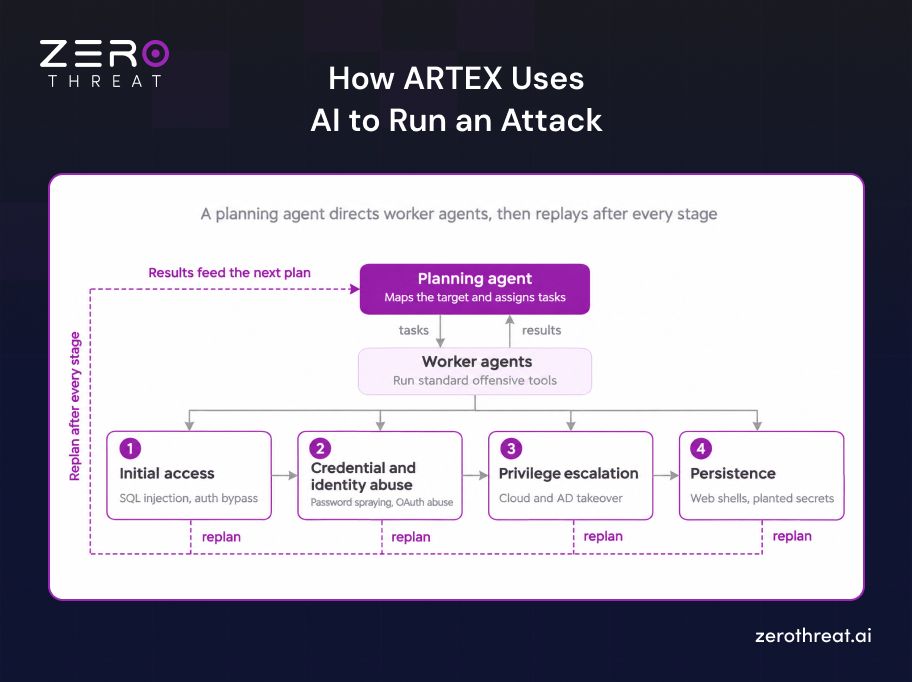
ARTEX runs an attack with a team of AI agents that work the way a human pentester would, only faster. A planning agent studies the target and assigns tasks. Worker agents carry those tasks out with standard offensive tools, and the planner picks the next move based on what they report. A human operator steps in only at key decision points.
Older attack automation repeats the same request until it works or gets blocked. ARTEX agents read each result, replan, and write new scripts as they go, so a failed exploit leads to a different approach. The framework works with almost any large language model. Operators have mostly picked cheaper models, which keeps the cost of each attack low.
1. Initial Access Through Internet-Facing Apps and APIs
The agents start by running reconnaissance on exposed applications. They then try SQL injection and authentication bypass against whatever they find. In more advanced cases, an agent has chained two zero-day vulnerabilities together to get root access on a server.
2. Credential and Identity Abuse
Once they're in, or once they have a stolen credential, the agents spray passwords across many accounts and abuse OAuth app credentials. In one October 2026 campaign, attackers signed in as a stolen multi-tenant backup application across many customer tenants, and in some of them they gave the app Global Administrator rights. Attackers have also forged admin tokens using old signing keys and chained weak SAML assertions with XXE to get past identity checks.
3. Privilege Escalation and Cloud or Directory Takeover
With elevated access, the agents map Active Directory objects at scale, escalate privileges and collect cloud access keys. Techniques seen in real intrusions include Kerberoasting, DCSync, and probing Azure and AWS permissions. Later stages often run entirely on stolen credentials, so the activity can look like a normal user or application at work.
4. Persistence
The agents set up several ways back in. They've planted web shells by poisoning database logs. In one campaign, they added new client secrets to other applications within about five minutes of getting admin rights. Some of those secrets were set to expire in 2028, and they stayed in place after the vendor disabled the compromised apps.
Each agent action runs in a burst of roughly 2 to 25 seconds. Put together, those bursts make an intrusion that moves fast but leaves a noisy trail of failed sign-ins and newly created credentials.
ARTEX chains small flaws into breaches. Test your apps the same way and prove what's exploitable. Test Like an Attacker
Which Weaknesses Does ARTEX Exploit?
ARTEX agents look for exposed web applications with injection or authentication flaws, sign-in pages that allow unlimited attempts, app identities with more permissions than they need, old keys and secrets, and legacy Active Directory and cloud settings. What the AI adds is speed: it finds these gaps and chains them together faster than a human attacker can.
- Vulnerable Internet-Facing Applications: Help desks, sales tools, and customer portals that face the internet are the usual first target. Agents probe them for known and unknown flaws. At DIVD, an agent chained two zero-days in a help desk application to get root access in 12 minutes.
- Injection Flaws in Web Apps and APIs: SQL injection is still one of ARTEX's main ways in. When an application builds database queries straight from user input, agents can pull data or gain a foothold. That's how the attacks on South Korean banks began.
- Broken Authentication and Access Control: Agents try to get around login checks and reach data or functions a user shouldn't be able to see. Weak session handling and missing authorization checks on API endpoints let them in without valid credentials.
- Sign-In Pages Without Rate Limiting: Password spraying works when an identity provider accepts large numbers of attempts from a single source. In one ARTEX-linked campaign, one address sprayed 327 accounts across eight organizations with more than 151,000 failed attempts in five days.
- App and Vendor Identities With Too Much Access: OAuth apps and multi-tenant vendor apps often have broad permissions that nobody reviews. When attackers stole a backup vendor's app credential, they signed in to customer tenants, and in some of them the app granted itself Global Administrator rights.
- Stale Keys, Secrets, and Weak Token Validation: Signing keys that haven't been rotated in years let attackers forge admin tokens; one group used keys untouched since 2022. Unsigned SAML assertions, chained with XXE, gave them another way past identity checks.
- Legacy Active Directory and Cloud Settings: Unsigned SMB and LDAP traffic, heavy use of NTLM, and cloud instances that don't enforce IMDSv2 all make privilege escalation easier. Agents use techniques such as Kerberoasting and DCSync to turn one compromised account into domain-wide access.
The first three weaknesses are in your web applications and APIs, which is where many ARTEX intrusions start. The other four are in identity and infrastructure, and that's where a small flaw turns into a full breach.
ARTEX is cheap for attackers to run. Find a plan that makes continuous defense affordable too. Check Out Pricing
How to Defend Against ARTEX and Other Similar AI Attacks?
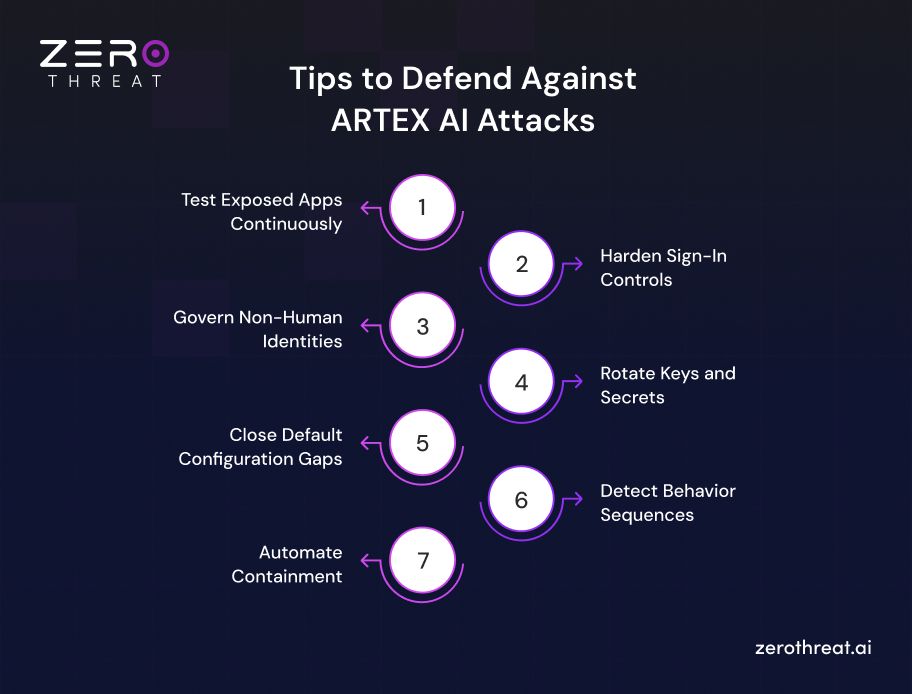
To defend against ARTEX, close the ordinary security gaps it exploits and get fast enough to catch it while it's still moving. AI agents have reached privileged cloud access in under three hours, so you need four things working together: continuous testing of exposed apps, tight identity controls, good key and secret hygiene, and detection based on behavior.
Test Exposed Apps Continuously
Many ARTEX intrusions start at an internet-facing web app or API. Keep an inventory of everything you expose, patch or take down outdated software, and test it often for injection, authentication, and access control flaws. Fix whatever is proven exploitable first, then retest to confirm the fix works.
Harden Sign-In Controls
Password spraying only works when a sign-in page lets attackers keep guessing. Rate-limit login attempts, require MFA on every account, and alert on bursts of failed sign-ins spread across many users. Make sure admin portals and control planes can't be reached from the open internet.
Govern Non-Human Identities
OAuth apps, service principals, and vendor integrations are now a main target. List every one of them, what each can access, and what would happen if its credential leaked. Cut permissions down to the minimum each one needs, and alert whenever an app gets a new secret or an admin role.
Rotate Keys and Secrets
Old signing keys and leaked secrets give AI agents an easy shortcut. Microsoft described one agentic attacker that went from finding exposed secrets on GitHub to stealing Azure Key Vault data in five minutes. Rotate keys regularly, including the ones in backups, and use short-lived credentials for workloads where you can.
Close Default Configuration Gaps
Many ARTEX privilege escalations rely on old default settings. Enforce signing for SMB and LDAP, use NTLM less, validate the signature on every SAML assertion, and require IMDSv2 on cloud instances. These fixes are routine work, but they remove the shortcuts agents use to go from one account to full control.
Detect Behavior Sequences
ARTEX operators change IP addresses, user agents, and app IDs quickly, so blocklists go out of date fast. Alert on sequences of behavior instead, such as an app signing in from a new location and then changing roles, or bulk reads across key vaults. Make sure your SIEM receives Graph activity logs and Key Vault logs.
Automate Containment
At ARTEX speed, a manual response usually comes too late. Pre-approve automated actions such as disabling accounts, revoking tokens, and isolating hosts. After you contain an attack, also remove any secrets and role grants the attacker planted, because disabling a compromised app leaves them in place. Preserve evidence before you delete anything.
Why Annual Pentests Can't Keep Up With ARTEX?
An annual pentest shows how secure you were on the days the test ran. ARTEX attacks move in hours. Microsoft saw attackers reach privileged cloud access in under three hours, and at DIVD the attacker went from first access to root in 12 minutes. Any flaw that appears after the test stays open until the next one.
Your applications also change all the time. A new release, a new API endpoint, a configuration change or a new vendor integration can each open a gap, and ARTEX agents look for those gaps automatically. ARTEX has more than 12,000 forks and runs on cheap models, so attackers can probe your exposed apps far more often than a yearly test checks them.
The practical fix is continuous penetration testing of the layer ARTEX targets first: your internet-facing web apps and APIs. Test after every significant change, fix what's proven exploitable first, and retest after each fix. Annual manual pentests are still useful for depth and compliance, and they work best alongside continuous testing.
How Does ZeroThreat Help Defend Against ARTEX-Style Attacks?
ZeroThreat protects the application layer where many ARTEX attacks begin: your internet-facing web applications and APIs. It's an AI penetration testing platform. It maps your exposed attack surface, tests it for injection, authentication, and access control flaws that ARTEX agents look for, confirms which of those flaws are exploitable, and retests as your applications change.
Map What ARTEX Would Find First
ARTEX starts with reconnaissance, so your first defense is knowing what you expose before an attacker does. ZeroThreat discovers your web apps, APIs, SPAs, and login-protected flows and keeps them in a live inventory. It reads JavaScript bundles to find hidden client-side routes, and it flags shadow and undocumented APIs that teams often forget to test.
Test the Flaws Behind Initial Access
ZeroThreat's web app testing checks for the weaknesses ARTEX uses to get its first foothold, including SQL injection, XSS, broken authentication, and insecure session handling. It tests login flows, MFA enforcement, and role-based access. Its API penetration testing tool adds checks for BOLA, token replay, and weak rate limiting. Plus, business logic testing covers workflow bypass and privilege escalation paths.
Chain and Validate Findings
ARTEX links small weaknesses into a larger breach, and ZeroThreat's AI penetration testing tests the same way. It connects individual findings into multi-step attack paths, then safely confirms each one can be exploited before reporting it. Every finding comes with request and response evidence, so your team spends its time on issues that are proven exploitable.
Retest as Apps Change
ARTEX agents can probe your apps at any time, so testing has to keep up. ZeroThreat plugs into CI/CD pipelines such as GitHub Actions, GitLab CI/CD and Azure Pipelines. It concentrates on new or changed endpoints and automatically retests issues after they're fixed. Setup only needs a URL, and its throttle-aware scanning is designed for production use.
ZeroThreat is built to test web applications and APIs. Identity governance, key rotation, Active Directory hardening, and endpoint detection still need their own controls, which are covered in the defense steps above. What ZeroThreat does is help you close the exploitable app and API flaws that many ARTEX attacks need for their first move.
ARTEX won't wait for your next pentest. Start testing your apps and APIs on every release. Get Started Now!
Summing Up
ARTEX shows how fast an open-source pentesting framework can become an attack platform. Its AI agents plan, exploit, and replan on their own, yet they rarely need new techniques. They exploit applications through ordinary gaps such as injectable web apps, weak sign-in controls, app identities with too many permissions, and stale keys.
Defending against ARTEX means closing those gaps and catching its activity early. Some of the practices to do that are:
- Testing your internet-facing apps and APIs continuously
- Rate-limiting sign-ins from suspicious users
- Providing the least privilege to non-human identities
- Rotating important keys and secrets
Each of these practices limits what an AI agent can do, and the first one protects the entry point many ARTEX attacks rely on. ZeroThreat’s AI penetration testing tool keeps testing your application continuously, so your team knows which flaws are exploitable and can fix them before an autonomous attacker finds them.
Frequently Asked Questions
How fast is an ARTEX attack?
ARTEX attacks take minutes to hours. Microsoft saw attackers reach privileged cloud access in under three hours. In one intrusion, the attacker went from first access to root in 12 minutes. After getting admin rights, attackers set up persistence in about five minutes. Each agent action runs in a burst of 2 to 25 seconds.
How does the ARTEX AI hacking framework work?
How can organizations detect ARTEX-style attacks?
Can AI penetration testing prevent ARTEX attacks?
Why is continuous penetration testing important against AI-driven attacks?

Explore ZeroThreat
Automate security testing, save time, and avoid the pitfalls of manual work with ZeroThreat.