 ZeroThreat Wins Bronze Stevie® Award in Tech Startup of the Year Read more

All Blogs
Penetration Testing in FinTech: Closing the Gap Between Innovation and Security
Quick Overview: This blog explores penetration testing in FinTech, highlighting its importance, methodologies, compliance needs, and real-world benefits. Learn how proactive security testing protects sensitive financial data, strengthens customer trust, ensures regulatory readiness, and helps FinTechs stay resilient against evolving cyber threats.
The financial technology (FinTech) industry has become the backbone of modern banking, payments, lending, wealth management, and digital financial services. According to report, the global FinTech market is expected to reach $324 billion by 2026, driven by innovation in digital transactions, blockchain, AI-driven financial services, and mobile banking adoption.
But with rapid innovation comes a steep rise in security risks. FinTech apps and systems handle sensitive financial data like payment card details, personal identification, and transaction histories, which makes them a prime target for cybercriminals. Reports show that nearly 27% of all cyberattacks in 2023 were aimed at banks and FinTech companies, with the average data breach in finance costing $5.9 million, higher than most other industries.
In this high-stakes landscape, penetration testing (pentesting) is no longer optional but a critical security practice. And that’s the reason 26% of financial services lead in penetration testing investment due to high-value data and strict regulatory requirements.
This blog explores what penetration testing means for FinTech, its user benefits, methodologies, and how it helps organizations achieve proactive resilience against evolving cyber threats. Also, it will show the importance of cybersecurity in FinTech.
Start testing your FinTech apps in minutes. Experience Smart Pentesting
On This Page
- What is Penetration Testing in FinTech?
- What are Challenges and Limitations of FinTech Security?
- Benefits of FinTech Penetration Testing
- Key Methodologies Used in FinTech Penetration Testing
- Real-World FinTech Breaches and Lessons Learned
- Best Practices for Effective FinTech Security
- How Can ZeroThreat Help FinTech Pentesting?
- Final Words
What is Penetration Testing in FinTech?
Penetration testing ethical hacking is a simulated cyberattack performed by security experts to identify vulnerabilities in applications, APIs, networks, and infrastructure before malicious hackers exploit them.
While talking about FinTech penetration testing, it goes beyond basic vulnerability scans. It focuses on:
- Web application security testing (web/mobile banking apps, wallets, trading platforms)
- API security testing (payment gateways, third-party integrations, data exchange)
- Cloud environments (AWS, Azure, GCP financial workloads)
- Network security (internal banking systems, data storage, payment processing)
- Authentication and Authorization (MFA, biometrics, tokenization, encryption)
The key objective is to uncover weaknesses in confidentiality, integrity, and availability of financial data, while protecting against FinTech compliance security risks with strict regulatory frameworks.
What are Challenges and Limitations of FinTech Security?
While FinTech drives innovation in digital payments, lending, and investments, securing these systems is far from straightforward. Following are some unique challenges and limitations that make building resilient defenses complex:
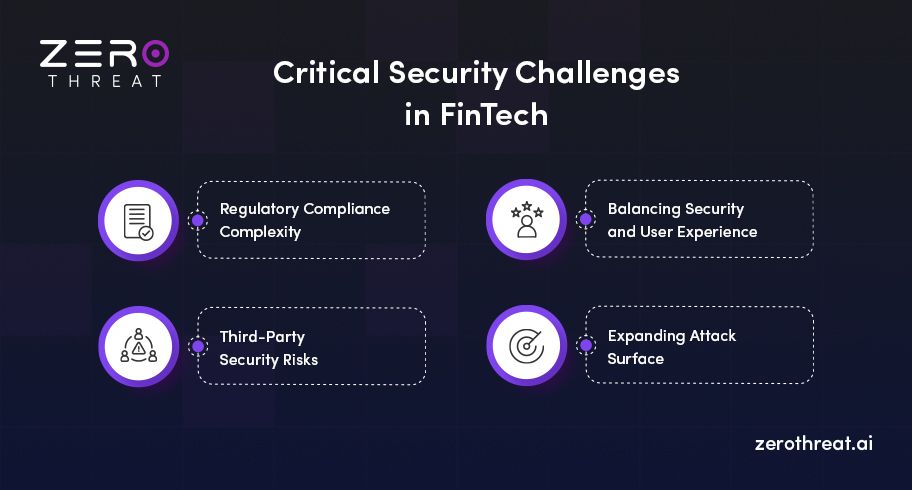
Regulatory Compliance Complexity
The regulatory environment for FinTech organizations is both complex and constantly evolving. Companies must navigate multiple compliance frameworks such as PCI DSS, GDPR, and region-specific financial regulations.
When a FinTech platform expands into multiple markets, it must adhere to diverse local regulations, often triggering a race against time that pulls critical resources away from core security initiatives. Failing audits can lead to fines and reputational damage.
Balancing Security and User Experience
In FinTech, the push for rapid innovation often clashes with the need for comprehensive security. To stay competitive, development teams frequently prioritize speed and feature delivery, leaving security as an afterthought instead of embedding it as a core design principle.
Moreover, customers expect instant transactions and seamless logins, but strong security controls like MFA or biometric verification can sometimes cause friction, leading to user drop-offs.
Third-Party Risks
Third-Party Risks pose significant challenges in FinTech applications. Many platforms depend on external vendors for critical services like payments, KYC verification, or advanced analytics.
However, a single security flaw in these integrations can escalate into large-scale breaches, compromising sensitive financial transactions and customer data. Strong vendor risk management and continuous monitoring are essential to mitigate this threat.
Expanding Attack Surface
The FinTech ecosystem spans mobile apps, APIs, cloud services, and third-party integrations. Therefore, each new feature introduces FinTech app cybersecurity threats. This interconnected environment multiplies entry points for cybercriminals, which makes comprehensive security a constant challenge. Continuous monitoring, proactive threat detection, and layered defenses are crucial to protect sensitive data while ensuring seamless innovation and user trust.
Benefits of FinTech Penetration Testing
The following benefits highlight why penetration testing for FinTech industry is essential for strengthening applications against evolving cyber threats.
Proactive Risk Identification
When we talk about FinTech pen testing it enables companies to uncover vulnerabilities before threat actors exploit them. For instance, securing an exposed API can prevent devastating breaches like the 2020 Dave Banking incident, where 7.5 million user records were leaked due to insecure configurations.
Improves Incident Response Readiness
By simulating attacks such as phishing, ransomware, or SQL injections, penetration testing evaluates how effectively internal teams detect, respond, and contain threats. This proactive readiness strengthens cybersecurity maturity and ensures FinTechs can limit damage, recover quickly, and maintain continuity when real-world attacks occur.
Ensures Regulatory Compliance
FinTech companies face strict regulations like PCI DSS, GDPR, and local banking laws. Penetration testing provides documented proof of due diligence, helping firms pass audits smoothly while avoiding fines. It also demonstrates a proactive approach to protecting sensitive data in highly regulated financial environments.
Safeguards Innovation
When there is any innovation in FinTech, it spans AI-driven trading, blockchain payments, and Buy-Now-Pay-Later models. However, each innovation expands the attack surface. While following the FinTech security penetration testing best practices, it ensures that newly launched services are secured. It also identifies backdoors and loopholes before attackers exploit them. This helps companies innovate with confidence while protecting sensitive customer and transaction data.
Want to know your app security posture? Run a quick free scan and uncover vulnerabilities before attackers do. Run Free Scan
Key Methodologies Used in FinTech Penetration Testing
Most FinTech ethical hackers follow structured frameworks such as:
- OWASP Top 10: To identify critical vulnerabilities like XSS, SQL Injection, and Broken Authentication in financial apps.
- NIST SP 800-115: A widely recognized pentesting guide for structured assessments.
- MITRE ATT&CK: To simulate tactics and techniques of real adversaries.
- PCI DSS Testing Procedures: Specifically for payment systems, covering encryption, access control, and cardholder data protection.
A typical pentest process includes:
- Planning & Reconnaissance: Understanding assets, systems, and regulations.
- Scanning: Using top pentesting tools to detect vulnerabilities in networks and applications.
- Exploitation: Attempting to exploit weaknesses like misconfigured firewalls or insecure authentication.
- Privilege Escalation & Lateral Movement: Testing how attackers could move deeper inside the system.
- Reporting & Remediation: AI-powered remediation reports, delivering actionable insights to mitigate and fix vulnerabilities.
Real-World FinTech Breaches and Lessons Learned
Let’s review some of the significant case studies explaining why FinTech pentesting is not optional but essential.
Case 1: Patching the Mobile Banking App That Almost Leaked 5 Million Records
In 2020, a European digital bank engaged a cybersecurity firm for a mobile app pen test. Testers discovered that the app stored sensitive data—user IDs, session tokens, and partial account numbers—in unencrypted local storage. Using basic forensic tools, they extracted this data from a rooted device.
The bank immediately implemented encrypted storage and secure key management. The fix prevented a potential breach affecting 4.8 million users and avoided a GDPR fine estimated at €40 million.
Case 2: Securing a Crypto Exchange Against Wallet Drainers
A cryptocurrency exchange underwent a penetration test focused on its web wallet interface. Testers found a cross-site scripting (XSS) vulnerability that could be exploited to inject malicious JavaScript into the user’s session. If exploited at scale, attackers could drain wallets by tricking users into signing unauthorized transactions.
The exchange patched the flaw and introduced Content Security Policy (CSP) headers. Six months later, when a similar XSS attack targeted a competitor, the protected exchange remained unscathed.
Best Practices for Effective FinTech Security
In a sector where trust is the ultimate currency, securing FinTech applications demands more than just compliance—it requires a proactive, layered defense. Let’s understand and go through the best cybersecurity practices for FinTech companies to strengthen resilience against evolving cyber threats:
Implement Strong Authentication and MFA
Multi-Factor Authentication (MFA) is a critical initiative for strengthening access security for both customers and employees. It ensures that even if credentials are compromised, attackers face an additional barrier.
Hence, FinTech firms should enforce MFA across all platforms, combining passwords with OTPs, device-based verification, or biometrics. Adaptive authentication further strengthens access control based on user behavior and risk.
Conduct Regular Penetration Testing
FinTech cybersecurity testing must be implemented on a regular basis to uncover hidden flaws before hackers do. In fact, pentesting validates your defense against OWASP Top 10 risks, phishing, and injection attacks, while ensuring compliance with PCI DSS and GDPR.
Comprehensive Encryption Strategies
End-to-end encryption is essential throughout the entire data lifecycle. In FinTech platforms, all data at rest in databases or storage must be protected with strong encryption (AES-256 or equivalent), while data in transit should always use Transport Layer Security (TLS 1.3).
Organizations must enforce regular key rotation, store encryption keys in secure vaults, and apply strict separation of duties to limit key access. Additionally, enabling end-to-end encryption for financial communications ensures sensitive messages remain protected from interception at any point in transmission.
Unsure where to begin with FinTech pentesting? Connect with our security experts for enterprise plan. Let's Connect
How Can ZeroThreat Help FinTech Pentesting?
FinTech organizations operate in a high-stakes environment where even minor vulnerabilities can result in severe financial loss, compliance violations, and reputational damage. Traditional security testing often falls short due to slow cycles, high false positives, and lack of real-world attack simulation. ZeroThreat bridges these gaps with an AI-driven, FinTech-ready penetration testing solution.
- AI-Powered Precision with Near-Zero False Positives
- 10x Faster Vulnerability Discovery
- Comprehensive Coverage for FinTech Ecosystems
- Seamless Compliance Readiness
- Actionable, AI-Generated Reporting
- Built for CI/CD and DevSecOps
- Zero Trust-Driven Architecture
Choose a suitable plan and see how ZeroThreat's AI-driven pentesting can protect your customers, ensure compliance, and accelerate your security posture.
Final Words
With millions of dollars and sensitive user data at stake, FinTech application penetration testing is a critical shield against evolving cyber threats. To reduce risk, they must adopt best practices such as multi-factor authentication, continuous security testing, robust encryption, employee awareness training, and well-prepared incident response strategies.
In an era where a single breach can destroy a FinTech startup or tarnish a banking giant, FinTech security testing is not just a security measure; it’s a competitive advantage.
Frequently Asked Questions
How is FinTech penetration testing different from regular penetration testing?
FinTech penetration testing focuses on financial applications, APIs, payment gateways, and compliance standards like PCI DSS. Unlike regular testing, it accounts for transaction integrity, data privacy, and evolving financial threats that directly impact customer trust and regulatory requirements.
How often should finance companies conduct fintech penetration testing?
What are the types of penetration testing used in fintech?
Does FinTech penetration testing protect FinTech apps from future cyberattacks?



Explore ZeroThreat
Automate security testing, save time, and avoid the pitfalls of manual work with ZeroThreat.