 ZeroThreat Wins Bronze Stevie® Award in Tech Startup of the Year Read more

All Blogs
The Enterprise Guide to Production-Safe Security Testing: Architecture, Compliance, and Best Practices
Quick Overview: Testing security in production does not have to mean risking downtime or compliance violations. This guide breaks down the architecture, controls, and best practices enterprises use to test live systems safely. It covers traffic isolation, non-destructive validation, compliance requirements across major frameworks, and the common mistakes that turn safe testing into real incidents.
Production is the one environment where real attackers actually operate, and the one environment most security teams are too afraid to test properly.
The numbers back up that fear. According to research, 95% of organizations rank pentesting as a top priority, yet they test only 32% of their global attack surface on average. That means most enterprises are leaving the majority of their environment unchecked, not because they do not care, but because testing it the old way feels too risky.
So, security teams settle for testing what feels safe. Staging. Sandboxes. Anything that is not actually production.
But that compromise comes at a price. Vulnerabilities that only show up under real traffic, real configurations, and real user behavior simply never get found.
This guide changes that equation. It breaks down the architecture, controls, and compliance practices that make production-safe testing possible, scalable, and audit-ready.
Start validating real production risks without worrying about operational disruption and compliance. Sign Up Now!
On This Page
- Understand Production-Safe Security Testing
- Production vs. Staging Security Testing: Understanding the Security Gap
- Why Testing in Production Is Traditionally Considered Risky
- Production-Safe Security Testing Architecture: Key Components
- Security Testing Compliance Requirements for Production Environments
- Common Mistakes Enterprises Make When Testing in Production
- Enterprise Best Practices for Scalable and Secure Production Testing
- Wrapping Up: Test Safely in Production at Scale with ZeroThreat
Understand Production-Safe Security Testing
Production-safe security testing is the practice of validating the security of live applications, APIs, and cloud environments without disrupting business operations, affecting users, or compromising data integrity. It enables organizations to identify real-world security risks that may only appear after deployment while maintaining system availability and performance.
Key characteristics of production-safe testing includes:
- Non-intrusive vulnerability validation
- Controlled and safe payload execution
- Rate limiting and execution safeguards
- Continuous testing within production environments
- Monitoring-driven risk assessment
Unlike traditional testing that relies solely on staging environments, production-safe security testing evaluates actual configurations, integrations, traffic patterns, and runtime behaviors. This helps DevSecOps and security teams validate exploitable risks in the environment attackers target most while reducing operational and compliance risks.
Production vs. Staging Security Testing: Understanding the Security Gap
| Aspect | Production-Safe Security Testing | Staging Security Testing |
|---|---|---|
| Environment | Live production systems | Pre-production replica environment |
| Data Exposure | Real production data and transactions | Test or sanitized datasets |
| Risk Validation | Validates real-world exploitability | Simulates potential security risks |
| Configuration Accuracy | Tests actual production configurations | Tests replicated configurations |
| User Traffic Visibility | Observes live traffic patterns and behaviors | Uses synthetic or limited test traffic |
| Vulnerability Detection | Identifies runtime and environment-specific vulnerabilities | Detects issues before deployment |
| Business Logic Coverage | Validates real user workflows and integrations | Limited to predefined test scenarios |
| Operational Impact | Uses controlled, non-disruptive testing safeguards | Minimal impact on business operations |
| Security Controls Required | Rate limiting, fail-safe mechanisms, monitoring, rollback controls | Standard testing controls and environment isolation |
| Compliance Considerations | Requires strict governance, auditability, and data protection controls | Lower compliance and operational risk |
| Testing Frequency | Continuous security testing and validation | Periodic or release-based testing |
| Security Assurance Level | Highest confidence in production readiness | Moderate confidence based on simulated conditions |
Why Testing in Production Is Traditionally Considered Risky
Testing in production has traditionally been viewed as a high-risk activity because live systems contain real users, real transactions, and business-critical workloads. A poorly controlled security test can affect application availability, data integrity, customer experience, and security compliance.
- Service Disruption and Downtime: Aggressive security testing can consume system resources, trigger application failures, or degrade performance, creating availability issues for users and business operations.
- Data Corruption Risks: Security tests executed without proper safeguards may modify, delete, or corrupt production data, impacting transaction accuracy and operational reliability.
- Exposure of Sensitive Information: Production environments contain customer records, credentials, and business data. Improper testing can lead to unintended sensitive data exposure and privacy violations.
- Impact on Customer Experience: Testing errors can create user-facing issues such as failed transactions, application instability, or inconsistent functionality, which can reduce customer trust.
- Compliance and Regulatory Concerns: Organizations must ensure security testing does not violate data protection requirements, audit controls, or industry regulations governing production systems.
- Unintended Effects on Integrated Systems: Modern applications depend on APIs, third-party services, and cloud infrastructure. Testing one component can unintentionally affect connected production services.
Uncover active runtime vulnerabilities safely before malicious threat actors exploit your enterprise architecture. Run Production-Safe Pentest
Production-Safe Security Testing Architecture: Key Components
A production-safe security testing architecture combines technical safeguards, visibility controls, and automated validation mechanisms that allow security testing in live environments without disrupting users, applications, or business operations.
Here are some of the common components in a production-safe testing architecture:
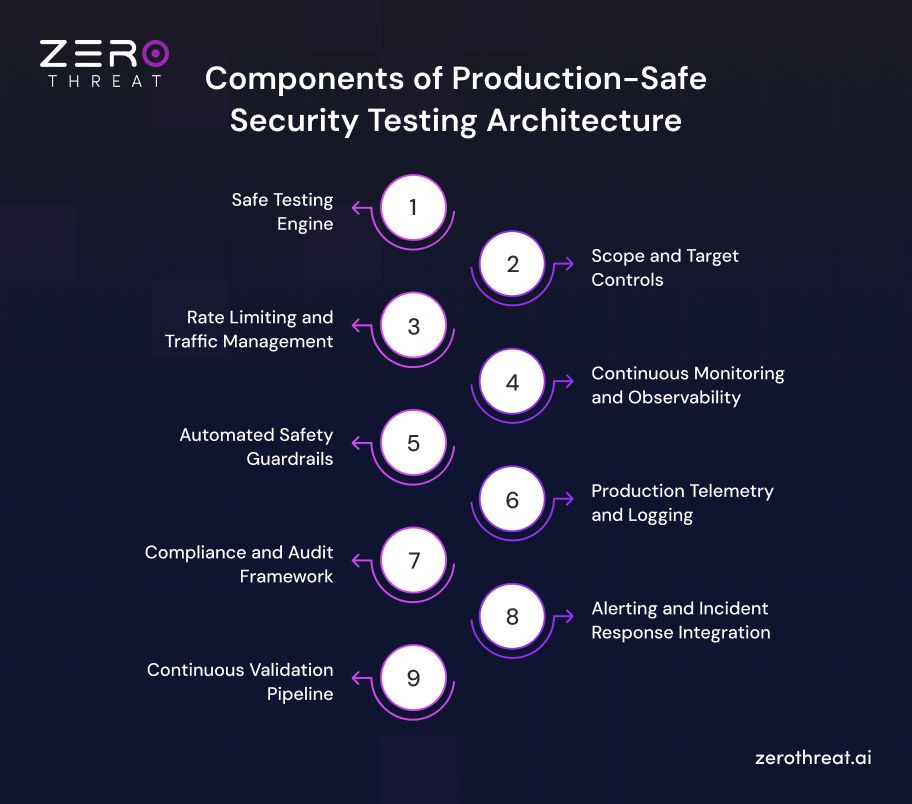
1. Safe Testing Engine
The testing engine is responsible for executing security assessments using controlled payloads and predefined safety rules. It validates vulnerabilities without performing destructive actions, helping organizations test production systems while minimizing operational risk.
2. Scope and Target Controls
Scope controls define which applications, APIs, services, and endpoints can be tested. These controls prevent unauthorized testing activity and ensure assessments remain within approved production boundaries.
3. Rate Limiting and Traffic Management
Rate limiting protects production workloads from excessive requests generated during testing. It helps maintain application performance, prevents service degradation, and ensures testing activity remains non-disruptive.
4. Continuous Monitoring and Observability
Real-time monitoring provides visibility into system health, application behavior, and testing activity. Security teams can quickly identify anomalies, measure impact, and stop testing if unexpected conditions occur.
5. Automated Safety Guardrails
Safety guardrails enforce predefined operational policies before and during testing. These controls can restrict payload execution, block risky actions, and automatically terminate activities that exceed risk thresholds.
6. Production Telemetry and Logging
Comprehensive logging captures testing events, application responses, and security findings. This data supports incident investigations, audit requirements, compliance reporting, and vulnerability validation.
7. Compliance and Audit Framework
Compliance controls maintain traceability across all testing activities. Detailed audit logs, approval workflows, and testing records help organizations meet regulatory and security governance requirements.
8. Alerting and Incident Response Integration
Security testing platforms should integrate with monitoring and incident response systems. This enables immediate notification when testing affects system behavior and allows rapid remediation when necessary.
9. Continuous Validation Pipeline
A continuous validation layer enables ongoing security testing within DevSecOps workflows. It helps organizations identify configuration drift, emerging vulnerabilities, and security regressions as production environments evolve.
Security Testing Compliance Requirements for Production Environments
Production security testing must align with the compliance frameworks that govern how an organization protects systems, processes sensitive data, manages risk, and validates security controls. While each framework has different requirements, they all expect organizations to demonstrate production-safe testing for compliance.
SOC 2
SOC 2 focuses on the effectiveness of security controls under the AICPA Trust Services Criteria. Although SOC 2 does not explicitly mandate penetration testing, auditors commonly expect evidence of security testing, vulnerability management, continuous monitoring, and remediation activities. Production-safe security testing helps organizations demonstrate that controls are functioning as intended, and that newly introduced vulnerabilities can be identified and addressed.
GDPR
The General Data Protection Regulation (GDPR) requires organizations to implement appropriate technical and organizational measures to protect personal data. When conducting security testing in production environments, organizations must ensure that testing activities do not expose, alter, or compromise personal information. Data minimization, access controls, encryption, logging, and accountability are critical considerations when testing systems that process personal data. GDPR compliance applies regardless of whether the data resides in production, staging, or testing environments.
PCI DSS
PCI DSS requires organizations that store, process, or transmit payment card data to maintain a strong security testing program. The framework requires regular vulnerability scanning, penetration testing, and validation of security controls protecting the cardholder data environment. Any production testing must be carefully controlled to ensure that payment systems remain available and that cardholder data is protected throughout the assessment process.
Common Mistakes Enterprises Make When Testing in Production
Even with the right intentions, enterprises often get production testing wrong. These missteps turn a useful security practice into unnecessary risk.
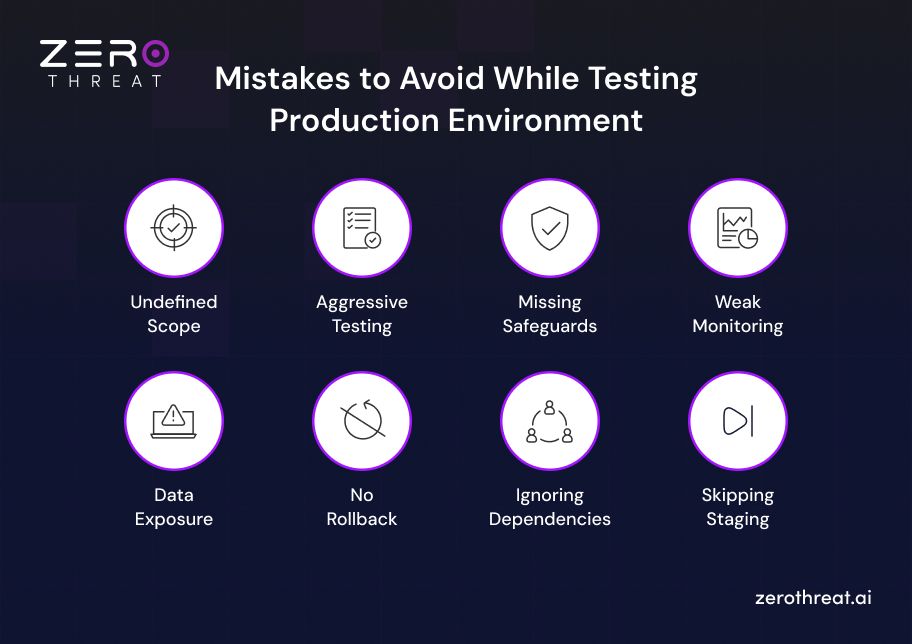
Undefined Scope
Testing without a clearly defined scope can lead to unauthorized assets, critical services, or third-party integrations being assessed unintentionally. This increases operational risk and makes it difficult to maintain control over testing activities.
Aggressive Testing
Using intrusive payloads or exploit techniques in production can negatively impact application performance and availability. Production testing should focus on safe validation methods that confirm risk without disrupting users.
Missing Safeguards
Many organizations begin testing without implementing essential controls such as rate limiting, execution restrictions, or automated stop mechanisms. Without these safeguards, testing activity can create avoidable operational issues.
Weak Monitoring
Production testing requires continuous visibility into application health and infrastructure performance. Insufficient monitoring can delay the detection of service degradation, failed transactions, or unexpected system behavior.
Data Exposure
Production environments contain valuable and sensitive information. Failing to implement data protection controls during testing can increase the risk of privacy violations, regulatory issues, and unauthorized access to critical records.
No Rollback
Unexpected issues can occur even during controlled assessments. Organizations that lack rollback procedures or recovery plans may experience longer outages and slower remediation when testing affects production services.
Ignoring Dependencies
Modern applications rely on interconnected APIs, cloud services, and external platforms. Testing one component without considering downstream dependencies can trigger unintended issues across connected systems and workflows.
Skipping Staging
Production testing should complement, not replace, testing performed in development and staging environments. Bypassing earlier validation stages often results in avoidable findings and increased risk within live systems.
Enterprise Best Practices for Scalable and Secure Production Testing
Scaling production testing across an enterprise requires more than good tools. These practices help security teams build a program that stays safe as systems and traffic grow.
Start With Narrow Scope
Begin testing on lower-risk systems before expanding to critical infrastructure. This builds confidence in the process, surfaces gaps in controls early, and gives teams a chance to refine procedures before higher-stakes systems are involved.
Automate Repetitive Validation
Manual testing does not scale across hundreds of services and endpoints. Automated, continuous pentesting handles repetitive vulnerability checks reliably, freeing security analysts to focus on complex issues that genuinely need human judgment and context.
Integrate With CI/CD Pipelines
Plugging security testing into existing CI/CD pipelines catches vulnerabilities before code reaches production at scale. This shifts testing earlier without removing the need for live validation, reducing the volume of issues found after deployment.
Maintain Cross-Team Communication
Security, operations, and compliance teams need shared visibility into testing schedules and outcomes. Regular communication prevents duplicated effort, reduces surprises during incidents, and ensures everyone understands the current risk posture across production systems.
Review and Update Controls
Production environments change constantly, so testing controls need periodic review. Outdated rate limits, scope definitions, or monitoring thresholds can quietly become ineffective as infrastructure scales, creating blind spots nobody notices until something fails.
Worried about breaking compliance or safety controls while testing live? Let’s handle that for you. Get in Touch
Wrapping Up: Test Safely in Production at Scale with ZeroThreat
Production is where real vulnerabilities live, and avoiding it only delays the inevitable. The right architecture, controls, and compliance practices make testing live environments practical, not risky, giving security teams the visibility they have always needed.
Getting there means committing to scoped testing, non-destructive validation, real-time monitoring, and documented compliance at every step. These are not optional extras. They are what separate a controlled test from an unplanned incident.
ZeroThreat brings these principles into one platform, enabling continuous, production-safe security testing at enterprise scale. Teams get accurate vulnerability detection without downtime, without compliance gaps, and without the guesswork that used to make production testing too risky to attempt.
Frequently Asked Questions
How do enterprises test applications without downtime?
Enterprises use production-safe security testing techniques that rely on controlled payloads, rate limiting, monitoring, and safety guardrails. These controls allow teams to validate vulnerabilities in live environments without affecting application availability, performance, or user experience.
How to ensure compliance during security testing?
How does continuous security testing work in production?
What precaution should be taken during production testing?
Related Articles
Explore ZeroThreat
Automate security testing, save time, and avoid the pitfalls of manual work with ZeroThreat.