 ZeroThreat Wins Bronze Stevie® Award in Tech Startup of the Year Read more

All Blogs
Broken Authentication in Modern SPAs: How Security Testing Can Validate Exploitable Risks

Quick Overview: Modern SPAs rely heavily on JavaScript, APIs, tokens, and client-side authentication flows, creating unique security challenges that traditional testing can overlook. This blog explores broken authentication in modern SPAs, common vulnerabilities, testing approaches, and how exploit validation can confirm whether an authentication flaw is genuinely exploitable. It also covers how ZeroThreat tests SPA authentication across browser and API workflows.
The login form is rarely where an SPA breaks. It validates credentials, shows a spinner, and drops the user into a dashboard exactly as designed. The failure happens after that: in how the access token is stored, whether the API re-checks every request, what the OAuth redirect accepts, and whether logout actually ends anything on the server.
These are not theoretical concerns. “Authentication Failures” sit at position seven in the OWASP Top 10:2025, mapped to 36 distinct CWEs including session fixation and improper authentication. In an SPA, most of those weaknesses are invisible from the login screen and only surface when you interrogate the token and the API directly.
This article works through two things. First, the six ways authentication breaks specifically in SPA architecture, each with the condition that makes it exploitable and the fix. Second, the testing method that separates a flagged signal from a validated exploit, because in SPA authentication security, the gap between "a scanner noticed this" and "an attacker can do this" is where real risk gets missed.
** Your authentication may have gaps you can’t see. Find them before attackers do.** Test Your App
On This Page
- What is Broken Authentication in Modern SPAs?
- Common Broken Authentication Vulnerabilities in SPAs
- Why Traditional Security Scanners Miss SPA Authentication Flaws
- How to Test Authentication Flows in Modern SPAs
- How Exploit Validation Confirms Real Authentication Risks
- How ZeroThreat Tests SPA Authentication
- Conclusion
What is Broken Authentication in Modern SPAs?
Broken authentication is any weakness that lets an attacker assume another user's identity by abusing how the SPA issues, stores, transmits, or terminates authentication state, which lives partly in the browser and partly in a stateless API rather than in a server-managed session. A web app pentesting tool can help identify these weaknesses.
In a traditional server-rendered app, the server holds the session and re-checks it on every page to render. An SPA works differently. The browser downloads a JavaScript bundle once, then the client renders every view and talks to the backend over API calls. Authentication states have to travel with those calls, usually as a token the browser holds. That single architectural shift is why broken authentication behaves so differently here than in classic web apps.
Three architectures dominate, and each puts authentication state somewhere different:
- Bearer JWT: The API issues a signed JSON Web Token on login. The SPA stores it and attaches it to each request in an Authorization header. The server is stateless and trusts any valid signature.
- OAuth 2.0 / OIDC with PKCE: The SPA delegates login to an identity provider and receive tokens through a redirect flow. Because an SPA is a public client that cannot hold a secret, RFC 9700 requires the Authorization Code flow with PKCE and deprecate the older implicit grant.
- Backend-for-Frontend (BFF): A thin server-side component holds the tokens and exchanges them for a HttpOnly session cookie, keeping tokens out of the JavaScript runtime entirely.
The common thread across all three is the core principle of single page application authentication security: the client cannot be trusted to enforce anything. A route guard that hides a page, a disabled button, a UI flag that says isAuthenticated: these are user experience, not security. Every API call must independently authenticate and authorize itself, because the SPA and its underlying API security are two separate trust boundaries that an attacker will always test separately.
Common Broken Authentication Vulnerabilities in SPAs
The most common SPA authentication vulnerabilities cluster into five classes: enforcement that exists only in the client, tokens exposed to script execution, JWT validation failures, OAuth and OIDC flow weaknesses, and a broken session lifecycle. Each is exploitable only under a specific condition, which is what testing has to confirm.
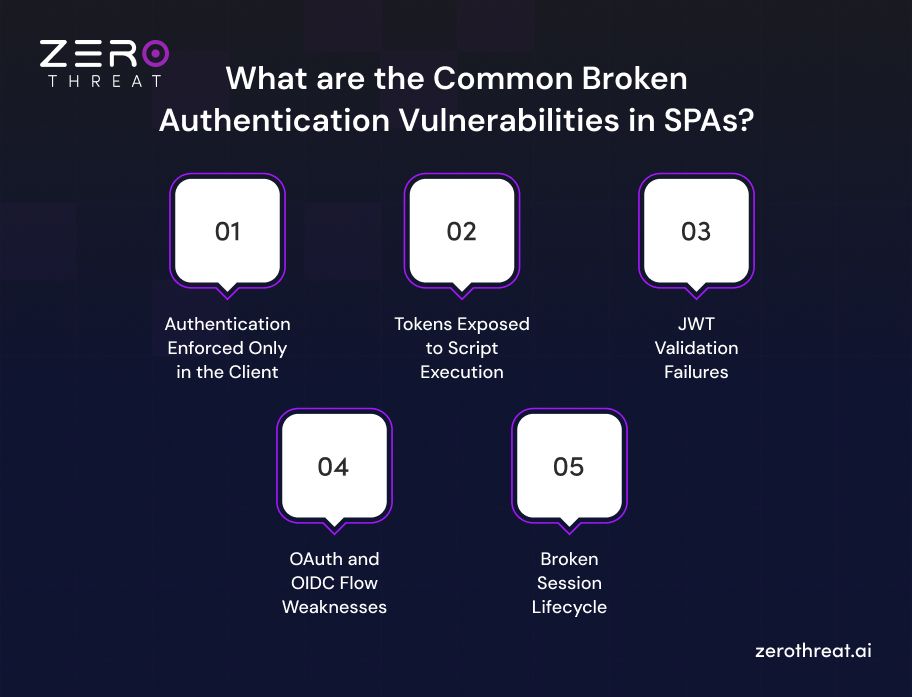
1) Authentication Enforced Only in the Client
The SPA's router blocks /admin unless a role claim is present, so the UI looks locked down. The flaw appears when the corresponding API endpoint does not repeat that check. An attacker ignores the interface entirely and calls GET /api/admin/users with an ordinary user's valid token. Step-up MFA has the same failure mode: if the API already issued a fully privileged token before the second factor, the SPA can prompt for a code that the backend never actually requires. Response manipulation is the crudest version, flipping a "mfaRequired": true or "isAuthenticated": false flag in the JSON response to unlock client-side gates.
Fix: Enforce authentication and authorization on every endpoint server-side; treat the client's checks as cosmetic.
2) Tokens Exposed to Script Execution
Storing access or refresh tokens in localStorage or sessionStorage makes them readable by any JavaScript running on the page. That turns any cross-site scripting flaw into full account takeover: a single injected script reads the token and exfiltrates it, and the attacker replays it from anywhere. The exploitable condition is the pairing and storage the script can reach plus an XSS sink anywhere in the app or its dependencies. In-memory storage (a JavaScript variable cleared on refresh) narrows the window, and the BFF pattern with an HttpOnly cookie removes script access to the token entirely, at the cost of managing a server component.
Fix: Keep tokens out of persistent web storage; prefer HttpOnly cookies via a BFF, and treat XSS as an authentication risk, not just a content one.
3) JWT Validation Failures
A stateless API trusts whatever a valid signature vouches for, so weak JWT verification is directly exploitable. The classic cases: accepting alg: none and dropping signature checks entirely; RS256-to-HS256 key confusion, where the server verifies an attacker-forged HS256 token using the public RSA key as the HMAC secret; skipping exp, aud, or iss validation so expired or misdirected tokens still pass; kid header injection pointing verification at an attacker-controlled key; and HMAC secrets weak enough to brute-force offline. Any one of these lets an attacker mint or extend a token the server will honor.
Fix: pin the expected algorithm server-side, validate exp/aud/iss on every request, and use high-entropy secrets or rotated asymmetric keys.
Let AI test whether your authentication defenses actually hold up. Run AI Pentesting
4) OAuth and OIDC Flow Weaknesses
SPA login delegated to an identity provider introduces redirect-flow risks. Residual use of the implicit grant returns tokens directly in the URL fragment, where they leak through browser history and Referer headers, which is exactly why RFC 9700 deprecates it. Missing PKCE leaves the authorization code open to interception. A missing or unverified state parameter enables login CSRF, forcing a victim into the attacker's session. Loose redirect_uri matching lets an attacker redirect the code or token to a domain they control. And silent-auth or popup flows that call postMessage without checking the origin will hand tokens to any listening frame.
Fix: Use Authorization Code with PKCE, enforce exact redirect_uri matching, require and verify state, and validate postMessage origins.
5) Broken Session Lifecycle
Authentication is not only about logging in, it is about reliably ending access. In SPAs, logout frequently clears client state, redirects to the login page, and leaves the token fully valid on the server, so a copied token keeps working after the user believes they are out. Related failures: access tokens with lifetimes measured in hours, refresh tokens that never rotate and have no reuse detection, and tokens that survive a password change. Two session-fixation-adjacent issues belong here too: cookie-based BFF sessions that omit Secure and HttpOnly attributes, and session identifiers that are not regenerated after login (CWE-384).
Fix: revoke tokens server-side on logout and password change, rotate refresh tokens with reuse detection, keep access-token lifetimes short, and set Secure/HttpOnly on session cookies.
Why Traditional Security Scanners Miss SPA Authentication Flaws
Traditional scanners miss SPA authentication flaws because they were built to crawl static HTML, not to render JavaScript, hold a token across a stateless API, or reason about whether a valid-looking request was actually authorized. The result is unreliable broken authentication detection in SPAs.
Four gaps explain the blind spot, and together they mark the real difference in SPA authentication testing vs traditional web application testing:
- JavaScript-Rendered Routes are Invisible: A legacy crawler reads the initial HTML shell and finds almost no links, because the SPA builds its views and discovers its API endpoints at runtime. The authentication surface is never mapped.
- Sessions Drop Mid-Scan: Token-based auth expires and refreshes during a run. A scanner that cannot execute the refresh flow silently reverts to an unauthenticated state and keeps "testing" nothing behind the login. This session-handling problem is covered in depth in ZeroThreat's guide to authenticated security testing.
- MFA and SSO Walls Block Entry: Multi-step logins, MFA prompts, and SSO redirects defeat tools that expect a single POST to a login form, so the entire post-login surface goes untested.
- Detection is Not Validation: A scanner can flag that a JWT appears in localStorage or that an endpoint returns a token. It cannot confirm that the server accepts a tampered version of that token, which is the only thing that proves exploitability.
The takeaway is not that automation fails, but that effective SPA testing requires a tool that renders the application like a browser, sustains real sessions through MFA and refresh, and reasons about authorization rather than pattern-matching responses. That capability set is precisely what dedicated SPA security testing is built around.
How to Test Authentication Flows in Modern SPAs?
To test authentication flows in modern SPAs, you drive the running application like a real user, capture how it issues and carries tokens, then attack the server directly, so authentication security testing for SPAs covers the client, the token, and the API as three separate targets.
Comprehensive SPA penetration testing for authentication is not a single scan. It is a sequence that maps the surface, tests server-side enforcement, attacks the token itself, and exercises the full session lifecycle. End-to-end authentication security testing for SPAs means all four run against a live, authenticated session, not just the public shell.

Map the Authentication Surface from the Running App
Start by rendering the SPA in a real browser, so the JavaScript executes and the true set of routes and API calls appears. Capture the login sequence end to end: where the token is issued, what format it takes, and where the client stores it. Extract auth-related endpoints from the JavaScript bundles and from live traffic and identify the identity provider and grant type in use. You cannot test what you have not mapped, and in an SPA the map only exists at runtime.
Test Server-Side Enforcement Directly
This is where most real findings come from. Take an authenticated API call captured in the previous step and replay it with the token removed, with a token from a lower-privilege account, and with a structurally tampered token. Bypass the UI completely and hit protected endpoints directly. Attempt the action that the client gates behind MFA and see whether the API enforces it. Strong SPA API security testing coverage means every endpoint the frontend calls are checked on its own, because that is exactly how an attacker reaches it.
Attack the Token
To test token-based authentication in SPAs, run a JWT tamper matrix against the API and observe which variants the server accepts. Swap the algorithm to none and to HS256 with the public key; submit an expired token; change the aud and iss claims; forge the kid header; and strip the signature. Each accepted variant is a concrete, demonstrable authentication bypass rather than a theoretical weakness.
Exercise the Full Session Lifecycle
Session management vulnerability detection in SPAs depends on testing what happens over time, not just at login. Replay a token after logout, after a password change, and after a refresh, to confirm whether old credentials are truly revoked. Test refresh-token reuse to see if a consumed refresh token is detected and the session family invalidated. Check whether concurrent sessions are tracked. This SPA session security testing is what surfaces the logout-does-nothing class of flaw that a point-in-time scan cannot see.
See what it costs to catch exploitable risks before they become incidents. Explore Pricing
How Exploit Validation Confirms Real Authentication Risks
Exploit validation confirms a real authentication risk by demonstrating that an attacker can actually use a flaw to gain unauthorized access, producing reproducible evidence, rather than merely reporting that the weakness pattern exists. It is how you validate exploitable authentication vulnerabilities instead of drowning teams in unconfirmed findings.
The distinction is the entire point of the title. Detection says a token sits in localStorage. Validation chains that with a live XSS sink, reads the token with an injected script, replays it against the API, and returns another user's data, proving account takeover. Detection says PKCE is missing. Validation intercepts the authorization code and exchanges it for a token, proving code interception. A single flaw is often only medium risk in isolation; chained, it becomes a critical attack path, and only validation reveals which chains are real in your application.
That is also what makes finding actionable. A validated authentication risk ships with the evidence standard an engineer needs to reproduce and fix it: the exact request and response pair, the acting identity, the affected endpoint, and the reproduction steps. This is how security testing validates real authentication risks and turns a noisy signal into a ranked, fixable issue with proof attached.
Note: A token in localStorage is a finding. A token replayed from another origin after logout is an incident. The difference between the two is validation, and it is the difference between a report your team argues about and one they act on.
Detection vs Validation: What Each Produces
| SPA Authentication Flaw | What a Scanner Flags | What Validation Proves | Evidence Produced |
|---|---|---|---|
| Token in localStorage | Token pattern present in web storage | XSS reads and replays it for account takeover | Injected-script PoC, replayed request, victim data returned |
| Client-only route guard | Nothing (endpoint looks normal) | Low-priv token calls admin API successfully | Request with user token, 200 response with admin data |
| Weak JWT validation | JWT in use | Server accepts alg:none or forged token | Tampered token, accepted response, decoded claims |
| Missing PKCE | Authorization endpoint present | Intercepted code exchanged for a token | Captured code, successful token exchange |
| Logout leaves token valid | Nothing (logout returns 200) | Post-logout token still accesses the API | Replayed request after logout, authenticated response |
How ZeroThreat Tests SPA Authentication
ZeroThreat tests SPA authentication by rendering the application in a real browser, sustaining an authenticated session through MFA and token refresh, then attacking the token and API directly to validate which flaws are actually exploitable rather than merely flagged.
Each capability maps onto the failure classes and test steps above. Its Playwright-based engine executes the JavaScript of React, Angular, Vue, and Next.js apps, so the true set of routes and API calls appears at runtime, and the authentication surface is mapped as it actually exists, not as a static crawler guess.
Because it performs authenticated security testing that holds a live session through multi-step logins, MFA prompts, and token refresh without pre-written scripts, it reaches the post-login surface where the broken-session-lifecycle and client-only-enforcement classes live, the exact area where legacy scanners silently drop to an unauthenticated state.
From inside that session, it attacks the token and the enforcement layer directly: replaying API calls with stripped, downgraded, and tampered tokens, running the JWT algorithm and claim matrix, and testing token validity after logout and password change. Findings are validated to keep false positives at near zero, so what surfaces is a confirmed attack path, not a pattern to triage.
Move beyond suspected vulnerabilities and confirm which SPA authentication flaws attackers could actually exploit. Secure Your SPA
Conclusion
Broken authentication in modern SPAs is a testing problem before it is a coding problem. The flaws are real, but their severity is decided by whether an attacker can actually reach and abuse them, and that answer only comes from exercising the running application, the token, and the API as separate targets under a live session.
This is the gap ZeroThreat is built to close and automated web app pentesting that proves exploitability is the difference between a report your team argues about and a resolution they can ship. Sign up free and see what your SPA's authentication actually exposes.
Frequently Asked Questions
Can a SPA be secure if authentication is handled entirely on the frontend?
No. Frontend authentication state can control what users see, but it cannot be the authoritative security boundary. The backend must independently validate authentication and enforce access to protected resources
Can broken authentication exist even when login and logout work correctly?
Can an authentication vulnerability affect APIs that are not directly exposed through the SPA interface?
Why can authentication vulnerabilities be difficult to reproduce consistently?
What is the difference between proving authentication bypass and merely detecting a suspicious authentication response?
Related Articles

Explore ZeroThreat
Automate security testing, save time, and avoid the pitfalls of manual work with ZeroThreat.