 ZeroThreat Wins Top InfoSec Innovators 2026 Award for Penetration Testing Read more


All Blogs
Why Automated Pentesting is Growing 4× Faster Than Traditional Security Testing
Quick Overview: As software development accelerates, traditional security testing struggles to scale with growing applications, APIs, and release cycles. Automated pentesting offers a more scalable approach to continuous security validation. This blog explores why automated pentesting is growing faster, the economics behind it, AI’s role beyond DAST, the false-positive tax, and where traditional pentesting still delivers value.
Application security demand is growing faster than security teams can hire against it. Portfolios expand, APIs multiply, and deployment frequency climbs, while the pool of qualified testers grows at the pace human expertise always has.
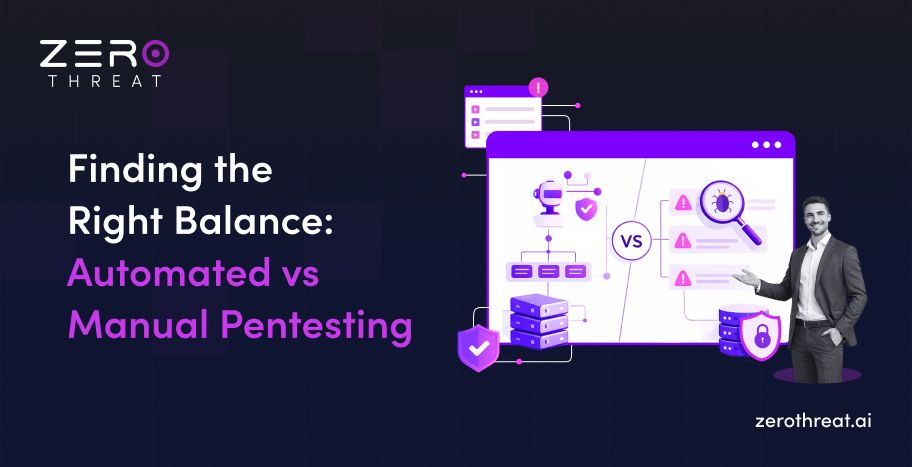
The response has been a quiet restructuring of how security testing gets delivered. In the debate over automated pentesting for web applications and APIs vs traditional security testing, the two are no longer competing for the same budget line in the same way. They operate on fundamentally different delivery models, one priced in tester-days and one priced in platform capacity, and those models scale according to different rules.
That structural difference shows up directly in the market data. It is not that automation is a better idea. It is that the unit economics of continuous, platform-delivered testing holds up as an application portfolio grows, and the unit economics of scoped human engagements do not. Understanding why organizations are moving to automated pentesting starts with that divergence, not with the technology.
This piece works through the arithmetic. What the growth differential actually measures, why the assumptions behind periodic testing stopped holding, how the cost curves diverge, why false positive rate is the hinge the entire argument turns on, and what technically changed to make validated automated testing credible. It closes with a worked model you can substitute your own inputs into.
Don’t let a testing backlog become your next security gap. Start Testing Continuously
On This Page
- What "Growing Faster" Actually Measures
- Traditional Security Testing Was Built for a Different Software Era
- Explaining Why Automated Pentesting is Growing Faster
- The False Positive Tax
- How AI Expanded Automated Pentesting Beyond Traditional DAST
- Where Traditional Pentesting Still Provides Greater Value
- Modeling the Switch for Your Portfolio
- Conclusion
What "Growing Faster" Actually Measures
Automated pentesting market growth measures the gap between two delivery models inside the same market: consultant-delivered penetration testing, sold as scoped and time-boxed engagements priced in tester-days, and platform-delivered continuous testing, sold as recurring capacity priced per application or environment. Separated out, the platform segment compounds at roughly 22% annually against single-digit growth for the consultant segment, a divergence of about 2.4x.
Headline market figures obscure this, and most coverage of automated pentesting market trends repeats the headline. The penetration testing market overall is projected to grow from roughly USD 1.98 billion in 2025 to USD 4.39 billion by 2031, a 14.2% CAGR. That single number averages a large, slow-growing segment with a small, fast-growing one, which tells you very little about where the shift is happening.
The composition matters more than the total. Manual penetration testing still held about 75% of market share in 2025, so it dominates the weighted average. Meanwhile, the platform-delivered segment is forecast to grow from USD 0.72 billion in 2026 to USD 1.98 billion by 2031, a 22.6% CAGR.
Back the platform segment out of the total and the residual, which is essentially the traditional consultant-delivered business, tells the real story:
| Segment | 2026 | 2031 | Implied CAGR |
|---|---|---|---|
| Total pentesting market | ~$2.26B | $4.39B | 14.2% |
| Platform-delivered / PTaaS | $0.72B | $1.98B | 22.6% |
| Residual (consultant-delivered) | ~$1.54B | ~$2.41B | ~9.4% |
A definitional note before going further, since the segment boundary does real work in the argument below. Automated penetration testing here means an engine that discovers surface, executes attack sequences, and validates exploitability without a human driving each step, delivered as recurring capacity rather than a scheduled engagement. That is a different thing from a scheduled scan, and the distinction is what the cost curves later in this article depend on.
One further point worth holding onto: the residual is still growing. Consultant-delivered testing is not shrinking, it is losing share while expanding in absolute terms. Any argument that automation replaces human testing outright predicts a negative number there, and the data does not show one. The correct framing is a shift in mix.
Traditional Security Testing Was Built for a Different Software Era
Traditional security testing was built on four assumptions that modern delivery has invalidated: that releases are infrequent enough for a point-in-time test to stay representative, that application scope is knowable in advance, that the attack surface is stable between assessments, and that findings remain valid for months after the report ships.
Each of those held reasonably well for a quarterly-release monolith behind a fixed perimeter. None of them survive in contact with CI/CD, API-first architecture, and ephemeral infrastructure.
What actually broke
Release cadence broke the representativeness assumption. An AI-driven remediation report describes the application as it existed on the day of testing. When the next deploy lands three months later, that report is still broadly accurate. When the next deploy lands on Thursday, it starts decaying immediately.
API-first design broke the scoping assumption. Scope used to be a list of hostnames. It is now a set of endpoints that changes with every service release, including endpoints that no inventory captures. Undocumented and deprecated-but-live endpoints are not scoping oversights, they are a structural consequence of independently deployed services.
Single-page applications broke the crawlability assumption that automated tooling depended on. Client-side routing means there is no server-rendered link graph to follow, so a testing engine that cannot execute JavaScript and drive state sees a fraction of the real web application attack surface.
The untested-change window
The consequence is measurable. Express it as the share of production changes that ship without ever being security tested:
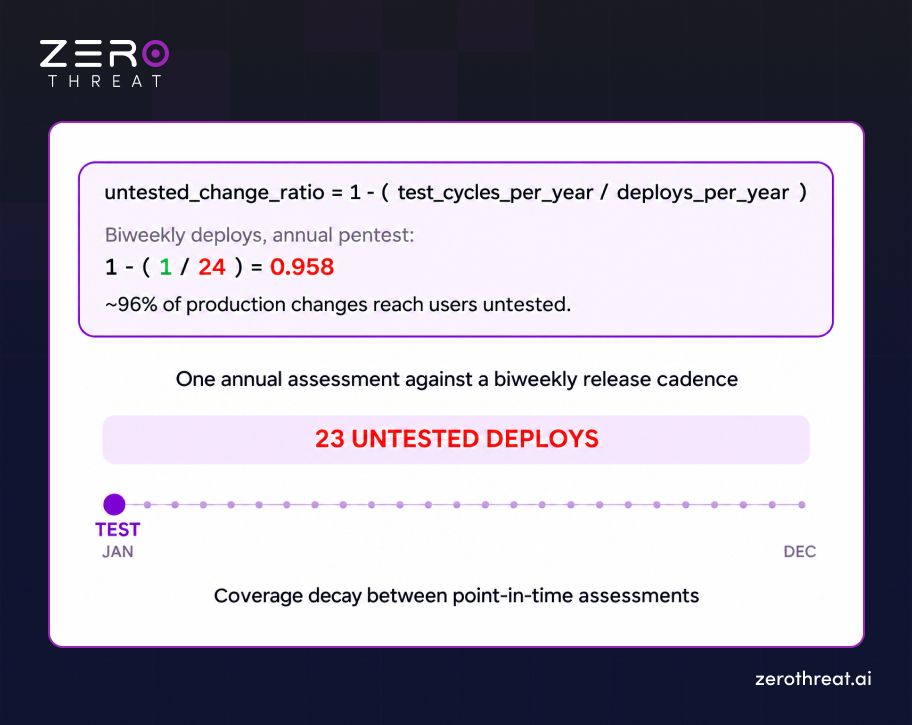
Compliance frameworks anticipated part of this. PCI DSS, for example, requires testing annually and after any significant change. The clause was written when significant changes were rare events. When architecture changes weekly, the "after significant change" trigger either fires continuously or gets quietly reinterpreted into meaninglessness, and in most programs it is the latter.
The Economics Explain Why Automated Pentesting is Growing Faster
While talking about difference between automated and manual pentesting, there’s one major difference. Manual testing cost scales linearly with the number of applications, because each application consumes a fixed quantity of a supply-constrained resource, while platform cost is largely fixed, so the marginal cost of testing an additional application approaches zero.
The supply constraint sets the ceiling
Start on the supply side, because it governs prices. A qualified application pentester takes years to develop. The pool grows at the rate skilled labor markets grow, which is low single digits, and it is competing against application portfolios that expand with every acquisition, every microservice split, and every new customer-facing integration.
Demand outrunning supply in a labor market produces exactly one outcome: day rates rise, lead times stretch, and the constraint binds regardless of budget. An organization that doubles its pentest budget does not get twice the testing. It gets somewhat more testing at a higher rate, delivered later. That ceiling is not a procurement problem to be negotiated around, and it is the reason the consultant segment cannot compound at 22% even where demand exists. The underlying cost structure of penetration testing is a labor market problem before it is a tooling problem.
Two cost curves
The manual model, where N is applications, F is assessments per application per year, D is tester-days, and R is day rate:
C_manual = N × F × D × R × (1 + overhead) overhead covers scoping, coordination, and report production, typically 30% to 40% of engagement duration ∂C / ∂N = constant > 0 every application costs full price The platform model, where P is annual platform cost and T is triage labour: C_platform = P + T ∂C / ∂N → ~0 marginal application adds capacity draw, not headcountThe distinction is not that one is cheaper. At N=1 the manual engagement is frequently cheaper and often deeper. The distinction is what happens to the derivative. Adding the fortieth application to a manual program costs the same as adding the first. Adding it to a platform program costs close to nothing, and adding the fortieth test cycle for that application costs close to nothing as well. That derivative is the whole mechanism behind reducing security testing costs with automated pentesting. In fact, it’s not a lower sticker price, but a flatter curve.
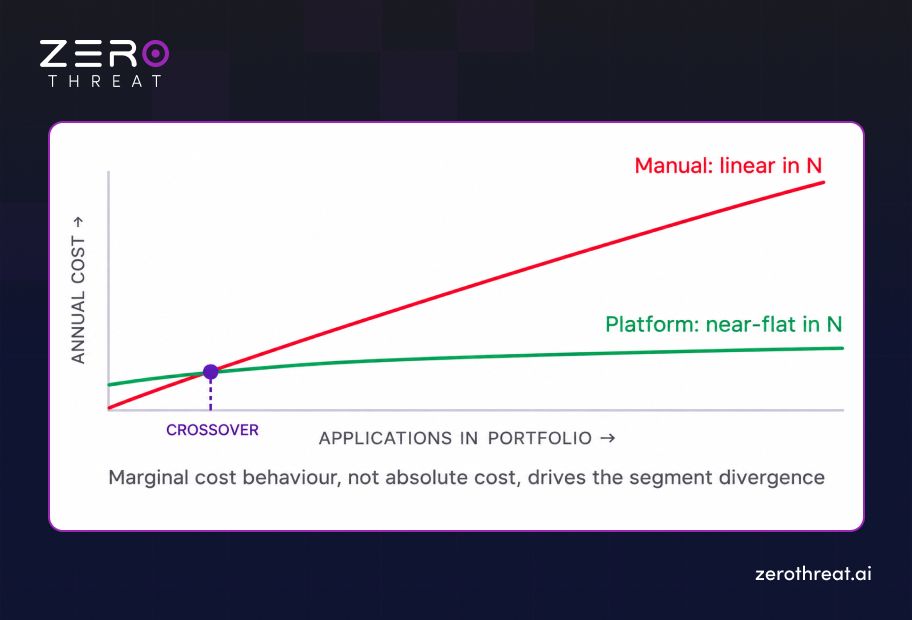
This is why the growth differential appears at the market level rather than only in individual buying decisions. Portfolios are getting larger everywhere at once, which moves the entire buyer population rightward along that x-axis. Past the crossover the arithmetic stops being a preference and starts being a constraint.
The 4× shift isn’t just about faster scanning. AI is changing what gets tested. Explore Automated Pentesting
The False Positive Tax
The false positive tax is the engineering labor consumed by triaging findings that are not real, and it is the single variable capable of inverting the entire economic argument for automation, because triage cost multiplies with testing frequency rather than staying fixed.
This is the part of the argument most automation advocacy skips, and skipping it is why the category has a credibility problem. Cheap automated scanning has existed for two decades. It did not displace manual pentesting. Understanding precisely why is what separates the current shift from the last one.
triage_hours = cycles × apps × alerts_per_cycle × fp_rate × minutes_per_alert
Note what cycles does to that expression. Automation's core advantage is frequency. But frequency is a multiplier on the false positive term, which means the more aggressively you automate, the more the false positive rate costs you. Automation amplifies its own core liability in exact proportion to its core benefit.
Run scanner-era numbers through it. Forty applications, biweekly scanning, 150 raw alerts per cycle, a 20% false positive rate, 15 minutes to dismiss each one:
24 × 40 × 150 × 0.20 × 15min = 7,200 hours/year
≈ 3.5 full-time engineers, before a single real vulnerability is fixed
At a loaded engineering cost of USD 75 per hour that is roughly USD 540,000 of labor. Against a forty-application manual program at USD 10,000 per assessment, which runs USD 400,000, the continuous automated option is more expensive. The organization that adopted it in 2012 was not wrong about coverage. It was correct about coverage and bankrupt on triage, so the tool got switched off and the annual engagement stayed.
Solve the same expression for the point where automation stops paying:
fp_breakeven = ( N × E - P ) / ( cycles × apps × alerts × t × R_eng ) = ( 400,000 - 60,000 ) / 2,700,000 = ~12.6% Above roughly 13% false positives, continuous automated testing costs more than the annual engagement it was meant to replace.The Real Threshold
Legacy DAST tooling routinely operates well above 13%. That is the whole explanation for why the first automation wave stalled, and it is why "faster and cheaper" was never a sufficient pitch. The threshold is not a marketing target. It is the line where the arithmetic reverses, and any platform sitting on the wrong side of it is transferring cost to engineering rather than removing it.
Two things move a platform to the right side of that line. Suppressing false positives before they reach a human, and reducing raw alert volume so that what surfaces is confirmed rather than suspected. Both are functions of whether the testing engine can actually prove a finding is exploitable, which is the subject of the next section.
How AI Expanded AI-powered Automated Pentesting Beyond Traditional DAST
The technical change that made the current generation viable is the shift from pattern matching against responses to autonomous multi-step execution. It engines that authenticate, holds state across a workflow, chains findings into an attack path, and confirms exploitability before reporting. That last capability is what collapses the false positive term.
Traditional dynamic application security testing sends payloads and inspects responses for signatures. It is genuinely useful against reflected and injection-class issues on unauthenticated surface. Its limitations are structural rather than incidental, and they map directly onto the cost problem above. The capability boundary between automated and manual testing has moved considerably as a result, which is why comparisons written even three years ago now misstate it.
Authenticated and Stateful Testing
Most application risks are behind login. A testing engine that cannot maintain a session, refresh tokens, handle multi-factor challenges, and recognize when it has been logged out is testing the marketing site. Stateful traversal means driving real authentication flows and holding context across requests, which is also the precondition for finding access control failures at all. Broken object level authorization (CWE-639) is invisible unless the engine can act as two different users and compare what each can reach.
Business Logic and Multi-step Attack Path Analysis
Logic flaws do not have signatures. A checkout that permits a negative quantity, a password reset that accepts an unbound token, a workflow that allows step three without step two (CWE-841): none of these produce an anomalous response to a payload. They require an engine that understands what the workflow is supposed to do and tests whether the sequence can be violated. This is the category legacy scanning never reached, and it is where most real-world breach paths in modern applications actually sit.
Exploit Validation and Proof-based Findings
This is an economically decisive one. Instead of reporting that a parameter appears injectable, the engine attempts the exploit in a controlled, non-destructive manner and reports only what it could confirm, with the request, response, and reproduction path attached. A finding that arrives with proof does not need triage to establish whether it is real. It needs remediation. The entire fp_rate term collapses, and with it the frequency multiplier that killed the previous generation. This is the defining property of agentic AI pentesting. It acts on the application across multiple steps rather than classifying its responses.
Attack Chain Construction
Individually low-severity findings frequently compose into a high-severity path. An information disclosure that leaks an internal hostname, plus a server-side request forgery vector (CWE-918), plus an unauthenticated metadata endpoint, is three medium findings and one critical breach path. Scoring findings in isolation systematically misprioritizes. Chain-aware analysis prioritizes by what an attacker can actually reach, and the same reasoning extends to detecting previously unseen vulnerability patterns rather than only cataloguing known signatures.
Pipeline Integration and Production Safety
Continuous automated security testing only delivers its coverage advantage if it runs where changes happen. That means CI/CD-triggered execution against pre-production, and safe execution against live environments, which requires rate awareness, non-destructive payload selection, and clean rollback of any state the test creates.
See what continuous pentesting could cost across your portfolio. Check Pricing
Where Traditional Pentesting Still Provides Greater Value
When talking about traditional pentesting, it retains a decisive advantage anywhere the task requires novel reasoning, human interaction, or physical presence: objective-driven red teaming, social engineering, custom exploit development, and original vulnerability research.
- Adversary simulation and red teaming: An automated engine tests an application. A red team pursues an objective across whatever path exists, including the ones nobody scoped, and evaluates detection and response rather than just presence of vulnerabilities.
- Social engineering and physical assessment: Not automatable in any meaningful sense, and frequently the shortest path to compromise in a mature environment.
- Custom exploit development: Turning an unusual primitive into working exploitation against a bespoke stack remains original engineering work.
- Novel vulnerability research: Any automated engine tests against classes of weakness that are already understood. Discovering a new class is human research, and the automated tooling that eventually covers it is downstream of that research.
- Custom cryptographic and protocol review: Design-level analysis of a proprietary scheme is a reasoning task, not a detection task.
Why the Residual Stays Positive
Return to the segment data. If automation were substituting for human testing, the consultant-delivered residual would be flat or negative. It is growing at roughly 9.4%. What the numbers describe is reallocation: continuous automated coverage absorbs the repetitive breadth work that consumed most of a traditional engagement, which frees expensive human hours for the work that genuinely requires them. Total demand for both rises. The mix shifts.
The Business Case: Modeling ROI for Your Portfolio
The business case for automated pentesting is built by converting both options to a common unit, cost per tested production change, rather than comparing an annual engagement fee against an annual subscription fee. The engagement and the subscription do not buy the same quantity of coverage, so comparing their prices directly answers the wrong question.
The inputs below are illustrative placeholders. Substitute your own.
| Input | Value |
|---|---|
| Applications in portfolio (N) | 40 |
| Deploys per application per year | 24 (biweekly) |
| Total production changes per year | 960 |
| Manual engagement cost per application | $10,000 (5 tester-days @ $2,000) |
| Platform cost, 40 applications, continuous | $60,000 |
| Loaded engineering cost | $75 / hour |
Calculating the ROI of Automated Pentesting
Manual, annual engagement per application
cost = 40 × $10,000 = $400,000
tested changes = 40 of 960 (one snapshot each)
cost per tested change = $10,000
Continuous platform, validated findings
platform = $60,000
triage = 320 confirmed findings × 25min × $75 ≈ $10,000
cost = $70,000
tested changes = 960 of 960
cost per tested change = $73
The absolute annual figures differ by a factor of roughly six. The coverage-normalized figures differ by a factor of roughly 137. That gap is the entire market story, and it is why the comparison is not close once portfolio size and release frequency are both realistic.
Two cautions on reading this. First, it assumes a validated-findings engine. Re-run it at a 20% false positive rate and the platform line lands near USD 600,000, and the conclusion reverses. The model is only as good as that one variable. Second, it compares breadth coverage to breadth coverage. It does not price adversary simulation, which most mature programs should continue to buy.
The configuration the arithmetic actually supports is a hybrid: continuous automated validation across the full portfolio, plus a smaller number of targeted human engagements concentrated on tier-one applications and objective-driven exercises. In this model that is roughly USD 60,000 in platform plus eight focused engagements at USD 80,000, for USD 140,000. Full-portfolio continuous coverage and deep human testing where it earns its rate, for around a third of the all-manual budget that covered 4% of production changes.
Start exploring how AI pentesting can help secure your web applications and APIs. Sign Up Now
Conclusion: The Market is Growing Because the Operating Model Scales Better
Manual pentesting scales with human power. Automated pentesting scales with software. That sentence is the whole of the market divergence, and every number in this article is based on our research and market understanding with the rough explanation of it under different conditions.
As release frequency and portfolio complexity keep increasing, continuous validation stops being the more sophisticated option and becomes the only one whose cost curve stays survivable. Organizations still buying annual engagements for a forty-application portfolio are not buying less security than they think. They are buying coverage of roughly 4% of what reaches production, at a hundred times the unit cost of the alternative.
The constraint the whole argument rests on is the false positive rate, which is exactly the variable ZeroThreat’s continuous automated pentesting with exploit validation is built around. Findings are validated through attempted exploitation before they surface, so what reaches your engineers is confirmed and reproducible rather than suspected. That is what keeps the triage term near zero and the frequency multiplier working in your favor instead of against you. Coupled with AI penetration testing across authenticated flows, API security testing, and business logic coverage, ZeroThreat delivers continuous breadth at a marginal cost per application that stays close to flat as the portfolio grows. delivers continuous breadth at a marginal cost per application that stays close to flat as the portfolio grows.
If you are building the case internally, start by running the model above against your own portfolio size and release cadence, then evaluate platforms on the one variable that decides it. Our automated penetration testing platform is built to hold that variable at zero.
Frequently Asked Questions
How much faster is the automated pentesting market growing than traditional security testing?
Platform-delivered continuous testing is forecast to grow at roughly 22.6% annually, while the residual consultant-delivered segment grows at approximately 9.4% once the platform segment is separated from the total. That is a divergence of about 2.4x. The frequently quoted 14.2% headline CAGR for the penetration testing market describes neither segment accurately, because it averages a large slow segment with a smaller fast one.
What is the business case for automated pentesting?
Does automated pentesting replace manual penetration testing?
What kind of security testing should still be done by human pentesters?

Explore ZeroThreat
Automate security testing, save time, and avoid the pitfalls of manual work with ZeroThreat.