 ZeroThreat Wins Top InfoSec Innovators 2026 Award for Penetration Testing Read more


All Blogs
What Makes an Effective Application Security Model? Key Components Explained
Quick Overview: AppSec is no longer limited to protecting code at the development stage. Modern applications require security controls across design, development, APIs, identity, data, testing, deployment, and runtime. This blog covers what an application security model is, its key components, how it works across the application lifecycle, how it applies to modern architectures, common security gaps, and how to build an effective model.
Most engineering organizations own a large collection of web app security testing tools and still cannot answer a basic question: which controls protect this application, at which stage, and who verifies they work. Vulnerability scanners run, and dashboards fill with findings, but nothing binds those pieces into a coherent structure. That gap is the difference between owning security tooling and operating an application security model.
Traditional application security focused on protecting the perimeter around a finished application. Security testing usually happened before release, while firewalls protected the application from outside threats. The rest was often assumed to be secure.
Modern applications have changed that approach. Business logic now runs across multiple services, APIs make authorization decisions at the object level, and applications can be updated every day. That means security can’t just sit around the application, but it needs to be built into the application itself.
In this article, we are going to explain what an application security model looks like in modern software environments and how its key components work together. We’ll cover the security controls that should be built across the application lifecycle. We’ll also look at how these controls connect to reduce vulnerabilities, protect application logic and APIs, and give security teams a clearer view of how well their applications are actually protected, including how web app pentesting helps validate application security verification standards requirements.
See which controls in your application security model actually hold under attack. Start Testing Free
On This Page
- What is an Application Security Model?
- Key Components of an Application Security Model
- How an Application Security Model Works Across the Application Lifecycle
- Application Security Models for Modern Application Architectures
- Common Gaps in Application Security Models
- How to Build an Effective Application Security Model
- Application Security Model: Key Takeaways
What is an Application Security Model?
An application security model is a structured definition of the security controls that protect an application, where each control sits within the system, and how those controls are verified across the software lifecycle. It specifies trust boundaries, the protections enforced at each boundary, and the evidence proving those protections work.
Three elements separate a model from a collection of tools. Trust boundaries state where untrusted data enters, where privilege changes, and where one service starts trusting another. Application security controls are the mechanisms enforced at each boundary: authorization checks, schema validation, encryption, rate limiting. Assurance is the testing and monitoring that confirm each control works as designed rather than merely existing on a diagram.
An application security framework such as OWASP SAMM or NIST SSDF supplies a maturity structure and shared vocabulary. A model is narrower: the applied answer for one system. Frameworks tell you which categories of practice to invest in; the model tells you what is enforced at the token exchange between your gateway and your billing service.
Key Components of an Application Security Model
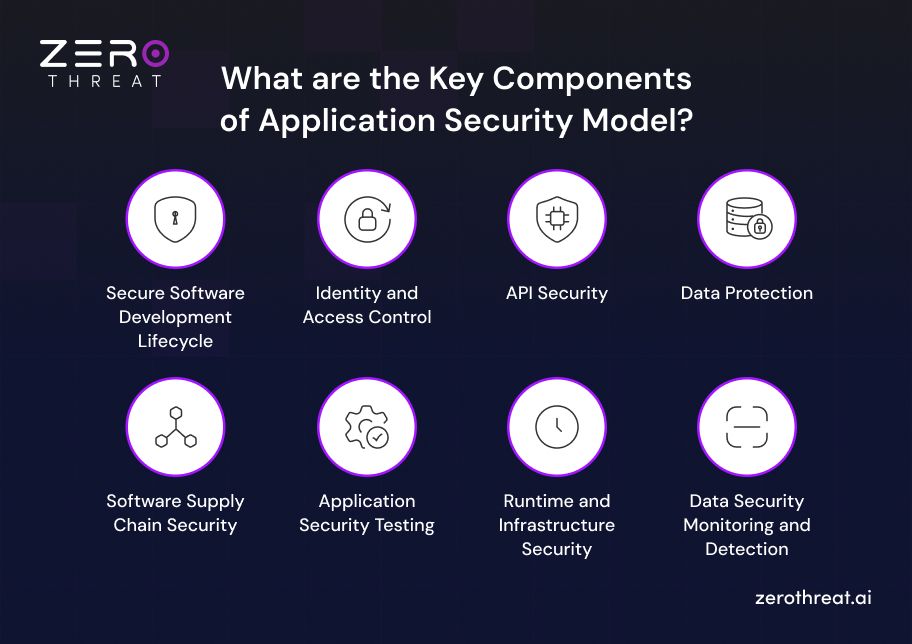
The key components of an application security model are the secure software development lifecycle, identity and access control, application and API security, data protection, software supply chain security, application security testing, runtime and infrastructure security, and security monitoring and detection. Each component owns a distinct control surface, and gaps appear where one component assumes another is covering a risk.
Secure Software Development Lifecycle
The SSDLC embeds security into design and coding rather than appending it before release. It covers threat modeling during design, secure coding standards, peer review with security criteria, and defined security requirements attached to features.
Threat modeling carries the most weight because it is the only component that catches insecure design. A missing authorization check is a coding defect scanner find; an architecture that trusts the client to supply the account ID is a design defect no scanner will flag. The output is documented by trust boundaries, abuse cases per feature, and mitigations assigned before implementation. Teams formalizing this stage can start with these best practices for secure web app development.
Identity and Access Control
This component governs who the caller is and what they may do. Authentication covers credential handling, session lifecycle, token issuance and expiry, and multi-factor enforcement. Authorization covers function-level permissions and object-level ownership checks.
Object-level authorization is where modern applications fail most consistently. A request carrying user A's valid token that returns user B's invoice is broken object level authorization, and it passes every authentication control in the stack. The model must require that every resource-returning endpoint validates ownership server side, not that the UI hides the wrong records.
API Security
API security governs how the application handles untrusted input and exposes functionality. Controls include parameterized queries, output encoding, canonicalization before validation, safe deserialization, egress restrictions to prevent server-side request forgery, and strict schema enforcement on every API contract.
APIs expand faster than governance does. Undocumented endpoints, deprecated versions left running, and internal services quietly exposed through a gateway all create surface no one is testing. Discovery matters as much as testing, since an endpoint outside the inventory is outside the model. These essential API security practices cover the control set, and API security testing validates authorization logic across REST and GraphQL.
Data Protection
Data protection defines how sensitive information is classified, encrypted, and restricted. It spans TLS enforcement for data in transit, encryption at rest for databases and object storage, modern hashing for credentials, key rotation policy, and vault-backed secrets management.
The recurring failure is not weak algorithms but weak key handling. Credentials committed to repositories, API keys embedded in client bundles, and encryption keys stored beside the data they protect all neutralize sound cryptography. The model should specify where every secret lives, who can read it, and how often it rotates.
Software Supply Chain Security
Third-party and generated code now form the majority of most applications, which makes the supply chain a first-class component rather than a subsection of dependency management. Controls include software bill of materials generation, composition analysis covering transitive dependencies, version pinning with checksum verification, build provenance, and artifact signing.
The distinguishing question is reachability. A critical CVE in a package your application never calls is lower risk than a moderate one in a library on your authentication path. Prioritizing purely by CVSS score without reachability context exhausts remediation capacity on findings that carry no exploitable impact.
Turn your AppSec model into actionable testing with AI that investigates vulnerabilities and attack paths. Explore AI Pentesting
Application Security Testing
Testing is the assurance layer that converts assumed controls into verified ones. A complete model places static analysis at commit, composition analysis at build, dynamic and authenticated testing against running environments, and exploit validation before release. Understanding how SAST and DAST differ matters because each catches defect classes the other structurally cannot.
Two capabilities separate adequate testing from thorough testing. Authenticated testing reaches the logic behind the login, where authorization flaws and workflow abuse live. Exploit validation confirms that a finding is genuinely reachable rather than theoretically present, which is what lets teams prioritize honestly. This component also produces the evidence of compliance mapping depends on, covering OWASP, PCI DSS, HIPAA, GDPR, and ISO 27001. Continuous automated penetration testing keeps that evidence current between releases. keeps that evidence current between releases.
Runtime and Infrastructure Security
Runtime controls protect the application as deployed. This covers container image hardening and scanning, workload isolation, network policy between services, secrets injection at runtime rather than at build, hardened configuration baselines, and edge filtering through a WAF or gateway.
Runtime protection compensates for known weaknesses; it does not remove them. Treating a WAF rule as remediation for an unfixed injection flaw leaves the defect in the codebase, exploitable through any path the filter does not cover.
Security Monitoring and Detection
Monitoring provides visibility into what the application is actually experiencing. It requires security-relevant event logging covering authentication attempts, authorization denials, privilege changes, and administrative actions, plus correlation identifiers that trace a request across distributed services.
Logging without alerting is the common half-implementation: events accumulate in storage nobody queries until an incident forces a retrospective search. The model must define which conditions trigger action, such as a spike in authorization denials from one token or enumeration patterns against an object-identifier endpoint. Detection output should also feed back into design, since a repeated incident class signals a threat model that missed something.
How an Application Security Model Works Across the Application Lifecycle
An AppSec model works across the application lifecycle by activating specific components at each stage and passing verified output forward, so that design decisions become coded controls, coded controls become tested evidence, and production signals return to inform design. The model functions as a loop rather than a linear sequence of gates.
The handoffs between each stage matter more than the stages themselves. If threat modeling doesn’t turn into clear security requirements, developers are left guessing. If testing produces findings that aren’t validated, teams end up wasting time on noise. And if monitoring doesn’t feed lessons back into design, the same types of security issues can keep coming back in future releases.
| Stage | Active Components | Primary Controls | Output Passed Forward |
|---|---|---|---|
| Design | SSDLC, Identity | Threat modeling, trust boundary definition, abuse cases | Security requirements per feature |
| Develop | SSDLC, App and API, Data | Secure coding standards, input handling, secrets policy | Reviewed code with controls implemented |
| Build | Supply Chain, Testing | SBOM generation, composition analysis, artifact signing | Signed artifact with dependency inventory |
| Test | Testing, Identity, App and API | Authenticated DAST, authorization testing, exploit validation | Validated findings with exploit evidence |
| Deploy | Runtime, Data | Configuration hardening, network policy, secrets injection | Hardened running environment |
| Monitor | Monitoring, Runtime | Security event logging, correlation, alerting thresholds | Attack and anomaly signal |
| Respond | Monitoring, Identity | Incident triage, session revocation, containment | Confirmed incident scope |
| Remediate | SSDLC, Testing | Fix, revalidation, threat model update | Updated design assumptions |
The Remediate stage closing back into Design is what makes this a model rather than a checklist. Without that return path, the same architectural weakness reappears in the next service built on the same pattern.
Application Security Models for Modern Application Architectures
A modern application security model adapts by shifting emphasis between components rather than adding new ones, because each architecture changes where trust boundaries fall, and which controls carry the most weight. The eight components remain constant; their relative priority does not.
| Architecture | What Shifts | Dominant Risk | Components Under Pressure |
|---|---|---|---|
| Microservices and APIs | Trust boundaries multiply across every service call | Service-to-service authorization gaps, shadow endpoints | Identity, App and API, Monitoring |
| Single-page applications | Logic and routing move to the client | Client-side trust assumptions, exposed API routes in bundles | Identity, App and API, Testing |
| Containers and Kubernetes | Workloads become ephemeral and orchestrated | Over-permissive network policy, unscanned base images | Runtime, Supply Chain |
| Serverless | Functions replace long-lived servers | Event-source injection, over-scoped execution roles | Identity, App and API, Runtime |
| AI-driven applications | Model outputs influence application behavior | Prompt injection into downstream actions, over-permissive tool access | App and API, Identity, Monitoring |
Single-page applications break conventional scanning. Endpoints exist only inside JavaScript bundles, rendering happens on client side, and workflows require multi-step interaction to reach. A model that relies on crawling static links maps a fraction of the real attack surface.
AI-driven applications introduce a boundary many models have not yet defined. When a model output can trigger a tool call, database query, or outbound request, that output is untrusted input reaching a privileged action. It is an authorization design problem, and it belongs to the threat model before it appears in production.
See what it takes to continuously test your applications instead of waiting for the next pentest cycle. See Pricing
Common Gaps in Application Security Models
The most common gaps in application security models are release-only testing, API authorization blind spots, unaddressed business logic flaws, findings without exploit validation, siloed tooling, and missing runtime feedback. These gaps share a pattern: the component exists on paper but produces no verified assurance.
- Testing at Release: Validation compressed into a pre-release window finds defects when changing them is most expensive, and ship pressure converts findings into accepted risk. Between releases, the model produces no assurance at all.
- API Authorization Gaps: Authentication is universally implemented; object-level authorization frequently is not. Endpoints that verify a valid token but never confirm the caller owns the requested resource pass most automated checks while exposing cross-tenant data.
- Business Logic Vulnerabilities: Signature-based scanners test inputs, not intent. A checkout flow that lets a user apply for a discount after payment authorization contains no malformed payload to match. Detecting these requires understanding what the workflow is supposed to do.
- Lack of Exploit Validation: A finding without proof of exploitability forces manual triage, and backlogs grow faster than they clear. Developers lose confidence in the queue, and critical issues wait behind theoretical ones. Agentic AI pentesting confirms reachability and impact before a finding reaches the developer. confirms reachability and impact before a finding reaches the developer. confirms reachability and impact before a finding reaches the developer.
- Siloed Security Tooling: When each component reports into a separate console with its own severity scale, nobody sees that a dependency flaw, an exposed endpoint, and a weak authorization check combine into one viable attack path. Chained risk is invisible to tools reporting in isolation.
- Poor Runtime Feedback: Production observes real attacker behavior, and most models discard that intelligence. Without a return path from monitoring into threat modeling and test coverage, the same weakness class keeps shipping.
How to Build an Effective Application Security Model
To build an effective application security model, map each principle to the specific gap it closes and to a control that produces evidence, rather than adopting principles as general aspirations. A principle without owning control and a verification method does not change the security posture of the application.
| Gap | Principle | Enforcing Control |
|---|---|---|
| Testing only at release | Continuous testing | Pipeline-triggered authenticated scans on every build |
| API authorization gaps | Least privilege | Server-side ownership checks on every resource endpoint |
| Business logic flaws | Continuous validation | Workflow-level testing across multi-step authenticated journeys |
| Lack of exploit validation | Risk-based security | Exploit confirmation and business-impact prioritization |
| Siloed tooling | Defense in depth | Consolidated findings with attack-path correlation |
| Poor runtime feedback | Security feedback loops | Detection signal routed into threat model and test coverage |
Sequence matters when retrofitting an existing application. Inventory comes first, because no control protects the surface you have not discovered. Identity and authorization follow, since broken access control carries the highest exploited impact. Continuous testing comes next to establish a baseline of verified findings, then supply chain, then runtime hardening and monitoring.
For an enterprise application security architecture spanning many teams, add one governance requirement: a named owner per component per application. Shared ownership of a control becomes no ownership. This web application security checklist works as a starting audit.
Start testing your applications with ZeroThreat and discover security weaknesses beyond surface-level vulnerabilities. Sign Up Free
Application Security Model: Key Takeaways
An application security model is only as strong as its assurance layer. Components can be documented, and controls configured, and the model still fails if nothing proves those controls hold under real attack conditions. Vulnerability exploitation now ranks among the leading initial access vectors in reported breaches, and the defects behind those intrusions are usually authorization and logic failures sitting inside a model someone considered complete.
That verification gap is what ZeroThreat’s AI pentesting closes. Its engine tests authenticated flows and multi-step workflows the way a real user moves through them, discovers API routes inside single-page application bundles, chains individual weaknesses into validated attack paths, and confirms exploitability before reporting. With comprehensive attack coverage, it turns the testing component from a periodic checkpoint into continuous, evidence-backed assurance mapped to OWASP, PCI DSS, HIPAA, GDPR, and ISO 27001. Sign up now and start scanning free to validate the controls in your own model.
Frequently Asked Questions
What is the difference between an application security framework and an application security model?
An application security framework is a standardized reference such as OWASP SAMM, NIST SSDF, or ISO 27001 that defines practice categories and maturity levels across organizations. An application security model is the applied, system-specific definition of which controls protect one particular application, where they sit, and how they are verified. A framework guides investment; a model documents enforced reality.
What is the difference between an application security model and an application security program?
What are the main layers of application security?
How do you identify security requirements during application design?

Explore ZeroThreat
Automate security testing, save time, and avoid the pitfalls of manual work with ZeroThreat.