 ZeroThreat Wins Bronze Stevie® Award in Tech Startup of the Year Read more

All Blogs
Quick Overview: A cybersecurity audit tells you exactly where your defenses stand, before an attacker finds out first. This guide covers what a cybersecurity audit is, how it differs from vulnerability assessments and penetration testing, the main audit types, a full 8-step process to run one, key frameworks like NIST and ISO 27001, and how often businesses should audit.
Most security teams only discover critical vulnerabilities after an attacker has already exploited them.
Relying on luck leaves digital infrastructure completely exposed. Research by Ponemon Institute reveals that 60% of data breaches stem directly from unpatched, known vulnerabilities, while 71% of organizations risk failing basic compliance standards due to manual evidence gathering and fragmented security processes.
That is where a cybersecurity audit changes the equation.
Instead of waiting for an intrusive threat actor or a surprise compliance penalty to expose your operational gaps, a cybersecurity audit delivers complete visibility across your digital footprint. It pinpoints severe misconfigurations, tests defensive controls, and validates compliance with industry frameworks like PCI DSS and ISO 27001.
In this guide, we'll break down what a cybersecurity audit actually involves, how does it differ from vulnerability assessment or penetration testing, the types you need to know, how to run one step by step, and which frameworks separate a checkbox exercise from a real security upgrade.
Your next audit shouldn't start with assumptions. Validate your defenses before attackers do. Test My App Free
Table of Contents
- What is a Cybersecurity Audit?
- What Does a Cybersecurity Audit Include?
- Cybersecurity Audit vs. Vulnerability Assessment vs. Penetration Testing
- Types of Cybersecurity Audits
- How to Perform a Cybersecurity Audit: 8-Step Process
- Areas Covered by a Comprehensive Cyber Security Audit
- Top Cybersecurity Audit Frameworks and Standards
- How Often Should Businesses Perform a Cybersecurity Audit?
- Keyways ZeroThreat Supports Cybersecurity Audits
- To Wrap Up
What is a Cybersecurity Audit?
A cybersecurity audit is a structured evaluation of an organization's systems, networks, and security controls. It measures how well current defenses hold up against real threats, gaps in policy, and weak points attackers could exploit.
The process covers access controls, data protection, network configuration, and incident response readiness. Auditors compare these against recognized frameworks like ISO 27001 or NIST to spot compliance gaps before regulators or attackers find them first.
Most organizations complete at least two audits a year, and A-Lign's 2026 benchmark found that 74% of enterprises run four or more annually. Frequent audits catch drift that a single yearly check often quietly misses entirely.
For most businesses, the real value isn't the report itself. It's the clear list of fixes that follows, ranked by actual risk, so security teams know exactly where to focus their limited time and budget.
What Does a Cybersecurity Audit Include?
A cybersecurity audit includes a structured review of security controls, policies, technologies, and processes to determine how effectively an organization protects systems, data, applications, and infrastructure from security risks.
Security Policies and Procedures
Auditors review security policies, standards, and operating procedures to determine whether they are documented, current, approved, and consistently followed. This includes policies for acceptable use, password management, data protection, incident response, access control, and overall cybersecurity governance.
Identity and Access Management (IAM)
The audit examines how users, administrators, and service accounts access critical systems. It evaluates authentication mechanisms, multi-factor authentication, privileged access, role-based access control, account provisioning, and access reviews to identify excessive or unauthorized privileges.
Network and Infrastructure Security
Auditors assess network architecture, firewalls, segmentation, endpoint protection, secure configurations, and other infrastructure controls. The objective is to determine whether network traffic, devices, servers, and critical infrastructure are adequately protected against unauthorized access and common attack vectors.
Data Protection and Encryption
A cybersecurity audit evaluates how sensitive and regulated data is collected, stored, processed, transmitted, and disposed of. It typically reviews encryption, data classification, backup controls, key management, retention policies, and measures designed to prevent sensitive data exposure.
Vulnerability and Patch Management
Auditors examine how an organization discovers, assesses, prioritizes, and remediates security vulnerabilities. This includes vulnerability scanning, patch management, risk-based prioritization, remediation timelines, and processes for addressing weaknesses across applications, operating systems, infrastructure, and exposed services.
Application and API Security
Application security controls are reviewed to identify weaknesses in web applications, APIs, authentication mechanisms, authorization controls, and application configurations. Technical testing may help validate vulnerabilities such as broken access control, injection flaws, security misconfigurations, and exposed sensitive data.
Security Monitoring and Logging
The audit evaluates whether security-relevant events are properly logged, monitored, and analyzed. It may review centralized logging, SIEM processes, alerting, threat detection, log retention, and incident indicators to determine whether suspicious activity can be detected and investigated effectively.
Incident Response and Business Continuity
Auditors assess whether the organization can respond to, contain, and recover from cybersecurity incidents. This includes incident response plans, escalation procedures, disaster recovery, backup strategies, communication processes, recovery objectives, and evidence of security incident exercises or testing.
Third-Party and Vendor Security
The audit may examine the security risks introduced by vendors, cloud providers, contractors, and other third parties. It reviews vendor assessments, security requirements, contractual controls, access permissions, data handling practices, and ongoing third-party risk monitoring.
Compliance and Regulatory Controls
A cybersecurity audit can evaluate whether security controls align with applicable regulations, contractual obligations, and industry standards. Depending on the organization, this may include requirements from frameworks and standards such as NIST CSF, ISO 27001, SOC 2, PCI DSS, or HIPAA.
Turn your next audit into proof, not paperwork, with continuous, exploit-validated testing. Get Audit-Ready Testing
Cybersecurity Audit vs Vulnerability Assessment vs Penetration Testing
These three terms get used interchangeably, but they serve different purposes. A cybersecurity audit reviews overall security posture and compliance. A vulnerability assessment finds and lists weaknesses. A penetration test actively exploits those weaknesses to prove real-world risk.
| Aspect | Cybersecurity Audit | Vulnerability Assessment | Penetration Testing |
|---|---|---|---|
| Purpose | Evaluates overall security posture, policies, and compliance | Identifies and catalogs known vulnerabilities | Simulates real attacks to exploit vulnerabilities |
| Scope | Broad, covers people, processes, and technology | Narrow, focused on systems and applications | Targeted, focused on specific systems or attack paths |
| Method | Reviews documents, controls, and interviews | Automated scanning tools | Manual and automated exploitation techniques |
| Depth | Surface-level review of controls and compliance | Identifies vulnerabilities without exploiting them | Confirms exploitability and real business impact |
| Frequency | Typically annual or per compliance cycle | Monthly or quarterly | Annual, or after major system changes |
| Output | Compliance report with gaps and recommendations | List of vulnerabilities ranked by severity | Proof-of-concept report showing exploited paths |
| Best For | Meeting regulatory and compliance requirements | Ongoing security hygiene and patch prioritization | Validating actual exploitability before attackers do |
Types of Cybersecurity Audits
Cybersecurity audits can differ based on their purpose, scope, and assessment criteria. Common types include internal, external, compliance, vulnerability, and penetration testing audits, each addressing different aspects of an organization’s security posture.
Internal Security Audits
Internal security audits are conducted by an organization’s internal audit or security team. They review security policies, access controls, configurations, risk management processes, and control effectiveness. The goal is to identify security gaps early and improve the organization’s overall cybersecurity posture before external assessments.
External Security Audits
External security audits are performed by independent auditors or third-party security professionals. They provide an objective evaluation of security controls, policies, infrastructure, and processes. Organizations often use external audits to validate their security posture, demonstrate accountability, identify control weaknesses, and provide assurance to customers or stakeholders.
Compliance Audits
Compliance audits determine whether an organization meets specific regulatory, contractual, or industry requirements. Auditors evaluate relevant security controls and supporting evidence against standards such as ISO 27001, SOC 2, PCI DSS, HIPAA, or other applicable requirements. Findings typically highlight compliance gaps that require remediation.
Vulnerability Audits
Vulnerability audits focus on identifying security weaknesses across systems, applications, networks, and infrastructure. They may involve vulnerability scanning, configuration reviews, and risk analysis to identify exploitable conditions. Findings are typically categorized by severity and prioritized based on potential impact, exposure, and remediation requirements.
Pentesting Audits
Pentesting audits incorporate controlled penetration testing to determine whether identified security weaknesses can be exploited. Security professionals simulate realistic attack techniques against authorized systems, applications, or APIs. The resulting evidence helps organizations understand exploitability, attack impact, and the effectiveness of existing security controls.
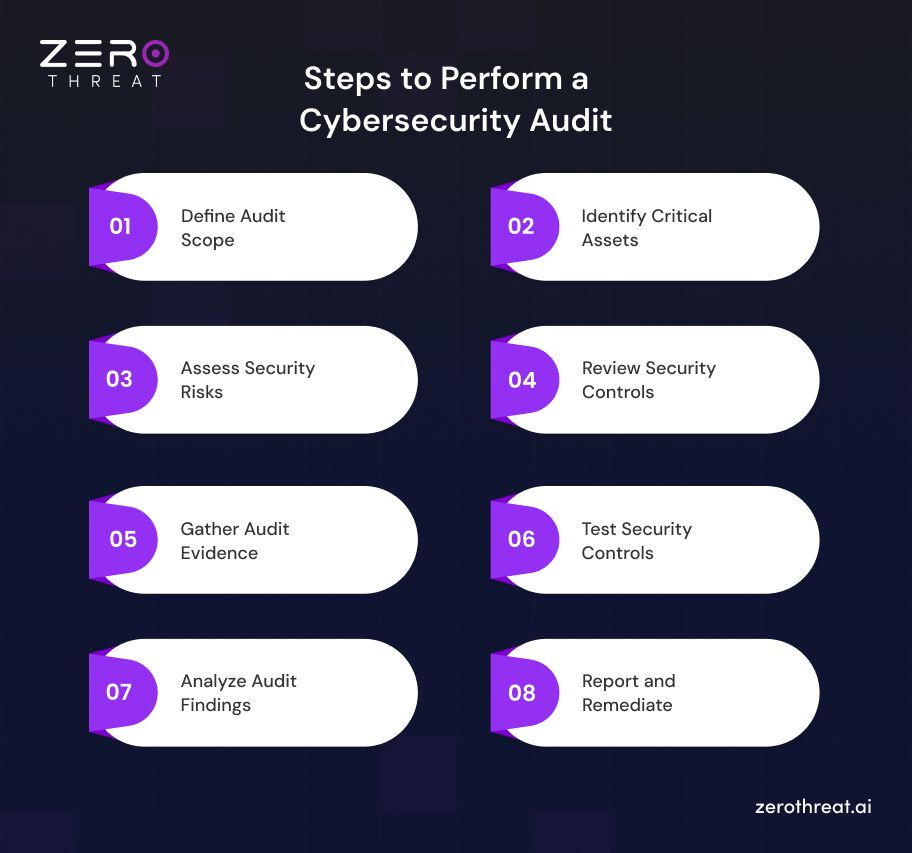
How to Perform a Cybersecurity Audit: 8-Step Process
A cybersecurity audit follows a structured process to evaluate security controls, identify risks, verify control effectiveness, and uncover gaps that could affect systems, data, and business operations.
Step 1: Define Audit Scope
Start by defining exactly what the audit will cover. Identify the systems, applications, networks, locations, business processes, and security controls that fall within scope. Establish the audit objectives, assessment criteria, timeframe, and responsibilities before testing begins. A clearly defined scope prevents gaps and keeps the assessment aligned with organizational risk and business requirements.
Step 2: Identify Critical Assets
Create an inventory of the assets included in the audit and determine which ones are most important to the organization. Include sensitive data, production systems, cloud resources, applications, APIs, endpoints, databases, and critical infrastructure. Classify assets based on business importance, data sensitivity, regulatory requirements, and potential impact if compromised.
Step 3: Assess Security Risks
Evaluate the threats and vulnerabilities that could affect the identified assets. Consider factors such as attack exposure, data sensitivity, existing vulnerabilities, threat likelihood, and potential business impact. Use the results to prioritize high-risk areas and determine where deeper assessment or technical security testing is needed.
Step 4: Review Security Controls
Review the security controls designed to reduce identified risks. Examine policies, procedures, configurations, technical safeguards, and operational practices to determine whether controls are implemented and functioning as intended. NIST recommends using assessment methods such as examination, interviews, and testing to collect evidence and evaluate control effectiveness.
Step 5: Gather Audit Evidence
Collect sufficient evidence to determine whether security controls are implemented and operating effectively. Evidence can include security policies, access reviews, configuration records, vulnerability scan results, system logs, incident records, training records, and previous audit reports. Keep evidence traceable to specific controls and document its source, collection date, and relevance to the audit objective.
Step 6: Test Security Controls
Test selected controls to verify that they work as intended in the real environment. Depending on the audit scope, testing may include configuration reviews, access control checks, log analysis, vulnerability scanning, or technical security testing. Document the testing method, systems reviewed, results, and any exceptions discovered during the assessment.
Step 7: Analyze Audit Findings
Analyze the evidence and test results to determine where security controls are ineffective, missing, or not properly implemented. Validate each finding before reporting it. Assign an appropriate risk rating based on factors such as likelihood, business impact, asset criticality, and exposure. This helps teams focus remediation efforts on the most significant security risks.
Step 8: Report and Remediate
Prepare an audit report that clearly communicates findings, supporting evidence, risk ratings, and recommended corrective actions. Assign ownership and remediation timelines to each significant finding. After fixes are implemented, perform follow-up validation to confirm that weaknesses have been addressed and controls are working effectively. Maintain the audit trail for future assessments and compliance reviews.
Audit-ready security testing shouldn't break your budget. Find the plan that fits your team. Explore Plans
Areas Covered by a Comprehensive Cyber Security Audit
A cyber security audit offers a systematic approach to examine digital assets, identify vulnerabilities, and mitigate security risks. However, it varies depending on the size and type of organization. Yet, the following are the key areas that all cybersecurity audits focus on.
- Network Security: It involves evaluating the networking assets of an organization to identify weaknesses that might allow attackers to launch attacks like DDoS.
- Application Security: It involves auditing application security by evaluating controls like output encoding, input validation, IAM (Identity and Access Management), etc.
- User Security: Assessing the user security controls of an organization that is involved in this process. It helps evaluate how strong security controls are to protect users’ data and access rights.
- Policies for Information Security: Reviewing the information security procedures and policies is an important part of the security audit. It ensures that the measures to protect information are updated, comprehensive, and implemented properly.
Top Cybersecurity Audit Frameworks and Standards
Cybersecurity audit frameworks and standards provide structured criteria for evaluating security controls, managing risks, and demonstrating compliance. The right framework depends on an organization’s industry, regulatory obligations, security objectives, and business requirements.
NIST CSF 2.0
The NIST Cybersecurity Framework 2.0 provides a flexible approach for managing cybersecurity risk through six core functions: Govern, Identify, Protect, Detect, Respond, and Recover. Organizations can use it to assess their current security posture, identify gaps, establish target outcomes, and continuously improve cybersecurity risk management.
ISO/IEC 27001
ISO/IEC 27001 is an international standard for establishing, implementing, maintaining, and continually improving an Information Security Management System (ISMS). It provides requirements for managing information security risks through documented processes, security controls, governance practices, and continual improvement. Organizations can also pursue certification against the standard.
CIS Controls
The CIS Controls provide a prioritized set of cybersecurity safeguards designed to reduce common attack risks. The controls cover areas such as asset management, vulnerability management, access control, audit logging, malware defenses, and data protection. They help organizations implement practical security measures and assess control maturity.
SOC 2
SOC 2 is an auditing framework for evaluating controls relevant to the Trust Services Criteria: security, availability, processing integrity, confidentiality, and privacy. It is widely used by technology and SaaS organizations to demonstrate that appropriate controls are designed and operating effectively to protect customer information and systems.
PCI DSS
The Payment Card Industry Data Security Standard (PCI DSS) establishes security requirements for organizations that store, process, or transmit payment card data. Its controls address areas including network security, access control, vulnerability management, encryption, logging, monitoring, and regular security testing to reduce payment data security risks.
HITRUST CSF
The HITRUST CSF is a comprehensive security and compliance framework that combines requirements from multiple standards, regulations, and authoritative sources. It helps organizations establish and assess controls across areas such as risk management, access control, incident response, vulnerability management, and data protection, particularly in highly regulated environments.
How Often Should Businesses Perform a Cybersecurity Audit?
Audit frequency depends on industry, company size, and regulatory obligations. Most businesses need at least one annual audit, though higher-risk sectors require more frequent reviews to stay compliant and secure.
- Annual Comprehensive Audits: Conduct a complete, enterprise-wide security evaluation yearly to maintain compliance benchmarks and assess long-term defensive posture against evolving threats.
- Major Infrastructure Changes: Schedule targeted audits after migrating to cloud environments, implementing novel network architectures, or integrating major software systems into your stack.
- Significant Application Updates: Audit web applications and core software after major releases or architectural rewrites to verify new code introduces no security flaws.
- Mergers and Acquisitions: Perform thorough audits during corporate acquisitions to evaluate the target organization's security controls and prevent importing undetected network vulnerabilities.
- Post-Incident Review: Execute immediate forensic audits following a security incident or breach attempt to identify exploited access points and prevent repeat occurrences.
- Regulatory Compliance Updates: Re-audit your environment whenever governing frameworks like SOC 2, ISO 27001, or GDPR update their compliance standards and control requirements.
Keyways ZeroThreat Supports Cybersecurity Audits
ZeroThreat helps with cybersecurity audits by combining continuous, AI-powered testing with compliance-ready reporting, giving audit teams verified evidence, faster remediation cycles, and clear visibility into real application risk.
Continuous, Audit-Ready Testing
Instead of relying on a single annual scan, ZeroThreat runs automated pentesting across every code push and scheduled interval. This keeps audit evidence current, so security teams walk into any audit cycle with fresh, verified findings instead of outdated reports.
Proof-Based Vulnerability Validation
Every finding includes reproducible exploit proof, complete with request and response evidence and exact payloads. This removes the guesswork auditors often face with unconfirmed findings, giving them confirmed exploitability data instead of a long list of theoretical risks.
Compliance-Mapped Reporting
Reports map directly to major frameworks, including OWASP, PCI DSS, HIPAA, ISO 27001, and GDPR. This saves audit teams the manual work of cross-referencing findings against multiple standards, turning one scan into audit documentation for several compliance requirements at once.
Near-Zero False Positives
With a false positive rate under 2%, audit teams spend less time chasing invalid alerts. This lets auditors focus review time on real, exploitable risks, making the overall audit process faster and more reliable for both security teams and compliance stakeholders.
Book a personalized walkthrough to see how ZeroThreat accelerates your upcoming audit preparation. Get in Touch
To Wrap Up
A cybersecurity audit provides a structured view of how well security controls protect critical systems, applications, data, and infrastructure. It helps organizations uncover control gaps, assess risk, strengthen defenses, and maintain security readiness.
Effective audits go beyond checking policies or meeting compliance requirements. They combine evidence review, control testing, risk analysis, and remediation to determine whether safeguards work as intended and address weaknesses before attackers can exploit them.
Continuous security validation also strengthens audit readiness as applications, APIs, infrastructure, and threats evolve. With ZeroThreat, teams can continuously test applications and APIs, validate security weaknesses, and strengthen their security posture. Sign up to start testing your security continuously.
Frequently Asked Questions
How much does a cybersecurity audit cost?
Costs typically range from $3,000 for small businesses running a basic assessment to $50,000 or more for enterprise-level audits covering multiple compliance frameworks. Factors like scope, number of systems, regulatory requirements, and whether you hire an internal team or external auditor all affect the final price. Compliance-driven audits, such as SOC 2 or ISO 27001, tend to cost more due to their documentation depth.
How long does a cybersecurity audit take?
Is a cybersecurity audit legally required?
What happens if a business fails a cybersecurity audit?
What qualifications should a cybersecurity auditor have?


Explore ZeroThreat
Automate security testing, save time, and avoid the pitfalls of manual work with ZeroThreat.