 ZeroThreat Wins Bronze Stevie® Award in Tech Startup of the Year Read more

All Blogs
Why Annual Penetration Testing Fails: The Case for Continuous Pentesting

Blog Overview: Annual pentests create a false sense of security. Threats evolve daily, new vulnerabilities emerge unexpectedly, and attack surfaces expand long before the next scheduled assessment arrives. This blog explores why relying on once-a-year testing leaves organizations exposed, how modern threat patterns outpace traditional cycles, and why a continuous pentesting approach delivers far stronger protection.
We all know that for years, annual penetration testing has been treated as a de-facto standard across industries. It fits into compliance calendars, helps teams prepare for audits, and checks a necessary box for certifications.
However, in today’s cloud-native world, an annual pentest using any automated pentesting tool is no longer a security strategy; it’s a security illusion. According to market research, the global penetration-testing market was valued at around US $1.7 billion in 2024, and is projected to reach approximately US $3.9 billion by 2029, growing at a compound annual growth rate (CAGR) of about 17.1%.
Development teams release modern software code on a weekly (and often daily) basis, organizations adopt third-party integrations, and attackers now move faster than ever. According to industry reports, more than 75% of security breaches exploit vulnerabilities introduced within the previous 12 months, after organizations completed their yearly vulnerability assessments. This time-gap makes the annual pentesting strategy dangerously outdated.
In this article, we are going to talk about why annual-only penetration testing is not sufficient, the risks it imposes, and outline better approaches. The primary objective is to provide practical guidance for security teams and leaders seeking to continually strengthen their security posture, rather than periodically.
Stay ahead of attackers with continuous pentesting. Get started in minutes—no security team required. Create Free Account
On This Page
- Why Should You Perform a Penetration Test?
- Why the Annual Pentest Model is Failing
- Business Risks Involved with Insufficient Testing Frequency
- Factors to Consider for More Frequent Pentesting
- Pentesting Frequency Options
- Why Continuous Pentesting Works Better
- Common Myths About Pentesting Frequency
- A Modern Strategy for Pentesting Frequency
- How to Decide What’s Right for Your Organization
- Optimize Your Web App Pentesting with ZeroThreat
- Final Thoughts
Why Should You Perform a Penetration Test?
Penetration testing in cybersecurity plays a critical role in a mature AppSec and DevSecOps program. Pentests simulate an attack against your system to test every aspect of your security across the system.
While vulnerability scanners and SAST/DAST tools catch known issues, they cannot replicate the decision-making of a skilled adversary. A pentest provides a controlled but realistic simulation of attacker behavior, which not only validates vulnerabilities, but also how your full app responds under genuine offensive pressure.
1) Helps You Uncover Vulnerabilities Beyond Automated Scanners
Modern applications include complex logic flows, distributed microservices, GraphQL endpoints, API gateways, and asynchronous workflows. Automated vulnerability scanners often fail to detect:
- Privilege escalation paths
- Broken access controls
- Race conditions
- Insecure multi-step workflows
- Logic-level flaws unique to your business domain
Top pentest tools emphasize these components with attacker-level reasoning, revealing gaps scanners will never catch.
2) Validates Your Security Architecture Under Real Attack Conditions
AppSec programs rely on layers of controls, including WAF rules, IAM policies, API gateways, secrets management, TLS configurations, container isolation, and zero trust architecture. A pentest verifies whether these controls:
- Trigger alerts in real time
- Block or rate-limit malicious traffic
- Enforce least privilege correctly
- Prevent lateral movement across microservices
- Resist token replay, session hijacking, or injection attempts
This validation is essential for DevSecOps teams who depend on security controls.
3) Identifies Drift Across CI/CD and Cloud Environments
Cloud-native architectures are dynamic. Infrastructure-as-code changes, environment-specific configs, and CI/CD pipelines introduce constant drift. Autoamted pentesting tool helps detect:
- Misconfigured access policies
- Overly permissive service accounts
- Exposed dev/stage APIs
- Forgotten test endpoints
- Debug routes shipped to production
These practical problems tend to come up in between scans which are automated and hence it is impossible to do without verification led by man.
4) Strengthen the Developer Feedback Loop
While going for the penetration testing schedule, DevSecOps thrives on quick feedback. Pentest results give engineering teams:
- Clear exploit narratives (not just vulnerability IDs)
- Reproducible scenarios showing how weaknesses are actually abused
- Prioritized remediation guidance tied to architectural context
- Insights that translate into better secure coding patterns
This accelerates remediation and reduces long-term security debt.
5) Improves API Security Posture
With APIs now the primary attack surface, API penetration testing ensures deeper coverage across:
- OAuth/OpenID flows
- JWT validation
- Token scoping and expiry
- Multi-service authentication chains
- Rate limiting and throttling
- Microservice-to-microservice trust boundaries
These are high-impact areas often not fully validated through automated tooling.
Why the Annual Pentest Model is Failing
Yearly pentest’s drawback is that it doesn’t work in today’s modern environment, where an application’s module changes too fast. Nowadays, modern apps deploy updates weekly, APIs expand constantly, and cloud configurations shift daily.
A pentest done months ago can’t protect applications that have changed hundreds of times since. New vulnerabilities appear every week, infrastructure drifts without warning, and attackers now scan the internet 24/7 using automated tools and API.
Hence, relying on annual or yearly pentesting will create long gaps in assessment and expose you to a false sense of security.
Therefore, to stay ahead of threats, you need a pentesting approach that matches the speed of development, but not one that waits 12 months to catch up.
Business Risks Involved with Insufficient Testing Frequency
When you choose a pentesting yearly, then the business (not the technology) invites the risk. Modern apps are constantly changing, and vulnerabilities introduced after the annual pentest remain exposed for months. This leads to higher breach likelihood, costly remediation, disrupted product release, and potential compliance failures.
Infrequent testing also creates long windows of exposure, weakens customer trust, and forces teams into reactive firefighting instead of proactive security. Without continuous penetration testing, security gaps turn into real business liabilities, impacting revenue, reputation, and long-term growth.
See how our intelligent pentesting engine uncovers real vulnerabilities faster than annual tests ever could. Explore Automated Pentesting
What are the Factors to Consider for More Frequent Pentesting?
The right pentesting frequency depends on how quickly your environment changes and how much risk your organization can tolerate. As we all know, modern applications, APIs, and cloud infrastructures evolve continuously. Hence, pentesting should align with operational reality, not an annual schedule.
Following are the primary factors that influence how often you should do a penetration test.
- Deployment velocity and code change frequency
- Application, API, and architecture complexity
- Type of data handled and regulatory requirements
- Cloud and infrastructure configuration changes
- New features, API endpoints, or third-party integrations
- Security incidents, suspicious activity, or drift detection
- Mergers, acquisitions, or major architectural shifts
- Overall risk tolerance of the organization
Pentesting Frequency Options
When deciding on a pentesting frequency for your organization, you have five basic options:
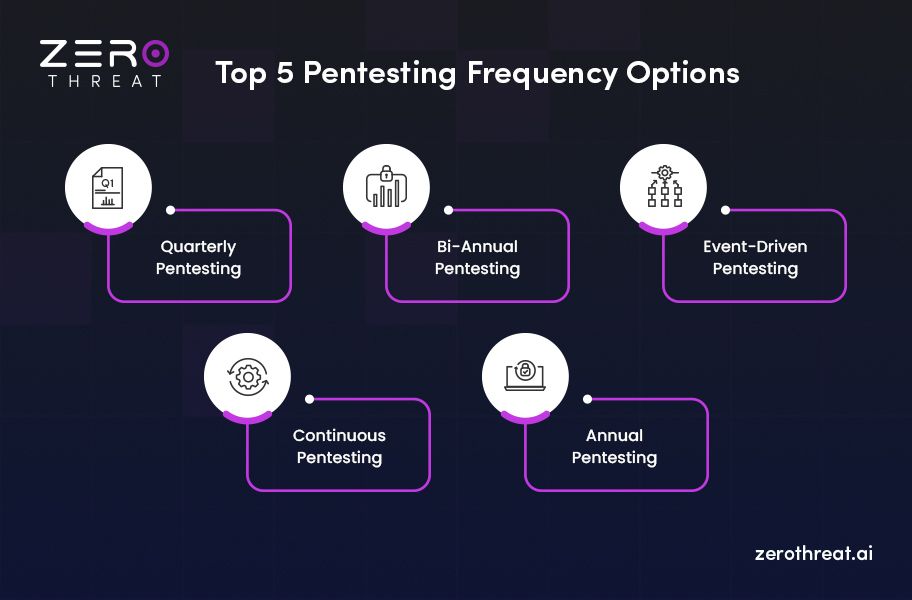
1) Quarterly Pentesting
A quarterly security assessment is performed every 3 months, designed for environments with rapid development cycles, frequent API changes, and ongoing cloud updates. This method aligns with agile teams that ship new features regularly and need recurring validation throughout the year.
Key Benefits
- Catches vulnerabilities introduced across multiple release cycles
- Maintains a consistent security baseline
- Reduces long exposure windows
- Improves audit readiness throughout the year
Pros
- Strong balance between security and cost
- Early detection of high-priority risks
- Works well with agile and product-driven teams
Cons
- May still miss rapidly emerging risks between tests
- Requires ongoing resource allocation
Best For
- SaaS companies
- Customer-facing applications
- Teams with monthly or bi-monthly releases
- Organizations handling sensitive or regulated data
2) Bi-Annual Pentesting
A twice-per-year testing method is suitable for organizations that update their applications or infrastructure at a moderate pace. This schedule aligns well with predictable, planned release cycles and provides better coverage than traditional annual tests.
Key Benefits
- Covers major product updates and infrastructure cycles
- Offers more visibility than annual testing
- Helps maintain compliance posture
Pros
- More cost-effective than quarterly or continuous testing
- Adequate for systems with moderate change
Cons
- Can leave multi-month gaps
- Not suitable for rapid-development or API-heavy environments
Best For
- Internal business systems
- Medium-complexity applications
- Teams with planned quarterly or semi-annual releases
3) Event-Driven Pentesting
Testing is initiated whenever significant changes occur, such as new feature rollouts, API launches, cloud migrations, or third-party integrations. Instead of time-based schedules, this model triggers pentests only when meaningful architectural or functional updates happen.
Key Benefits
- Immediate validation after impactful releases
- Ensures major updates don’t introduce critical flaws
- Ideal for unpredictable or burst-style development cycles
Pros
- Highly targeted
- Ensures new features and cloud configurations are secure before go-live
Cons
- Reactive rather than continuous
- Can be difficult to plan budgeting around variable frequency
Best For
- Major feature releases
- New API endpoints
- Cloud migrations or infrastructure re-architecture
- Third-party integrations (payments, CRMs, authentication providers)
4) Continuous Pentesting
Continuous pentesting is an always-on, automated and human-validated security testing approach integrated into CI/CD pipelines. It adapts to daily or weekly deployments, constantly monitors APIs and cloud assets, and validates security posture in near real time.
Key Benefits
- Detects vulnerabilities as soon as they appear
- Maps closely to modern DevSecOps workflows
- Provides near real-time attack surface monitoring
- Reduces mean time to detect (MTTD) and remediate (MTTR)
Pros
- Always-on visibility
- Best defense against zero-days and configuration drift
- Scales with cloud, microservices, and API changes
Cons
- Higher operational investment
- Requires alignment with DevOps pipelines and automation tools
Best For
- Fast-moving engineering teams
- CI/CD environments with weekly or daily deployments
- Cloud-native, microservices-heavy systems
- Businesses with low tolerance for security risk
5) Annual Pentesting
A once-a-year penetration test is commonly used to satisfy compliance needs such as SOC 2, PCI-DSS, and ISO 27001. It provides a high-level, point-in-time snapshot of the security posture but does not account for changes introduced throughout the year.
Key Benefits
- Satisfies regulatory expectations (SOC 2, PCI-DSS, ISO 27001)
- Provides a baseline view of risk
Pros
- Cost-efficient
- Works for organizations with slow-changing systems
Cons
- Leaves long exposure windows
- Outdated almost immediately in dynamic environments
- Insufficient for modern attack surfaces (APIs, cloud, microservices)
Best For
- Compliance-only needs
- Systems with minimal change
- Organizations early in their AppSec maturity journey
Transparent, flexible pricing built for startups, SaaS, and enterprises. Choose a plan that fits your needs. View Pricing
Why Continuous or Frequent Pentesting Works Better
Continuous or frequent pentesting provides clear visibility and delivers risk reduction that annual testing cannot match. It aligns security with the rapid pace, ensuring vulnerabilities are found when they appear, not months later.
Therefore, instead of relying on outdated, point-in-time snapshots, organizations get an always-current view of their attack surface and can remediate issues before attackers find them.
Why it works better:
- Fits the speed of modern development - detects vulnerabilities immediately as new code, APIs, or infrastructure changes go live.
- Reduces exposure windows - lowers the time a vulnerability remains exploitable.
- Catches issues that scanners and annual tests miss - especially logic flaws, API risks, and cloud misconfigurations.
- Keeps up with dynamic cloud environments - identifies drift, misconfigured IAM roles, or accidental exposures in real time.
- Improves remediation cycles - teams fix issues faster when they’re discovered closer to deployment.
- Strengthens compliance posture - provides ongoing evidence of security, not a once-a-year report.
- Supports DevSecOps workflows - integrates naturally into CI/CD pipelines and automated development practices.
Common Myths About Pentesting Frequency
Many organizations still rely on outdated assumptions when deciding how often to run penetration tests. These misconceptions create blind spots that leave systems exposed for months at a time.
Below are some of the most common myths that lead to unnecessary risk.
- “Annual pentesting is enough to stay secure.”
Annual tests only provide a snapshot; your environment changes far more often. - “Compliance requirements define the right frequency.”
Compliance is a minimum baseline, not a security strategy. - “Automated scanners can replace frequent pentests.”
Scanners detect known issues but cannot find logic flaws, chained exploits, or complex API vulnerabilities. - “We only need to test when we release major features.”
Minor updates, configuration changes, and dependency shifts can introduce critical risks too. - “Cloud platforms already secure most of our infrastructure.”
Cloud providers secure the platform, including misconfigurations, IAM mistakes, and exposed services are still your responsibility. - “If nothing has gone wrong, testing can wait.”
Attackers actively scan for new exposures daily; the absence of incidents doesn’t mean the absence of vulnerabilities.
A Modern Strategy for Pentesting Frequency
Instead of relying on rigid annual assessments, you need a flexible, risk-based model that aligns with continuous delivery, evolving APIs, and dynamic cloud infrastructures.
And that’s where modern pentesting comes into the picture. It focuses on maintaining real-time visibility, validating new changes as they occur, and reducing the window of opportunity for attackers.
A modern strategy is about:
- Risk-based testing frequency
- Continuous coverage for fast-changing environments
- Event-driven testing
- Periodic manual deep dives
- Integration with DevSecOps workflows
- Real-time attack surface monitoring
- AI-driven remediation reports
How to Decide What’s Right for Your Organization
Determining the ideal pentesting frequency is a strategic one. Every organization has different risks, compliance pressures, architectures, and operational realities.
To choose the right testing method, evaluate the factors that directly influence how often your applications should be validated.
- Compliance obligations: Do industry regulations require specific pentesting or vulnerability scanning minimums? And are those minimums sufficient to truly protect the confidentiality, integrity, and availability of your applications and data?
- Risk profile: Do you handle high-value assets, financial information, personal data, or large volumes of sensitive records that elevate your exposure?
- Risk environment: Has your sector, customer base, or product recently been targeted by known threat groups or emerging exploits?
- Security history: Have you experienced a breach, incident, or major vulnerability in the recent past that indicates you may need tighter validation?
- Technology changes: Have you rolled out major updates, new APIs, cloud migrations, infrastructure changes, or do you push code frequently?
- Business changes: Are you expanding into new markets, onboarding third-party integrations, or preparing for an acquisition or merger that increases your attack surface?
- Budget and resource availability: What portion of your IT or security budget can you allocate to ongoing pentesting, and how does that align with your risk tolerance?
By evaluating these factors together, you can determine a pentesting schedule that supports both your security goals and your business realities. This ensures the level of testing matches the level of risk your organization faces.
Have questions about continuous pentesting or enterprise requirements? Our security experts are here to help. Talk to an Expert
Optimize Your Web App Pentesting with ZeroThreat
Traditional pentesting can’t keep up with the speed of modern web applications, but ZeroThreat is built to close that gap. By combining intelligent automation with Zero Trust architecture, ZeroThreat transforms pentesting from a slow, annual process into a continuous and scalable security workflow. Instead of waiting weeks for results or relying on outdated reports, you get instant insights into vulnerabilities as your application evolves with web app pentesting.
With ZeroThreat, you can:
- Run full pentests on demand without lengthy setup or scheduling delays.
- Monitor your attack surface as new features and APIs are deployed.
- Uncover logic flaws, complex API risks, and chained vulnerabilities through AI-driven testing backed by expert validation.
- Shorten remediation cycles with precise findings, reproducible exploit paths, and prioritized fixes.
- Integrate security into your CI/CD pipeline so every release is validated automatically.
- Stay audit-ready year-round with ongoing assessments and exportable compliance reports.
Get started for free with ZeroThreat to secure fast-moving web applications, without the friction of traditional pentesting.
Final Thoughts
Penetration testing is one of the most effective ways to understand how your systems appear through an attacker’s eyes.
Most industries are governed by security and privacy regulations that mandate regular pentesting. Instead of treating this as a checkbox exercise, it’s an opportunity to gain a deeper understanding of your risk surface and guide your security program in the right direction.
And if a breach ever occurs, presenting a bare-minimum or low-quality pentest report won’t protect your reputation or reassure affected customers.
In a nutshell, continuous pentesting is about prevention. Therefore, investing in a next-generation automated penetration software is the best way to stay ahead of security.



Explore ZeroThreat
Automate security testing, save time, and avoid the pitfalls of manual work with ZeroThreat.