 ZeroThreat Wins Bronze Stevie® Award in Tech Startup of the Year Read more

All Blogs
What is the Best Way to Prevent BOLA Vulnerabilities in APIs?
Quick Overview: Broken Object Level Authorization (BOLA) is one of the most critical API security vulnerabilities, enabling unauthorized access to sensitive resources. This blog explores how BOLA occurs, proven strategies to prevent it, best practices for testing and access control, common implementation mistakes, and how ZeroThreat detects and validates BOLA vulnerabilities in modern APIs.
Your API knows exactly who the caller is. It validates their token, loads their session, and confirms they are allowed to hit the endpoint. Then it takes an object ID straight from the request URL and hands back the record, without ever asking the one question that matters: does this object belong to this user?
That gap is Broken Object Level Authorization, and it is the most exploited flaw in modern APIs. OWASP ranks it API1:2023, the top entry in the API Security Top 10, and it has held that position since the list launched in 2019. The reason it persists is uncomfortable: BOLA is not an injection bug you can pattern-match. A malicious request is byte-for-byte indistinguishable from a legitimate one, which is precisely why firewalls and single-user scanners miss it.
This guide covers how the flaw happens, how to build authorization that stops it, and how API penetration testing can confirm the fix is real.
Think your APIs are safe? Prove it. Start Free Scan
On This Page
- What is BOLA?
- Why BOLA is the Most Critical API Security Risk
- How BOLA Vulnerabilities Occur in APIs
- Implement Object-Level Authorization Correctly
- API Security Best Practices to Prevent BOLA
- How to Test APIs for BOLA Vulnerabilities
- Common Mistakes That Lead to BOLA
- How ZeroThreat Detects BOLA
- Conclusion
What is BOLA?
BOLA (Broken Object Level Authorization) is an access control flaw where an API authenticates a user but fails to verify that they are authorized to access the specific object they requested, letting attackers reach other users' data by manipulating an object identifier.
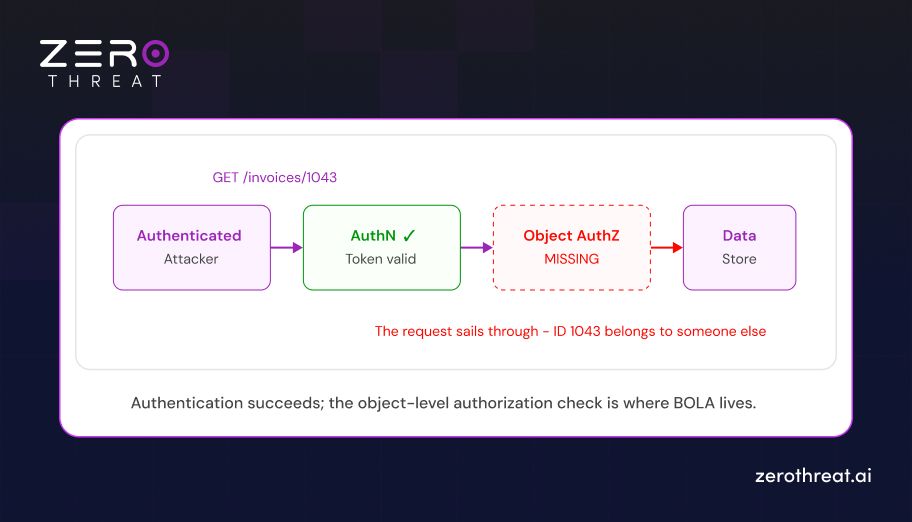
The flaw sits at the object level. The user legitimately has access to the endpoint itself, for example GET /api/invoices/{id}. The violation happens when they swap the {id} for one that belongs to someone else, and the server returns it anyway. Authentication asks who are you; authorization asks may you do this to this object. BOLA is the failure of that second question at the granularity of a single record.
In web applications, the same class of bug has long been called IDOR (Insecure Direct Object Reference). BOLA is OWASP's framing of the identical weakness in an API context. Both map to CWE-639: Authorization Bypass Through User-Controlled Key, whose parent is CWE-284 (Improper Access Control). CWE-639 now also appears in the 2025 CWE Top 25, so citing both OWASP API1:2023 and CWE-639 in a finding gives your developers a precise, standards-backed reference for the class of bug and its fix.
Why BOLA is the Most Critical API Security Risk
BOLA tops the OWASP API Security Top 10 because it is both easy to exploit and widespread, and a single vulnerable endpoint can expose every record in a dataset through simple identifier enumeration.
OWASP rates BOLA's exploitability as Easy and its prevalence as Widespread, the reason it generates more reported findings than any other API vulnerability class. The impact is not incremental. Because the flawed endpoint sits inside a legitimate, authenticated session, an attacker who can iterate object IDs can often walk an entire table, one record at a time, without tripping a single alarm.
The breach record makes the point concretely. A 2025 disclosure showed an IDOR flaw exposing roughly 64 million McDonald's job applications through a recruitment API. Earlier cases include Uber, where a BOLA flaw could have enabled full account takeover across rider and driver accounts, and connected-car APIs that exposed owner data by failing to validate vehicle ownership. The common thread is that none required an exotic exploit chain, just an identifier for the server to trust too much.
There is a structural reason this keeps happening. As the OWASP entry notes, APIs expose object-handling endpoints by design, creating a broad attack surface of object-level access decisions. Validating object ownership consistently across distributed microservices and multi-tenant environments is genuinely hard, and any endpoint that gets skipped becomes the weak link.
How BOLA Vulnerabilities Occur in APIs
BOLA vulnerabilities occur when an API uses a client-supplied object identifier to fetch or modify a record without checking that the authenticated user is permitted to act on that specific object.
Consider an invoicing endpoint. A logged-in user views their own invoice through a request the client generates automatically:
Attacker request GET /api/v2/invoices/1043 HTTP/1.1 Host: api.example.com Authorization: Bearer <attacker_valid_token> → 200 OK // returns another user's invoice What should happen GET /api/v2/invoices/1043 HTTP/1.1 Host: api.example.com Authorization: Bearer <attacker_valid_token> → 403 Forbidden // object not owned by callerThe attacker changes nothing but the number. Their token is valid, the endpoint is one they are allowed to call, and the object ID is sequential and guessable. If the server loads invoice 1043 and returns it without confirming ownership, that is BOLA. The most common root causes:
- Object Identifier Manipulation: Sequential or predictable IDs in the URL, body, query string, or a GraphQL variable let an attacker enumerate objects they should never see.
- Missing Object-level Authorization Checks: The code authenticates the request and may check role or endpoint access, but never confirms the caller owns the specific object being loaded.
- Trusting Client-supplied Ownership Fields: The request carries a user_id or tenant_id the server reads instead of deriving it from the session, so an attacker simply supplies someone else's.
- Unprotected Nested and Related Resources: A guarded top-level route (/accounts/{id}) with unguarded child routes (/accounts/{id}/documents/{docId}) where only the parent is checked.
Detect BOLA through real attacker behavior, not just API scans. Explore API Pentesting
Implement Object-Level Authorization Correctly
Correct object-level authorization means checking, on every request and inside every function that loads an object by ID, that the authenticated user is permitted to act on that specific object, using an identity derived from the session rather than the request.
This is the control that actually prevents BOLA. Everything else in this guide is defense in depth around it. Get these four things right.
1) Derive identity from the session, never from client-supplied IDs
The user's identity must come from the authenticated session or verified token, and ownership must be checked against it. Never trust a user_id, account_id, or ownership field that arrives in the request body or query string. The scoping belongs in the query itself:
BAD: loads any invoice by ID, then trusts it invoice = Invoice.find(params[:id]) render json: invoice GOOD: scope the lookup to the authenticated user invoice = current_user.invoices.find_by(id: params[:id]) return head :forbidden unless invoice render json: invoiceThe good version cannot return an object the current user does not own, because the object is fetched through the ownership relationship. This is the single most reliable pattern for the common case.
2) Enforce the check on every request, including state-changing actions
Object-level authorization is not a one-time gate at login. Every GET, PUT, PATCH, and DELETE that touches an object by ID needs its own check, evaluated continuously across the session. A frequent gap: read endpoints are scoped correctly, but the delete or update on the same object is not, so an attacker cannot read record 1043 but can still destroy it.
3) Choose the right authorization model: RBAC, ABAC, or ReBAC
Object-level decisions usually need more than roles. Pick the model that matches how your objects relate to users:
| Model | Decides On | Best Fit for BOLA Prevention |
|---|---|---|
| RBAC Role-Based | The user's role | Endpoint and function access. Insufficient alone for object ownership, since two users share a role but not their records. |
| ABAC Attribute-Based | Attributes of user, object, and context | Fine-grained rules like "owner or same department," where ownership is one attribute among several. |
| ReBAC Relationship-Based | The relationship between user and object | Ownership and sharing graphs (owner, editor, viewer). A strong fit for object-level checks in collaborative and multi-tenant apps. |
In practice, most teams combine RBAC for coarse endpoint access with ABAC or ReBAC for the object-level decision. The point is that "the user has the right role" must never be mistaken for "the user owns this object."
4) Enforce tenant isolation in multi-tenant systems
Multi-tenancy is where BOLA gets expensive: a missing check leaks not one peer's record but an entire other organization's data. Scope every query to the tenant resolved from the session, and treat any tenant identifier in the request as untrusted input. A shared authorization layer that injects the tenant boundary into every data access is far safer than relying on each endpoint to remember it.
Key nuance: Comparing the session user ID against an ID in the request is not a sufficient fix on its own. As OWASP notes, that only covers a narrow subset of cases. BOLA is about whether the caller may act on the requested object, so the authorization decision has to be tied to the object's real ownership in your data model, not to a value the client can change.
Top API Security Best Practices to Prevent BOLA
Let’s follow the essential API security best practices in order to prevent BOLA, which treats unguessable identifiers as defense in depth rather than access control.
Adopt Deny-by-default Authorization
Every object access should be denied unless an explicit rule grants it. Deny-by-default means a newly added endpoint that nobody remembered to protect fails closed instead of leaking data. It converts the most common cause of BOLA, a forgotten check, from a silent breach into a visible 403.
Centralize Authorization Instead of Scattering It
When each endpoint implements its own ownership check, inconsistency is inevitable and one of them will be wrong. A centralized authorization layer or policy engine (for example, a policy-as-code service that every request passes through) gives you one place to define, review, and test object-level rules. It is also what makes deny-by-default enforceable across a growing API surface.
Scope Database Queries to the Authenticated User
This is not about SQL injection. It is about writing every object query so it can only ever return rows the caller owns. Prefer WHERE owner_id = :session_user baked into the data-access layer over fetching by primary key and checking ownership afterward. If the ownership constraint lives in the query, a forgotten post-fetch check cannot cause a leak.
Treat Unpredictable IDs as Defense in Depth Only
Random UUIDs make blind enumeration much harder, so they slow down a drive-by attacker guessing sequential integers. They add no authorization. If an ID leaks through a list endpoint, an email, a referral link, or a GraphQL edge, the object is still wide open. Use UUIDs to raise the cost of guessing, never as the control that decides access.
Apply Least Privilege Across Endpoints
Grant each caller the narrowest access that lets them do their job, and apply the same rigor to internal, admin, and nested routes as to public ones. Inconsistent access control across endpoints, where the main route is locked down, but a sibling or child route is not, is one of the most common ways BOLA slips into an otherwise well-secured API.
How to Test APIs for BOLA Vulnerabilities
API security testing for BOLA requires authenticating as at least two separate users and replaying each user's requests with the other's credentials, then watching for successful responses that return data the caller should not be able to see.
You cannot confirm object-level authorization with a single identity, which is exactly why generic scanners and WAFs struggle here: to them, a valid user reading their own record and an attacker reading someone else's are the same request. Effective BOLA testing is inherently multi-identity.
Manual Authorization Testing
Create two accounts, A and B. Capture A's legitimate requests, then replay them using B's token while swapping A's object IDs in. A 200 that returns A's data to B is a confirmed BOLA finding. Work methodically through every endpoint that takes an object ID, and do not forget request bodies, query parameters, headers, and GraphQL variables, not just path parameters.
Test Horizontal and Vertical Privilege Escalation
Horizontal: same privilege level, different owner, for example user B reading user A's invoice. Vertical: lower privilege reaching a higher-privilege object, for example a standard user acting on an admin-owned resource. BOLA testing must cover both, across read and state-changing operations, because an endpoint can be safe for reads and vulnerable for deletes.
Automate Multi-identity Testing, Then Validate Exploitability
Manual testing does not scale to hundreds of endpoints or survive every deploy. Automated API security testing that drives requests under two or more identities, ideally from your API specification, can systematically probe object-level authorization across the whole surface. The critical final step is exploit validation: confirming that a suspected BOLA actually returns unauthorized data, rather than flagging every ID parameter as a theoretical risk. Validation is what separates a real, actionable finding from the false-positive noise that makes teams ignore their scanner.
Common Mistakes That Lead to BOLA Vulnerability
The most common mistakes that cause BOLA are assuming authentication equals authorization, trusting client-side or client-supplied access decisions, relying on UUIDs for security, and leaving nested or inconsistent endpoints unprotected.
- Assuming authentication equals authorization. A valid token proves who the caller is, not that they may touch a given object. This conflation is the root of nearly every BOLA.
- Enforcing access control on the client. Hiding a button or filtering a list in the frontend changes nothing. The API is called directly, and the check must live server-side.
- Relying on UUIDs as the access control. Unguessable IDs slow enumeration but grant no authorization. A leaked UUID is still a fully accessible object.
- Missing checks on nested resources. Guarding /accounts/{id} but not /accounts/{id}/documents/{docId} leaves the child object exposed.
- Inconsistent access control across endpoints. One route scopes to the owner, a sibling route forgets. Attackers look for exactly this asymmetry.
- Checking reads but not writes. Object authorization on GET while DELETE or PATCH on the same object goes unchecked.
How ZeroThreat Detects BOLA?
Preventing BOLA is your application code's job. Proving that prevention holds, on every endpoint and after every deploy, is where ZeroThreat’s AI-powered API pentesting comes in. Because BOLA is a logic flaw invisible to signature-based tools, it needs testing that understands which object belongs to which user, and that is exactly how ZeroThreat's authenticated, business-logic-aware pentesting works.
- Discovers hidden and authenticated API endpoints, including shadow and nested routes that manual testing overlooks, so no object-handling endpoint is left untested.
- Tests object-level authorization across real API workflows, driving requests under multiple identities the way an attacker would, not just scanning for known CVEs.
- Detects horizontal and vertical privilege escalation across both read and state-changing operations, catching the read-safe-but-delete-vulnerable gaps.
- Validates exploitability to eliminate false positives, confirming a BOLA actually returns unauthorized data before it reaches your queue, so findings are real and actionable.
- Runs continuously in CI/CD to catch authorization regressions the moment a new endpoint or code change reintroduces the flaw.
The result is a report that hands security teams the full attack path and impact, and hands developers the endpoint, parameters, evidence, and remediation needed to close the gap fast.
See how security teams continuously detect BOLA with ZeroThreat.Book Live Demo
Conclusion
BOLA stays at the top of the OWASP API Security Top 10 for a simple reason: the exploit looks exactly like normal traffic, so nothing catches it unless you deliberately check object ownership on every request. Prevention comes down to a discipline, not a product: derive identity from the session, scope every query to the authenticated user, enforce the check on reads and writes alike, centralize it, and default to deny. UUIDs and firewalls buy time; only object-level authorization buys safety.
The hard part is proving that discipline holds across a growing API, across every nested route, after every deploy. That verification is invisible to signature-based scanners because BOLA is a logic flaw, and it is precisely what authenticated, business-logic-aware pentesting is built to find. Sign up for ZeroThreat to test your APIs for BOLA the way an attacker would, and confirm your authorization actually holds before someone else checks it for you.
Frequently Asked Questions
Is BOLA the same as IDOR?
BOLA and IDOR describe the same underlying flaw, an authorization failure where a user-controlled identifier grants access to an object the caller should not reach. IDOR is the traditional web application term; BOLA is OWASP's name for it in an API context (API1:2023). Both map to CWE-639, so the terms are often used interchangeably in findings.
Why is BOLA the number one risk in the OWASP API Security Top 10?
Can a WAF prevent BOLA?
What is the difference between BOLA and BFLA?
Which authorization model best prevents BOLA?
Does authentication protect against BOLA?


Explore ZeroThreat
Automate security testing, save time, and avoid the pitfalls of manual work with ZeroThreat.