 ZeroThreat Wins Bronze Stevie® Award in Tech Startup of the Year Read more

All Blogs
How ZeroThreat Detects BOPLA Across Multi-Object API Responses Without Manual Test Case Writing
Quick Overview: This blog explains what BOPLA is, why it is difficult to detect through manual testing, and how ZeroThreat automatically identifies excessive data exposure and mass assignment vulnerabilities using multi-object API response analysis, runtime field discovery, and AI-powered validation without requiring manually written test cases.
BOPLA sits at position three in the OWASP API Security Top 10 for 2023. Unlike injection vulnerabilities where a payload triggers a visible error, BOPLA has no single test you can run. It covers two distinct attack surfaces: API responses that return fields a user should never see, and write operations that accept fields a user should never be able to modify. Both require understanding what the API is supposed to expose for a given role and comparing that against what it actually exposes at runtime. Across an API with dozens to hundreds of endpoints, that comparison cannot happen manually at any reasonable pace.
Most APIs in production have dozens to hundreds of endpoints. Writing manual test cases for BOPLA coverage across all of them is how the vulnerability stays in the top three: not because it's hard to find, but because finding it at scale requires time most teams don't have. ZeroThreat removes that constraint. This article explains what BOPLA actually is, why automated detection requires multi-object response analysis rather than signature matching, and how ZeroThreat's API scanner finds it without a single manually authored test case.
Stop chasing authorization flaws manually. Launch your first automated BOPLA scan today. Hunt API Threats for Free
ON THIS PAGE
- What Is BOPLA in API Security?
- Difference Between BOLA and BOPLA
- The Two Attack Vectors: Where BOPLA Lives in the HTTP Exchange
- Why Manual Test Case Writing Doesn't Scale for BOPLA
- How ZeroThreat Detects BOPLA Without Manual Test Cases
- What This Means for Teams Running API Security Programs
What Is BOPLA in API Security?
Broken Object Property Level Authorization (BOPLA) is OWASP API3:2023. It occurs when an API correctly authenticates and authorizes access to an object but fails to restrict which properties within that object a user can read or modify. The result is one of two exploitable conditions: the API returns fields a user should never see (Excessive Data Exposure), or the API accepts and applies fields a user should never be able to write (Mass Assignment).
BOPLA was created in the 2023 OWASP API Security update by merging two separate 2019 categories: Excessive Data Exposure (API3:2019) and Mass Assignment (API6:2019). The consolidation reflects a shared root cause: authorization is enforced at the object level but not at the property level within that object. The user passes authentication, the access control check passes at the object boundary, and the API then returns or accepts the entire object without filtering by role, permission, or context.
Difference Between BOLA and BOPLA
BOLA and BOPLA are both authorization failures, but they break at different boundaries. The distinction matters for detection because the two require entirely different test approaches.
| Aspect | BOLA (API1:2023) | BOPLA (API3:2023) |
|---|---|---|
| What breaks | Object-level access control | Property-level access control within an object |
| Attack vector | Change an object ID in the URL | Read a field that should be filtered, or write a field that should be read-only |
| Example request | GET /api/users/1042 (attacker owns 1041) | GET /api/users/1041 returns is_admin, credit_score, ssn the user should never see |
| Detection approach | Cross-user object ID substitution | Response field analysis and cross-object property comparison |
| Signature-based detection | Possible (ID enumeration pattern) | Not possible (fields are structurally valid; content reveals the flaw) |
A BOLA finding tells you an attacker reached the wrong object. A BOPLA finding tells you the right object returned too much, or accepted too much. The boundary that broke is inside the response body or the request payload, not at the endpoint level.
Eliminate the blind spots in your API logic with ZeroThreat’s autonomous, MFA-aware testing. Explore Advanced API Testing
The Two Attack Vectors: Where BOPLA Lives in the HTTP Exchange
Excessive Data Exposure occurs when the API serializes and returns more object properties than the client needs, trusting the client-side application to filter out sensitive fields before displaying them. In practice, the client filters the display. The API response still contains the data. Any client that reads the raw response, including an attacker intercepting traffic, sees everything the API serialized.
The pattern is common in APIs built with ORMs or automatic serialization frameworks. A Django REST Framework ModelSerializer, a Spring @JsonProperty without explicit field exclusion, or a Rails to_json call without a permitted attributes list will serialize the entire database model object into the response. Fields like is_admin, credit_score, internal_notes, password_hash, ssn, stripe_customer_id, and kyc_status all appear in the response body alongside the fields the client legitimately needs.
A typical vulnerable response looks like this:
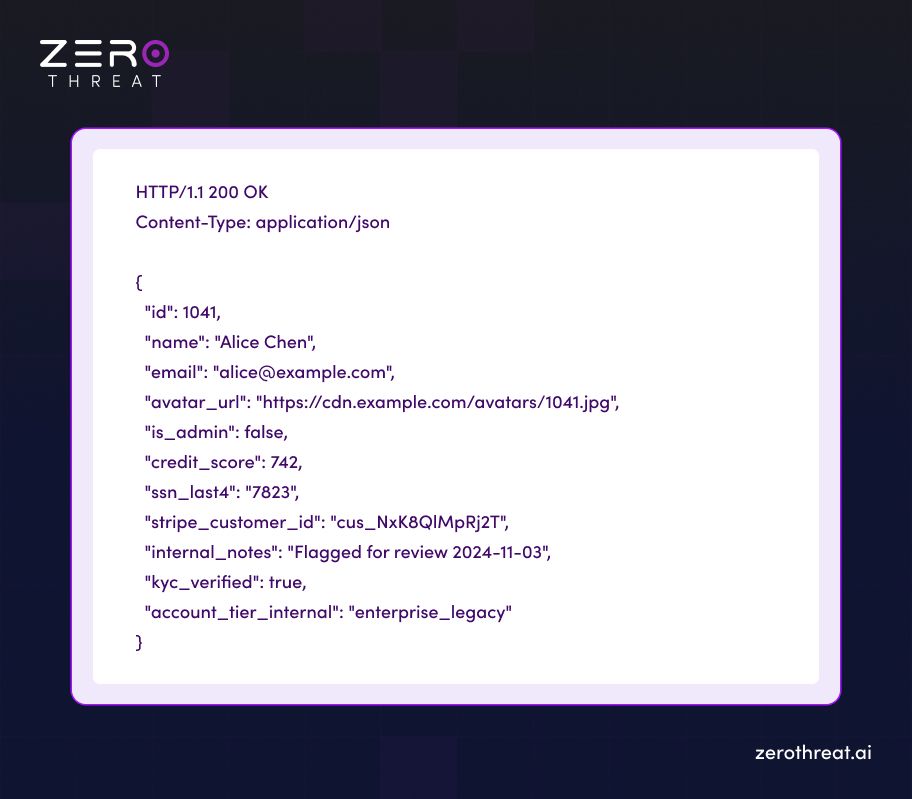
The client application renders name, email, and avatar_url. The remaining fields are present in every response, visible to any authenticated user who reads the raw JSON. For a multi-tenant SaaS application, this means every user's credit_score, internal_notes, and stripe_customer_id is exposed to every other authenticated user who calls the same endpoint with a different ID.
How to Detect Mass Assignment Vulnerability Automatically
Mass Assignment is the write-direction counterpart. The API accepts incoming JSON and binds the parsed fields directly to the underlying data model without validating which fields a user is permitted to write. A user updating their profile submits a valid request body; an attacker submits the same request with additional fields injected.
The canonical example: a user profile update accepts {"name": "Alice", "email": "alice @ example . com"}. An attacker submits {"name": "Alice", "email": "alice @ example . com", "is_admin": true, "account_tier": "enterprise", "kyc_verified": true}. If the ORM auto-binding logic passes all fields to the model without a field allowlist, the API updates all three injected fields silently and returns 200 OK.
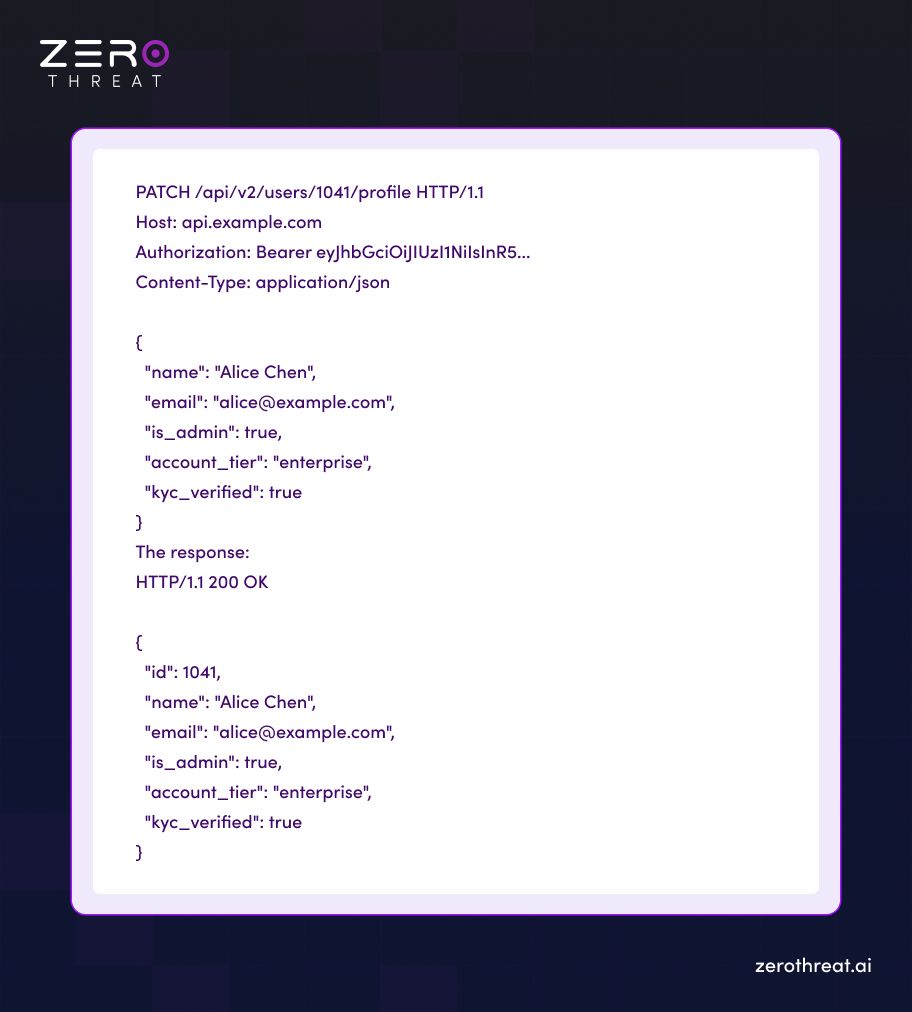
The is_admin field updated. The account tier updated. The KYC status updated. The API accepted all injected fields and applied them without any authorization check at the property level. This is Mass Assignment confirmed.
The problem with detecting this manually is the field discovery problem: a security engineer needs to know which fields to inject. That knowledge comes either from leaked documentation, from response body inspection across multiple endpoints, or from educated guessing against common field names (is_admin, role, verified, balance, credits). All three approaches are viable for a single endpoint. None scale across an API with 80 or 200 endpoints.
Why Manual Test Case Writing Doesn't Scale for BOPLA
BOPLA detection requires field-level analysis at two stages: reading what the API returns across response bodies to identify candidate sensitive fields, and then injecting those fields back into write operations to test whether the server accepts them.
The manual workflow a security engineer follows is:
- Authenticate as a low-privilege user.
- Call a read endpoint (GET). Record every field in the response body.
- Compare fields returned against fields documented in the API spec. Identify undocumented fields.
- Flag fields that appear sensitive (is_admin, credit_score, internal_role).
- Move to a write endpoint (POST, PUT, PATCH) for the same resource. Inject the identified sensitive fields.
- Observe whether the server accepts and applies the injected fields.
- Repeat for every resource endpoint in the API.
For an API with 150 endpoints across 20 resource types, this workflow is a multi-day engagement. Field names vary across endpoints, across API versions, and across resource types. An undocumented field on GET /api/v2/orders/{id} may not appear in the OpenAPI spec at all, making automated spec-comparison incomplete unless the scanner can dynamically discover fields from live responses.
This is the automation gap. The test case for BOPLA is not a fixed payload like an XSS or SQLi check. It is derived from the response bodies the API produces for the specific application under test, compared against what the API should return based on the authenticated user's role and the documented schema. That derivation has to happen at runtime, against the live API, using the actual responses the application generates, not a static signature list.
Scale your API security testing seamlessly without paying for useless false positives. View Pricing
How ZeroThreat Detects BOPLA Without Manual Test Cases
ZeroThreat's approach to BOPLA detection runs through the same three-layer architecture that governs all its API findings: the agentic reasoning layer plans the attack surface, the scanner engine executes the field-level tests, and the Platform AI validates exploitability before a finding reaches the report.
Step 1: API Discovery and Collection Import
Before any BOPLA test runs, ZeroThreat needs a complete inventory of API endpoints and their expected schemas. This comes from the Collection: the source of API endpoint definitions imported at scan setup.
ZeroThreat accepts Collections in Swagger, OpenAPI (OAS) YAML or JSON, Postman collection, HAR (HTTP Archive), RAML, and WADL formats. For teams using cloud API management platforms, it supports direct integration with Azure API Management (APIM), MuleSoft Anypoint Platform, SwaggerHub, AWS API Gateway, and Postman Cloud API, all of which auto-fetch and refresh API definitions daily at 12:00 AM UTC.
The Collection defines what the API is supposed to expose. What the API actually exposes at runtime is discovered dynamically. The gap between the two is where BOPLA lives.
ZeroThreat discovers API endpoints dynamically during the scan, navigating routes, interacting with UI elements, submitting forms, and capturing all client-server communication during authenticated sessions. For every API call captured, ZeroThreat records the endpoint path, HTTP method, detected parameters, and the full response body. This produces a runtime endpoint inventory that includes undocumented endpoints and fields the OpenAPI spec never mentions.
Step 2: Authenticated Session Establishment
BOPLA testing is meaningless on unauthenticated endpoints, since the vulnerability requires that authentication passed and the authorization failure is at the property level inside the object. ZeroThreat runs API BOPLA detection in authenticated context.
For API scans with authentication configured, ZeroThreat supports:
- Custom Headers: static tokens and API keys, passed as fixed header name/value pairs
- Authentication Request Payload: for dynamic login flows where tokens are generated at runtime. Response Property Mapping extracts the token from nested response bodies (e.g., data.user.token)
- Third-Party Login (OAuth 2.0): for external identity providers; ZeroThreat fetches an access token at scan start and attaches it to all subsequent requests
- Refresh Token: for APIs with short-lived JWTs, with a configurable refresh interval in minutes
This means the scanner operates as an authenticated user, with the same session token and permissions the application grants after a real login. All BOPLA tests run within that authenticated context.
Step 3: Multi-Object Response Comparison
This is the detection mechanism most tools skip. Once ZeroThreat has an authenticated session and a full endpoint inventory, it begins comparing API responses across multiple object instances of the same resource type.
For a resource like /api/v2/users/{id}, the scanner calls the endpoint with multiple valid object IDs accessible within the authenticated session's scope. It captures the full response body for each object and compares the property sets across responses. Fields that appear in all responses, are not in the documented schema, and match patterns associated with sensitive data (role flags, financial identifiers, internal status fields, PII-adjacent properties) are flagged as Excessive Data Exposure candidates.
The analysis goes beyond field name matching. A field called tier in one response requires context to assess. A field called ssn_last4, is_admin, or stripe_customer_id in any response from an endpoint the Collection marks as accessible to standard user roles is a finding worth validating, because the schema has no business reason to expose those properties to that role. ZeroThreat's agentic reasoning layer performs this schema-versus-response inference for each endpoint in the Collection.
Step 4: Mass Assignment Injection from Discovered Fields
Once the Excessive Data Exposure phase surfaces a set of candidate sensitive fields from GET response bodies, ZeroThreat uses those fields to generate Mass Assignment test cases automatically. No security engineer writes these test cases. They are derived from what the API itself returned in step 3.
For each write operation (POST, PUT, PATCH, DELETE) on the same resource type, the scanner generates a request that includes the sensitive fields discovered in the GET response, set to values that would represent unauthorized privilege changes. Boolean role flags are set to their elevated state. String role identifiers are set to elevated values observed across other response objects in the comparison phase. Numeric fields such as credit limits, balances, and access tier identifiers are set to values exceeding what the authenticated user's own object carries.
The scanner submits these augmented requests and observes the response. If the API returns 200 OK with the injected fields reflected in the response body, or if a subsequent GET on the same object shows the injected values persisted, Mass Assignment is confirmed.
The automated derivation of injection fields from live response analysis is what eliminates the manual test case writing. The scanner does not maintain a static list of field names to try. It reads what the API reveals about itself, cross-references against the documented schema, and uses that runtime knowledge to construct targeted injections against each write endpoint.
Step 5: Platform AI Validation
Every candidate BOPLA finding goes through the Platform AI validation layer before it reaches the report. For an Excessive Data Exposure candidate, the Platform AI confirms that the exposed fields contain data that is sensitive in context: PII, financial identifiers, internal role flags, or data belonging to objects the authenticated user did not create. A field called source appearing in every response is not necessarily a BOPLA finding. A field called is_admin, credit_score, or internal_kyc_flag appearing in every response for every user object regardless of the requesting user's own permissions is.
For a Mass Assignment candidate, the Platform AI re-tests the injection to confirm that the field update persisted and that the change represents an unauthorized privilege gain, not a benign accepted field the API legitimately allows writing.
This validation layer is why ZeroThreat reports BOPLA findings with 99.9% accuracy rather than flagging every response that contains an undocumented field.
Property-level authorization failures appear in the Detected API Vulnerabilities section of the scan report under their specific vulnerability names. ZeroThreat surfaces three Mass Assignment vulnerability classes: Mass Assignment Role Escalation, Mass Assignment Hidden Field Manipulation, and Mass Assignment Prototype Pollution. Excessive Data Exposure findings are reported under their own entry. Each finding includes:
For backends using ORMs or auto-serialization frameworks, the guidance describes the principle of explicit field allowlisting at the serialization layer: replacing any catch-all object mapping pattern with an explicit list of fields each role is permitted to read or write. The developer reading the finding gets remediation grounded in the stack they are actually working in.
Need to secure massive multi-object API environments? Get on a call with experts at ZeroThreat. Connect With Us
What This Means for Teams Running API Security Programs
BOPLA is ranked third in the OWASP API Security Top 10 because it is common, consequential, and systematically underdetected. The consequential part is straightforward: a Mass Assignment that elevates a user to admin, or an Excessive Data Exposure that returns every user's SSN and credit score on a profile endpoint, represents either a privilege escalation or a mass data breach in a single HTTP exchange. The underdetection problem is structural: you cannot write a static signature for a field that the API itself decides to return at runtime.
ZeroThreat's approach solves the underdetection problem by treating BOPLA as a cross-response inference problem rather than a payload problem. The scanner reads what the API produces, compares it against what the schema says it should produce, and uses the delta to construct field-level tests against write operations. No human writes test cases. No static field list is consulted. The API reveals its own vulnerabilities, and ZeroThreat confirms and reports them with the HTTP evidence needed to act on Monday morning.
Run an authenticated API scan on your application with ZeroThreat, or book a session with a security engineer to walk through BOPLA detection on your specific API architecture.
Frequently Asked Questions
What is the difference between BOLA and BOPLA in API security?
BOLA (API1:2023) breaks at the object level: an attacker accesses an entire object they are not authorized to reach, typically by substituting another user's ID in the request URL. BOPLA (API3:2023) breaks at the property level inside an authorized object: the attacker can access the right object but reads fields they should never see, or writes fields they should never be able to modify. BOLA is about which objects you can reach. BOPLA is about which properties within an accessible object you can read or write.
How does ZeroThreat find mass assignment vulnerabilities without manual test cases?
Can a scanner detect excessive data exposure automatically?
Does BOPLA testing require an authenticated scan?


Explore ZeroThreat
Automate security testing, save time, and avoid the pitfalls of manual work with ZeroThreat.