 ZeroThreat Wins Bronze Stevie® Award in Tech Startup of the Year Read more

All Blogs
Multi-Step Workflow Abuse: How Playwright-Driven Application Journey Testing Finds It
Quick Overview: Multi-step workflow abuse often hides in the gaps between application states, making it one of the hardest vulnerabilities to detect. This blog explains what multi-step workflow abuse is, why traditional scanners fail to identify it, and how Playwright-driven Application Journey testing uncovers vulnerabilities across sequential workflows. It also covers common abuse patterns, workflow attack surfaces, real-world examples, and the key capabilities required to effectively test workflow security.
Multi-step workflow abuse is one of the most consistently undertested vulnerability classes in web application security. Attackers exploit it by manipulating the order, timing, or state of requests across a workflow to reach outcomes the application was never designed to permit. The attack surface is not inside any single endpoint: it lives in the transitions between steps, where one request’s output becomes the next request’s trust assumption. Conventional security tools, which test each request in isolation, cannot see this surface at all.
This article explains what multi-step workflow abuse is, why automated tools miss it, and how ZeroThreat’s Application Journey testing, powered by Playwright, detects vulnerabilities across sequential application states with proof-based validation.
See the vulnerabilities hiding between your endpoints. Start your free stateful pentest now. Begin Free Trial
ON THIS PAGE
- What Is Multi-Step Workflow Abuse?
- Common Workflow Abuse Patterns Include:
- Why Automated Tools Miss Workflow Flaws
- The Attack Surface Lives Between States
- How ZeroThreat's Application Journeys Test Workflow Abuse
- What This Looks Like in Practice
- Evaluating Workflow Abuse Coverage: What to Look for in Any Platform
- Conclusion
What Is Multi-Step Workflow Abuse?
Multi-step workflow abuse is the exploitation of sequential application states to reach an outcome the application was not designed to permit. Rather than attacking a single vulnerable endpoint, the attacker manipulates the order, timing, or content of requests across a workflow to bypass the logic controls that were only designed to hold when users follow the intended path.
The OWASP Web Security Testing Guide frames the core question precisely: if an authentication mechanism is designed to execute steps 1, 2, and 3 in order, what happens when a user goes from step 1 directly to step 3? The application may grant access (fail open), deny it, or return an unhandled error. All three outcomes carry security implications. The third is often where serious vulnerabilities hide.
Common Workflow Abuse Patterns Include
Skipping required steps by directly invoking later-stage functionality before prerequisites are satisfied. A checkout flow that validates payment on step 3 but allows order confirmation to be triggered from step 1 is the canonical example.
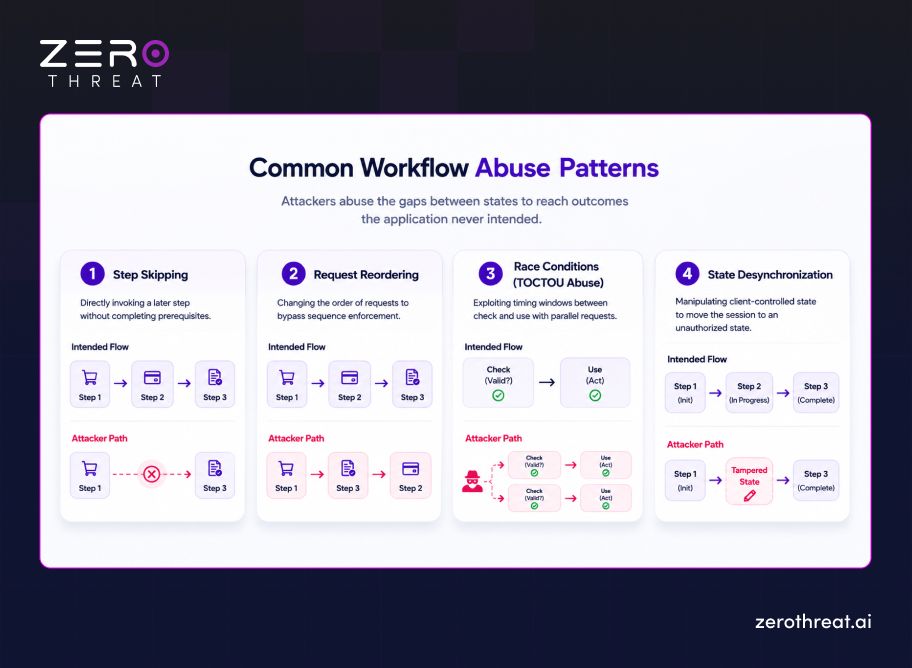
Reordering requests to bypass enforced sequence controls. Some applications validate state per-request rather than per-session, which means a client can replay an earlier state to trick the server into re-evaluating a condition that should have been resolved.
Parallel request injection (TOCTOU abuse). Time-of-check-to-time-of-use conditions arise when an application checks a value (say, a coupon code's redemption status) and then acts on it in two separate operations. If an attacker fires concurrent requests into that window, both may pass the check before either updates the state. The result: a single-use coupon used multiple times, a credit balance spent twice, or a subscription trial extended indefinitely.
State desynchronization across session boundaries. Applications that maintain workflow state in client-controlled parameters, rather than enforcing server-side, are vulnerable to parameter manipulation mid-flow. Changing a status field, a role identifier, or a step indicator between requests can move the session to an unintended state the server accepts without re-validating.
Why Automated Tools Miss Workflow Flaws
The OWASP WSTG stable documentation states this directly: "This type of vulnerability cannot be detected by a vulnerability scanner and relies upon the skills and creativity of the penetration tester."
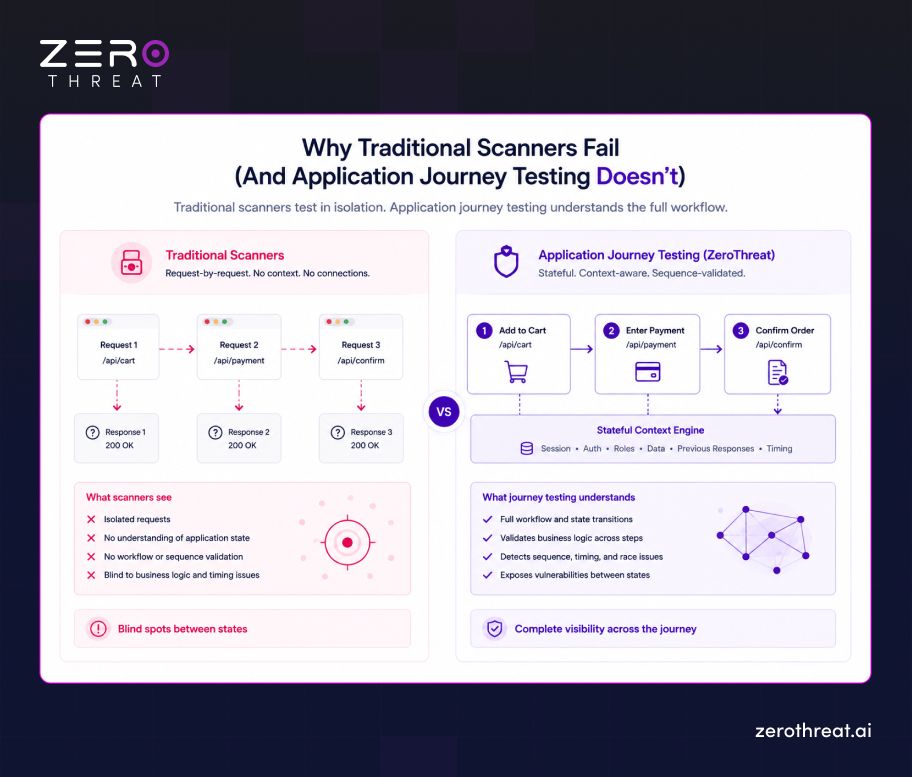
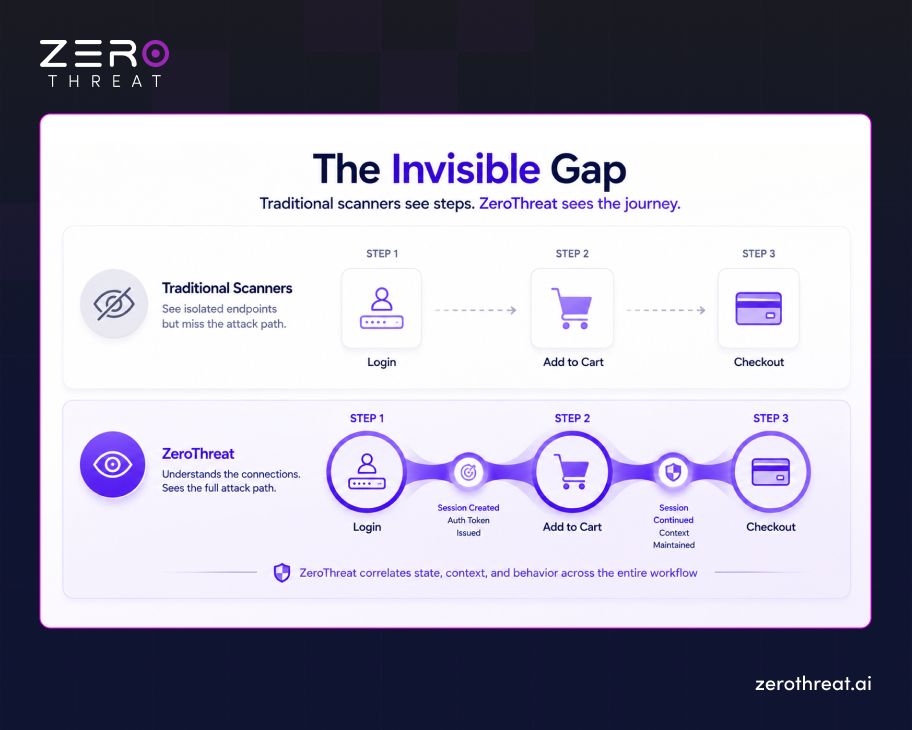
That observation holds for traditional scanners because the gap is structural. Signature-based tools operate request by request. They cannot model what a workflow is supposed to do, reason about what a sequential state transition should look like or recognize when a particular request sequence represents an exploit rather than legitimate use.
Multi-step workflows remain largely untested by conventional security tools because those tools do not understand the relationship between sequential API calls. Time-based vulnerabilities such as race conditions in payment processing go undetected because conventional scanners have no concept of when timing matters.
The challenge extends beyond tooling architecture into coverage scope. Legacy tools were designed for crawl-based discovery: follow links, enumerate forms, fire payloads, check responses. A workflow that requires navigating an authenticated SPA, maintaining a session token across five API calls, and observing the interplay between role state and access control does not fit that model at any point.
Research published at NDSS 2026 confirms the same limit from an academic direction: automated tools that attempt to detect business logic vulnerabilities are forced to use narrow, hard-coded heuristics. Those heuristics cannot capture the application-specific context required to distinguish legitimate behavior from a security violation in a multi-step flow.
The practical consequence is that workflow vulnerabilities survive automated scanning and often survive periodic manual pentesting too, because a tester who is not specifically looking for sequential-state abuse will follow the happy path.
The Attack Surface Lives Between States
To understand why conventional tools fail, it helps to map precisely where workflow vulnerabilities live.
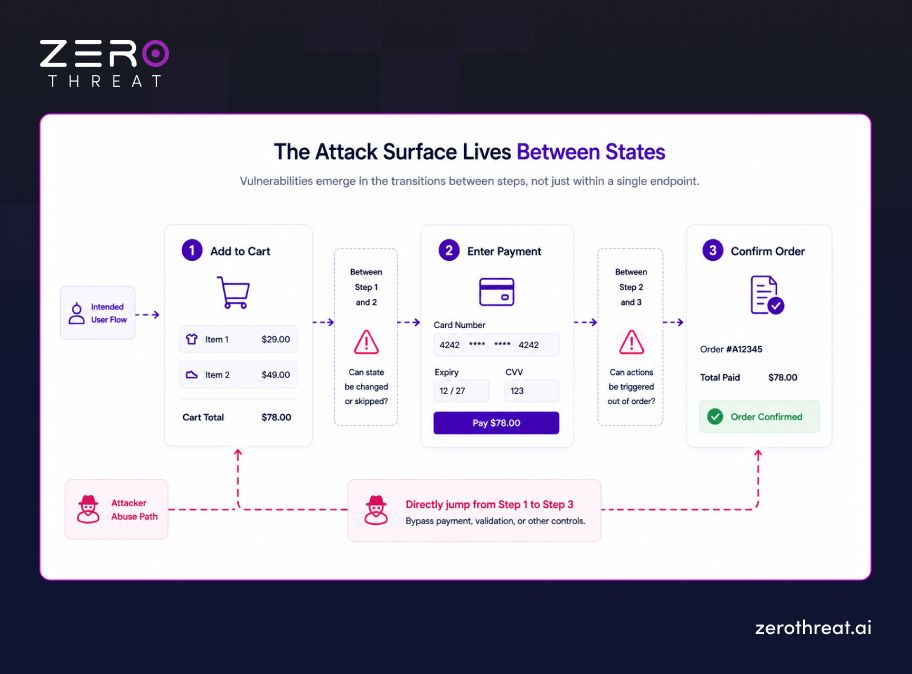
In a three-step checkout flow (add to cart, enter payment, confirm order), the security-relevant moments are not inside step 1, step 2, or step 3 in isolation. They are:
- Between step 1 and step 2: can a user submit payment details for a cart whose items have already changed server-side?
- Between step 2 and step 3: can order confirmation be triggered before payment validation succeeds?
- Parallel to step 2: can two payment attempts execute against the same cart concurrently, each passing validation before either updates the cart state?
A classic logic flaw in online stores involves adding an item to a cart, paying for it, then adding more items before force-browsing to the order confirmation page. A variation occurs when payment validation and order confirmation are performed during the processing of a single request, creating a race window an attacker can exploit.
None of these transitions are visible to a scanner that sends one request and reads one response. All of them are visible to a platform that models the workflow as a sequence of connected states and tests the transitions between them.
Expose hidden flaws between your application states before malicious attackers exploit them. Run Playwright Security Test
How ZeroThreat's Application Journeys Test Workflow Abuse
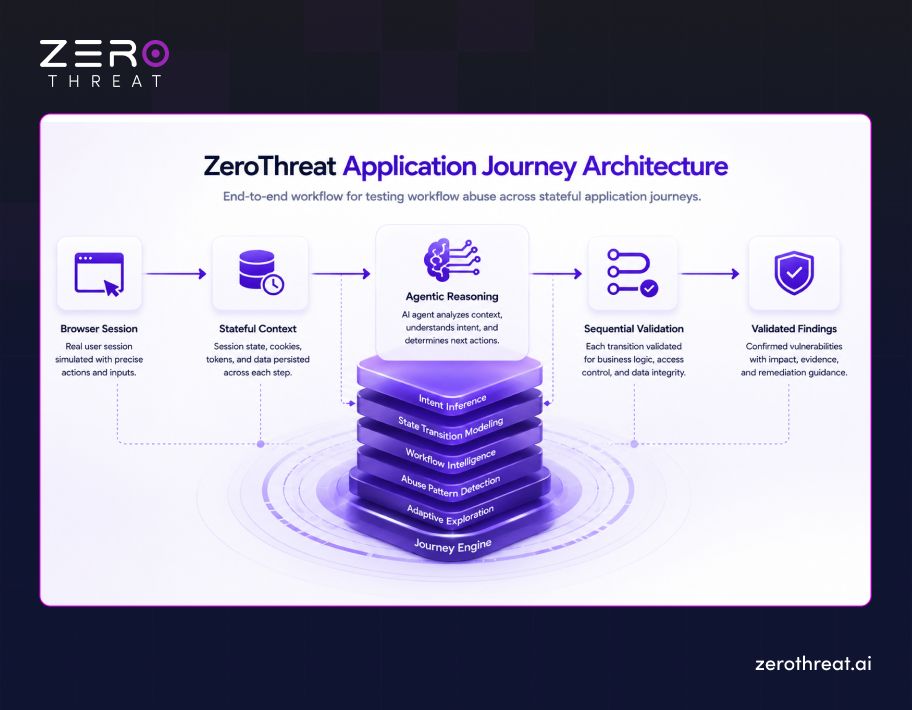
ZeroThreat’s Application Journeys are powered by Playwright, a real browser automation engine that navigates web applications exactly the way a human tester or attacker would. Rather than sending isolated requests, Application Journeys execute full multi-step workflows in a live browser session, maintaining authentication state and session context at every step. This is what makes it possible to detect vulnerabilities that only appear across state transitions, not at any single endpoint.
Step 1: Execute Real User Workflows
Application Journeys launch a real browser session and navigate the application as an authenticated user. Using Playwright, ZeroThreat’s engine interacts with forms, buttons, APIs, and application states across multi-step workflows such as onboarding, approvals, account management, checkout processes, and administrative actions.
Step 2: Maintain Authentication and Session Context
Unlike traditional scanners that test requests in isolation, Application Journeys preserve authentication state, session tokens, user roles, and workflow context throughout the entire interaction. This allows testing to occur within the same conditions attackers encounter after gaining access to a legitimate account.
Step 3: Analyze Workflow Boundaries and State Transitions
As workflows execute, our smart engine evaluates how the application handles state changes, role transitions, authorization checks, and business process controls. This helps identify areas where workflow integrity depends on assumptions that may be bypassed, manipulated, or abused.
Step 4: Test for Workflow Abuse and Business Logic Weaknesses
Application Journeys validate security controls across multi-step processes by testing for issues such as workflow bypasses, authorization weaknesses, race conditions, parameter manipulation, replay scenarios, and application-specific business logic flaws that are difficult to detect through conventional crawling or signature-based testing.
Step 5: Deliver Validated Findings with Evidence
When vulnerabilities are identified, ZeroThreat provides validation evidence, affected workflows, reproduction details, and risk context. Security teams receive actionable findings tied directly to the workflow where the issue occurs, helping prioritize remediation based on real application impact.
What This Looks Like in Practice
Consider a SaaS application with a multi-step subscription upgrade flow: initiate upgrade, enter billing details, confirm plan change. The application validates that the user is authenticated at step 1 and that billing details are valid at step 2 before confirming the upgrade.
A conventional scanner probes each endpoint for injection patterns and checks HTTP responses. It finds nothing wrong because there is nothing syntactically wrong. The endpoints are functioning as designed.
ZeroThreat's Application Journey for this flow navigates the workflow as an authenticated user, then systematically probes the state transitions: can confirmation be triggered without valid billing details? Can two concurrent upgrade requests execute against the same account, one passing billing validation before the other updates the subscription state? Can the billing step be replayed with modified plan parameters after confirmation has already been issued?
Each probe is executed in a live browser session, with session state preserved across steps. Findings are validated before reporting. If the application fails open at a state transition, the finding arrives with the exact request sequence, the session state at each step, and the resulting impact (unauthorized plan change, duplicate billing, or privilege escalation to a paid tier).
Evaluating Workflow Abuse Coverage: What to Look for in Any Platform
When assessing any AI-powered pentesting platform's handling of workflow vulnerabilities, these are the questions that distinguish real coverage from a marketing claim.
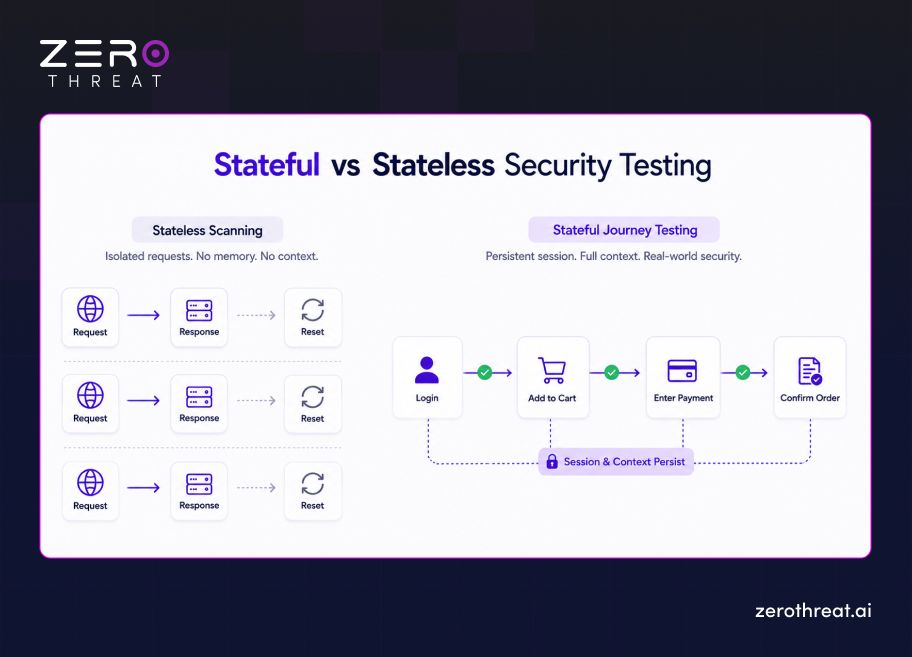
Does the platform maintain stateful sessions across a full workflow? A tool that resets session state between requests cannot test multi-step flows. The test only matters if the platform can be in state A before probing for state B.
Can it navigate authenticated flows and SPAs? Workflow abuse vulnerabilities frequently appear in the authenticated layers of modern applications, behind OAuth, MFA, and JWT-based sessions. A platform that cannot authenticate and maintain session state through these layers is not testing the attack surface that matters.
Does it test state transitions, or just endpoints? The attack surface for workflow abuse is in the transitions between steps, not in the steps themselves. Ask whether the platform reasons about sequence and order, not just payloads and responses.
Are findings validated before they reach the analyst? Workflow abuse findings are particularly prone to false positives because the boundary between intended behavior and exploitable behavior is application-specific. A validation layer that re-tests the exploit path in context before reporting is not optional for this class of vulnerability.
Does it cover race conditions and TOCTOU conditions? Parallel-request injection is a significant subset of workflow abuse. Ask whether the platform can time concurrent requests into a state transition window and observe whether the application's check-then-act logic holds under concurrent load.
Let us show you how ZeroThreat maps and secures your custom state transitions. Contact Us
Conclusion
Workflow vulnerabilities are not hidden. They are simply invisible to tools that were not built to see them. A scanner that tests endpoints in isolation will always miss the attack surface that lives in the transitions between them.
Playwright-driven application Journeys testing in ZeroThreat close that gap: Session execution, agentic reasoning over sequential states, and exploitability-first validation across the full workflow, producing findings that arrive with reproduction steps instead of triage questions.
If your current security testing has no answer to "what happens between steps 2 and 3," that is an untested attack surface.
Frequently Asked Questions
What is the difference between a business logic vulnerability and a workflow abuse vulnerability?
Business logic vulnerabilities are a broad class covering any flaw in how an application enforces its intended rules and decisions. Workflow abuse is a specific subset: it exploits the sequential structure of multi-step processes, targeting the transitions between states rather than any single step. All workflow abuse is a form of business logic exploitation, but not all business logic flaws involve multi-step sequences.
Why do most automated security tools miss multi-step workflow vulnerabilities?
What is a TOCTOU vulnerability in a web application?
How does Playwright-based testing improve workflow security coverage?
Can workflow abuse vulnerabilities be found in APIs as well as web applications?
Explore ZeroThreat
Automate security testing, save time, and avoid the pitfalls of manual work with ZeroThreat.