 ZeroThreat Wins Bronze Stevie® Award in Tech Startup of the Year Read more

All Blogs
Application Security Statistics 2026: Facts, Trends & Market Insights
Quick Overview: Explore the latest application security statistics for 2026, including trends in vulnerabilities, API security, software supply chain risks, AI-generated code, data breaches, and DevSecOps. These insights help security leaders and developers understand today's threat landscape and strengthen application security strategies.
Application security has become a business-critical priority as organizations accelerate digital transformation, cloud adoption, APIs, and AI-powered applications. Every new application, third-party integration, and software update expands the attack surface, giving cybercriminals more opportunities to exploit vulnerabilities. As a result, application-layer attacks continue to rise, leading to costly data breaches, regulatory penalties, operational disruptions, and reputational damage.
The latest application security statistics of 2026 reveal a clear trend: attackers are finding and exploiting vulnerabilities faster than organizations can identify and remediate them. From insecure APIs and software supply chain risks to misconfigurations and business logic flaws, modern applications face a wider range of threats than ever before. Traditional security testing alone is no longer sufficient, making continuous application security testing, automated pentesting, and risk-based vulnerability management essential for reducing exposure.
This blog brings together the latest application security statistics, facts, and trends for 2026 from trusted industry reports and research. Whether you're a CISO, security leader, developer, DevSecOps engineer, or compliance professional, these insights will help you understand the evolving threat landscape, benchmark your security posture, and make informed decisions about protecting your web applications and APIs.
The numbers are alarming. See what attackers see before they do. Start Free Scan
On This Page
- Application Security Market Analysis
- Application Security Threat Statistics
- Application Security Statistics by Regional Analysis
- Supply Chain Attacks and Third-party Breaches
- Open-source Application and Dependency Risk
- AI-powered Development and Emerging AppSec Risks
- Conclusion
Application Security Market Analysis
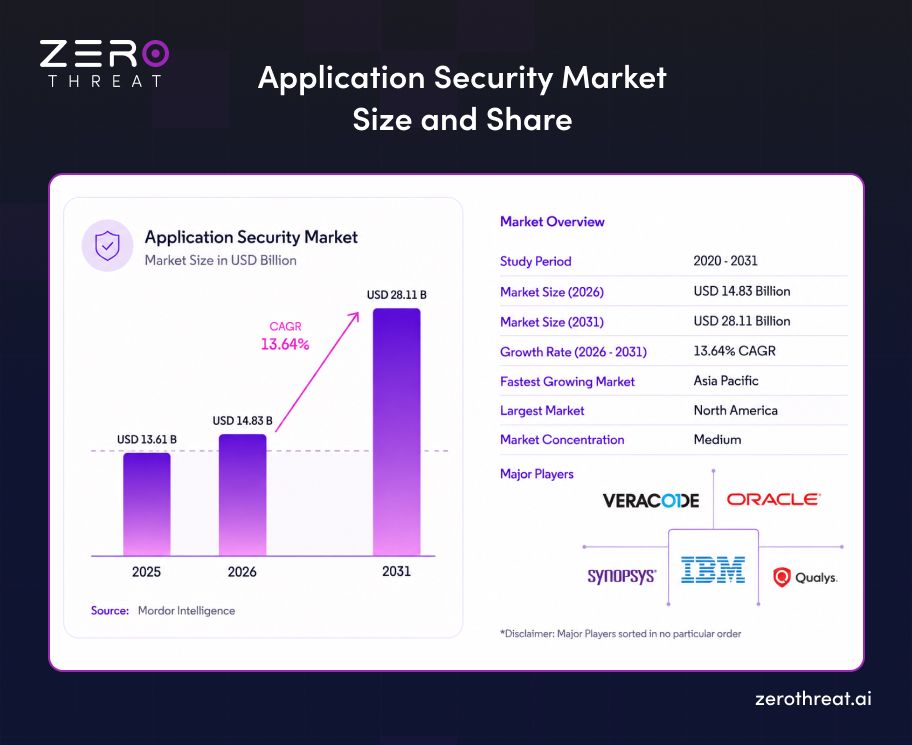
The application security market size is expected to increase from USD 13.61 billion in 2025 to USD 14.83 billion in 2026 and reach USD 28.11 billion by 2031, growing at a CAGR of 13.64% over 2026-2031.
- By component, application security solutions generated 61.48% of the market revenue in 2025, while the services segment is expected to grow at a CAGR of 13.67% between 2026 and 2031.
- By deployment model, cloud-based application security platforms accounted for 57.81% of total market spending in 2025 and are projected to grow at a CAGR of 13.77% through 2031.
- By organization size, large enterprises represented 60.58% of the application security market in 2025, while small and medium-sized businesses (SMBs) are expected to experience a CAGR of 13.72% from 2026 to 2031.
- By security testing technology, Static Application Security Testing (SAST) held a 36.38% market share in 2025, whereas Interactive Application Security Testing (IAST) is projected to grow at a CAGR of 13.69% through 2031.
- By industry vertical, the Banking, Financial Services, and Insurance (BFSI) sector accounted for 24.83% of the application security market in 2025, while the healthcare sector is expected to register the fastest growth at a CAGR of 13.79% by 2031.
- By region, North America held the largest market share at 40.91% in 2025, while Asia-Pacific is projected to be the fastest-growing region, expanding at a CAGR of 13.83% through 2031.
Application Security Threat Statistics
- 83% of applications have at least one security vulnerability, while 20% contain at least one high-severity vulnerability.
- API attacks increased by 20% year over year, with 57% of organizations experiencing API-related security incidents in the past two years.
- 63% of organizations experienced a software supply chain security incident in the last two years.
- Only 45% of organizations are confident they can identify every internet-facing application and API they own.
- 32% of exploited vulnerabilities in 2024 were initially discovered as zero-day vulnerabilities.
- Nearly 70% of organizations report that insecure APIs have delayed application releases or digital transformation initiatives.
- The median time for attackers to exploit a newly disclosed vulnerability is measured in days rather than weeks, shrinking defenders' remediation windows.
- Over 90% of modern applications contain open-source components, making software supply chain security a core application security concern.
- More than half of organizations cite vulnerability remediation, not vulnerability discovery, as their biggest application security challenge.
- Applications and APIs remain one of the most common initial attack vectors in ransomware and data breach investigations.
- 80.3% of applications scanned in 2025 contained at least one security flaw, while 56.2% had at least one high-severity vulnerability.
- Half of organizations now carry critical security debt, and the average time required to fix security flaws has increased by 47% since 2020.
- 70% of organizations' critical security debt originates from third-party code and software supply chain dependencies.
- Akamai observed more than 311 billion web application and API attacks during 2024, representing a 33% year-over-year increase.
- Attackers launched more than 150 billion API attacks between January 2023 and December 2024, highlighting APIs as one of the fastest-growing attack surfaces.
- 87% of organizations experienced at least one API-related security incident during the previous 12 months, up from 76% in 2022.
- Only 16% of enterprises fully integrate API security testing into their software development pipelines.
- The average API-related security incident now costs organizations more than US$700,000 annually.
- According to the 2024 Verizon Data Breach Investigations Report, exploitation of vulnerabilities as the initial access vector increased by nearly 180% year over year.
- Only 16% of organizations fully integrate API security testing into CI/CD pipelines.
- Average annual API security incident cost exceeds US$700,000.
- Attackers launched over 150 billion API attacks between 2023 and 2024.
- Over 90% of modern applications contain open-source software.
- 84% of codebases contain at least one known open-source vulnerability.
- 91% of codebases contain components that are more than four years out of date.
- 63% of organizations experienced a software supply chain incident in the past two years.
- Organizations using AI and automation reduced breach costs by nearly US$2.2 million compared to those without them.
- Over 97% of developers have used AI coding assistants at work.
Modern attacks need modern testing. Upgrade to AI. Discover AI-powered Pentesting
Application Security Statistics by Regional Analysis
North America is expected to account for 39% of the global application security market's growth during the forecast period, driven by strong cybersecurity investments, stringent regulatory requirements, and widespread adoption of DevSecOps and cloud-native security solutions.
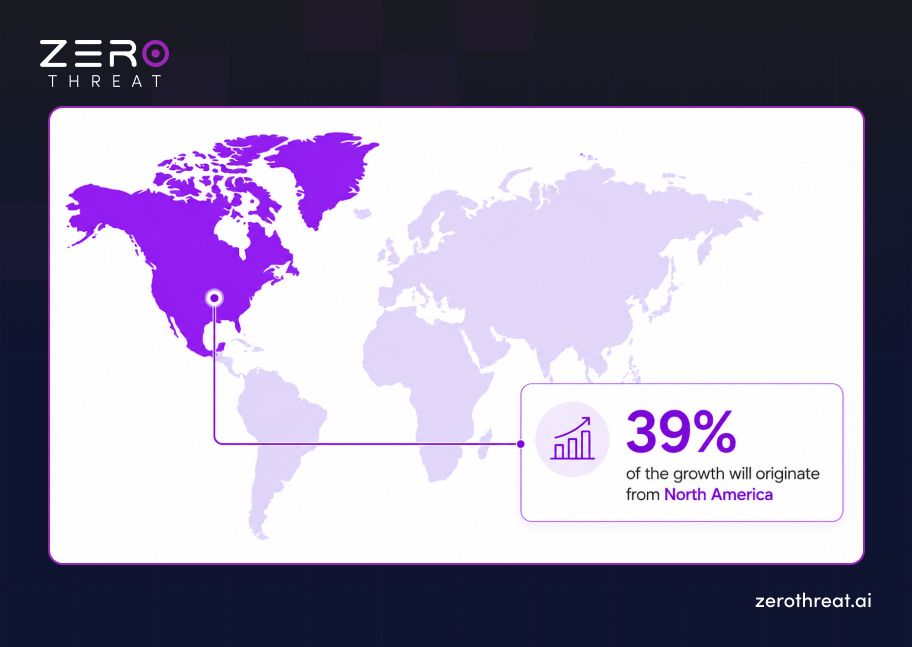
North America continues to lead the global application security market, supported by widespread cloud adoption, growing reliance on mobile applications, and rising cybersecurity investments. The region's mature technology ecosystem, combined with the presence of major security vendors such as IBM, Cisco, Synopsys, and Contrast Security, is expected to sustain strong market growth throughout the forecast period.
Supply Chain Attacks and Third-party Breaches
Third-Party Breach Statistics
70% of cybersecurity leaders reported experiencing a significant third-party or supply chain-related security breach within the past year, highlighting the growing risks posed by external vendors and software dependencies.
Supply Chain Incident Statistics
While most organizations experienced a limited number of software supply chain attacks, 5% of cybersecurity leaders reported facing 10 or more supply chain-related security incidents in a single year, underscoring the escalating threat to enterprise software ecosystems.
Supply Chain Attack Frequency
Organizations experienced an average of 28 software supply chain attacks per month between April and October 2025, which is more than double the average of 13 monthly attacks recorded from early 2024 through March 2025.
npm Supply Chain Attack
The Shai-hulud software supply chain attack compromised approximately 1,000 npm packages in 2025, marking the first known registry-native worm and exposing developer secrets across an estimated 25,000 code repositories.
Open-source Application and Dependency Risk
Third-Party Software Risk
51% of security teams identified vulnerabilities in third-party software and open-source dependencies as their biggest cybersecurity risk, ranking just behind data breaches and ransomware attacks.
Software Supply Chain Visibility
35% of organizations cited limited visibility into their software suppliers' cybersecurity practices as a major security concern, making it difficult to assess and manage third-party risk effectively.
Vulnerable Codebases
87% of audited codebases contained at least one known security vulnerability, while 78% included high-risk flaws capable of enabling remote code execution or significant data exposure.
Enterprise Code Vulnerabilities
Enterprise codebases contained an average of 581 security vulnerabilities, reflecting the growing complexity of modern software, increased reliance on third-party components, and faster development cycles.
Outdated Software Components
93% of audited codebases showed no development activity during the previous two years, and 92% included software components that were at least four years old, leaving organizations exposed to known vulnerabilities. Only 7% used the latest component versions.
Widespread Vulnerability Exposure
87% of development teams had at least one vulnerability affecting 40% or more of their software portfolio, with Java, .NET, and Rust environments showing the highest concentration of vulnerable applications.
AI-powered Development and Emerging AppSec Risks
AI-Generated Code Adoption
34% of application security professionals reported that more than 60% of their organization's code is now AI-generated, highlighting the rapid adoption of AI coding assistants and the growing need for automated security validation.
AI Hallucinations in Software Dependencies
Large language models (LLMs) recommended non-existent dependency versions in 27.76% of upgrade suggestions, resulting in more than 10,000 hallucinated package recommendations that could disrupt software supply chains.
Third-Party Components in Agentic AI
82.4% of agentic AI tools rely on third-party software components, while many lack complete or verifiable software lineage, increasing supply chain and dependency risks.
Unverified AI Models in Production
49% of development teams include unvetted machine learning models in their applications, introducing new attack surfaces that many traditional application security tools are not designed to detect or secure.
Curious how exposed your applications really are? Book a Free Demo
Conclusion
Application security is no longer just a technical concern, but it's a business imperative. The latest AppSec statistics for 2026 reveal a clear pattern: organizations are building applications faster than ever, while attackers are exploiting vulnerabilities, APIs, software supply chains, and AI-generated code at an equally rapid pace. As digital ecosystems continue to expand, the cost of overlooking application security continues to rise.
The data also highlights an important shift in how organizations approach security. Rather than relying on periodic assessments, businesses are investing in continuous application security testing, automated vulnerability detection, API security, software supply chain protection, and DevSecOps practices to reduce risk throughout the software development lifecycle.
Whether you're a CISO, security leader, developer, or DevSecOps engineer, these application security statistics can help benchmark your security posture, identify emerging risks, and prioritize the initiatives that matter most. Staying informed about evolving threats and industry trends is essential for building resilient applications, reducing business risk, and protecting sensitive data in an increasingly connected world.

Explore ZeroThreat
Automate security testing, save time, and avoid the pitfalls of manual work with ZeroThreat.