 ZeroThreat Wins Top InfoSec Innovators 2026 Award for Penetration Testing Read more


All Blogs
API Pentesting in Event-Driven and Microservices Environments
Quick Overview: API pentesting in microservices environments requires deeper visibility and continuous testing. This guide explains why API security is critical, the most common vulnerabilities in distributed systems, key testing challenges, and proven best practices. It also explores how ZeroThreat’s AI pentesting solution supports API pentesting for microservices architecture.
Switching to microservices is like trading one massive vault for dozens of smaller safe deposit boxes. While this architecture speeds up development, it also multiplies your attack surface by turning a single-entry point into fifty or more independent API endpoints. One of the real-world examples of it is: a single API flaw would've allowed an attacker to expose nearly 100 million user records at Starbucks.
In these distributed systems, traditional perimeter security fails because internal traffic isn't automatically safe. Attackers often exploit undocumented endpoints that traditional scanners frequently miss. To protect sensitive data, teams must adopt a Zero Trust model where every service-to-service request is strictly verified..
In this blog, we’ll explore common API vulnerabilities in microservices and challenges to pentest them. We’ll learn how ZeroThreat’s AI-driven API security testing tool simplifies penetration testing in microservices, detecting vulnerabilities, including BOLA and business logic flaws.
Run automated API penetration testing on your microservices today with ZeroThreat. Sign Up Now
On This Page
- What are Microservices?
- Why API Security is Critical in Microservices Architecture
- Common Security Vulnerabilities in Microservices APIs
- Challenges of API Penetration Testing in a Microservices Environment
- How ZeroThreat Automates API Testing in Microservices
- Best Practices for API Security in Microservices Architecture
- Summing Up
What are Microservices?
Microservices refer to a style of building applications by breaking them down into many small, independent services (functionalities). Instead of having one large application do everything, each service does one job. These services work together by communicating with each other through lightweight APIs.
This approach gives development teams a lot of flexibility while building an application. Each microservice can be developed and updated on its own, using the best tools for the task. That means changes in one service don’t have to affect the whole system. It also helps teams scale parts of an application independently. For example, if one service gets heavy use, only that service needs more resources, not the entire system.
Key ideas behind microservices:
- Each service does one specific job and nothing more.
- Services communicate using APIs, often over HTTP.
- They can be built in different languages and technologies.
- Teams can develop and deploy services independently.
Because of this structure, microservices can make applications easier to scale, faster to update, and simpler to manage.
But when it comes to security, microservices can be challenging to handle because each individual's services need to be tested based on their functionality and context. We’ll dive into it in the further section; for now, let’s get to understanding the importance of security in microservices.
Why API Security is Critical in Microservices Architecture
Microservices depend entirely on APIs to function. Because these APIs handle sensitive data and connect to every part of your system, they are the primary target for attackers looking to exploit microservices-based web applications.
Expanded Attack Surface
Using a microservices architecture style replaces a single entry point with dozens of independent API endpoints. Each new service adds a potential door for hackers, increasing the complexity of securing your entire system against unauthorized access and data breaches.
Lateral Movement Risks
In this architecture, a single compromised endpoint can lead to a total system breach. Attackers often use one weak service as an initial security gap to "pivot" through your infrastructure, accessing internal databases and customer information, leading to sensitive data exposure.
Lack of a Trusted Network
Unlike monolithic apps, microservices communicate across different cloud regions and network boundaries. You can no longer assume that internal traffic is safe. Every service must independently verify the identity of the caller to prevent unauthorized inter-service communication.
Protection of Sensitive Data
APIs are the primary conduits for exchanging high-value information, such as personal IDs and financial records. Without robust security, these endpoints can lead to data leaks or allow logic abuses that result in sudden financial and reputational damage.
Dynamic Infrastructure
Microservices use containers that are constantly created and destroyed, receiving new IP addresses each time. This makes traditional, IP-based security controls impractical, requiring API-level security that stays consistent regardless of how or where the specific service is running.
Detect vulnerabilities across all your microservice endpoints using ZeroThreat's AI pentesting tool. Run API Pentest
Common Security Vulnerabilities in Microservices APIs
Microservices have a complex web of interactions where small oversights can lead to massive breaches. Understanding these common API vulnerabilities is the first step toward securing your distributed architecture and protecting sensitive data from sophisticated attacks.
Broken Object Level Authorization (BOLA)
BOLA is a top threat where attackers change resource IDs in API requests to access data belonging to others. It often happens when a service doesn't verify if the requesting user has permission for that specific object. Continuous testing is vital to catch these critical logic flaws.
Shadow and Zombie APIs
Shadow APIs (undocumented) or zombie APIs (forgotten) create massive blind spots because they are no longer monitored by security teams. These hidden endpoints often lack modern security patches, giving hackers an easy backdoor into your system. Discovering these is essential for a complete security assessment.
Broken Service-to-Service Authentication
Many teams mistakenly trust internal traffic and fail to verify identities between individual microservices. If an attacker compromises one service, they can easily move laterally through the network to access sensitive databases. Implementing mutual TLS (mTLS) or JWT at every hop prevents unauthorized access.
Excessive Data Exposure
APIs often return more information than a user needs, inadvertently leaking sensitive data like PII or internal credentials. Attackers can sniff these responses to gather intelligence for larger breaches. Proper data masking and strict response schemas help minimize what is exposed.
Lack of Rate Limiting and DoS Resilience
Without strict throttling, a single compromised service or malicious user can overwhelm your system with excessive requests. This leads to cascading failures and service outages across your entire architecture. Effective rate limiting ensures high availability and protects against brute-force abuse.
Challenges of API Penetration Testing in a Microservices Environment
Microservices offer incredible flexibility, but they also make penetration testing much more complex. From hidden endpoints to infrastructure that changes by the minute, security teams face several unique hurdles when trying to protect these distributed systems.
Changing API Endpoints
Microservices are ephemeral, meaning containers and services are constantly created and destroyed. This makes traditional testing, which often relies on stable IP addresses, nearly impossible. You need API security testing tools that can stay consistent and adapt to a dynamic environment where the underlying infrastructure changes every time a new version is deployed.
Complexity of Multiple Protocols
Modern applications rarely stick to just one type of communication. A single ecosystem might use a mix of REST, GraphQL, gRPC, and SOAP. Each protocol has its own unique security requirements and vulnerabilities. Finding tools that can effectively scan and validate all of these different types of APIs across the system is a major technical challenge.
Finding the "Hidden" Attack Surface
One of the biggest challenge is simply knowing what needs to be tested. In a microservices environment, it is common for "Shadow APIs" (undocumented ones) or "Zombie APIs" (old, forgotten versions) to slip through without being tested. If your testing tools cannot parse API definitions like Swagger or OpenAPI, these hidden endpoints can become backdoors for attackers.
Keeping Up with Rapid Deployment
In an Agile or DevOps environment, code is updated and deployed several times a day. Traditional manual penetration testing simply cannot keep pace with the deployment speed. Here, the challenge lies in integrating automated or AI security checks directly into the CI/CD pipeline for “shifting the security testing left”, so that vulnerabilities can be detected during development.
Stop wasting hours on false positives. Discover cost-effective security testing that delivers real signals. Explore Pricing
How ZeroThreat Automates API Testing in Microservices
ZeroThreat simplifies the complex task of securing microservices by automating the entire penetration testing lifecycle. Its AI penetration testing tool mimics real-world attackers to uncover vulnerabilities with 99.9% accuracy. Designed for modern security needs, it delivers results faster and accelerates fixes by 5x.
- Automated Discovery: It automatically maps your entire attack surface, finding hidden "Shadow" and "Zombie" APIs that developers might have forgotten or left undocumented.
- Business Logic Testing: The tool identifies complex flaws like Broken Object Level Authorization (BOLA), privilege escalation paths, and business logic that manual testers usually have to find.
- Multi-Protocol Support: It provides comprehensive coverage for all modern API types used in microservices, including REST, GraphQL, gRPC, and SOAP.
- CI/CD Integration: ZeroThreat integrates directly into your development pipeline to catch and remediate security issues during the build process rather than after deployment.
By automating these processes, ZeroThreat reduces manual pentesting work by up to 90%. This allows security teams to focus on high-priority risks that actually impact the business.
What are the Best Practices for API Security in Microservices Architecture?
Securing a microservices mesh requires moving away from basic perimeter defense and adopting a "security everywhere" mindset. To prevent data leaks and unauthorized access, you need to embed security controls directly into the communication paths between your services.
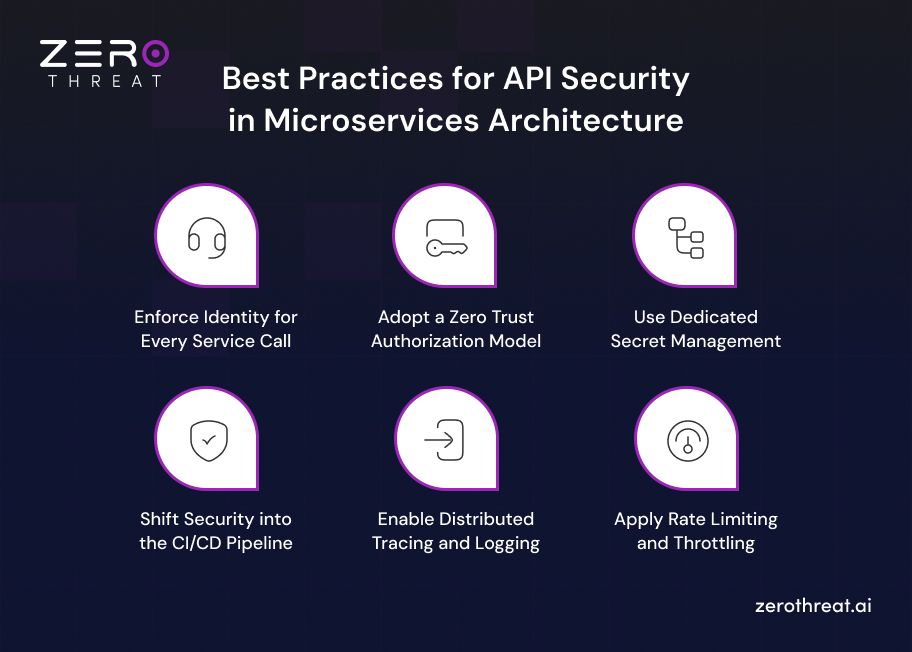
Enforce Identity for Every Service Call
Every service must verify exactly who is calling it before processing any request. Use JWT (JSON Web Tokens) for stateless authentication or mTLS (Mutual TLS) for encrypted, two-way identity verification. This ensures that even if an attacker gains a foothold in one service, they cannot easily call others without valid, verified credentials.
Adopt a Zero Trust Authorization Model
Proving identity is only half the work; you must also verify what a user or service is actually allowed to do. Implement OAuth 2.0 scopes or policy engines like OPA to check permissions at every single hop, not just at the endpoints. This "Zero Trust" approach prevents attackers from moving laterally through your environments if they compromise on a low-level service.
Use Dedicated Secret Management
Never hardcode API keys, database passwords, or certificates in your code or configuration files. Instead, use tools like HashiCorp Vault or Azure Key Vault to store, encrypt, and manage secrets. These tools can generate dynamic secrets that expire quickly, significantly limiting the damage if credentials are ever stolen.
Shift Security into the CI/CD Pipeline
Waiting until production to test your security is a recipe for disaster. Automate your API security testing for OWASP Top 10 risks directly into your development workflow. This "shift-left" approach allows your team to find and fix vulnerabilities as they write code, which is much faster and cheaper than patching a live system.
Enable Distributed Tracing and Logging
When there are multiple services running at the same time, you need a clear way to follow a request from start to finish. Use unique trace IDs to link logs across every service a request touches. Centralizing these logs into a single dashboard allows your security team to quickly identify attack patterns or unauthorized access attempts that would otherwise stay hidden.
Apply Rate Limiting and Throttling
Protect your services from being overwhelmed by a flood of requests, whether they are accidental or part of a DoS attack. Set strict limits at both the gateway and individual service levels to block brute-force attempts and ensure your system stays stable. Adaptive rate limiting can even adjust these caps in real-time based on the current load.
Ready to scale API pentesting and make sure no vulnerabilities slip into your microservices environment? Get Started FREE
Summing Up
Microservices architecture gives development teams speed and flexibility. But it also expands the API attack surface in ways many organizations underestimate. Each service introduces new endpoints, new authentication flows, and new opportunities for misconfiguration. Without proper testing, small gaps in one API can quickly turn into larger security incidents across the system.
To stay secure, security teams need to focus on what truly matters:
- Identify and test all exposed and internal APIs, not just public endpoints
- Validate authentication and authorization at every service layer
- Detect common vulnerabilities like BOLA, injection flaws, and excessive data exposure
- Address business logic weaknesses that span multiple services
- Integrate continuous API penetration testing into CI/CD pipelines
Microservices penetration testing is an ongoing security practice that changes with your architecture. This is where ZeroThreat’s API security testing tool helps discover each endpoint, simulate real attack paths, and continuously test distributed services.
you are finding it complex or time-consuming to detect vulnerabilities in your microservices environment, try using ZeroThreat AI for free It can be integrated into your DevOps pipelines, and you can replace 90% of manual security testing efforts with automation.
Frequently Asked Questions
Why does traditional API penetration testing fail in microservices architectures?
Traditional scanners often overlook hidden shadow APIs because they cannot parse modern API definitions like OpenAPI or Swagger. Furthermore, they typically assume a trusted internal network, whereas microservices require every single service-to-service call to be independently verified.
How should authentication be tested in distributed API systems?
How do event-driven systems increase API attack surface?
How often should APIs in microservices environments be tested?



Explore ZeroThreat
Automate security testing, save time, and avoid the pitfalls of manual work with ZeroThreat.