 ZeroThreat Wins Bronze Stevie® Award in Tech Startup of the Year Read more

All Blogs
AI-Powered DAST: The Future of Dynamic Application Security Testing

Quick Overview: Traditional DAST struggles to keep pace with modern applications, often missing business logic flaws and complex attack paths. This blog explores how AI is redefining Dynamic Application Security Testing with deeper context, smarter vulnerability discovery, and better risk prioritization. It also covers AI's limitations and how ZeroThreat delivers AI-driven DAST in practice.
A real attacker does not stop at your login page. They register an account, finish onboarding, move through a multi-step checkout, tamper with a single parameter on step three, and walk out with another customer's data. A traditional DAST scanner, by contrast, frequently never gets past authentication at all.
Dynamic Application Security Testing (DAST) tests a running application from the outside, with no access to source code. The classic loop is straightforward: crawl the application to discover its surface, fire payloads at whatever it finds, then analyze the responses for signals of a vulnerability. That model worked well when applications were server-rendered forms and predictable URL patterns.
It does not hold up against a modern single-page application with token-based auth, client-side routing, and business rules distributed across a dozen API calls. The stakes have moved too.
AI is what closes the gap between what scanners test and what attackers actually do. Not as a marketing layer bolted onto the same crawler, but as a change in how the engine decides where to go, what to test, and what is worth reporting.
This article covers where traditional DAST breaks down, how AI-driven engines address each failure, what AI still cannot do, and how ZeroThreat’s AI-powered DAST delivers this in practice.
The Future of DAST has already arrived. Are you still testing the old way? Start the Upgrade
On This Page
- Where Traditional DAST Breaks Down
- How AI is Redefining DAST
- What AI Still Cannot Do: Limitations and Considerations
- How Zerothreat Delivers AI-driven DAST In Practice
- Conclusion
Where Traditional DAST Breaks Down
Traditional DAST breaks down because it crawls without understanding the application. It cannot reliably reach authenticated or workflow-gated states. Moreover, it has no model of what an endpoint is supposed to do, and it reports pattern matches rather than validated exploits. Each of these limits is structural, not a tuning problem.
Five failure modes account for most of the gap between scanner output and attacker reality.
Crawler blind spots in JavaScript-heavy applications. Legacy crawlers follow anchors and form actions in returned HTML. In a React or Vue application, routes are resolved on client side, views render after asynchronous data fetches, and entire sections of the application exist only after a state transition. What the crawler never renders; it never tests, and coverage gaps do not appear as findings. They appear silent.
Fragile authentication and session handling. Recorded login sequences break the moment a selector changes, an MFA step is added, or a token rotates mid-scan. Scanners commonly log themselves out by requesting the sign-out endpoint they discovered while crawling, then continue the scan unauthenticated without flagging it. The most sensitive parts of an application are precisely the parts behind that session.
No reasoning about business logic. A vulnerability scanner can test whether a price field accepts a script tag. It cannot ask whether the price field should be accepted by the client at all. Broken access control, IDOR (CWE-284 and related weakness classes), workflow sequence bypasses, and negative-quantity abuse are logic failures with valid syntax and clean HTTP 200 responses. Signature matching has nothing to match against.
False-positive noise. When the detection method is response pattern matching, ambiguity resolves toward reporting. Teams then spend triage hours disproving findings, and the practical result is a decline in trust: scanner output stops being read carefully, and real issues get buried alongside the noise.
Isolated findings with no attack-path context. Traditional output is a flat list sorted by CVSS. A verbose error message, a permissive CORS policy, and a weak object reference each look like low or medium severity in isolation. Chained together, they can produce full account takeovers. The scanner never makes that connection because it evaluates findings on one request at a time.
How AI is Redefining DAST
AI is redefining DAST by replacing blind crawling and signature matching with an engine that reasons about the application it is testing. It navigates the way a user does, selects payloads based on what an endpoint appears to do, validates exploitability before reporting, and assembles individual weaknesses into complete attack paths. Each capability below maps directly to one of the failure modes above.
Intelligent Crawling and Attack Surface Coverage
Intelligent crawling uses a real browser and a reasoning loop to reach application states that link extraction never discovers. The engine renders the application, interprets the rendered DOM, and decides which interactions plausibly lead somewhere new: expanding a menu, submitting a form with contextually valid data, switching tenants, triggering a modal that loads a fresh route.
It also handles authentication as an ongoing state to maintain rather than a script to replay. The engine recognizes when a session has degraded, re-establishes it, and avoids self-inflicted logout by treating destructive or session-ending endpoints differently from ordinary navigation. Coverage stops being a function of how well someone wrote a crawl configuration.
Application-aware, Context-driven Testing
Application-aware testing means the engine infers what an endpoint does before deciding how to attack it. A parameter named invoice_id on an authenticated GET request that returns a PDF is a different target from a search box that reflects user input into a results header.
That inference changes payload selection from exhaustive to deliberate. Rather than firing a generic library at every parameter, the engine tests object reference tampering and cross-tenant access on the first, and reflection and context-specific encoding bypasses on the second. Fewer requests, better targeted, with far more relevant coverage per unit of scan time. This is also what makes production-safe testing feasible: the engine can reason about which probes carry side effects.
ZeroThreat doesn't stop at "vulnerable." It shows what an attacker does next. Test Modern Applications
Complex-workflow and Business Logic Testing
Complex-workflow testing exercises multi-step user journeys end to end, so the engine can attack the logic that connects the steps, not just the inputs within them. From registration, onboarding to cart, discount application, checkout, and refund, is a sequence of state changes, and the security-relevant questions live between those states.
Can step four be reached without completing step three? Does the server re-validate the price it sent in step two, or trust the value returned in step five? Can a coupon be applied twice by replying to a request? Can one tenant's identifier be substituted into an otherwise valid request? These are the questions a business logic testing engine asks, and they cannot be answered without carrying real state through a real workflow.
Attack Chain Reasoning Instead of Isolated Findings
Attack chain reasoning connects individually low-severity weaknesses into the single path an attacker would actually take. Instead of reporting three unrelated medium findings, the engine reports one critical path and shows how each link enables the next.
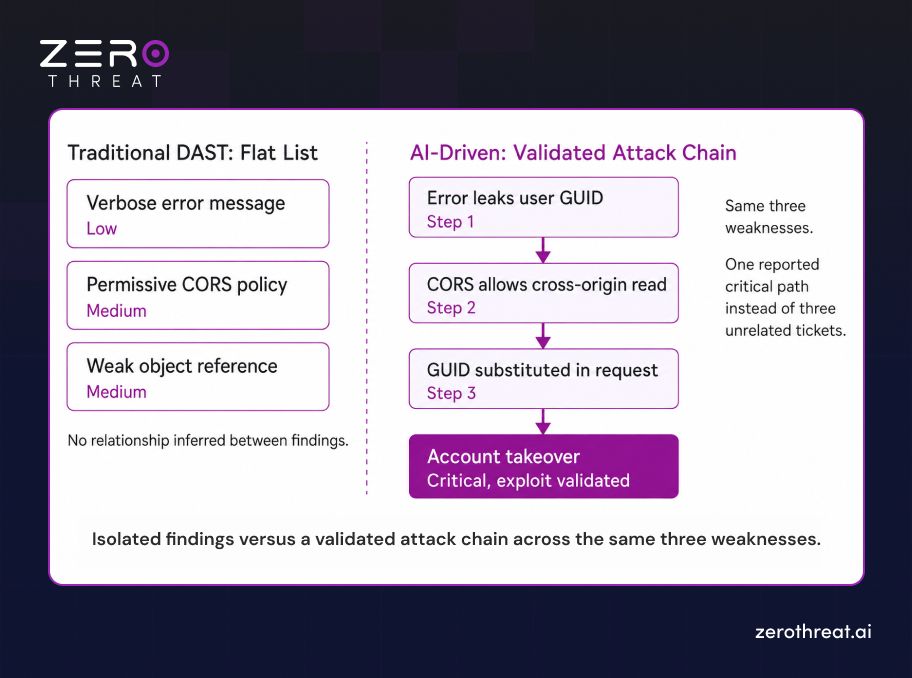
The practical difference is what reaches the backlog. Three separate tickets sorted by CVSS invite deprioritization. One validated path to account takeover does not.
False-positive Elimination Through Exploit Validation
Exploit validation removes false positives by requiring the engine to safely demonstrate an issue before reporting it, rather than inferring it from a response pattern. A suspected injection point is confirmed through controlled, non-destructive proof of impact. A suspected access control flaw is confirmed by retrieving a resource the test identity should not be able to reach.
Anything that cannot be demonstrated does not ship as a finding. That single constraint changes the economics of AppSec far more than any detection improvement: engineering time moves from disproving scanner output to fixing confirmed defects, and security teams regain the ability to treat a report as a work queue rather than a research project.
Business-aware Prioritization and Remediation Intelligence
Business-aware prioritization ranks findings by what an exploit would actually cost the organization, not by severity score alone. A validated IDOR exposing customer payment records on a production billing endpoint outranks a higher-CVSS issue on an internal admin tool with three users and no sensitive data.
The same reasoning improves what gets handed to the team doing the fix. Instead of a CWE reference and a link to documentation, the finding carries the exact request sequence, the affected endpoint and parameter, the evidence captured during validation, and remediation guidance specific to the observed defect rather than the vulnerability class.
The comparison of traditional DAST vs AI-driven DAST looks like this:
| Dimension | Traditional DAST | AI-driven DAST |
|---|---|---|
| Coverage | Link and form extraction, misses client-rendered routes | Rendered navigation and reasoning-driven state exploration |
| Authentication | Recorded sequences, brittle, prone to self-logout | Session maintained and re-established during the scan |
| Business logic | Not tested | Multi-step workflows exercised and attacked |
| False positives | High, pattern-based inference | Near zero, exploit validated before reporting |
| Attack-chain awareness | None, findings evaluated in isolation | Weaknesses correlated into full attack paths |
| Remediation output | Vulnerability class and generic guidance | Repro steps, endpoint, parameter, evidence, targeted fix |
| Prioritization | CVSS ordering | Business impact and exploitability weighted |
| Scan effort | Manual configuration and tuning per application | Autonomous, minimal setup |
Make the move from legacy DAST without breaking your budget. Start Today
What AI Still Cannot Do: Limitations and Considerations
AI does not make dynamic testing complete, and treating it as complete is the fastest way to build false confidence. Four limits are worth holding onto when evaluating any AI-driven testing platform.
Reasoning quality varies by application. Engines perform best on conventional patterns: standard auth flows, REST and GraphQL conventions, recognizable commerce and SaaS workflows. Highly bespoke domain logic, unusual protocols, and deeply stateful legacy systems still produce weaker inference and thinner coverage.
Scope guardrails are not optional. An engine that autonomously explores and interacts needs explicit boundaries: what is in scope, which environments and identities it may use, which operations must never be attempted. Autonomy without constraint is a reliability problem before it is a security one.
Human judgment still governs the edges. Whether a given data exposure is acceptable, whether a workflow bypass matters given a compensating control elsewhere, whether a finding is a defect or an intentional design tradeoff: these are contextual calls. AI-driven testing compresses the effort of finding and proving issues. It does not replace the security engineer who decides what the organization does about them, and it augments rather than eliminates skilled offensive testing.
False negatives remain the harder problem. Validation-first design makes false positives rare, which is the right tradeoff, but a clean report is evidence of what was tested and proven, not proof that nothing exploitable exists. Coverage reporting matters as much as findings, and any platform that cannot tell you what it reached is telling you less than it appears to.
How ZeroThreat Delivers AI-driven DAST In Practice
ZeroThreat delivers these capabilities as an AI-powered DAST platform rather than a scanner with a model attached. The reasoning behavior described above is the baseline. What follows is what changes operationally once it is running against your applications.
Full-funnel external attack surface coverage. Testing is not confined to the application layer. A single assessment spans ports, SSL and TLS configuration, DNS, and mail infrastructure through web applications, APIs, authentication, and business workflows. Classic DAST tooling covers the last portion of that funnel and leaves the exposed perimeter to a separate tool and a separate report.
One scan, two reports. The same assessment produces different outputs for the two teams that need it. Security teams receive the full attack path, the business impact of each chain, and the resulting priority order. Application teams receive reproduction steps, affected endpoints and parameters, captured evidence, and remediation guidance. Neither team has to translate the other's report, which is where most of the delay between finding and fix actually accumulates.
Complex workflows without Playwright specs. Multi-step journeys are exercised without anyone authoring or maintaining test scripts. Nothing to write when a flow is added, nothing to repair when a selector changes in a sprint, no drift between what the specs cover and what the application now does. Workflow coverage stops depending on someone's remaining budget for test maintenance.
Compliance mapping built into findings. Each finding carries its mapping to OWASP, PCI DSS, HIPAA, GDPR, and ISO 27001 at the point of discovery. Evidence collection for an audit becomes a filter on existing results rather than a quarter-end reconstruction exercise.
Measured outcomes rather than adjectives. In practice, this produces 10x faster detection, more than 2,000 URLs scanned in 15 minutes, and a 90% reduction in manual pentesting effort, with agentic exploit validation keeping false positives at effectively zero.
Don't just read about the future of DAST. Experience it. Schedule My Demo
Conclusion
The redefinition underway in DAST is not about scanning faster. It is about closing the distance between what a tool tests and what an attacker does. Rendered navigation reaches the application states that matter. Workflow testing attacks the logic between steps. Validation makes findings trustworthy. Chain reasoning makes them actionable. Business-aware prioritization makes them fixable in the right order.
ZeroThreat’s AI-powered DAST tool was built around that model. It treats every target as an application to be understood before it is attacked, proves exploitability before it reports, and delivers the result in the form each team needs to act on: attack paths and impact for security, reproduction and remediation for engineering. If your current scanner is producing long lists you do not fully trust, that is the gap worth closing.
Sign up with ZeroThreat and run your first AI-powered dynamic app security testing in minutes.
Frequently Asked Questions
Can AI-driven DAST test authenticated areas of an application?
Yes. Rather than replaying a brittle recorded login sequence, an AI-driven engine treats the session as state to maintain: it detects when a session has degraded, re-establishes it during the scan, and avoids triggering sign-out endpoints it encounters while exploring. This is what makes coverage of authenticated and role-specific functionality reliable instead of best-effort.
Can AI-driven DAST find business logic vulnerabilities?
Does AI-driven DAST replace manual penetration testing?



Explore ZeroThreat
Automate security testing, save time, and avoid the pitfalls of manual work with ZeroThreat.