 ZeroThreat Wins Bronze Stevie® Award in Tech Startup of the Year Read more

All Blogs
50+ Software Supply Chain Attack Statistics and Trends for 2026
Quick Overview: Software supply chain attacks are rising at an unprecedented pace, fueled by malicious open-source packages, vulnerable dependencies, compromised vendors, and AI-generated code. This roundup highlights the latest supply chain attack statistics for 2026, covering breach trends, financial impact, third-party risks, SBOM adoption, and emerging software supply chain threats to help organizations better understand and reduce their exposure.
Software supply chains have become one of the most targeted attack surfaces for cybercriminals. Rather than attacking organizations directly, threat actors increasingly compromise trusted software vendors, open-source libraries, third-party services, and CI/CD pipelines to gain access to thousands of downstream customers through a single breach. From high-profile incidents like SolarWinds and MOVEit to the growing abuse of open-source packages, supply chain attacks have evolved into a major enterprise security risk.
The latest supply chain attack statistics for 2026 reveal how quickly these attacks are increasing, which industries are most affected, and why organizations continue to struggle with third-party risk visibility. These trends can help organizations prioritize software supply chain security, strengthen vendor risk management, and adopt automated penetration testing to continuously identify and validate vulnerabilities across applications and APIs.
In this article, we've compiled the most recent supply chain attack statistics, facts, and trends for 2026 to provide a clear picture of the current threat landscape and what it means for modern application security.
Every dependency could be your weakest link. Start finding them today. Sign Up Free
On This Page
- Key Supply Chain Attack Statistics: An Overview
- Open-Source Ecosystem Statistics
- Third-Party Vendor Risk Statistics
- Supply Chain Breach Cost Statistics
- SBOM Production by Open-Source Projects
- AI and Dependency Risk Statistics
- Conclusion
Key Supply Chain Attack Statistics
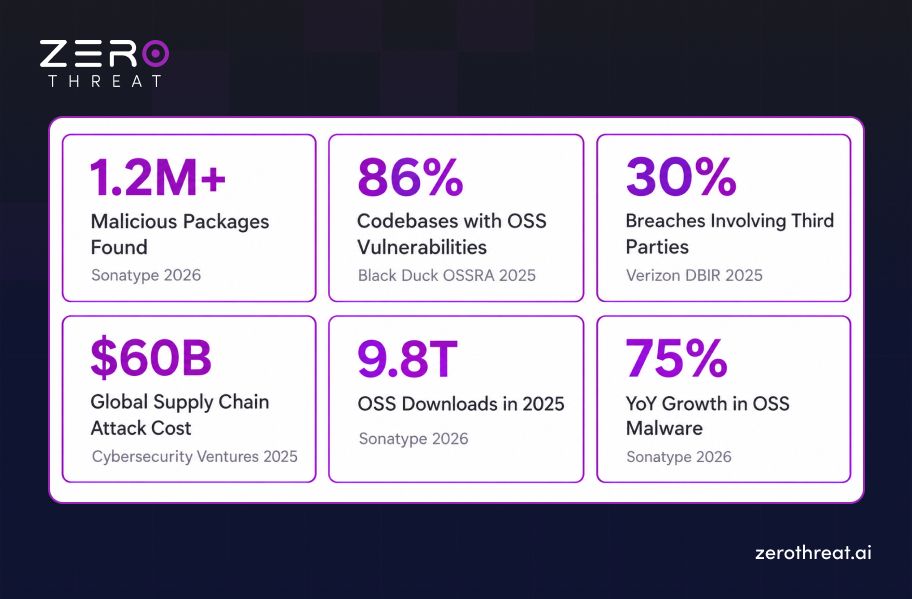
- 48% of breaches involved third parties in Verizon's 2026 DBIR, up 60% from the previous year's 30%, highlighting the growing role of supply chain and vendor-related risk.
- The economic impact of software supply chain attacks is projected to reach $138 billion annually by 2031, underscoring the growing financial risk of software supply chain compromise.
- 95% of software vulnerabilities exist in transitive (indirect) dependencies rather than direct dependencies. Despite this risk, 80% of enterprise software dependencies go more than a year without being updated, leaving organizations exposed to known security flaws.
- The average cost of a supply chain breach reached $4.91 million in 2025. These incidents also took an average of 267 days to identify and contain, making them the longest-lasting breach type tracked by IBM.
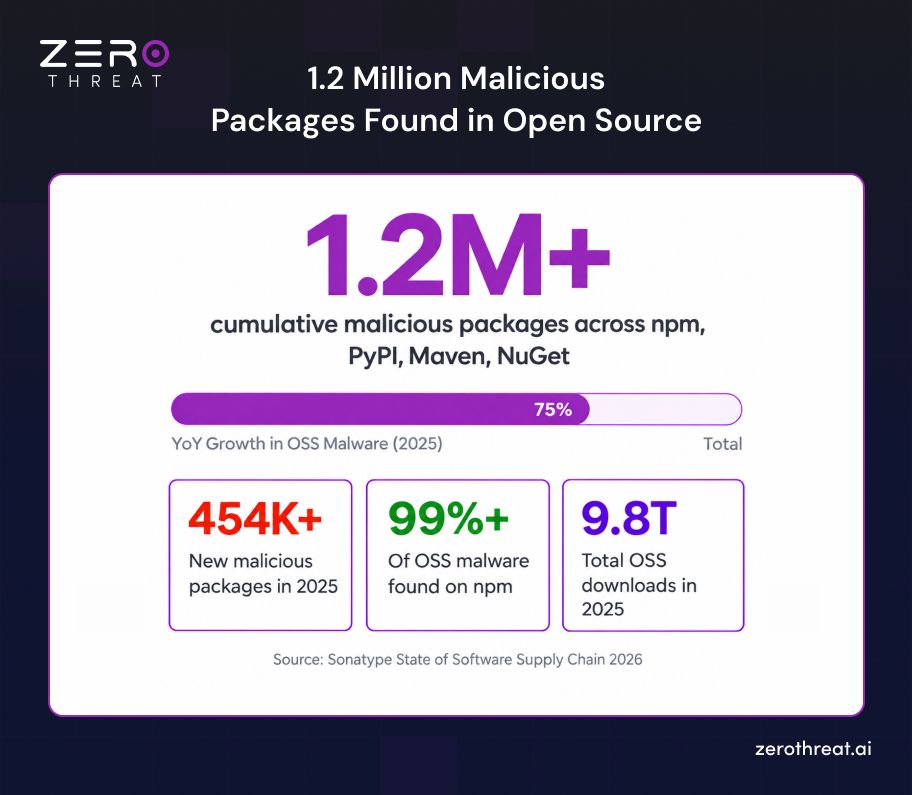
- More than 454,600 malicious open-source packages were discovered across ecosystems such as npm, PyPI, Maven, NuGet, and Hugging Face, which is a 75% increase from the previous year. The cumulative total has now surpassed 1.23 million malicious packages.
- Malicious open-source package detections increased by 73% in 2025. The npm ecosystem alone recorded over 10,800 malicious packages, representing more than 100% growth year over year.
- Over 1,000 npm packages were infected by the Shai-Hulud self-propagating worm in September 2025, exposing approximately 25,000 GitHub repositories in the first known software registry-native worm attack.
- The MOVEit supply chain attack affected 2,773 organizations and more than 95 million people, making it the largest software supply chain breach campaign recorded by victim count.
- 30% of breaches involving AI applications originated from supply chain compromises, while 44% of zero-day exploits targeted managed file transfer (MFT) platforms, highlighting attackers' growing focus on trusted software infrastructure.
- Supply chain attacks accounted for 10.6% of all cyber incidents tracked across the EU in ENISA's 2025 threat landscape, with software vendors, cloud service providers, and MSP/MSSPs emerging as the fastest-growing targets.
Open-Source Ecosystem Statistics
- 9.8 trillion open-source package downloads were recorded across Maven Central, npm, PyPI, and NuGet, highlighting the scale of today's software supply chain.
- 27.5% of identified malicious packages were classified as Potentially Unwanted Applications (PUAs), including spam packages, fake projects, and packages containing hardcoded credentials.
- 5.7% of malicious packages attempted to exfiltrate host information, while 3.9% targeted secrets such as API keys, CI/CD tokens, and developer credentials.
- 2.7% of malicious packages functioned as droppers/loaders and 2.1% contained backdoors, showing that attackers increasingly deploy multi-stage malware instead of single-payload attacks.
- Malicious threats targeting open-source repositories increased by 1,300% between 2020 and 2023, demonstrating how attackers are increasingly abusing trusted software ecosystems.
- Repository abuse tactics such as spam packages, typosquatting, and package squatting account for 55.9% of all malicious packages discovered across open-source repositories.
- 17% of malicious open-source packages are classified as critical security threats, while nearly half are categorized as potentially unwanted applications (PUAs) that can still introduce significant security and operational risks.
- Around 20% of Docker Hub's 15 million imageless repositories were linked to malware and phishing campaigns in 2024, highlighting how attackers continue to misuse container registries.
- JFrog identified 25,229 exposed secrets and access tokens in public software repositories, a 64% increase year over year, with 27% of those credentials remaining active and vulnerable to abuse.
- Approximately 13% of all Log4j downloads were still vulnerable, accounting for around 40 million vulnerable downloads out of nearly 300 million, despite security patches being available for more than four years.
- 95% of vulnerable software component downloads had a patched version available, yet organizations continued using outdated releases.
- Only around 0.5% of vulnerable components had no upstream fix available, indicating that most supply chain risk stems from delayed patching rather than unavailable fixes.
- Sonatype analyzed 37,000 AI-generated dependency upgrade recommendations and found that leading LLMs can recommend non-existent or incorrect dependency versions, introducing new software supply chain risks.
Vulnerable packages are only the beginning. Find the real attack paths. Explore AI Pentesting
Third-Party Vendor Risk Statistics
- 41.8% of breaches affecting leading fintech companies originated from third-party vendors, demonstrating that vendor ecosystems remain a primary attack vector.
- 52.6% of key Indian suppliers experienced at least one third-party breach in the past year, highlighting growing cyber risk across global supply chains.
- 98 of France's 100 largest companies suffered at least one third-party breach during the previous 12 months, while 100% had at least one breached fourth-party supplier.
- According to SecurityScorecard's analysis of 1,000 global breaches, attackers increasingly exploit trusted vendor relationships instead of directly targeting enterprise infrastructure.
Supply Chain Breach Cost Statistics
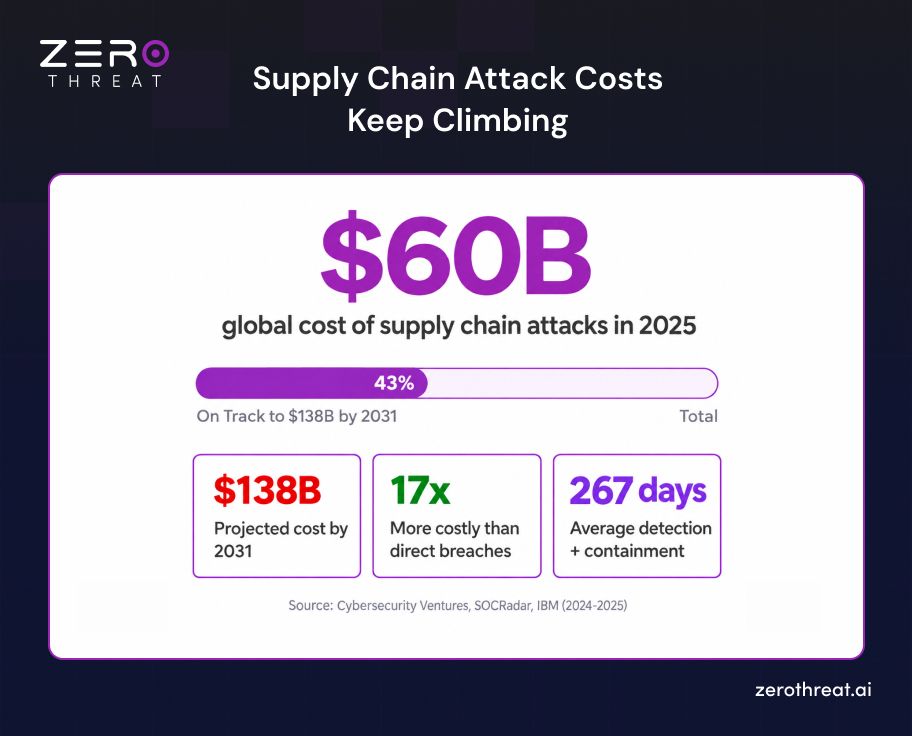
- The global cost of supply chain attacks is projected to rise from $46 billion in 2023 to $60 billion in 2025, and is expected to reach $138 billion by 2031, growing at an estimated 15% annually.
- The global average cost of a data breach reached $4.99 million in 2026, a 12% increase from the previous year, and a new record high. In the United States, the average cost rose to $11.5 million per breach.
- Supply chain breaches cost organizations approximately 17 times more to remediate than first-party breaches, reflecting the complexity of investigating and recovering from attacks involving third-party vendors and software dependencies.
- Organizations take an average of 267 days to identify and contain a supply chain breach, making it the longest breach lifecycle of any attack vector tracked in IBM's Cost of a Data Breach Report.
- Supply chain compromise was the second most common initial attack vector in India, accounting for 17% of all data breaches.
- Organizations in India reduced the average breach lifecycle to 263 days, yet supply chain incidents continued to rank among the most disruptive attack vectors.
- Research organizations experienced the highest average breach cost (₹289 million), illustrating the financial impact when software supply chains are compromised.
- Third-party involvement in data breaches rose 60% in 2026, with breaches involving third parties now accounting for 48% of all breaches, highlighting the growing risk posed by supply chain and partner ecosystems.
- Exploitation of edge devices and VPNs increased from 3% to 22% of exploit-driven breaches, an eightfold jump. Despite the growing threat, only 54% of affected edge devices had been fully patched.
- Just 24% of organizations are confident in the security of their direct software dependencies, underscoring persistent concerns around third-party code and open-source components.
- Less than one in four organizations regularly audit their software supply chain, leaving many without adequate visibility into the security of their vendors, dependencies, and development pipelines.
- 52% of security teams miss their vulnerability remediation SLA targets, while 74% set remediation deadlines of one week or less, creating unrealistic expectations that are difficult to achieve in practice.
SBOM Production by Open-Source Projects
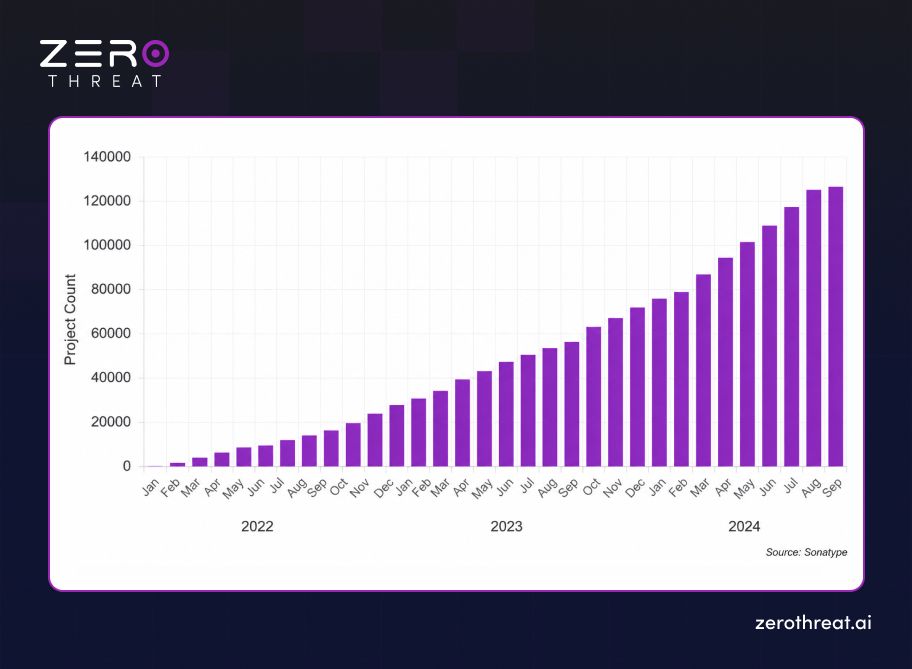
Government initiatives such as U.S. Executive Order 14028 have significantly increased awareness and adoption of Software Bills of Materials (SBOMs). As a result, more open-source projects are publishing SBOMs alongside their software releases. However, adoption remains gradual rather than exponential.
- Nearly half of organizations had adopted Software Bills of Materials (SBOMs) by 2024, and 78% planned to expand their use as software supply chain security became a higher priority.
- Gartner projected that 60% of organizations developing or procuring critical infrastructure software would require SBOMs, up from less than 20% in 2022.
- In 2026, U.S. federal SBOM policy shifted toward a risk-based approach. OMB Memorandum M-26-05 rescinded earlier software supply chain security memoranda and allows agencies to adopt contractual terms requiring software producers to provide a current SBOM upon request.
AI and Dependency Risk Statistics
- 27.8% of AI-generated dependency upgrade recommendations referenced non-existent package versions, based on Sonatype's analysis of 36,870 real-world upgrade recommendations, exposing developers to software supply chain risks caused by AI hallucinations.
- GPT-5 expressed high confidence in only 3.68% of dependency recommendations, despite achieving 98% accuracy in those cases. Nearly half of all low-confidence recommendations were incorrect, highlighting the need for human validation and real-time package intelligence.
- In 345 analyzed cases, AI-recommended dependency upgrades actually reduced software security, introducing more vulnerabilities than they resolved instead of improving the application's security posture.
- Ungrounded AI models left up to 70% more Critical and High-risk vulnerabilities unresolved compared with dependency recommendations backed by live package registry and vulnerability intelligence.
- Even the best ungrounded AI models continue to fabricate roughly 1 in 16 dependency recommendations, creating opportunities for attackers to exploit hallucinated package names through slopsquatting attacks.
- Research on more than 576,000 AI-generated code samples found that 19.7% referenced hallucinated software packages, many of which attackers can register as malicious dependencies. Additionally, 43% of hallucinated package names reappeared consistently, making them predictable targets for supply chain attacks.
- Only 20% of AI-generated dependency recommendations were considered safe to use, while the remaining 80% contained hallucinated package versions, outdated components, or known security vulnerabilities.
- 39% of developers use AI-generated code without making any modifications, increasing the risk of introducing insecure dependencies, vulnerable code, or software supply chain issues into production.
- Just 24% of organizations conduct comprehensive reviews of AI-generated code, including checks for intellectual property, licensing, security vulnerabilities, and code quality before deployment.
- JFrog reported a 6.5× increase in malicious machine learning models on Hugging Face, which added more than one million new models and datasets during 2024, highlighting the growing software supply chain risks in AI ecosystems.
See how attackers exploit vulnerable dependencies before you do. Book a Demo
Conclusion
The latest software supply chain security statistics for 2026 reveal a clear trend: attackers are increasingly exploiting the software ecosystems organizations rely on every day. From malicious open-source packages and vulnerable dependencies to third-party vendors and AI-generated code, the software supply chain has become one of the fastest-growing attack surfaces in cybersecurity.
These numbers also show that many risks are preventable. Regular dependency updates, continuous third-party risk assessments, SBOM adoption, secure CI/CD practices, and automated application security testing can significantly reduce exposure before attackers find a way in.
As software supply chains continue to grow in complexity, organizations need greater visibility into every component, dependency, and vendor they trust. Taking a proactive approach today is the best way to minimize tomorrow's supply chain risks.

Explore ZeroThreat
Automate security testing, save time, and avoid the pitfalls of manual work with ZeroThreat.