 ZeroThreat Wins Bronze Stevie® Award in Tech Startup of the Year Read more

All Blogs
Session-Aware Security Testing: The Key to Better Vulnerability Detection
Quick Overview: Many application vulnerabilities exist behind authenticated sessions, where traditional scanners often lack visibility. This blog explores how session-aware security testing maintains valid user sessions to uncover deeper vulnerabilities across web applications and APIs, improve testing coverage, and identify risks hidden within real user workflows and role-based access controls.
An attacker who steals a set of valid credentials does not stop at the login page. They authenticate, move through the account, change an object ID in a request, and walk out with data belonging to every other user on the platform. The most damaging vulnerabilities in a modern application live on the far side of the login form, inside authenticated workflows a logged-out visitor never sees.
This is exactly where most security scanners stop. A tool that crawls only the public surface, or logs in once and silently loses its session three requests later, tests a small fraction of the real application. Everything behind authentication (the account pages, the admin functions, the multi-step workflows, the API endpoints that accept object IDs) stays invisible. The scan comes back clean not because the application is secure, but because the scanner never reached the code that matters.
Session-aware security testing closes that gap. By establishing a valid session, holding it across the entire scan, and reasoning about which role each request belongs to, it reaches the endpoints and vulnerability classes that unauthenticated scanning structurally cannot.
This article breaks down how AI pentesting tool performs session-aware testing, the vulnerability classes it unlocks, why one session is never enough, how it changes API testing, what commonly breaks these scans in practice, and how to measure the coverage you gain.
If your scanner can't maintain a session, it can't see the full risk. Start Testing for FREE
On This Page
- What is Session-Aware Security Testing?
- The Coverage Gap: What Session-Blind Scanning Never Reaches
- How Session State is Established and Maintained During a Scan?
- Vulnerability Classes That Only Surface Inside a Valid Session
- Multi-Role and Cross-Session Testing
- Session Awareness in API Testing
- What Breaks Session-Aware Scans, and How to Fix It?
- Measuring the Coverage Improvement
- Conclusion
What is Session-Aware Security Testing?
Session-aware security testing is an approach that establishes an authenticated session, maintains it across the full scan lifecycle, and issues every request as a real logged-in user in a known role. Instead of probing whatever a vulnerability scanner can reach anonymously, it authenticates the way a user would, keeps that session alive, and continuously verifies it has not been dropped, so testing happens inside the application rather than at its front door.
It is worth separating this from the weaker idea of authenticated scanning. Many tools describe themselves as authenticated because you can paste in a cookie or a token at the start of a scan. That is a one-time handoff. The moment the token expires, the application rotates the session, or a logout link gets crawled, the scanner quietly falls back to testing as an anonymous user, and every finding after that point is measured against the login page instead of the real application.
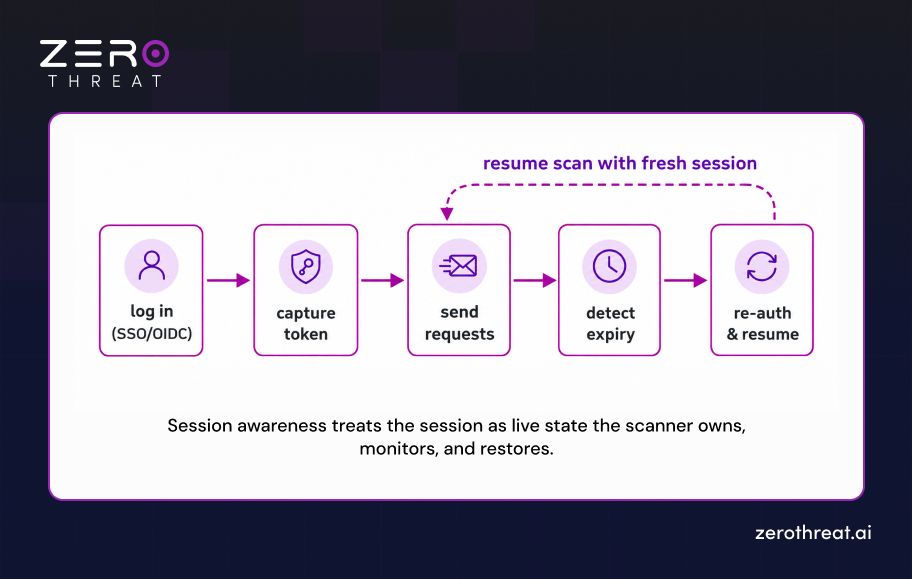
Session awareness is the stronger property: the scanner treats the session as live state it is responsible for. It knows what a logged-in response looks like, detects when the session breaks, re-authenticates on its own, and can hold several sessions at once for different roles. That distinction is the difference between a scan that started authenticated and one that stayed authenticated through every request.
The Coverage Gap: What Session-Blind Scanning Never Reaches
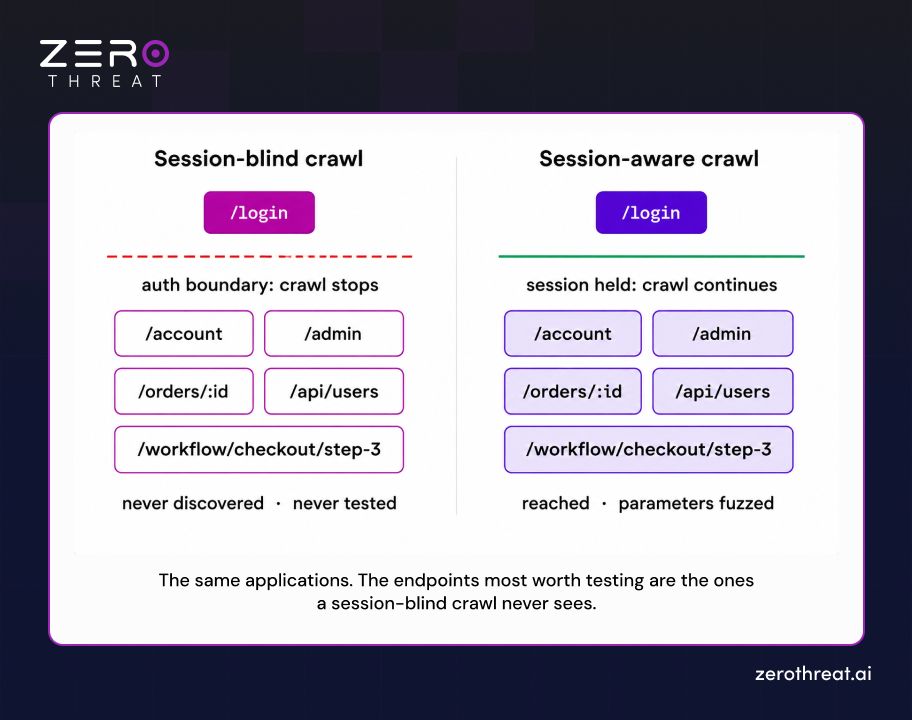
Session-blind scanning misses most of an application's attack surface because the majority of endpoints, and nearly all of the high-value ones, sit behind authentication where an unauthenticated crawler cannot follow. The public surface is the marketing site, the login page, and a password reset form. The application is everything after login.
Three distinct failures create the gap:
Crawl Collapse at The Authentication Boundary
A crawler discovers endpoints by following links and forms from where it currently stands. Standing outside the login wall, it can enumerate the handful of public routes and then stops, because every meaningful link points to a page that requires a session it does not have. The authenticated route map, often the large majority of the application, is never even discovered, so it can never be tested. You cannot fuzz a parameter on an endpoint you never found.
Silent Session Loss Mid-scan
This is a quieter and more dangerous failure. A scan begins authenticated, then loses the session partway through a token expires; a tested action triggers a logout, or a concurrent login invalidates the cookie. The vulnerability scanning tool keeps sending requests, but the server now answers everyone with a 302 redirect to the login page. The tool records those as clean, non-vulnerable responses. The result is a report full of green for endpoints that were never actually tested.
False Negatives as Unreachable Code Paths
Both failures produce the same outcome: false negatives. The vulnerable code exists, but the scanner's requests never reached it in an authenticated state, so nothing fired. A clean report from a session-blind scan is not evidence of a secure application. It is often just evidence of shallow reach.
AI that understands sessions finds more than AI that simply scans. Explore AI Pentesting
How Session State is Established and Maintained During a Scan
A modern vulnerability scanner maintains state by authenticating through the application's real login flow, capturing the resulting session token, attaching it to every request, and detecting and recovering the session when it breaks mid-scan. The mechanics below matter because each one, when it fails, silently drops coverage.
Establishing the Session
Authentication is rarely a single form of post anymore. A vulnerability scanning platform has to handle classic username and password forms, single sign-on through SAML, and OAuth2 or OIDC redirect flows where the token is issued by a separate identity provider. Multi-factor steps add another hop. If the tool cannot complete this handshake, everything behind it is unreachable, so the login flow itself is the first thing that determines coverage.
Knowing Where the Token Lives
Once authenticated, session state can live in several places, and the scanner has to attach the right one to each request: a session cookie, a bearer token in an Authorization header, a custom header, or a JWT carried by the client. Anti-CSRF tokens complicate this further, because they are often single-use and must be freshly extracted from each response and replayed on the next state-changing request. Miss the CSRF token and every POST, PUT, and DELETE gets rejected before it tests anything.
Detecting Logged-in Versus Logged-out State
This is the heart of session awareness. The scanner needs a reliable signal for "am I still authenticated," whether that is an explicit verification rule (a request to a known authenticated endpoint that must return 200) or a heuristic (the presence of a logout link, the absence of a login form). Without it, the scanner cannot tell a genuine clean response from a redirect to the login page, and silent session loss goes undetected.
A verification rule the scanner checks between requests GET /api/v1/me # canary endpoint Expect: 200 AND body contains "user\_id" On failure: re-authenticate, then resume from last requestRe-authentication and Token Refresh
Long scans outlive short sessions. When a token expires or a refresh window closes mid-scan, a session-aware tool re-runs the login flow or exercises the refresh token, then resumes rather than reporting the rest of the scan against a dead session.
Session Isolation Across Concurrent Threads
Top vulnerability scanners run requests in parallel for speed. If two threads share one session, one thread's logout or token rotation can invalidate the other's requests, producing phantom failures and unstable results. Real session awareness isolates state per worker so parallelism does not corrupt the session, which is one of the quiet places naive authenticated scanners break down.
Vulnerability Classes That Only Surface Inside a Valid Session
Broken access control, the single most common web application vulnerability class, is only detectable from inside a valid session, because the flaw is defined entirely by what an authenticated user can reach beyond their intended permissions. In the OWASP Top 10, Broken Access Control ranks first, with some form found in 94% of applications tested and more occurrences than any other category. A scanner with no session has no user, no permissions, and therefore no way to detect permission being violated.
The same logic extends across a whole family of high-impact flaws that share one precondition: a valid, held session.
- BOLA / IDOR: Proving an object-level authorization flaw requires an authenticated request whose object ID can be swapped for one belonging to another user. No session, no test.
- Broken Function Level Authorization and Privilege Escalation: Reaching an admin-only function as a standard user is only meaningful once you are logged in as that standard user.
- Mass Assignment: Over-permissive object writes surface only when you can submit an authenticated update and observe which extra fields the server accepts.
- Session Fixation and Insufficient Session Expiry: These are flaws in the session mechanism itself, untestable without exercising real sessions.
- Authenticated Stored XSS and Internal SSRF: Payloads that only land on admin dashboards or internal tooling are invisible to an anonymous crawler that never reaches those surfaces.
- Business Logic Flaws: Abuse of a multi-step workflow (a transfer, an approval, a checkout) requires holding a session across every step of that workflow.
| Vulnerability class | Session requirement | Detectable unauthenticated? |
|---|---|---|
| BOLA / IDOR | Authenticated request with a swappable object ID | No |
| Broken function level auth (BFLA) | Low-privilege session reaching a high-privilege function | No |
| Privilege escalation | Known role to compare escalated access against | No |
| Mass assignment | Authenticated write to observe accepted fields | No |
| Session fixation / weak expiry | Live session to manipulate | No |
| Authenticated stored XSS | Access to authenticated input and render surfaces | No |
| Business logic abuse | Held session across a multi-step workflow | No |
| Reflected XSS on a public page | None | Yes |
The pattern is hard to miss. Almost everything an attacker actually monetizes lives in the "No" rows, and every one of those rows depends on a session a scanner has to establish and hold.
Multi-Role and Cross-Session Testing
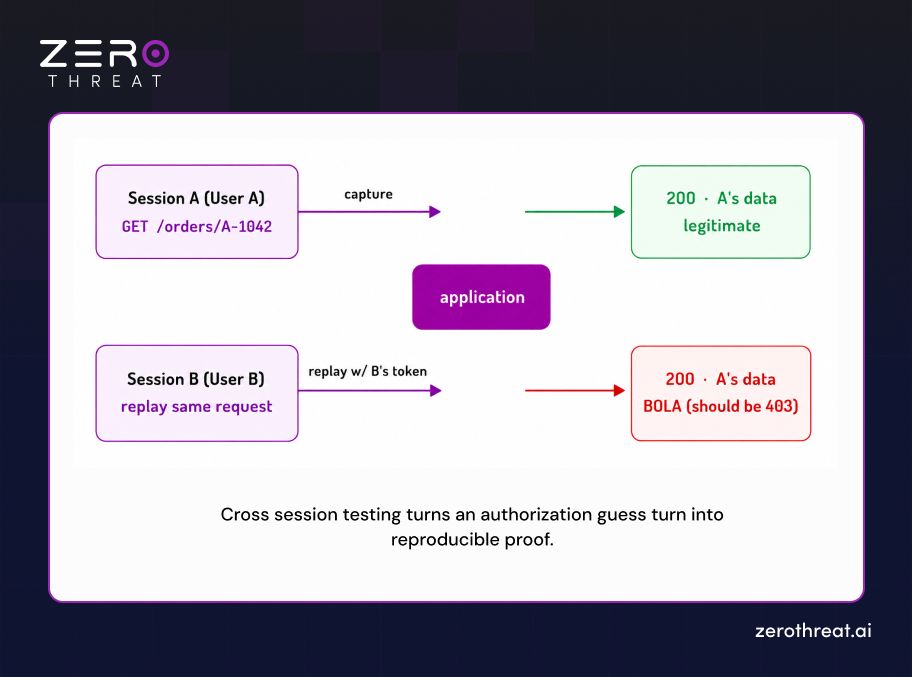
Multi-role testing proves an authorization flaw by capturing a request as one user and replaying it with a different user's session, then checking whether the application wrongly returns the first user's data or honors the action. One session tells you what a user can do. Authorization bugs are about what a user can do that they should not, and that comparison needs at least two sessions.
Coverage has a second axis here that single-session scanning ignores entirely: role coverage. Testing only as an administrator hides horizontal access bugs between two standard users. Testing only as one standard user hides vertical escalation into admin functions. Real coverage means running the same endpoints through a matrix of roles: admin, standard user A, standard user B, and an unauthenticated baseline.
The mechanism is a capture-and-replay diff:
Capture a legitimate request as User A GET /api/orders/A-1042 Cookie: session=USER\_A → 200 {order data}Replay the same request with User B's session GET /api/orders/A-1042 Cookie: session=USER\_B Expected: 403 Forbidden Vulnerable: 200 + User A's order <-- horizontal access violationThis is the difference between checkbox authenticated scanning and testing that actually exercises access control. The finding is not a guess based on a URL pattern. It is proof: the same object, requested with the wrong identity, returned data it should have been refused.
Before you renew your scanner, compare what you're missing. Compare Plans
Session Awareness in API Testing
Session-aware API testing acquires a token from the API's authentication endpoint, attaches it to every call, and refreshes it before expiry, because APIs have no login form or crawlable UI for a scanner to follow. Everything that made session handling matter for web apps is sharper for APIs, where there is no page to render and no link to click.
An API scanner with no session logic effectively tests only unauthenticated routes: health checks, public docs, and the token endpoint itself. The business-critical surface (the endpoints that read and write real objects) sits behind a token it never acquired. Several API-specific details decide whether that token holds:
- Token Acquisition: The scanner must call the auth endpoint, parse the token from the response, and know which header to place it in for every subsequent request.
- Short-lived JWT Expiry: API tokens are often deliberately short-lived. A long scan will outlive the token repeatedly, so refresh handling is not optional, it is the difference between full and partial coverage.
- Scope and Audience Claims: The same user can hold tokens with different scopes. Coverage means testing across scopes, not just one broad token.
- GraphQL and Non-REST Shapes: A single GraphQL endpoint hides many operations behind one URL, so session-aware testing has to exercise queries and mutations, not just crawl paths.
This is also where session awareness meets the top API risk directly. OWASP ranks BOLA as the number one API risk, and OWASP is explicit that object-level authorization checks must be validated continuously throughout a session, and that these flaws are not reliably caught by generic automated testing. Detecting them requires exactly the two capabilities this article has been building toward: a held session, and the ability to replay across identities.
What Breaks Session-Aware Scans, and How to Fix It
Session-aware scans break most often at MFA, CAPTCHA, account lockout, and concurrent-login invalidation, each of which severs or blocks the session the scanner depends on. These are practical, recurring problems with practical solutions, and knowing them in advance is the difference between a scan that reaches the application and one that stalls at the door.
- MFA and CAPTCHA: These are designed to stop automation. For testing, use dedicated test accounts with MFA disabled or backed by a programmatic seed, and allowlist the scanner against CAPTCHA in non-production, or provide a bypass token for the test tenant.
- Account Lockout and Rate Limiting: Aggressive scanning can trip lockout thresholds and lock out the very account the scan runs. Provision test accounts exempt from lockout, or tune scan concurrency to stay under the threshold.
- Concurrent-login Invalidation: Apps that permit one active session per user will invalidate the scanner's session when someone else logs in as that account. Give the scanner its own dedicated accounts that no human uses during a run.
- Destructive Actions Inside Authenticated Flows: Authenticated scanning can hit delete, submit, or pay. Maintain an exclusion list for destructive endpoints, and run against seeded, disposable test data rather than real records.
- CI/CD Credential Handling: Automated scans need credentials injected safely. Store them as pipeline secrets, never in scan configs committed to source control.
Session-Aware Testing Best Practices
- Provision dedicated test accounts per role, exempt from lockout and MFA friction.
- Define an explicit logged-in verification rule, so silent session loss is detected, not ignored.
- Maintain an exclusion list for destructive endpoints and run on seeded, disposable data.
- Configure token refresh and re-authentication, so long scans never run against a dead session.
- Isolate session state across concurrent scan threads to keep parallel results stable.
- Verify coverage by comparing crawled endpoint counts authenticated versus unauthenticated.
Measuring the Coverage Improvement
Coverage improvement is measured by comparing what a scan reaches with and without a maintained session: authenticated endpoints discovered, parameters fuzzed, workflows completed, and findings by vulnerability class. Coverage claims mean nothing without a baseline, so measure the same application both ways and diff the numbers.
The metrics that actually show the gain:
- Endpoints Discovered: Total routes reached authenticated versus unauthenticated. The delta is the attack surface session-blind scanning hiding.
- Parameters Fuzzed: Discovered endpoints that are never exercised are not coverage. Count parameters actually tested behind auth.
- Authenticated Routes Reached: The proportion of the known authenticated route maps the scan actually touched while holding a session.
- Workflow Completion Rate: For multi-step flows, how many the scanner completed end to end rather than abandoning after the session dropped.
- Findings by Class, Before and After: The appearance of BOLA, BFLA, and business logic findings that were structurally impossible to detect without a session is the clearest signal the coverage gain is real.
| Capability | Session-Blind Scanning | Session-Aware Testing |
|---|---|---|
| Reaches authenticated routes | No | Yes |
| Survives token expiry mid-scan | No | Yes |
| Detects broken access control | No | Yes |
| Cross-role authorization testing | No | Yes |
| Tests authenticated APIs (BOLA) | No | Yes |
| Completes multi-step workflows | No | Yes |
See what your application looks like through an attacker's session. Book My Demo
Conclusion
A scan is only as good as it reaches. Session-blind tools stop at the login page and report the untested majority of an application as clean, while the vulnerability classes attackers actually exploit (broken access control, BOLA, privilege escalation, business logic abuse) all live on the authenticated side of that wall. Session-aware testing is what carries a scan across it: establishing a session, holding it through every request, and replaying across roles to prove authorization flaws rather than guessing at them.
This is exactly how ZeroThreat’s AI penetration testing works. It authenticates through real login flows, maintains session state across complex workflows without scripted specs, and runs multi-role, cross-session authorization testing with validated, proof-based findings. Start testing what your scanner has been missing
Frequently Asked Questions
Can session-aware testing detect vulnerabilities in GraphQL and WebSocket APIs?
Yes, but only if the tool understands those protocols rather than just crawling URLs. A single GraphQL endpoint hides many operations behind one path, so testing must exercise individual queries and mutations under a held session. WebSocket APIs maintain a long-lived authenticated connection, so the tester has to establish the session, upgrade the connection, and probe messages within it. In both cases, session awareness is the precondition, and protocol awareness is what turns that session into real coverage.
How does ZeroThreat maintain an authenticated session throughout a scan?
Can ZeroThreat perform multi-role and cross-session authorization testing?
Is ZeroThreat's session-aware testing safe to run against production?


Explore ZeroThreat
Automate security testing, save time, and avoid the pitfalls of manual work with ZeroThreat.