 ZeroThreat Wins Bronze Stevie® Award in Tech Startup of the Year Read more

All Blogs
Understanding Business-Critical Attack Paths: A Guide for Security Leaders
Quick Overview: A business-critical attack path is a validated, exploitable chain of steps that reaches an asset with real business impact. This guide shows security leaders how these paths form, why severity scores miss them, how to prioritize by impact, and how ZeroThreat surfaces the chains that matter.
An attacker rarely needs one catastrophic flaw. They need a way in, a way up, and a way through. A forgotten debug endpoint leaks an internal user ID. That ID feeds an access-control gap exposing another account's order history. That history returns and admin invite token still valid in the response body. Three findings, each rated low or medium in isolation, combine into full access to customer records. No single severity score predicted it. The chain did.
This is the gap between how scanners report risk and how attackers operate. Vulnerability assessment tools produce lists ranked by per-finding severity. Attackers ignore the list and follow the path, linking weaknesses until they reach something worth stealing. For security teams, the question is not how many critical are there in the queue. It is which sequences of exploitable steps reach the assets the business cannot afford to lose.
The 2026 Verizon DBIR sharpened the stakes: exploiting vulnerabilities is now the leading initial access vector in breaches, and the report concludes that choosing the right flaws to fix matters more than patching faster. That is an attack-path problem.
This guide covers what a business-critical attack path is, what one looks like step by step, how to prioritize paths by business impact instead of raw severity, and how ZeroThreat’s AI-powered pentesting tool discovers and ranks the chains that threaten your business.
What if your "low-risk" finding is the first step to a full compromise? Find Out Free
On This Page
- What is a Business-critical Attack Path?
- Anatomy of a Business-critical Attack Path
- Prioritizing Attack Paths by Business Impact
- How Zerothreat Delivers Business-critical Attack Paths
- Conclusion
What is a Business-critical Attack Path?
A business-critical attack path is a validated, exploitable sequence of steps that connects an entry point to an asset with significant business impact, such as customer data, payment systems, or administrative control.
Unlike an isolated vulnerability, which is a single weakness scored on its own, an attack path is defined by where it ends, not by the severity of any step along the way. A low-severity information leak is a footnote in a report until it becomes the first link in a chain that reaches unencrypted cardholder data. (For a deeper treatment of how chains differ from standalone findings, see our breakdown of isolated vulnerabilities vs attack chains.)
Two qualifiers make a path business-critical. First, it is exploitable: the sequence has been proven reachable in the running application, not inferred from a version number. Second, it terminates as an asset to the business genuinely values. A validated path to a public marketing page is noise. A validated path to your customer database, payment flow, or admin console is a board-level risk.
Anatomy of a Business-critical Attack Path
The anatomy of a business-critical attack path is a linked progression from initial access, through privilege or logic abuse, to a high-value asset, where each individual step enables the next.
Consider a concrete chain against a typical SaaS application. Read step by step as none of these findings would top a severity queue. Read as a sequence; they end in a reportable breach.
1) Initial access: information disclosure (Low)
A verbose API error and an exposed .git directory reveal internal endpoint structure and a naming pattern for object IDs. CWE-200. On its own, an informational finding most teams defer.
2) Lateral read: broken access control (Medium)
An IDOR on /api/v2/users/{id}/orders lets a low-privilege authenticated user read other accounts' objects. OWASP A01 / CWE-639. Still "just" a medium, because the data exposed looks limited.
3) Privilege abuse: business-logic flaw (Medium)
A profile-update call honors a client-supplied role field server-side, and a workflow accepts an out-of-order state transition. OWASP A04 Insecure Design. The attacker becomes an administrator.
4) Terminal asset: bulk data exposure (Critical impact)
The admin API is now reachable, exposing bulk customer PII and payment records. This is the asset the business cannot afford to lose, and the reason the whole chain is business critical.
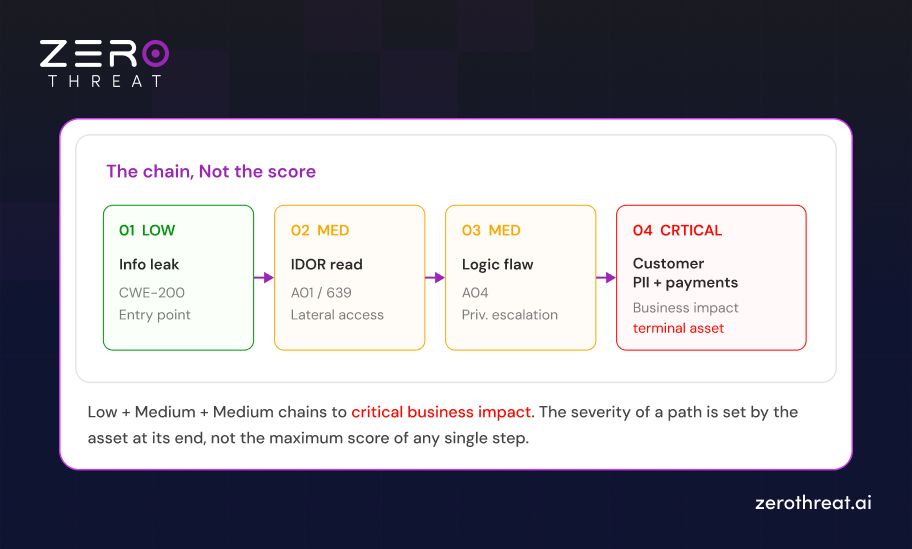
The lesson for leaders is structural. Each step here is defensible in a severity report as "not urgent." The path is a breach. Any model that scores steps in isolation will systematically underweight exactly the sequences attackers rely on.
See what happens when ai stops scanning and starts reasoning. Explore AI Pentesting
Prioritizing Attack Paths by Business Impact
Prioritizing attack paths by business impact means ranking validated chains by the value and sensitivity of the asset each chain reaches, rather than by the CVSS score of any single vulnerability inside it.
Severity-first triage has no concept of reachability or chaining. It scores findings one at a time, so a cluster of mediums that leads to cardholder data is ranked below a lone critical that leads nowhere exploitable. Leaders then allocate scarce remediation capacity against a queue that is sorted by the wrong key.
The data now makes this a first-order problem, not a philosophical one. In the 2026 Verizon DBIR, only 26% of known-exploited vulnerabilities were fully remediated, and the median time to fix one rose to 43 days. No team patches everything, and the report's own conclusion is blunt: choosing the correct vulnerabilities to fix matters more than patching faster. When capacity is finite, the prioritization model stops being a reporting artifact and becomes a control. Its quality decides how much real risk you actually retire.
Two ways to rank the same findings:
| Dimension | Severity-first Triage | Attack-path Prioritization |
|---|---|---|
| Unit of analysis | Individual finding | Complete exploitable chain |
| Ranking basis | CVSS severity of the step | Business impact of the terminal asset |
| Business context | Absent | Central to the ranking |
| Reachability | Assumed, not tested | Proven through validation |
| Typical output | A long queue of "criticals" | A short, ordered set of real paths |
| What a leader sees | Volume | Decisions |
The operating principle is straightforward: rank each validated path by the asset it reaches, weight it by how exploitable and how reachable it is, and map it to the business function it threatens. A handful of ranked paths tied to named assets is a resource-allocation plan. A thousand-row severity export is not.
How ZeroThreat Delivers Business-critical Attack Paths
ZeroThreat’s web app and API pentesting delivers business-critical attack paths by mapping your external attack surface, chaining validated exploits the way an attacker would, and ranking each path by the business impact of the asset it reaches.
The platform is built around the distinction this article draws, so the output is a set of ranked, proven paths rather than a severity of export.
Business Context as Input
You define what "critical" means for your environment: which assets, which data stores, which workflows carry real consequences. Prioritization is anchored to that objective, so the ranking reflects your business, not a generic scoring table.
Application-aware Attack Chain Discovery
Our automated penetration testing tool reasons about how individual findings connect into a reachable chain, and it tests complex, authenticated workflows the way a real user moves through them, with no Playwright specs to write. That application awareness is what surfaces the multi-step sequences a per-finding scanner never assembles.
Business-aware Prioritization
Each path is ranked by the impact of the asset at its end, not by the maximum severity of any step. The chain from the anatomy above would surface as a single critical path to customer data, not three deferrable mediums.
Zero False Positives
Every path is confirmed by exploitation, so the ranking is trustworthy. Validation is precisely what turns prioritization into a control: you are ordering real, reachable paths, not triaging a list padded with theoretical findings.
Output Built for Two Teams
Security teams receive the full attack path, its business impact, and its priority. Application teams receive reproduction steps, affected endpoints, parameters, evidence, and remediation guidance for the same finding. Each side gets what it needs to act, from one validated result.
Compliance Mapping
Findings map to OWASP, PCI DSS, HIPAA, GDPR, and ISO 27001, so a discovered path doubles as audit-ready evidence rather than a separate reporting exercise.
If your current automated pentesting tooling hands you severity, not paths, that is the gap ZeroThreat closes.
Show us your toughest application. We'll show you what it missed. Challenge Us
Conclusion
Security leaders do not suffer from a shortage of findings. They suffer from a shortage of clarity about which chains reach the assets that matter. The severity queue answers "what did we find," but the question a leader has to answer is "what can actually get to our customer data, and in what order do we stop it." Those are different questions, and only one of them maps to how attackers work.
That reframe is where ZeroThreat’s business logic security testing is built to help. By mapping the attack surface, discovering application-aware chains, validating each one to zero false positives, and ranking paths by business impact, it turns a flat list into a short set of decisions, with the evidence each team needs to act attached. Sign up for ZeroThreat to see the business-critical attack paths in your own applications.
Frequently Asked Questions
How is an attack path different from an isolated vulnerability?
An isolated vulnerability is a single weakness scored on its own, while an attack path is a chain of weaknesses linked together to reach a valuable asset. A finding rated low in isolation can be the first step in a critical path, which is why path context, not per-finding severity, reflects real risk.
Why do CVSS scores fail to capture attack-path risk?
How should security leaders prioritize attack paths?


Explore ZeroThreat
Automate security testing, save time, and avoid the pitfalls of manual work with ZeroThreat.