 ZeroThreat Wins Bronze Stevie® Award in Tech Startup of the Year Read more

All Blogs
Quick Overview: API discovery and API scanning serve different but complementary roles in API security. API discovery identifies all exposed APIs, while API scanning tests those APIs for vulnerabilities. This blog explains their differences, why discovery must come before scanning, and how integrating both ensures complete API visibility and security coverage.
We all know, attackers do not start with your API documentation. They start with your DNS records, your JavaScript bundles, your mobile app traffic, and your forgotten staging subdomains. Every endpoint they find that your security team has not is an endpoint that has never been tested, never patched, and never logged as an asset worth defending.
That gap is now the dominant way breaches begin. APIs sit squarely in that blast radius, because the endpoints most likely to carry an exploitable flaw are the ones nobody knew to scan.
This is why the difference between API discovery and API scanning matters more than the terms suggest. Teams often use them interchangeably, assume their scanner "covers APIs," and never ask the prior question: covers which APIs? Discovery and scanning are separate disciplines with different inputs, different techniques, and different outputs, and one strictly depends on the other. A capable API pentesting tool needs to address both sides: discovering the APIs that exist and testing them for vulnerabilities.
This guide breaks down what each does, how they differ side by side, why discovery must come first, and how to connect both into a single continuous workflow that leaves attackers nothing untested to find.
Your API inventory is changing every day. See what's exposed before it becomes tomorrow's security incident. Scan My APIs Free
On This Page
- API Discovery vs API Scanning: A Comparison
- What is API Discovery?
- What is API Scanning?
- Why API Discovery Must Come Before API Scanning
- Building an Integrated Discovery-to-Scanning Workflow
- Conclusion
API Discovery vs API Scanning: A Side-by-Side Comparison
API discovery is the process of finding and inventorying every API an organization exposes, while API scanning is the process of actively testing known APIs for security vulnerabilities. Discovery produces visibility. Scanning produces findings. The table below breaks down the differences across every dimension that matters to a security team.
| Dimension | API Discovery | API Scanning |
|---|---|---|
| Purpose | Identify every API and endpoint that exists, including undocumented ones | Detect and validate exploitable vulnerabilities in known APIs |
| Primary input | Network traffic, gateway configs, OpenAPI specs, code repositories, DNS and subdomain data | A known API inventory, endpoint definitions, and valid authentication credentials |
| Output | A live API inventory: endpoints, methods, parameters, data classifications, owners | Vulnerability findings with evidence, severity, affected endpoints, and remediation steps |
| Techniques | Traffic analysis, spec ingestion, crawling, code analysis, runtime observation | Fuzzing, injection testing, auth and access-control testing, business logic abuse, schema violation |
| Security value | Eliminates blind spots; you cannot protect what you cannot see | Proves which weaknesses are actually exploitable before attackers do |
| Limitations | Finds APIs but does not test them; an inventory is not an assessment | Only tests what it is pointed at; unknown endpoints stay untested |
| When performed | Continuously, since APIs change with every deployment | On every release, on a recurring schedule, and after significant API changes |
The shortest way to hold the distinction: discovery is reconnaissance of your own attack surface, scanning is the assault against it. Attackers run both phases against you. Most security programs only run second, against a partial map.
What is API Discovery?
API discovery is the automated process of identifying, cataloging, and continuously maintaining an inventory of every API an organization exposes, including documented, undocumented, shadow, and zombie endpoints. Its goal is a single, accurate answer to the question every security assessment depends on: what is actually reachable?
What discovery has to find
A mature discovery process accounts for four categories of API, and only the first is easy:
- Documented APIs: Endpoints described in official specs and known to both engineering and security.
- Undocumented APIs: Live endpoints that were never written into a spec, often internal utilities or partner integrations that grew organically.
- Shadow APIs: Endpoints deployed outside governance entirely, typically by teams shipping under deadline, invisible to the security organization.
- Zombie APIs: Deprecated versions that were replaced but never decommissioned, still accepting traffic on old paths like /api/v1/ long after /api/v3/ shipped.
Discovery sources and techniques
No single source finds everything, which is why discovery engines correlate several:
- OpenAPI/Swagger Specifications: The declared surface. Fast and structured, but only as complete as the documentation habits behind it.
- API Gateways and Load Balancers: Route configurations reveal what the infrastructure is actually serving, including endpoints no spec mentions.
- Traffic Analysis: Observing live requests and responses surfaces every endpoint that receives real calls, which is the only technique that reliably catches shadow and zombie APIs.
- Source Code Repositories: Route definitions, controllers, and client SDKs in code expose endpoints before they ever receive traffic.
- Runtime Observation: Crawling applications and exercising real user workflows reveals the APIs a frontend actually calls, including ones assembled dynamically in JavaScript.
The output: A living inventory
API discovery is not a one-time census. Its output is a continuously updated inventory that records each endpoint's methods, parameters, authentication requirements, data sensitivity, and drift against its published spec. When a new endpoint appears in traffic that no spec declares, that delta is itself a security signal.
One boundary worth stating plainly: discovery performs no vulnerability testing. An inventory tells you an endpoint exists and what it accepts. It says nothing about whether that endpoint enforces authorization correctly or sanitizes its inputs. That is scanning's job.
A complete API inventory is only the beginning. Simulate real attack paths with AI-powered pentesting. See AI in Action
What is API Scanning?
API scanning is the active security testing of known API endpoints to identify exploitable vulnerabilities, sending crafted requests against each endpoint and analyzing responses for weaknesses an attacker could abuse. Where discovery observes, scanning attacks. It takes the inventory as input and returns evidence of what breaks.
Authenticated vs Unauthenticated Scanning
Unauthenticated scanning tests what an anonymous attacker can reach: exposed endpoints, missing auth requirements, verbose error responses, and information leakage. Authenticated scanning is where serious findings live. By testing with valid credentials at multiple privilege levels, a scanner can verify whether user A can read user B's records, whether a standard account can invoke admin functions, and whether session and token handling hold up under manipulation. Most API breaches exploit flaws that only appear behind a login.
What API scanning tests for
Modern API scanning maps to the OWASP API Security Top 10, and the highest-impact categories are the ones generic web scanners handle worst:
- BOLA (Broken Object Level Authorization, CWE-639): Manipulating object identifiers to access other users' data. The number one API risk, and detectable only by testing with multiple identities.
- BFLA (Broken Function Level Authorization): Lower-privileged users invoking endpoints reserved for higher roles.
- Broken Authentication: Weak token validation, predictable session handling, missing rate limits on credential endpoints.
- Mass Assignment: Submitting unexpected fields that the API binds to internal object properties, such as "role": "admin" in a profile update.
- Injection (CWE-89 and related): SQL, NoSQL, and command injection through parameters, headers, and body payloads.
- SSRF (CWE-918): Coercing the API into making server-side requests to internal resources.
- Excessive Data Exposure: Responses returning full objects and trusting the client to filter sensitive fields.
- Business Logic Abuse: Flaws in workflow sequencing, such as skipping payment steps or replaying state transitions, which no signature-based check can catch.
The Output: Proven Findings, Not Possibilities
Vulnerability scanning's deliverable is the inverse of discovery's. Instead of an inventory of what exists, it produces findings: the vulnerable endpoint, the exact request that triggered the flaw, the evidence in the response, the severity in context, and the remediation path. The quality bar that separates useful scanning from noise is validation.
A finding backed by a reproduced exploit is a work item. A finding based on a pattern match is a triage burden, and at API scale, unvalidated results bury teams in false positives faster than they can dig out.
Why API Discovery Must Come Before API Scanning
API discovery must come before API scanning because a scanner can only test endpoints it knows exist, so every undiscovered API is automatically an untested API. This is not the best practice preference. Scanning coverage is only as complete as the API inventory it relies on.
The arithmetic is unforgiving. If your inventory captures 70% of your real API footprint, then a scanner with perfect detection still leaves 30% of your attack surface untested, and it is the worst 30%. Documented APIs get code review, spec validation, and testing attention. The shadow and zombie endpoints outside the inventory received none of that while they were built and now receive none of it in production either. The endpoints least likely to be discovered are precisely the ones most likely to be vulnerable.
What Disconnection Looks Like in Practice
When API discovery and API security testing run separately, or discovery does not run at all, the same failure patterns recur across organizations:
- Shadow APIs bypass testing entirely. An endpoint stood outside governance never enters the scan scope, so it ships, runs, and ages without a single security test.
- Deprecated versions stay exposed. The v3 API gets scanned every release while v1, still routable and still authenticated with old logic, sits outside the schedule indefinitely.
- Test and development endpoints reach production. Debug routes and internal utilities cross environment boundaries during deployment and inherit production data with development-grade controls.
- Microservice APIs multiply undocumented. Service-to-service endpoints spun up inside a mesh rarely make it into any central spec, and each one is a lateral movement path.
- Stale inventories rot silently. An inventory built once and never refreshed drifts further from reality with every sprint, and the scan scope drifts with it.
Every one of these is the same root failure wearing a different outfit: scanning scoped by an inventory that no longer matches reality. The fix is not a better scanner. It is discovery running continuously, feeding the scanner a scope it can trust.
Know exactly what you're protecting, and what it costs to secure it. Compare Plans
Building an Integrated Discovery-to-Scanning Workflow
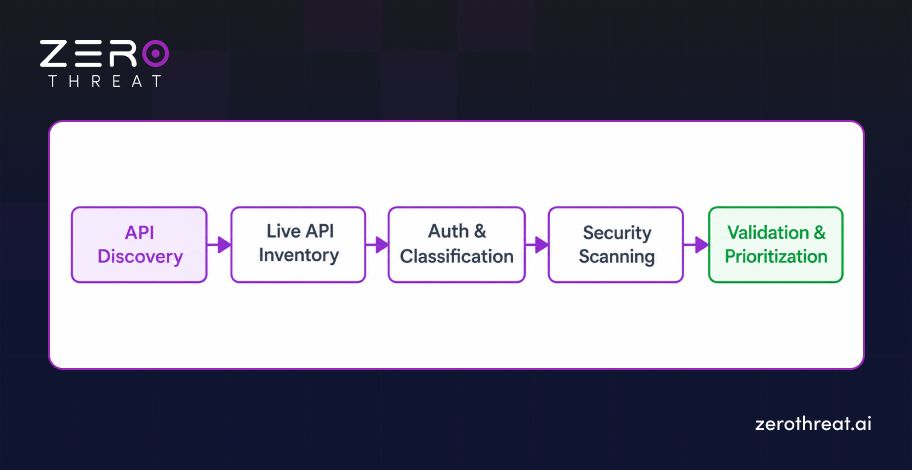
An integrated API security workflow connects continuous discovery directly to security scanning, so every newly found endpoint automatically enters the test scope without manual handoff. The goal is to close the gap between "we found it" and "we tested it" to near zero.
Four stages, connected:
1) Discover Continuously: Run API discovery as an always-on process across traffic, specs, gateways, and code, not as a quarterly project. APIs change with every deployment, and discovery cadence has to match deployment cadence.
2) Maintain a Real-time Inventory: Treat the inventory as the single source of truth for scan scope. New endpoint in traffic means new entry in inventory means new target in the next scan, automatically.
3) Authenticate and Classify before Testing: Provision credentials at multiple privilege levels for each API so scanning can exercise authorization logic, and classify endpoints by data sensitivity so findings inherit business context from the start.
4) Scan on Every Change: Trigger scans from the same events that change the inventory: deployments, spec updates, newly discovered endpoints. In CI/CD, this means discovery deltas and code merges both queue security tests before release, which is where shift-left actually becomes real for APIs.
The integration between discovery and scanning matters more than any individual stage. An API discovery tool and a scanner that does not share an inventory, recreate the disconnection problem with extra steps. When both run on the same platform against the same live inventory, the question, "Did we test everything we expose?" finally has a verifiable answer.
Watch hidden APIs become visible, and immediately testable, in a personalized demo. Schedule a Demo
Conclusion
API discovery answers "what APIs exist?" API scanning answers "which APIs are vulnerable?" Neither is sufficient alone. An inventory without testing is a map of unlocked doors, and a scanner without discovery tests the doors you already knew about while attackers walk through the ones you missed.
ZeroThreat’s AI-powered API pentesting closes that gap on a single platform. Its discovery engine builds and maintains a live inventory of your entire API surface, including the shadow and undocumented endpoints specs never mention, and feeds it directly into application-aware security testing that validates real exploit paths with authenticated, multi-privilege coverage of BOLA, broken auth, injection, and business logic abuse.
Sign up for ZeroThreat and see your complete API attack surface, discovered and tested, in your first scan.
Frequently Asked Questions
Can API scanning discover hidden or undocumented APIs?
No, traditional API scanning cannot reliably discover hidden or undocumented APIs because scanners test only the endpoints they are given as scope. Discovery requires different techniques such as traffic analysis, gateway inspection, and runtime observation. Some modern platforms combine both capabilities, using discovery to expand scan scope automatically, but scanning alone leaves unknown endpoints untested.
Is an OpenAPI specification enough to discover every API?
Can DAST tools scan APIs?


Explore ZeroThreat
Automate security testing, save time, and avoid the pitfalls of manual work with ZeroThreat.