 ZeroThreat Wins Bronze Stevie® Award in Tech Startup of the Year Read more
ZeroThreat vs Akto: AppSec Built for Scale and Governance
ZeroThreat is an AI-driven application security testing platform for continuous DAST and automated pentesting. While Akto emphasizes API discovery and monitoring, ZeroThreat validates real exploitability across web apps and APIs, reducing false positives by 99.9%.
ZeroThreat vs Akto: Securing Applications That Drive the Business
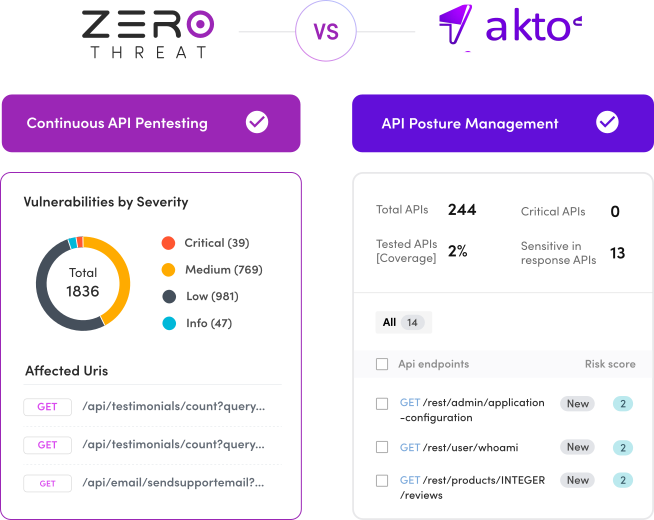
ZeroThreat is a modern penetration testing platform built for teams that want to find what attackers can actually exploit. Through continuous DAST and automated penetration testing, ZeroThreat validates vulnerabilities with real attack techniques, ensuring security teams act only on issues that present real-world risk.
Akto focuses on API observability and posture management, helping organizations inventory APIs, detect changes, and identify configuration weaknesses across environments. It is well-suited for teams looking to maintain API security.
ZeroThreat vs Akto: Feature Comparison
| Capability | ZeroThreat | Akto |
|---|---|---|
| Platform Focus | ||
| Platform Focus | Application and API security with automated pentesting | API discovery, traffic analysis, and runtime monitoring |
| Primary Use Case | Continuous web and API security testing with exploit validation | API inventory, behavior monitoring, and anomaly detection |
| Architecture | Cloud-native SaaS | Cloud-native with agent-based traffic analysis |
| Deployment Model | SaaS | SaaS with on-prem data collectors |
| Setup & Onboarding | Quick setup with minimal configuration |  Requires traffic integration and tuning Requires traffic integration and tuning |
| Scalability | Built for fast-scaling SaaS and CI/CD-driven teams | Scales with production traffic and operational effort |
| Architecture, Deployment & Setup | ||
| On-premise deployment |  Yes Yes | Yes |
| Quick setup & minimal configuration | Yes | Partial |
| Scales for modern SaaS environments | Yes | Yes |
| Web & Application Security Testing (DAST) | ||
| Automated web vulnerability scanning | Yes | Yes |
| Authenticated scanning (modern auth flows) | Yes | Yes |
| OWASP Top 10 coverage | Yes | Yes |
| Business logic vulnerability detection | Yes | Limited |
| Low false-positive rate | Yes (exploit-validated) | Limited |
| API Security Capabilities | ||
| Native API security testing | Yes | Yes |
| REST API scanning | Yes | Yes |
| GraphQL API scanning | Yes | Yes |
| OpenAPI / Swagger support | Yes | Yes |
| Auth-aware API testing | Yes | Limited |
| API-first testing workflows | Yes | Yes |
| Automated Pentesting Capabilities | ||
| Automated penetration testing | Yes |  No No |
| Large attack/test library | Yes (130K+ extensive test coverage) | No |
| Chained attack detection | Yes | No |
| Contextual risk verification | Yes | Limited |
| Human-like attack logic (no manual scripting) | Yes | No |
| Scan Quality & Accuracy | ||
| High-signal vulnerability detection | Yes | Limited |
| Context-aware findings | Yes | Partial |
| Actionable remediation guidance | Yes | Yes |
| Automation & DevSecOps | ||
| CI/CD pipeline integration | Yes | Yes |
| Continuous security testing | Yes | Yes |
| Developer-friendly workflows | Yes | Limited |
| Fast scan execution | Yes | Partial |
| Reporting & Risk Management | ||
| Clear, actionable reports | Yes | Yes |
| Compliance-ready reporting (OWASP, HIPAA, etc.) | Yes | Yes |
| Prioritized risk insights | Yes | No |
| Easy export & sharing | Yes | Yes |
| Usability & Team Fit | ||
| Modern, intuitive UI | Yes | Yes |
| Minimal tuning required | Yes | No |
| Suitable for small security teams | Yes | Partial |
| Pricing & Commercial Model | ||
| Transparent pricing | Yes | Limited |
| Suitable for startups & mid-market | Yes | Partial |
| Enterprise-focused licensing | No | Yes |
| Additional Capabilities | ||
| Exploit proof-of-concept (PoC) validation | Yes | No |
| Active attacker-style testing | Yes | No |
| Additional Features | ||
| Dedicated SSL/TLS Certificate scan | Yes | No |
| Dedicated Vulnerable JavaScript package detection | Yes | No |
| Mail server vulnerability section | Yes | No |
| Dedicated Vulnerable server side technology section | Yes | No |
| Ports Scanning and automated POC exploitation | Yes | No |
What Makes ZeroThreat the Best Choice for Application and API Security
Proven Reduction of Exploitable Risk
ZeroThreat’s API security testing validates vulnerabilities through real attack execution, giving CISOs confidence that reported issues represent true business risk, not theoretical exposure.
Continuous Security Without Slowing Delivery
Designed for modern DevSecOps, ZeroThreat delivers application security testing that scales with development velocity and supports rapid, secure releases.
Complete Visibility Into Application & API Exposure
ZeroThreat continuously uncovers known and unknown application endpoints, enabling leadership to maintain an accurate, real-time view of the attack surface.
Regional Data Storage for Regulatory Assurance
Enable organizations to keep security data within approved geographic boundaries. This helps CISOs meet data residency and regulatory requirements without compromising testing capability.
No Learning Curve
ZeroThreat is built for immediate adoption, enabling you to start scanning on day one without training or specialized expertise. This ensures consistent security coverage across teams.
Security Aligned with Zero Trust Principles
Testing is performed across authenticated user contexts and access boundaries, ensuring vulnerabilities are identified as attackers would encounter them in real environments.
What Security Teams Say About ZeroThreat


ZeroThreat.ai exceeded my expectations with its lightning-fast scan, detailed remediation, and easy-to-use interface. It’s perfect for both developers and security teams.
Web Developer
After using ZeroThreat.ai multiple times, I can say it makes my work much easier. The scans are deep, reports are clear, and it works perfectly for client projects.
Cybersecurity Expert

The setup was super smooth; we just integrated ZeroThreat into our CI/CD once, and now every build gets scanned automatically, allowing my team to fix security issues early on.
DevSecOps Lead
ZeroThreat.ai has been a game-changer for our team. It is effortless to use; the scans are quick, and it fits perfectly into our development pipeline for detecting vulnerabilities.
VP of Product Development
It made vulnerability testing across our systems effortless, and the results are quite accurate. Plus, the DevOps integration was simple, and it’s saving our engineers hours every week.
President
I’ve tried many scanners, but ZeroThreat.ai stood out instantly. It’s accurate, catches real logic flaws, and saves me hours by cutting out the usual false-positive noise.
Security Engineer
Pay for Coverage That Reduces Real Risk
ZeroThreat offers a transparent pricing model designed to scale with your API footprint. As coverage grows, pricing remains predictable, helping security leaders plan budgets with confidence while ensuring every dollar is invested in a measurable reduction of exploitable risk.
(Target Based Unlimited Scan)
Best Value
For dev teams running frequent scans across staging, QA, and production.
$100
Target = Target Application (URL, Web App, APIs)
Additional targets @ $75 each
Annually
20% Saving
(Unlimited Targets)
For developers or security teams needing flexible, on-demand scans.
$125
Credit Valid for 1 Year

How Volume Discount Works
Buy more scan credits, save more per scan:
- - 5% off from 10–20 credits
- - 10% off from 30–50 credits
- - 15% off from 75–100 credits
- - 20% off from 250+ credits
Discounts are applied
automatically as you increase
your credit purchase.
Each credit @ $25
99.9%
AI-Enhanced Accuracy
90%
Reduced Manual Pentest
ZERO
Configuration Required
10X
Faster Scan Result
Frequently Asked Questions
What is the primary difference between ZeroThreat and Akto?
ZeroThreat focuses on active, vulnerability-validated application and API security through continuous DAST and automated pentesting. Akto focuses on API discovery, inventory, and posture monitoring, with some active testing via traffic replay.
Does Akto perform active penetration testing like ZeroThreat?
Which platform is better for reducing false positives?
How do ZeroThreat and Akto differ in API security coverage?
Is ZeroThreat or Akto better suited for DevSecOps teams?
Which platform provides clearer risk prioritization for CISOs?
Who should choose ZeroThreat over Akto?
Security Testing That Confirms What Matters
Confirm what attackers can actually exploit, not just what scanners find.