 ZeroThreat Wins Bronze Stevie® Award in Tech Startup of the Year Read more

All Blogs
What is Vulnerability Assessment Cost? A Complete Breakdown
Quick Summary: Assessing your digital assets for vulnerabilities is an important and regular activity to keep your data safe. However, it is a business decision that involves costs. Hence, doing a cost-benefit analysis is important to make the right decision that offers higher ROI. We will discuss the cost of vulnerability assessment in detail with its factors in this blog to help you make an optimal decision.
While the average vulnerability assessment cost can be anywhere between $1,000 to $10,000, the actual cost depends on a host of factors. The scope of testing, target complexity, and various features in the assessment plan are some factors that contribute to the cost.
In the contemporary threat landscape where cyberattacks are becoming more complex and AI-driven, robust security assessments are pivotal to protect your digital data and assets. However, these assessments must look beyond traditional methodologies.
Innovative security assessment methods being used today are highly effective but slightly more costly than traditional approaches. Often these methods combine automated and manual tests for a comprehensive assessment.
In this blog, we are going to discuss vulnerability assessment cost, factors affecting it, components, and more. Let’s get started!
Save Millions of Dollars in Data Breaches by Performing a Comprehensive Security Assessment Start for Free
On This Page
- An Overview of Vulnerability Assessment
- Factors Affecting Vulnerability Scan Cost
- Components of Vulnerability Assessment Cost
- Variances in the Vulnerability Scanning Cost
- Leverage ZeroThreat for Vulnerability Testing
An Overview of Vulnerability Assessment
Vulnerability assessment (aka vulnerability scanning) is a systematic process to discover, test, and remediate vulnerabilities in web apps, APIs, networks, and other assets. It helps discover critical security weaknesses in systems and applications to take appropriate measures to protect them from cyberattacks.
For example, vulnerability scanning helps discover common web application risks like misconfigurations, cross-site scripting, SQL injection, and more. The process also involves prioritizing the vulnerabilities based on their severity and impact.
You can remediate vulnerabilities based on the detailed technical report from the assessment.
Key Factors Influencing Vulnerability Scan Cost
Vulnerability scanning cost isn’t the same for every organization, it may differ due to various reasons. Indeed, there are several factors that influence the cost. So, knowing these factors is crucial to understanding the possible cost in your context. Let’s check all these factors.
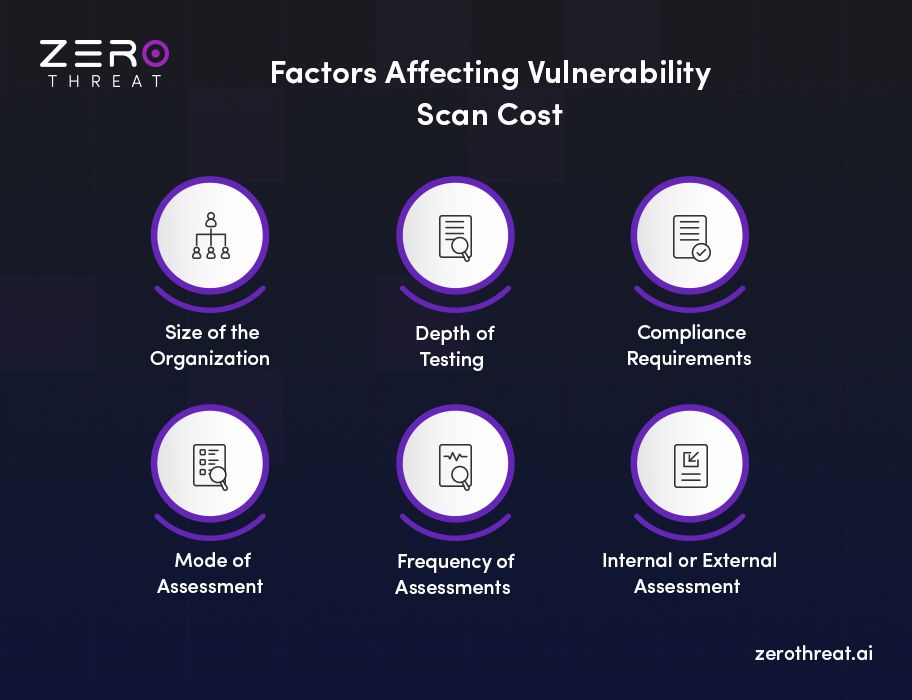
Size of the Organization
The size of your organization is one of the crucial factors determining vulnerability scan pricing. For instance, enterprises or large organizations have an extensive and complex digital environment with multiple data entry points.
As a result, such organizations have a wider attack surface. So, you need a more fine-tuned vulnerability assessment to uncover potential data breach risks for such organizations. Besides, these organizations have a large number of devices, networks, and applications.
On the contrary, smaller organizations and startups have fewer devices, networks, and applications. Consequently, their attack surface isn’t as big as a large organization’s. This definitely impacts your cyber security audit cost.
We can safely conclude that for large organizations, the vulnerability scan cost will be higher due to their large and complex digital infrastructure. And it will be lower for smaller organizations in a similar way.
So, for smaller organizations, the cost can be in the range of $500 - $2,500, and it can be in the range of $2,500 - $5,000 and more for larger organizations.
Depth of Testing
Another crucial factor in determining vulnerability assessment pricing is the depth of testing. Vulnerability scans that cover an extensive scope of an organization’s IT infrastructure are rather costly than those limited to specific assets or resources.
For example, assessing all applications, networks, and systems of an organization will cost more than assessing a single set of applications, networks, or systems. An extensive assessment will require more time, resources, and expertise. Consequently, this will be a costlier option.
Compliance Requirements
Organizations in certain industries like healthcare, fintech, and government must strictly meet regulatory standards and compliances. So, they must follow rules established by GDPR, PCI DSS, HIPAA, and other regulations or standards.
Regular vulnerability assessments help organizations attain compliance. However, security assessments focusing on compliance require thorough security audits and detailed reporting. Consequently, the cost will naturally be higher in this case.
Mode of Assessment
Cyber security risk assessment cost is affected by which mode of assessment you choose. There are automated scanning and manual assessments. While automated scans are quick and require less human intervention, manual assessments are time-consuming and human-driven.
Automated scanning can be performed by anyone, as they don’t require any specialized skills. However, manual assessments are done by skilled professionals. Hence, it involves human-led assessments that can cost more than automated scans.
Frequency of Assessments
Security best practices necessitate frequent scanning of your digital assets to constantly identify and mitigate potential vulnerabilities. Regular scanning and patching of vulnerabilities is apparently more costly than a one-off security assessment.
Organizations often conduct quarterly or monthly security audits to assess and identify risks within their digital landscape to prevent data breaches. So, based on the frequency of security assessments, the cost can vary across organizations.
Internal or External Assessment
Vulnerability assessments can be performed by an internal team or an external service provider. Based on which way you go will drastically impact your cyber security assessment cost. For an internal team, you will need to invest in various tools and training.
Today, there are lots of free vulnerability scanning tools that your team can leverage to perform regular security assessments. These tools work seamlessly for different kinds of applications, networks, and systems and require minimal human intervention.
On the other hand, external assessment involves a third-party vendor offering expertise in vulnerability assessment. Security assessment cost varies based on team size, tool pricing, and assessment rates. However, automated tools are often less costly than manual third-party tests.
Identify 130K+ CVEs Most Accurately with AI-powered Vulnerability Scanning Perform a Scan
Breaking Down the Vulnerability Assessment Cost in Components
The cost of vulnerability scanning can be broken into numerous components. Understanding these components of vulnerability assessment cost will help you optimize the cost by allocating resources efficiently.
Licensing or Subscription Fees
Subscription and licensing fees for tools and software acquired for vulnerability scanning are among the key components of the cost. This cost can vary with the scale of the scans, team size, and subscription plans. It determines the overall cost of a vulnerability scanning tool.
Costs Associated with Internal Teams
You need a team, or skilled internal resources dedicated to handling the vulnerability management task. Consequently, there are various expenses related to training, salaries, and maintaining the resources.
Costs for Vulnerability Remediation
Vulnerability assessment uncovers various security flaws and weaknesses that must be addressed. Remediation is the step in which organizations patch vulnerabilities, fix misconfigurations, and take appropriate measures to mitigate cyber risks. There are many kinds of expenses in this process that contribute to vulnerability assessment costs.
External Consulting Costs
Your organization can also collaborate with an external consultation provider for security assessment. In this case, you will incur costs that depend on the duration of engagement, scope of assessment, and complexity of your digital landscape.
Understanding the Variances in the Cost of Vulnerability Assessment
Effective decision-making in cybersecurity comes from a proper understanding of diverse cost factors. Another thing you should know is what causes the variances in the cost to make prudent decisions. The cost of vulnerability assessment can vary for many reasons such as the pricing model, outsourcing, and more. Let’s discuss these reasons in detail.
Different Pricing Methods
Vulnerability assessment price can vary due to different pricing models. It can be divided into three categories.
- Per Scan: This is a pay-as-you-go method in which you pay for the number of scans you perform. So, the cost varies based on how many scans are conducted in a specific time period.
- Per IP: In this method, the risk assessment cost varies with the number of IPs scanned. You can perform security scans multiple times, but as the number of IPs increases, the cost will rise.
- Subscription: In the subscription-based model, you pay a recurring fee that enables you to scan as many IPs as permitted by the subscription plan. Similarly, you can scan as many times as you want, again depending on the subscription plan.
Variances Based on Vendor
The cost of vulnerability scanning also varies based on the service provider you choose. Depending on the service quality and expertise of a vendor, the cost can be lower or higher. Moreover, higher-priced vendors often provide in-depth assessment, detailed reporting, and value-added benefits that result in higher prices.
In-house vs Outsourcing
Your vulnerability assessment cost also varies based on whether you outsource it or conduct it internally. When an in-house team conducts the tests, you incur expenses related to internal resources, training, and tools. In the case of outsourcing, you incur expenses related to consultation and expertise provided by the vendor.
Scan 10x Faster to Save Hours in Security Assessment and Minimize Your Costs and Risks Try It Now
Leverage Cost-effective Assessment with ZeroThreat
Vulnerability assessments are vital for your organization to proactively identify and remediate vulnerabilities. It helps you keep your systems and applications secure against emerging cyber threats. However, manual assessments are costly as they are entirely dependent on human expertise and skills.
Fortunately, you can automate this process and reduce the overall costs with ZeroThreat which is powerful vulnerability scanning tool. ZeroThreat’s automated scanning minimizes human intervention which saves cost and time in scanning. With a next-gen spider, it thoroughly scans web apps and APIs simulating the attacks of a hacker.
It offers 10x faster scanning results and discovers weaknesses with 99.9% accuracy. Learn more to know how it helps you.
Frequently Asked Questions
What is API security testing cost?
The cost of API security testing ranges between $500 - $3,000 depending on multiple factors such as the complexity and scope of scanning.
What is the average vulnerability assessment cost in cyber security?
What is the cost of penetration testing?


Explore ZeroThreat
Automate security testing, save time, and avoid the pitfalls of manual work with ZeroThreat.