API Threat Detection
ZeroThreat’s API security examines how your APIs are used, mapping normal interaction flows and uncovering blind spots where threats, like session abuse or logic manipulation, may occur. It also validates authentication, authorization, and data-handling flows by testing them under real-world adversarial conditions.
No Credit Card Required
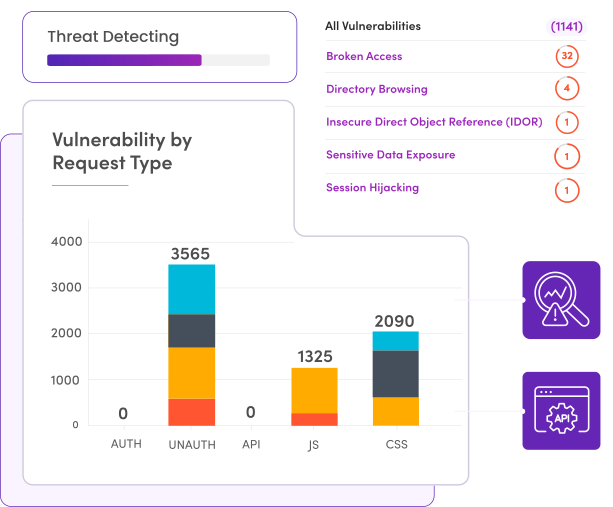
Seamless API Import from Multiple Sources





98.9%
Accuracy Rate

90%
Reduced Manual Pentest
ZERO
Configuration Required

10X
Faster Scan Result
Intelligent API Pentesting for Modern Threat Surfaces
Stay ahead of automation tactics, business-logic exploitation, and emerging API threat vectors with adaptive, behavior-aware analysis. ZeroThreat’s API threat detection tool evaluates how your APIs operate under real conditions.

Sensitive Data Exposure
Analyzes response outputs, data flows, and object structures to identify where personal data, session artifacts, or internal references are unintentionally exposed.

Shadow API Exposure
Enumerate your API landscape, detect hidden routes, legacy versions, and inconsistent methods that expand your attack surface without your team’s awareness.

Broken Object Level Authorization (BOLA)
Tests endpoints using client-provided identifiers to uncover authorization gaps where attackers can access, modify, or delete resources belonging to other users.
API Security Platform for Preventing Abuse and Exploitation
ZeroThreat’s API pentesting delivers unified visibility by ingesting collections from Swagger, Postman, Mulesoft, HAR, and RAML to construct an authoritative model. This model enables security teams to evaluate authentication flows. With prioritized insights into endpoint behavior and logic inconsistencies, ZeroThreat equips enterprises to enforce stronger governance, reduce operational risk, and maintain API resilience.
Business Logic Testing
Uncover hidden logic flaws, sequence manipulation risks, and inconsistent workflow conditions that attackers exploit to alter system behavior. ZeroThreat exposes these logic gaps early, enabling enterprises to secure critical operations and prevent transactional misuse.
API Authentication Analysis
Evaluate authentication flows, token behaviors, and identity transitions that may enable unauthorized access or credential abuse. With API authentication, ZeroThreat identifies weaknesses, helping organizations safeguard user accounts and protect sensitive data.
Sensitive Data Exposure Detection
Identify unintended data leaks, excessive object responses, and metadata disclosure that increase compliance and privacy risk with API security testing tool. Enable enterprises to safeguard PII, maintain regulatory compliance, and minimize the impact of breaches.
Attack Surface Coverage
Detect API abuse, shadow APIs and undocumented entry points that attackers target to gain system access. ZeroThreat maps your complete API footprint, allowing enterprises to reduce blind spots, improve visibility, and minimize operational risk across environments.
Security Posture Assessment
Detect misconfigurations, outdated routes, and missing security controls that weaken your API environment. ZeroThreat provides actionable insights that improve governance, reduce systemic exposure, and elevate long-term resilience across distributed applications.
Input Validation Testing
Expose weak parameter handling and unchecked inputs that allow attackers to manipulate responses or trigger unintended logic paths. ZeroThreat simulates adversarial input patterns to help enterprises harden validation layers and reduce injection-based risks.
Unlock Faster API Risk Detection with ZeroThreat
Expose hidden attack vectors instantly through next-generation API analysis and automated threat discovery.
Security That Scales with Your APIs
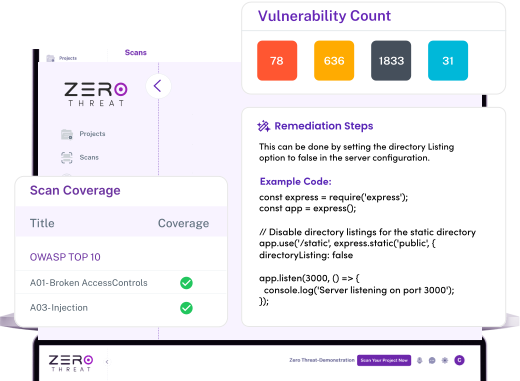
- Shift Left API Security Testing
- LLM-Powered Context Awareness
- Supports All APIs (gRPC, REST, SOAP, GraphQL)
- Complete DAST Coverage
- OWASP Top 10 & CWE Top 25 Coverage
- AI-Driven Remediation Reports
Real Stories from Teams Securing Their APIs


ZeroThreat.ai exceeded my expectations with its lightning-fast scan, detailed remediation, and easy-to-use interface. It’s perfect for both developers and security teams.
Web Developer
After using ZeroThreat.ai multiple times, I can say it makes my work much easier. The scans are deep, reports are clear, and it works perfectly for client projects.
Cybersecurity Expert

The setup was super smooth; we just integrated ZeroThreat into our CI/CD once, and now every build gets scanned automatically, allowing my team to fix security issues early on.
DevSecOps Lead
ZeroThreat.ai has been a game-changer for our team. It is effortless to use; the scans are quick, and it fits perfectly into our development pipeline for detecting vulnerabilities.
VP of Product Development
It made vulnerability testing across our systems effortless, and the results are quite accurate. Plus, the DevOps integration was simple, and it’s saving our engineers hours every week.
President
I’ve tried many scanners, but ZeroThreat.ai stood out instantly. It’s accurate, catches real logic flaws, and saves me hours by cutting out the usual false-positive noise.
Security Engineer
Protect Your APIs With Zero Effort
Launch API security testing in seconds and uncover critical risks without configuring a single thing.
Frequently Asked Questions
What is API threat detection and why is it critical for modern applications?
API threat detection identifies malicious behavior, misuse, and logic abuse across API interactions. With applications increasingly API-driven, detecting these threats early is essential to prevent data exposure, fraud, and service disruption in modern distributed environments.